

Day 01
Assisi and the Sacred Sites of St. Francis
- The guided tour of Assisi will let you discover not only the places directly connected to St. Francis and St. Chiara, but also all the beauty of a typical Umbrian medieval village with its characteristic streets.
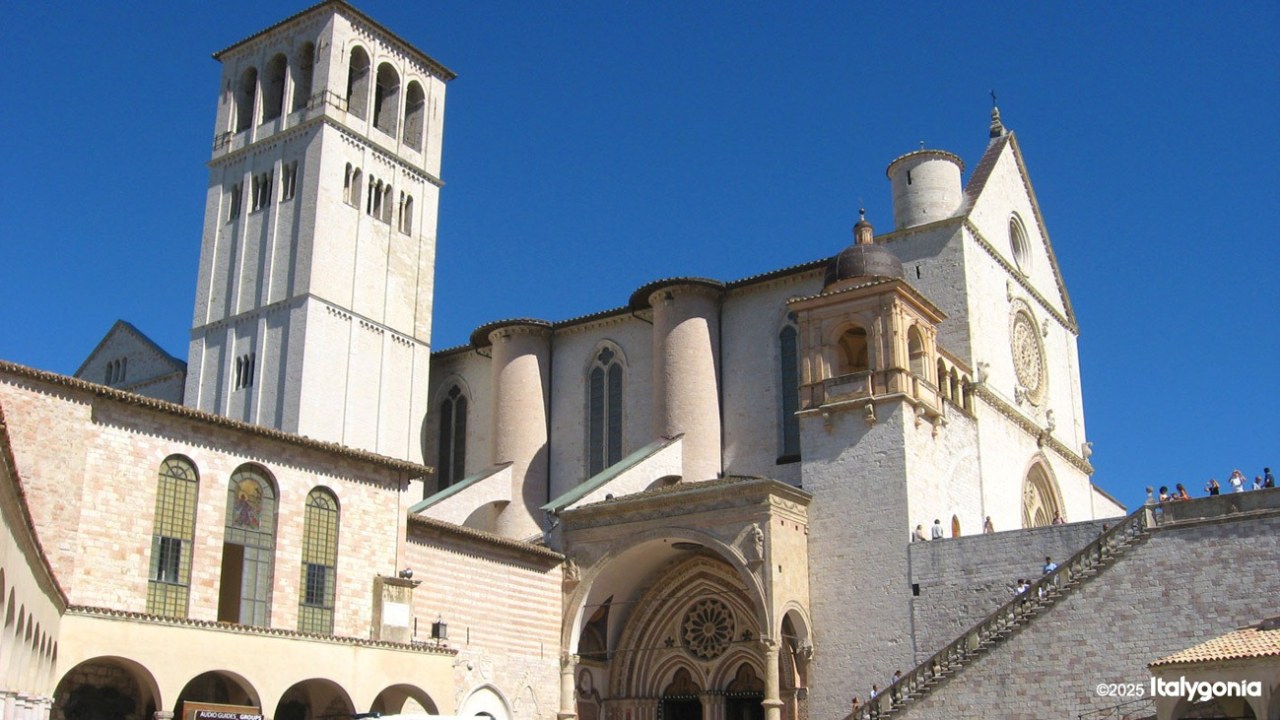
- It begins at the gateway to the town, Porta San Francesco, set between the medieval walls. A few steps away, we reach the square known as Colle del Paradiso, home to the beautiful Basilica of Saint Francis.
- Inside, we visit the Gothic Upper Church, famous for Giotto's magnificent cycle of frescoes depicting scenes from the Old and New Testaments and the life of St. Francis. The Lower Church, in Romanesque style, is entirely covered with frescoes and gold stuccoes and has a sepulchral function, housing the Crypt of St. Francis carved into the rock, the saint's tomb, and the Chapel of the Relics.
- After visiting this spiritual place, we continue through the characteristic streets of the village, discovering one of its most beautiful squares with the Palace of the Capitano del Popolo, which in the 14th century was the seat of the Commander of the Militia, along with the evocative Captain's Tower and its clock.
- In the Town Square, once the Roman forum, we can admire the Corinthian columns of the Temple of Minerva, later transformed into the Church of Santa Maria sopra Minerva with Baroque decorations inside. Also beautiful are the Palace of the Priors and the elegant Fountain of the Three Lions that adorn the square.
- We continue the tour with a visit to the Cathedral of San Rufino, the oldest church in Assisi and an important place of Franciscan worship in Umbrian-Gothic style. Inside is the baptismal font where St. Francis and St. Chiara were baptized and where St. Francis gave his first sermon. Some sections of the pavement are made of glass, allowing you to see the Roman remains beneath the cathedral.
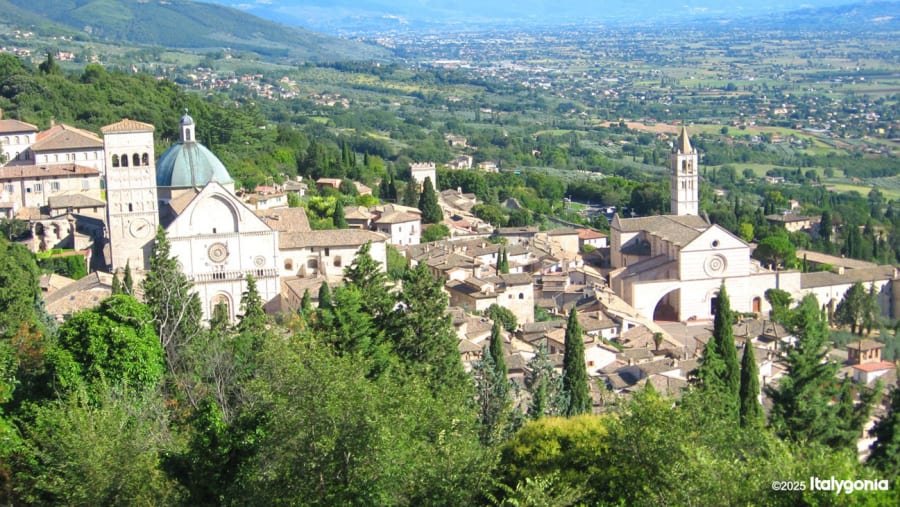
- Among souvenir shops, panoramic views over the valley, and typical Umbrian restaurants, we end our guided tour by exploring the Church of Santa Chiara. Following the teaching of St. Francis, she founded the Order of the Poor Clares. The facade is in pink and white stone, and inside the church we find the Crucifix that spoke to St. Francis in the Hermitage of San Damiano, as well as the tomb and relics of the saint.