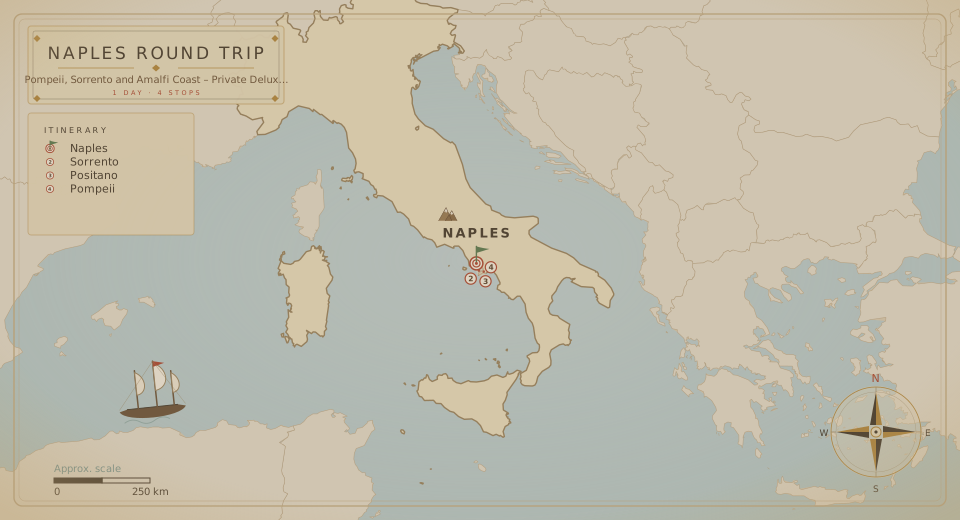
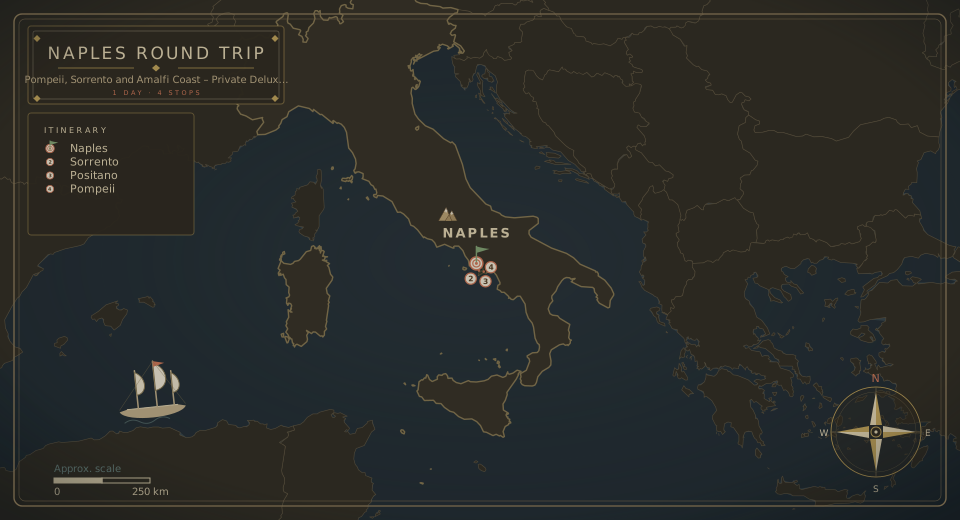
This scenic stop in Meta allows you to take photos and have a memory of picturesque Sorrento! Meta rises about 111 meters above sea level and covers an area of about 2.5 km², which includes both coastal areas, with more than 800 meters of coastline, and mountainous areas, with the hamlet of Alberi, the 642-meter Mount Vico Alvano to the southeast, and part of the Camaldoli Mountains.The Li Galli islands make up a very small archipelago between Capri and Positano, one of the most striking places not only in Campania but in the entire Mediterranean. Making up the archipelago are three islands, Gallo Lungo, La Rotonda and La Castelluccia, and together they integrate an extremely picturesque marine protected area.Positano is perhaps a unique place in the world! It is a jewel of spontaneous architecture, set on rock overhanging the sea. Clusters of colorful, sometimes cubic-looking houses are built on often very steep steps down to the beach, connected by alleys and long flights of steps.Legend has it that in its sea dwelt the mythical Sirens who tempted Ulysses with a melodious song. And still today to go to that sea - with blue and green reflections, in a thousand different shades according to the play of the sun - one can imagine that from the waves emerge - beautiful and persuasive - the Sirens.
But perhaps it is Sorrento a Siren who captivates and bewitches with the scents of the lemon and orange trees, with the olive trees with dark twisted trunks and silver leaves that move slowly, with a slight sound, to the wind coming from the sea, with the rocks born from the distant fury of a volcano.Pompeii is a city in Campania, located in the Gulf of Naples and on the slopes of the volcano Vesuvius. It is a city with a very ancient origin: it began as an Oscan settlement, was later inhabited by the Samnites and then, starting in the first century BC, conquered by the Romans.
City buried by the eruption of Vesuvius. Today it is known as the city where there is one of the most important archaeological sites in the world. The Roman city was in fact buried by lava following the eruption of Vesuvius in 79 AD. The lava and ash were a kind of cover that allowed the city to maintain itself over the centuries and be protected from the elements; for that very reason the city has remained intact and can be visited today.
Note: The remaining time is for the round trip and the time spent between attractions.