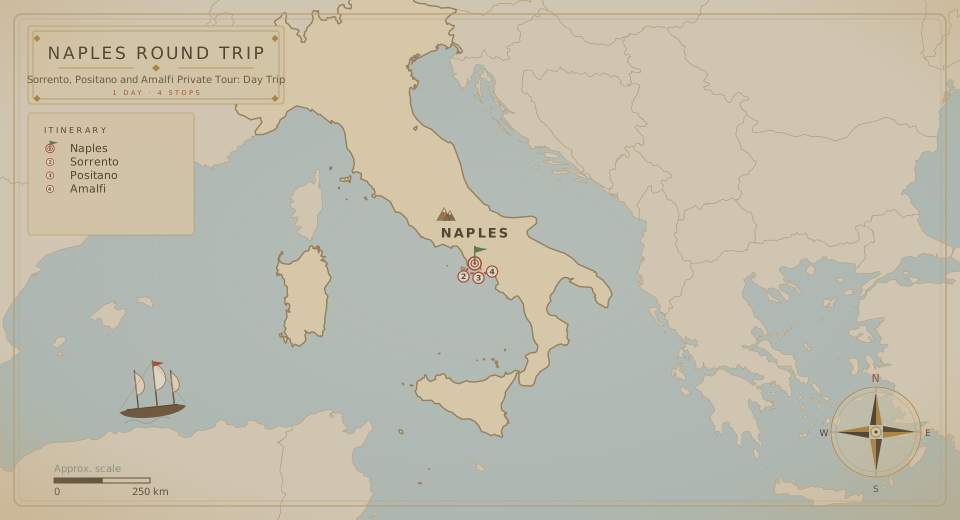
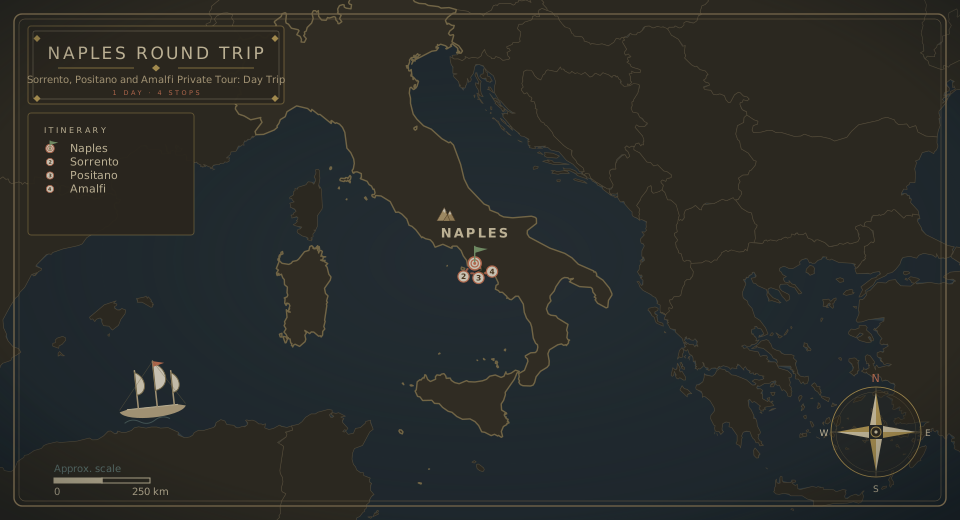
The municipality of Meta is located in the Sorrento peninsula together with the municipalities of Vico Equense, Piano di Sorrento, Sant'Agnello, Sorrento and Massa Lubrense. It is the second town on the peninsula coming from Naples, after Vico Equense, in fact it overlooks only the Gulf of Naples. Meta rises approximately 111 meters above sea level and extends over an area of approximately 2.5 km², which includes both coastal areas, with over 800 meters of coastline, and mountainous areas, with the hamlet of Alberi, Monte Vico Alvano to the South East, of 642 meters, and part of the Lattari Mountains. Although there are no real political divisions within the municipality, popular tradition sees Meta divided into two very distinct parts: Meta "upstairs" and Meta "downstairs"; the first includes Alberi and the internal area of the town; the second is instead made up of the area in front of the coast.The city of Sorrento, from which the entire territory takes its name which, perched on the Lattari Mountains, separates the Gulf of Naples from that of Salerno, is a renowned destination for international tourism: nestled on a large tufaceous terrace overlooking the sea, it is a small and quiet holiday center famous for its villas, hotels, parks and gardens, as well as for its beautiful views and characteristic citrus groves. Of Greek origin, and then grown under Roman domination, Sorrento today gravitates around Piazza Tasso and Corso Italia (on which the Duomo stands), from which the sea view can be reached through a maze of narrow streets full of characteristic and lively commercial establishments. The most evocative panorama is the one observable from the viewpoint of the Villa Comunale, which opens onto the port and the entire Gulf of Naples.Gallo Lungo is the largest of the three and is the only one to have been inhabited since Roman times: it has an elongated shape that extends for about 400 m with a variable width which towards the center is about 100 m and towards the « head" is approximately 200 m.
To the west of Gallo Lungo are La Rotonda and Dei Briganti to the north of Rotonda, the latter name reported on the website of the municipality of Positano[1], although more commonly the island is indicated in texts with the name of La Castelluccia. The islets are covered with grass and shrubs, with an abundance of daffodils.Positano is perhaps a unique place in the world! It is a jewel of spontaneous architecture, set on the rock overlooking the sea. Clusters of colorful houses, sometimes cubic in appearance, are built on often very steep steps, which lead down to the beach, connected by alleys and long stairways. If arriving in Positano along the coastal road, from Amalfi or Sorrento, offers sudden panoramic views of the small city from above, disembarking from the sea is truly a unique experience that fills your eyes and soul with beauty!
And it is precisely from the sea, that around the 1st century. AD the Romans arrived first, intent on building sumptuous maritime villas in Positano and along the Amalfi Coast 'for the exercise of their refined leisure'. The villa in Positano would have belonged to Posides Claudi Cesaris, freedman of the emperor Claudius, hence the name Posidianum extended from the villa to the entire place.Furore is one of the most evocative villages on the Amalfi Coast. It is a UNESCO heritage site and is one of the most beautiful villages in Italy. Known above all for its suggestive fjord, it is also the home of Fiorduva, one of the most appreciated wines in the world.
A small reality with great riches waiting to be discovered. Furore will captivate you above all for its landscape appearance.
In fact, it appears as a charming village nestled in a deep valley: a nativity scene of little houses clinging to the slopes of the Lattari Mountains, which has remained intact with the passage of time, nestled between overhanging rocks and rich vegetation climbing on the rocky walls.The existence of the cave was unknown until 1932, when a fisherman accidentally discovered its existence.
The life of the fisherman, called Luigi Buonocore, changed completely, to the point that from the moment of discovery until his death the man was labeled as the "discoverer of the cave" (legend has it that Mr. Luigi was recognized on the street, to the point of taking on the connotations of “living myth”).
The merit of this fisherman is truly enormous, since he brought to everyone's attention a wonderful space for tourist but also scientific purposes. In fact, the cave is a magical kingdom, in which light takes on wonderful and fairy-tale connotations. When the sea is calm and the sun is high, the cave appears truly magical thanks to the reflections that the light is capable of generating.Amalfi, charming town on the Amalfi Coast, Italy. With colorful architecture and historic cathedrals, it overlooks the Tyrrhenian Sea. Its Mediterranean charm, terraced lemon groves and delicious cuisine capture the hearts of visitors. The Cathedral of Sant'Andrea and the museums tell its rich history. Breathtaking views and recreational activities make Amalfi an unmissable destination. Ideal base for exploring other coastal gems. A magical place that fascinates and enchants anyone who sets foot there.