Train station Zürich HB
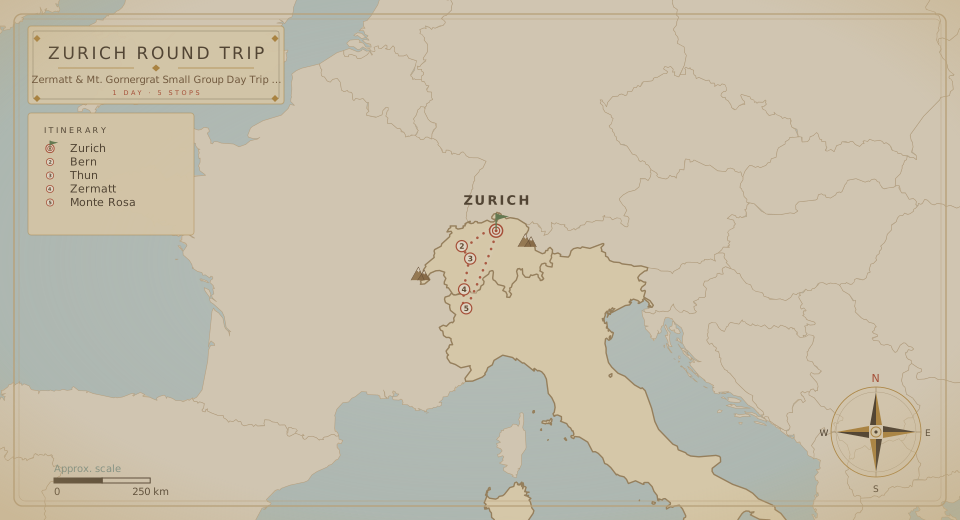
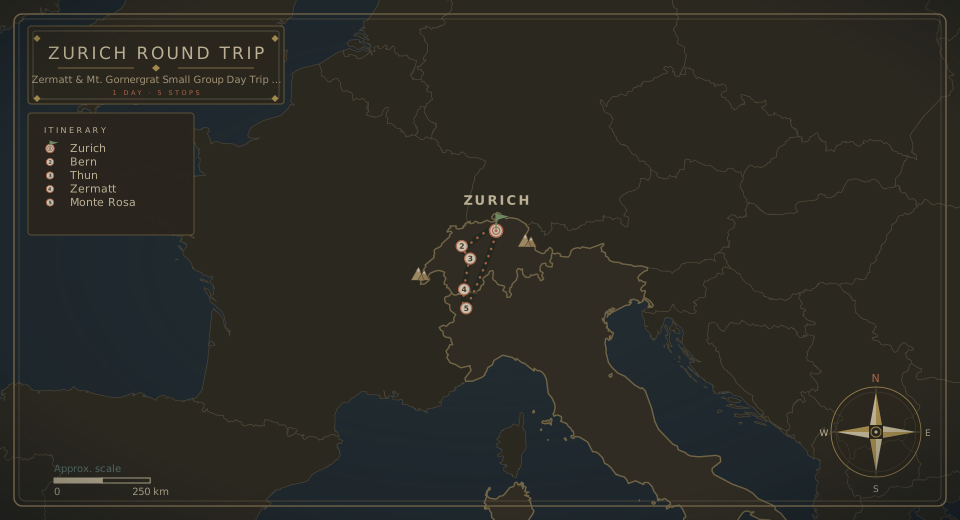
Your tour starts with the train ride from Zürich to Visp (two hours). The intercity train takes you in one hour to Bern.
Bern (passing by)
Berne is called the "Federal City" and functions as the capital of Switzerland. As the seat of the city and large parts of the cantonal and federal administration, it is the largest center of public administration in the country
travel along lake Thun
Lake Thun is a fjord lake in the Bernese Oberland on the northern edge of the Alps.
crossing the alps in a tunnel
The Lötschberg Base Tunnel is a 34.6-kilometre-long railway tunnel that crosses under the northern Alpine chain at the Lötschberg between Frutigen in the Bernese Oberland (Canton of Bern, Switzerland) and Raron (Canton of Valais, Switzerland) and was put into operation in 2007. This base tunnel is part of the Lötschberg-Simplon axis of the New Rail Link through the Alps (NRLA), which runs from Basel via Bern-Thun-Spiez to the Lötschberg and on via Brig-Simplon-Domodossola to Milan and Novara-Genoa, and next to the one running parallel Gotthard axis forms a second route for the transalpine rail freight traffic of the European Corridor (Rotterdam-Genoa).
Viso (passing by)
Visp is a municipality in the canton of Valais in Switzerland. It is located at the entrance to the Vispertal at the mouth of the Vispa in the Rotten. The small town is the capital and largest municipality in the district of Visp.
Here you get off the intercity train and change direct onto the Matterhorn-Gotthard-Railway. The cogwheel train takes you within 55 minutes to Zermatt
St. Niklaus
The Mattertal is one of the southern side valleys of the Rhone Valley in Valais. It is one of the valleys that have cut deep into the Valais Alps to the south, up to the main Alpine ridge (there is also the border ridge between Switzerland and Italy) and open to the north towards the Rhone, the main geographic axis of Valais. Three of the four highest mountain massifs in the Alps lie in the valley's border.
Zermatt alpine village
Walk through the old part of the alpine village of Zermatt with it's typical wooden houses.
Viewpoint Kirchbrücke
Visit the viewpoint for the typical Zermatt village picture to the Mt. Matterhorn
Mountaineer's Cemetery
The graveyard shows you, how closed the success to climb Mt. Matterhorn and the risks are. It's part of the history of Zermatt, that accidents on high alpine climbing happens.
Hotel Monte Rosa
The hotel Monte Rosa is where the first ascent to Mt. Matterhorn startet. Several information about the first ascent and it's historical tragedy are available here.
Gornergrat railway
On a 30 minutes cogwheel train ride you get up to 10000ft altitude. In this high alpine area, beautiful views to Mt. Matterhorn and the glaciers await you. Mt. Gornergrat is in all year snow.
Mt. Gornergrat
The Gornergrat is a mountain ridge at an altitude of 3135 m above sea level. M. It is located about three kilometers east of Zermatt in the Swiss canton of Valais. The Gornergrat is located between the Gorner Glacier and the Findel Glacier and offers views of more than 20 four-thousanders, including Monte Rosa, the Matterhorn and the Liskamm.
The Gornergratbahn runs from Zermatt (1620 m above sea level) to the Gornergrat, overcoming an altitude difference of almost 1500 metres. At the terminus (3089 m above sea level) on the southwestern tip of the ridge is the Kulmhotel, which is the highest mountain hotel in Switzerland.
Visit the scenic viewpoint with the all year snow or have a look at the multi-media experience world, which shows the Matterhorn and its surrounding alpine world in all dimensions, will fascinate both young and old and is even a great place to visit on the Gornergrat when the weather is not so good.
return travel
After returning from Gornergrat, your travel back to Zürich will take place (3 hours). You trave on the same way back as you arrived in the morning.