

Porto – Atlantic Character, Medieval Origins and Metropolitan Energy
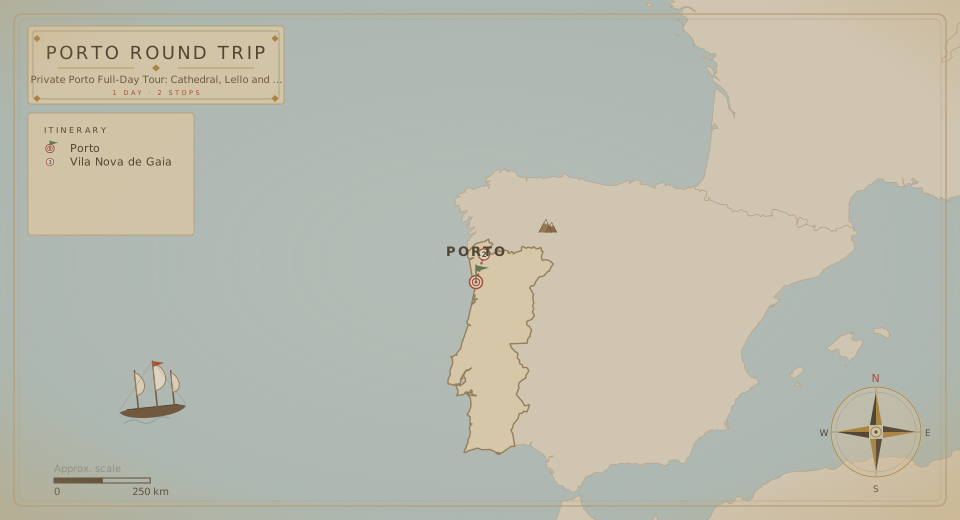
Set on the banks of the Douro Rivernear its meeting with the Atlantic Ocean, Porto is one of Portugal’s most historically significant cities, with municipal roots that go back to the 12th century and a historic centre recognised by UNESCO for its urban and architectural value. The city combines medieval origins, mercantile memory, and a strong cultural identity that remains immediately visible in its streets, monuments, and riverfront.
Today, Porto has a resident population of 252,687 within the municipality, while the wider Porto Metropolitan Area is home to around 1.8 million inhabitants. This gives the city both the intimacy of a walkable historic core and the broader presence of one of Portugal’s most important metropolitan regions.
This is a city best understood through contrast: granite and river light, sacred monuments and commercial façades, intimate streets and panoramic viewpoints, local tradition and outward-looking energy. As an introduction to northern Portugal, Porto offers substance, beauty, and a rare ability to feel both historic and fully alive.
Avenida dos Aliados and Liberty Square – Porto’s Grand Civic Axis
The sequence formed by Avenida dos Aliados and Liberty Square is the formal civic heart of Porto, where the city’s urban scale becomes immediately legible. Framed by imposing buildings from the late 19th and early 20th centuries, this central axis presents Porto in its most ceremonious and public architectural language.
At the centre of Liberty Squarestands the equestrian statue of D. Pedro IV, inaugurated in 1866, while the avenue rises northward toward the monumental City Hall. Together, the square and avenue express civic confidence, urban order, and the institutional face of Porto before the route descends into the older quarters.
This is a stop that brings clarity and civic grandeur to the beginning of the day. For travellers arriving fresh to the city, Avenida dos Aliados and Liberty Square offer an elegant first reading of Porto’s scale and confidence.
São Bento Station – Azulejos, History and the Art of Arrival
The São Bento Station is one of Porto’s most recognisable interiors, admired for the narrative power of its tilework and the elegance of its early 20th-century design. Built on the site of the former Convent of São Bento de Avé-Maria, the station was designed by Marques da Silva, and its vestibule is lined with around 20,000 azulejos painted by Jorge Colaço.
For visitors, the station works as far more than a transport hub. Historical scenes, ethnographic detail, and the chronology of Portuguese life and movement unfold across the walls, turning arrival into interpretation and making the space one of the city’s most memorable public interiors.
This is a stop that combines artistry, architecture, and public history with unusual ease. The São Bento Stationoffers one of the most evocative introductions to Porto’s cultural imagination.
Porto Cathedral – Romanesque Origins Above the Historic Core
The Porto Cathedral, or Sé do Porto, stands at the oldest heart of the city and remains one of its most important monuments. Its construction began in the 12th century, traditionally under Bishop D. Hugo, in a strong Romanesque style later enriched by Gothic and Baroque interventions.
From its hilltop setting, the cathedral helps visitors understand Porto’s geography and long urban continuity. The fortified exterior, the layered architectural language, and the commanding position above the old city give the visit both historical depth and visual authority.
This is a stop that adds weight, perspective, and spiritual continuity to the itinerary. The Porto Cathedraloffers one of the clearest ways to understand the city’s medieval foundations and enduring identity.
Livraria Lello – A Curated Interior of Wood, Glass and Symbolism
The Livraria Lello is one of Porto’s most celebrated interiors, known for its decorative richness and theatrical spatial experience. The current bookshop opened in 1906, and its celebrated staircase was built in reinforced concrete, one of the earliest examples of the material used in this way in Portugal.
Inside, visitors encounter carved wood, stained glass, symbolism, and a flowing central stair that gives the space its singular atmosphere. More than a literary attraction, the bookshop is an exercise in design and mood, where structure and ornament come together in one of Porto’s most distinctive interiors.
This is a stop that brings imagination, craftsmanship, and visual impact to the day. The Livraria Lello offers one of the most memorable interior experiences in Porto.
Carmelitas Church – A Seventeenth-Century Landmark of Porto Rococo
The Church of Carmelitas is one of the key stops in Porto’s Rococo and Nasoni-associated architectural sequence. Its origins belong to the 17th century, while the façade and interior language reflect the decorative refinement that shaped much of religious Porto in the 18th century.
For visitors, the church offers a quieter but elegant architectural reading, where restraint in the exterior opens into a richer interior atmosphere. Its place within the Carmo-Carmelitas ensemble also helps explain how religious, urban, and artistic identities overlap in this part of the city.
This is a stop that adds elegance, historical texture, and artistic continuity to the route. The Church of Carmelitas offers a rewarding encounter with one of Porto’s significant religious monuments.
Carmo Church and the Hidden House – Rococo Porto and an Unusual Urban Detail
The Carmo Church is one of the most striking works of 18th-century Porto Rococo, known both for its architecture and for the powerful visual identity of its tiled lateral façade. In 1912, that side elevation was covered with figurative azulejopanels designed by Silvestre Silvestri, adding one of Porto’s most recognisable exterior images.
What makes the setting especially memorable is the narrow house built between Carmo and Carmelitas, often described as the city’s “hidden house.” Together, church and house create one of Porto’s most curious and photogenic examples of how architectural ingenuity and urban custom shaped the built fabric.
This is a stop that combines artistry, atmosphere, and local singularity. The Carmo Church and its hidden house offer one of the most visually distinctive moments of the morning route.
Clérigos Church and Tower – Baroque Porto Through Nicolau Nasoni
The Clérigos Church and Towerform one of Porto’s most emblematic ensembles and one of the clearest expressions of the city’s Baroque identity. The complex is associated with the Italian architect Nicolau Nasoni, and the tower, completed in the 18th century, remains one of Porto’s most recognisable landmarks.
For visitors, the ensemble offers both architectural reading and urban orientation. The church gives form to Nasoni’s dramatic Baroque language, while the tower connects monument and panorama, allowing the city centre and the Douro landscape to be understood from above.
This is a stop that brings altitude, artistry, and landmark status to the itinerary. The Clérigos complex offers one of Porto’s strongest combinations of monument and viewpoint.
Bolhão Market – Porto’s Everyday Life in a Historic Market Setting
The Bolhão Market is one of Porto’s most emblematic civic and commercial spaces, closely tied to the city’s daily identity. Its history reaches back to the 19th century, and the restored market continues to place fresh produce, small traders, and local rhythm at the centre of the experience.
For visitors, Bolhão offers a brief but vivid encounter with Porto beyond monuments. The movement of vendors, the colour of local products, and the market’s architectural setting bring a more immediate and lived-in dimension to the day, balancing the formal heritage stops with everyday atmosphere.
This is a stop that adds local character and human scale to the route. The Bolhão Market offers one of the simplest and most authentic glimpses of daily life in Porto.
Praça da Batalha and Teatro Nacional São João – Civic Memory and Theatrical Heritage
The area of Praça da Batalha forms one of the historic civic thresholds of Porto, long associated with movement, urban expansion, and public life. The square is closely tied to the Teatro Nacional São João, first inaugurated in 1798, destroyed by fire in 1908, and later rebuilt from a project by José Marques da Silva, one of Porto’s most important architects.
For visitors, the square offers more than a passing urban landmark. It helps explain Porto’s civic scale and cultural continuity, while the theatre adds a strong architectural and artistic note to the route, linking the city’s public life to performance, memory, and renewal across centuries.
This is a stop that adds cultural weight and urban texture to the day. Praça da Batalha and the Teatro Nacional São João offer a concise but meaningful reading of Porto as both a historic and theatrical city.
Fernandine Wall – Porto’s Medieval Defensive Ring
The Fernandine Wall preserves one of the clearest traces of medieval Porto’s defensive logic. Built between 1368 and 1437 under King Fernando, it replaced the earlier high-medieval enclosure that had become too small for the growing city.
Even in fragments, the wall gives visitors a powerful sense of Porto’s older urban limits. Its surviving stretches help explain how the medieval city occupied the hills above the river and how defence, topography, and expansion shaped the form of the historic centre.
This is a stop that adds structure and historical depth to the route. The Fernandine Wall offers one of the clearest ways to imagine Porto as a fortified medieval city.
Church of Santa Clara – A Hidden Baroque Treasure of Porto
The Church of Santa Clara is one of Porto’s most extraordinary religious interiors, although its exterior remains comparatively discreet. Its story reaches back more than six centuries, preserving a 15th-century Gothic structure later transformed into one of the great monuments of Portuguese Baroque gilded woodcarving.
For visitors, Santa Clara offers one of the most striking contrasts in the city: a restrained architectural shell opening into an interior of intense decorative richness. Its gilded carving, devotional atmosphere, and layered artistic history make it one of Porto’s most rewarding sacred spaces for those drawn to beauty beyond the obvious landmarks.
This is a stop that adds surprise, refinement, and spiritual depth to the day. The Church of Santa Claraoffers one of Porto’s most memorable hidden interiors.
Santa Catarina, Café Majestic and Rivoli – Porto Between Commerce and Belle Époque Elegance
Rua de Santa Catarina is one of Porto’s best-known commercial streets, where everyday city life meets some of its most iconic façades and interiors. Here, the Café Majestic, opened in 1921, remains one of the city’s best-loved examples of Belle Époque elegance, while the nearby Teatro Rivoli, opened in 1932, adds a strong 20th-century cultural note to the avenue’s urban character.
The wider area also includes the animated Galerias Palladium clock, one of Porto’s most curious urban details. Together, these elements create a sequence that feels lively, layered, and unmistakably urban, linking shopping street movement with cultural memory and architectural style.
This is a stop that brings local rhythm, urban atmosphere, and visual charm to the itinerary. Santa Catarina, the Café Majestic, and the Rivoli reveal Porto as a city where commerce, elegance, and everyday life still meet naturally.
Merchant Porto and the Riverside – Trade, Stone and River Identity
The riverside sequence around São Francisco, Palácio da Bolsa, Casa do Infante, São Nicolau, and the Ribeira reveals Porto as a mercantile city shaped by guild wealth, maritime exchange, and river commerce. The Church of São Franciscobegan in the 14th century in a Gothic language later transformed by lavish 17th- and 18th-century gilded woodwork, while the Palácio da Bolsa rose in the 19th century in a strongly Neoclassicalstyle.
Nearby, the Casa do Infante, built in 1325 by Afonso IV, preserves the memory of Porto’s royal, customs, and mint functions, while the Ribeira retains the urban fabric of a city long oriented toward the river. Together, these elements explain how wealth, trade, devotion, and urban identity converged in Porto’s historic commercial core.
This is a stop that gives the city economic depth and narrative coherence. Porto’s riverside quarter offers one of the clearest readings of how commerce shaped the beauty and character of the historic centre.
Bridges of Porto – Engineering Landmarks Across the Douro
The bridges of Porto and Vila Nova de Gaia are among the most recognisable elements of the city’s landscape, linking topography, engineering, and urban identity. The Maria Pia Bridge, completed in 1877 by Gustave Eiffel with Théophile Seyrig, stands as one of the great milestones of 19th-century iron engineering.
Seen in sequence with the Luís I Bridge, the Infante Bridge, and the São João Bridge, these crossings help visitors understand Porto as a city of slopes, river passages, and structural invention. The bridges are not only infrastructure, but also visual anchors that define the city’s silhouette and the rhythm of the Douro corridor.
This is a stop that adds movement, scale, and technical beauty to the day. The bridges of Porto offer one of the strongest ways to read the city through landscape and engineering together.
Serra do Pilar and Morro Garden – The Grand Panorama Over Porto
The Serra do Pilar is one of the great panoramic anchors of the Porto experience, combining monumental presence with a commanding view over the Douro. The monastery began in 1538 and was completed around 1670, with its church and cloister both circular in plan — a rare feature in Portugal and a remarkable expression of classical design.
From the terrace and nearby Morro Garden, visitors can read Porto and Gaia with unusual clarity: the Luís I Bridge, the cathedral hill, the riverside quarters, and the line of the Douro all become immediately legible. The panorama is expansive yet precise, making it one of the most rewarding and intelligible viewpoints in the region.
This is a stop that brings calm, perspective, and visual synthesis to the afternoon. The Serra do Pilaroffers one of the most memorable overviews of Porto and its river landscape.
Port Wine Cellars of Vila Nova de Gaia – Ageing, Style and the Douro Connection
The Port Wine Cellars of Vila Nova de Gaia are among the defining experiences of the Porto region, where the story of the Douro comes into focus through ageing, blending, and interpretation. Along the Gaia riverfront, the historic lodges preserve the long tradition of maturing Port wine before its shipment and international recognition.
For visitors, the cellar experience offers a clear explanation of styles, ageing methods, and the relationship between the Douro Valley and the riverfront storage culture of Gaia. Whether in houses such as Ferreira, Sandeman, Taylor’s, Graham’s, or Fonseca, the atmosphere combines history, aroma, and education in a format that feels both grounded and memorable.
This is a stop that gives the day its most recognisable wine conclusion. The Port Wine Cellars of Vila Nova de Gaia offer one of the clearest and most satisfying ways to understand the relationship between Porto, the Douro, and one of Portugal’s most celebrated wines.