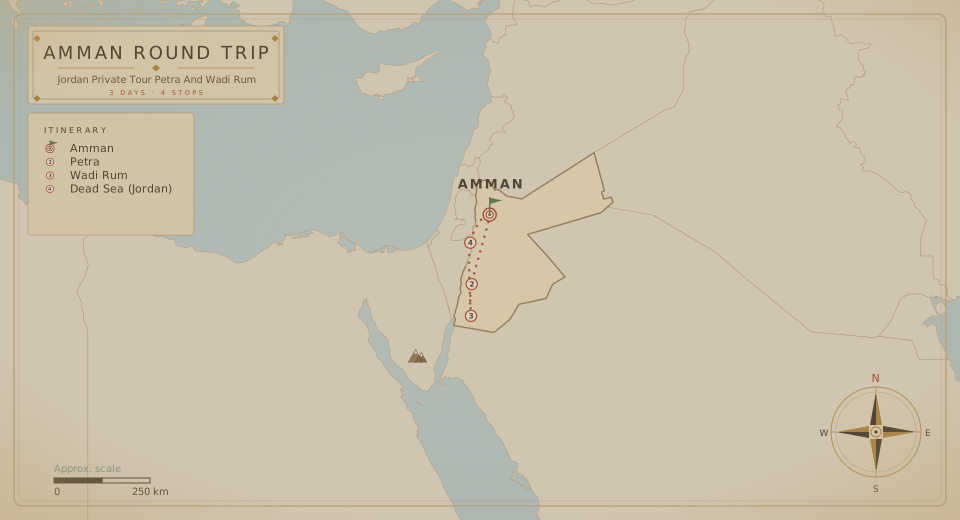
Day (1): Amman Airport-Petra Visit-Petra
Upon arrival and after you
have cleared customs and immigration, our representative will meet you then
drive to Petra and enjoy a guided tour of the many sites of Petra.
Petra was carved into the rose-red Sharah Mountains by the Nabateans and lost
to Civilization until re-discovered by the Swiss Burkhardt. Around 11,000 BC
Stone Age man was already exploiting the abundant natural resources of the
Petra region, particularly wild goats and by 7000 BC some of the world’s
earliest farmers were living in a walled village at Beidha, cultivating
cereals and collecting nuts and fruits. But Petra really came to
prominence in the 7C BC when the Edomites settled on Umm al-Biyara and other
mountain strongholds and built a town at Tawilan above ’Ain Musa, in the
hills to the north. Subject to Assyria, Babylonia, and then Persia,
Edom in the 3C BC became the nucleus of an Arab state, the Nabateans kingdom
and its capital at Petra. Originally from North Arabia, the Nabateans
are first mentioned by the 1C BC historian Diodorus, who relates that in 312
BC Antigonus, the One-Eyed sent his general Athenaeus against ‘the land of
the Arabs who are called Nabateans’, at that time a nomadic people who raised
cattle and sheep and could survive for long periods in the desert, where they
created a network of secret underground reservoirs. Athenaeus attacked
a certain strong, though un-walled rock, perhaps the great massif of Umm
al-Biyara at Petra, where the Nabateans had left their valuables, elders,
women and children while celebrating a festival, killed some of the Arabs
there and made off with vast quantities of frankincense, myrrh and
silver. Some 150 years later the Nabateans had settled and Petra was
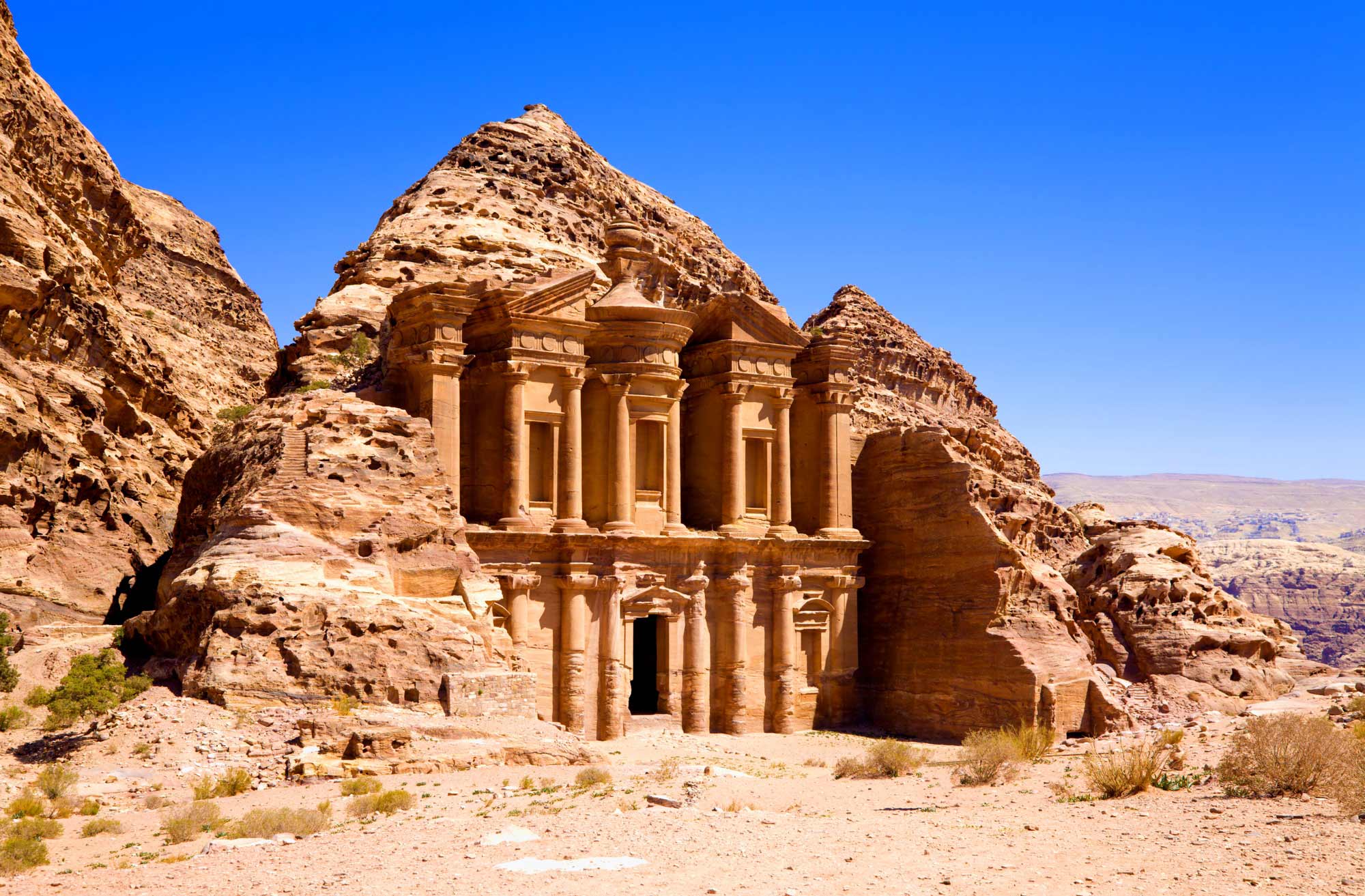
the capital of an organized state, walk through the Siq, a narrow and winding
fissure between the cliffs, to reach the Treasury, the Roman Theater, the
Courts, Qasr Bint Pharaoun, Temple of the Winged Lion and other monuments.
Then drive to Petra Hotel for overnight