

Day 01
Best of Rome Landmarks and Historic Squares
- Meet your tour guide and begin your Best of Rome tour.
- Visit the Trevi Fountain.
- The Fontana di Trevi, or Trevi Fountain in English, is a monumental fountain in Rome, built to mark the end of an aqueduct stretching from outside the city to its centre. It is the largest Baroque fountain in the city and the most intricate of its kind in the world. Tradition says that if travellers about to depart the city throw a coin over their shoulder into the fountain, they will be blessed with a safe return to Rome. The fountain is famous worldwide, but many people do not know the long history and secrets behind its construction. It is time to do justice to this extraordinary masterpiece of Italian art. The place where the fountain stands today was once merely a simple outlet of a 21 km-long aqueduct constructed by Marcus Agrippa around 19 BC. The aqueduct was heavily damaged during the barbarian invasions in 537 AD, and little was done to the fountain until a millennium later. During the early Renaissance, popes began decorating the ends of the aqueducts they had restored and created thousands of fountains all around the city, but this one was very special. At first, Pope Nicholas V had Leon Battista build a new fountain. The fountain underwent a great deal of work over the next 200 years, and Pope Clemens XII held a contest for a new design in 1730. Many important architects participated: Luigi Vanvitelli, Pietro Bracci, Giambattista Maini, Edme Bouchardon, Lambert-Sigisbert (Adam the Elder), Ferdinando Fuga, and Giambattista Contini, but against all odds, it was Nicola Salvi who won the contest. While he was not the last architect to work on it, the fountain today looks unquestionably different. You will see for yourselves.
- Head to the Spanish Steps.
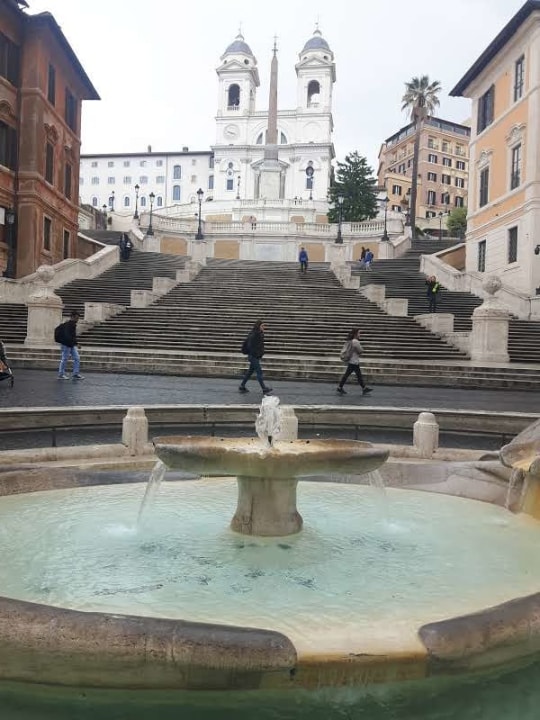
- In the 17th century, the famous Trinitá dei Monti church, which overlooks the Spanish Square, was under French ownership. The French ordered the construction of a massive, elegant staircase to connect the church to the popular plaza below. A design competition was held in 1717, and the staircase was entrusted to an unknown architect, Francesco de Sanctis. The Spanish Steps are a popular meeting point for locals and tourists alike. While the steps were initially named after the church and its plaza at the top of the staircase, they were later renamed to match the lower and more popular Piazza di Spagna. The square itself was called the Spanish Square because the Spanish Embassy to the Holy See was located there. The reason why the piazza became one of Rome's most popular gathering places is no coincidence. Due to its beautiful and artistic surroundings, the area has always been highly appreciated by painters and poets. The French Academy - where some of France's most talented artists, writers, and musicians worked - was founded nearby in the 7th century. The artists' presence attracted many beautiful women to the area, hoping to be chosen as artists' models. This, in turn, attracted rich Romans and travellers looking for a wife or a mistress. The many wealthy people in the area also drew beggars, and quickly the steps became crowded with people from all kinds of backgrounds. The Spanish Steps have long been a traditional and popular meeting point. While the steps are the main attraction, visitors should also pay attention to the many beautiful buildings in the area. Another feature to notice is the beautiful Baroque fountain called "Fontana della Barcaccia" at the lower end of the stairs. Bernini's fountain of a sinking ship was built to represent a folk legend. It is said that a fishing boat was carried away to this exact spot during the Tiber flood in the late 16th century. Throughout history, the Spanish Steps have been restored several times. The square was already one of the most popular tourist attractions in the city during the Renaissance period, and it still is to this very day.
- Stroll through Piazza Navona.
- Piazza Navona is one of the most famous and arguably the most beautiful of Rome's many squares. This large and lively piazza features no fewer than three magnificent fountains and the Baroque church of Sant'Agnese in Agone. The reason for the square's oval shape is that it was built on the former Stadium of Domitian, constructed by Emperor Domitian in 86 AD. The stadium once had a larger arena than the Colosseum and was mainly used for festivals and sporting events. In the 15th century, the stadium was paved over to create Piazza Navona, but remnants of Domitian's stadium are still visible around the area. The main attraction is the trio of fountains that adorn the square. The central and largest fountain is the Fontana dei Quattro Fiumi (Fountain of the Four Rivers). It was constructed between 1647 and 1651 at the request of Pope Innocent X. The fountain's design was first commissioned to Borromini but was ultimately handed to his rival Bernini. The two other fountains on the piazza are the Fontana del Nettuno (Neptune Fountain) and the Fontana del Moro (Moor Fountain) at either end of the square. The Fontana del Nettuno, also known as the Calderari, was built in 1576 by Giacomo della Porta. The statues of Neptune surrounded by sea nymphs were added in the nineteenth century. The Fontana del Moro was also built by Giacomo della Porta. The central statue of a Moor holding a dolphin, designed by Bernini, was added in the seventeenth century. The tritons are nineteenth-century additions. Another highlight of Navona Square is the church of Sant'Agnese in Agone. It was commissioned by Pope Innocent X in 1652 and built on the site where, according to legend, St. Agnes was stripped naked but miraculously saved from disgrace by the extraordinary growth of hair. Also known as the artists' square, Piazza Navona today is a popular meeting point and a perfect place to stroll through Rome's centre while admiring the work of several artists.
- Go to the Vittoriano, with a breathtaking view of Rome, the Roman Forum, and the Imperial Forum.
- Inspiring and overwhelming for any Roman, the Vittoriano is both a symbol of the nation's pride and, controversially, an "out-of-place" and invasive monument on Piazza Venezia - and for good reason. It was built between 1885 and 1911 to celebrate the unification of Italy as a nation and was dedicated to the first king of the nation, Vittorio Emanuele II. While the building itself is a massive statesmanlike construction surrounded and furnished with statues and fountains from all over the country, its sheer size and grandeur overshadow some of the more ancient wonders nearby, such as the Roman and Imperial Forums. Its impact on the ancient city does not end there, especially considering the ruins and medieval churches destroyed to allow its construction. Not to mention its bright and unspoiled colour, which clashes with those of the older buildings one is used to seeing in Rome. So much so, in fact, that the impeccably polished white marble used to build it has earned it the nickname "Wedding Cake". But there is much more to the Vittoriano than meets the eye. Even though its imperial twentieth-century style may seem intrusive against Rome's ancient flair, its tall terraces add a whole new experience for visitors. Even if you feel no patriotic awe or affection, the Vittoriano's terraces offer a look into the nearby Roman and Imperial Forums it overshadows, allowing us to admire their constructions in totality. The uppermost level, reachable by elevator, provides one of the best views over Rome from between two crowning statuary groups. Needless to say, the features of this monument contribute to its patriotic image. Guarded by soldiers, a flame burns on the front terrace of the monument to mark the grave of an unknown soldier; this is the Altar of the Fatherland, the Altare della Patria. The massive gilt bronze equestrian statue is of Vittorio Emanuele II, King of Sardinia. The other statues and decorations ornamenting the monument all have allegorical significance: the statues around the base of the equestrian statue represent fourteen historically important Italian cities, while the two quadrigae on top symbolise Liberty and Unity. Aside from its impressive exterior, the building also graces visitors with lavish halls inside, hosting a series of exhibition rooms and, most importantly, the Museo del Risorgimento, dedicated to the unification of Italy. Majestic or pretentious? Breathtaking or overwhelming? That is for the viewers of the monument to decide. One thing is certain: the Vittoriano makes up for its imposing presence in Rome with an endless series of majestic features, making it well worth a visit to decide for oneself.
- See the Aventine Keyhole and Terrace, as well as Mascherone's Fountain.
- Peek through this keyhole on a piazza designed by Piranesi in 1765, and you will see a garden path ending in bushes that perfectly frame St. Peter's dome at the centre of the view. What you are peering through are the gardens of the Villa del Priorato di Malta, one of the Roman properties belonging to the famous Knights of Malta. This is one of the last surviving orders of knights left over from the Crusades. The knights left their late medieval home on the island of Malta long ago, and their headquarters are now here in Rome. This Aventine villa is actually home to the Order's ambassadors to Italy and the Holy See. The Italian state recognises the sovereignty of this ancient military order, which means there are actually three nations and three national capitals contained within Rome: Italy, the Vatican, and the Knights of Malta.
- Walk through Campo de' Fiori Square.
- The square's name can be directly translated as "field of flowers", as it once was, in fact, nothing more than an unused meadow between Pompey's Theatre and the Tiber River. The area remained undeveloped for many centuries, as the neighbouring river was prone to flooding. Santa Brigida Church was constructed there in the 15th century, marking the beginning of the square's development. After the Orsini Palace and the Palazzo della Cancelleria were erected there as well, the city finally had reason to pave the area and officially call it a square. For centuries, criminals and so-called heretics were publicly tortured and executed at Campo de' Fiori. Giordano Bruno was one of the more well-known figures executed in this square. He was condemned by the Roman Inquisition because the ideas he spoke of were considered "dangerous". The Dominican friar was one of the first to realise that stars are actually suns in the universe. In 1887, sculptor and freemason Ettore Ferrari designed a statue of Bruno. It was placed in the piazza facing the Vatican, as if to defy all it stands for. Bruno is now considered an advocate of the right to free speech. Like many other public areas in Rome, the architecture at Campo de' Fiori was never standardised, which explains the discontinuity in the styles of the buildings surrounding the square. However, the square's many colours and facets contribute to its liveliness, making it an intriguing experience by day and by night. In the mornings, it hosts a daily vegetable and fruit market. By night, the orange-lit square comes to life again as its many surrounding restaurants and bars make it an appealing location for dinner and drinks.
- Proceed to see Ara Pacis.
- The altar was originally named Ara Pacis Augustae after Emperor Augustus, but it is often simply referred to as Ara Pacis. The altar was commissioned by Augustus in 9 BC as the Altar of Majestic Peace to celebrate his victories in Gaul and Hispania, now France and Spain. More importantly, it celebrates the establishment of peace in the Roman Empire, achieved as a result of the Pax Romana period from 27 BC to 180 AD. In its time, it was considered one of the most important monuments in Rome. The altar is located in what was once known as Campus Martius, an area in the floodplain of the Tiber River. It was strategically placed so that the shadow of the obelisk on Campus Martius, now Piazza di Montecitorio, would fall on the Ara Pacis on the birthday of Emperor Augustus. The Ara Pacis was sculpted from white marble. The scenes found on the altar depict traditional Roman piety. The emperor and his family are prominently represented in the altar's sculptures. There are also several figures of priests and other individuals wearing laurel crowns of victory. The actual altar table, decorated with sculptures of winged lions, used to stand inside the Ara Pacis. The most notable fact about the figures is that they are a classic example of Roman sculpture. Unlike Greek sculpture, the figures actually resemble real individuals and are not idealised.
- End the tour by exploring the Pantheon.