Morocco · Desert Adventure

11-Day Morocco Tour from Casablanca to Marrakesh with Sahara Camp

11 Days Round trip from Rabat Easy pace

The journey

Trip highlights
  • 01 Wander the Chefchaouen medina and its mesmerizing blue-hued surroundings
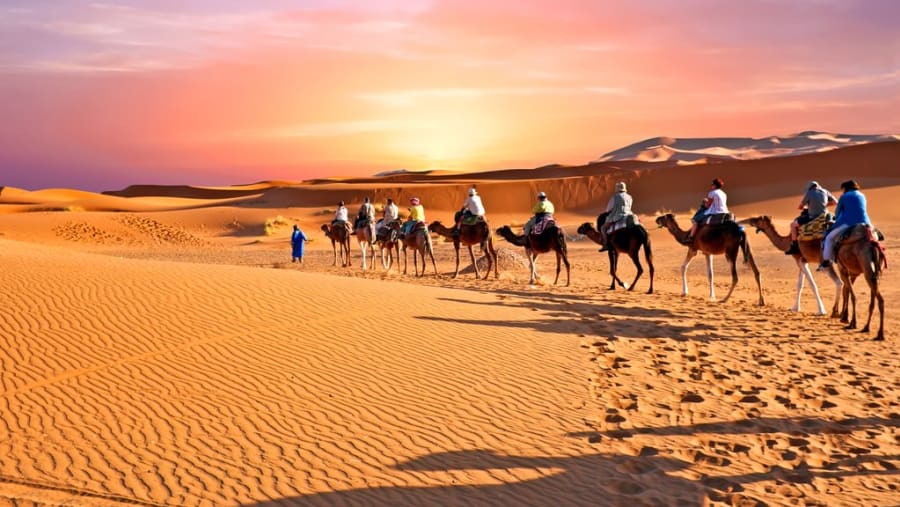
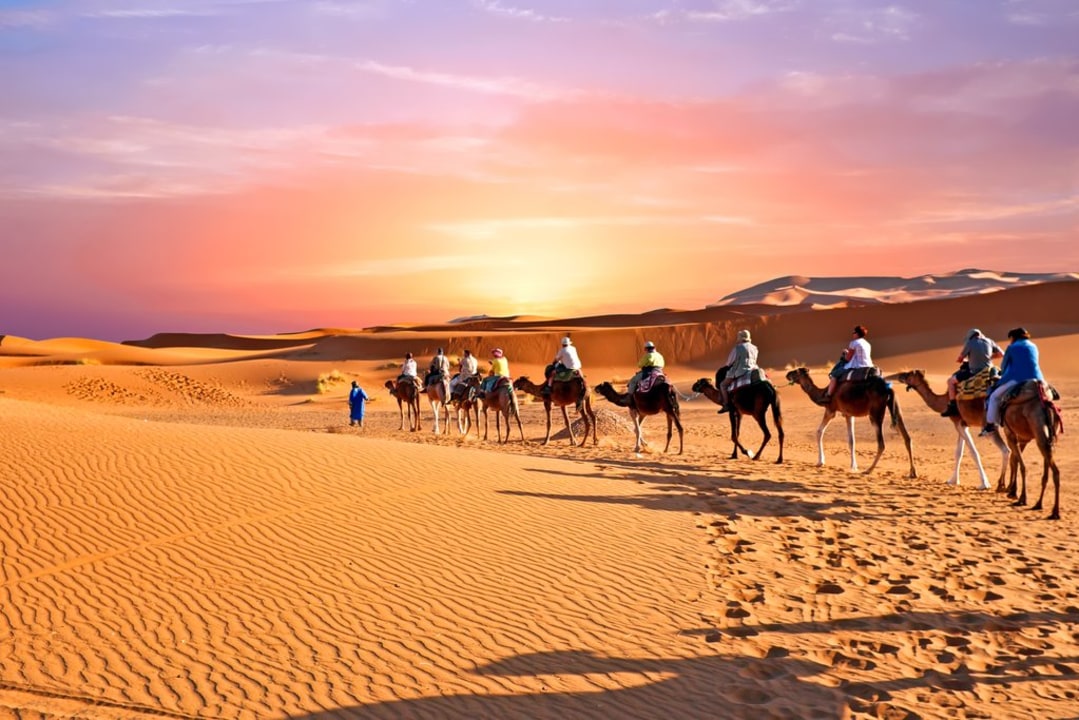
  • 02 Ride a camel into your luxury Sahara Desert campsite among the dunes
  • 03 Explore the Marrakesh souks, along with the busy Jemaa el Fna square
  • 04 Tour the ancient Fez medina and learn how clothing is dyed in the tanneries

From the blue medina of Chefchaouen to the red dunes of the Sahara, this colourful 11-day journey through Morocco has it all. Begin in Casablanca and Rabat, continue through the imperial cities of Fez and Meknes, and explore the Roman ruins of Volubilis before heading south through the Atlas landscapes to Merzouga. Enjoy a camel ride into the Erg Chebbi dunes, camp under the stars in the Sahara, and discover Aït Benhaddou on the way to lively Marrakesh and its famous souks.

Enjoy a camel ride into the Erg Chebbi dunes, camp under the stars in the Sahara, and discover Aït Benhaddou on the way to lively Marrakesh and its famous souks.

From the itinerary

At a glance

What this trip includes

Duration 11 Days
Tour type Shared
Activity level Easy
Accommodation Included · Standard
Transport Included
Wheelchair access Yes
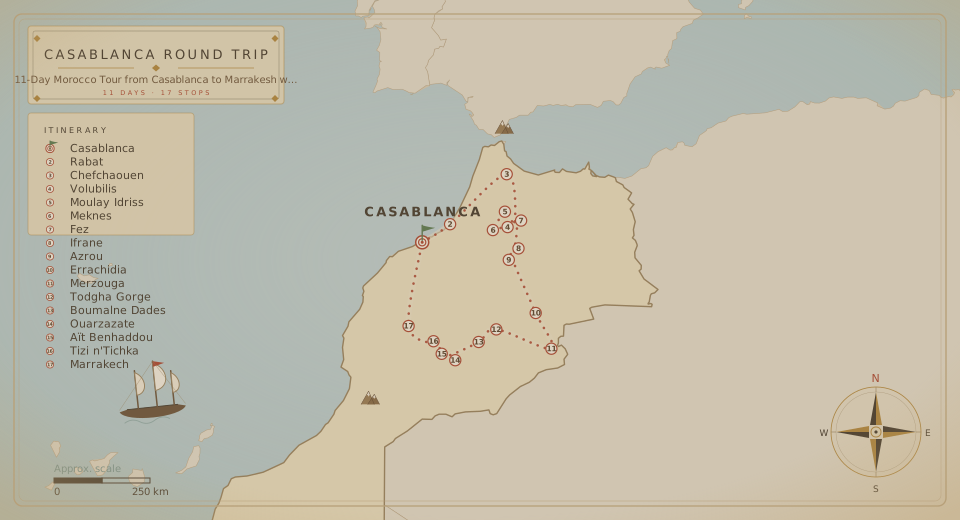
Cities Casablanca, Fez, Marrakech, Meknes, Errachidia, Rabat, Ouarzazate, Chefchaouen, Merzouga, Todgha Gorge, Aït Benhaddou, Tizi n'Tichka, Azrou, Ifrane, Moulay Idriss, Boumalne Dades, Volubilis
Languages English, French, German, Italian, Spanish

Day by day

The itinerary

1
Day 01

Arrival in Casablanca and Transfer to Rabat

  • Greetings from Morocco! When you land in Casablanca, you'll meet your driver outside the terminal. After you have settled into your accommodations, head to Hassan II Mosque, the biggest mosque in Morocco and the third-largest mosque in the world open to non-Muslims. This marvel of contemporary Moroccan architecture, which can hold up to 105,000 people in prayer, was created by hundreds of skilled artisans from all over the nation, many of whom donated their labour.
  • The journey then continues to Rabat, where you will see the unfinished Hassan Tower, which has stood there since 1199. The tower was built at the request of Abu Yusuf Yaqub al-Mansur and was intended to serve as the minaret of what would have been the world's biggest mosque. Unfortunately, the project was abandoned after the Sultan's death in 1199, leaving incomplete outer walls, 348 columns, and a minaret that reached only 140 feet instead of the intended 260 feet.
  • The Mohammed V Mausoleum, located next to Hassan Tower, houses the graves of the current king's grandfather, Mohammed V, as well as his father, Hassan II, and his uncle, Prince Abdallah. A masterpiece of Alaouite architecture, it has white walls and a roof with green tiles.
  • After a long and busy first day, take some time to unwind on your own.
2
Day 02

Journey to Chefchaouen

  • You will travel to Chefchaouen today. Walls, doors, windows, stairways, alleyways, and archways are all painted in a combination of sky-blue pastels and darker, more intense shades, making this tiny city a visual delight in blue. Chefchaouen, in the Rif Mountains, is a popular destination for travellers seeking a taste of traditional Morocco.
  • Once you have checked into your riad, a traditional Moroccan home, you are free to relax or take your time exploring the town. The main square, Place Outa el Hammam, is a good place to observe daily life. You can get a better sense of the town by climbing the narrow, winding alleys away from the touristy areas. Budget-conscious shoppers will love shopping here because they can find handcrafted wool clothing, woven blankets, cedarwood furniture, and other artisanal goods. Order a Maqlouba (upside-down) coffee and sip it while observing neighbourhood women fetch water and wash their clothes in the nearby spring.
  • Before going to bed for the evening, take time to enjoy dinner on your own.
3
Day 03

Chefchaouen to Fez via Volubilis, Moulay Idriss and Meknes

  • You have time to do a little more exploring in the medina before you leave. If you get up early enough, you can see the sunrise from the Spanish Mosque, or you can enjoy a leisurely morning watching the city come to life from a café in Place Outa el-Hammam.
  • You'll stop at Volubilis, a UNESCO World Heritage Site that houses the best-preserved Roman ruins in Morocco, en route to Fez. The vast complex offers a relaxing break from driving, as you can wander around and discover large merchant homes with visible heating systems, temples, and numerous preserved mosaics. If you would like, you can typically hire a guide here on your own; your driver can help you with this.
  • The next stop is Moulay Idriss, which appears to be a sitting camel from a distance. In 789 CE, Moulay Idriss established the town after escaping religious and tribal strife in Mecca. He founded the Idrisid dynasty here, making Moulay Idriss the first Islamic capital of Morocco and a place of ongoing cultural significance. The city is also home to Morocco's only round minaret. Either wait until the next stop or eat your lunch here.
  • Meknes, a thriving city, is the final stop before Fez. Its medina is smaller than Fez's, so you can stroll through it at your own pace without worrying about pushy shop owners. You can see gardens, palaces, the imposing Bab al-Mansour gate, the Mausoleum of Moulay Ismail, and the Royal Stables as your driver guides you through the Ville Impériale neighbourhood. Be on the lookout for Roman columns concealed in unexpected places, because many of these palaces were built using materials taken from Volubilis.
  • Fez, one of Morocco's four imperial cities, is where the day will come to an end. Moulay Idriss I founded Fez, which Moulay Idriss II elevated to the status of the Idrisid dynasty's capital. The late afternoon and early evening will be yours after being driven to your riad in the Fez Medina.
  • The largest car-free urban area in the world, the ancient and unforgettable Fez Medina is a maze of winding alleys that climb up both sides of a steep river valley. When exploring the Fez Medina alone, getting lost is likely, but it can also be liberating. The key to leaving the medina is to be aware of whether you are walking uphill or downhill at all times. Generally, ascending a hill will bring you to the edge of the medina, where you can hail a taxi or more clearly see your destination.
4
Day 04

Guided Exploration of Fez

  • Talk to a local expert who can assist with planning your trip. With a private tour guide, you will explore Fez today. Although you will drive to some places, be prepared to walk a lot. You can anticipate the following.
  • Learn about the significance of the elaborate décor as you start at the Royal Palace, which has seven golden doors.
  • Wander through the Mellah, or Jewish neighbourhood, which was constructed next to the palace to provide security.
  • Take in the cityscape from Borj Sud, a former fortress that serves as one of the city's lookout points. From here, you can identify landmarks that would otherwise be hidden by structures that obscure the skyline.
  • Visit a pottery cooperative to observe the production of distinctive Fez pottery and the intricate mosaics that adorn half of Morocco.
  • Enter the historic medina, a sort of living museum. Keep moving and be aware of the donkeys, because the Fez medina is very much a local community where people live, work, and go about their daily lives.
  • Visit Al-Quaraouiyine University, which was founded in 859 CE by a woman and is the oldest degree-granting institution still in existence.
  • You can see why Fez is regarded as Morocco's handicraft capital by visiting craft studios. This can include, among other things, the silk weavers, where exquisitely colourful fabrics are woven from silk fibres of the agave plant, and the renowned Fez tannery, where a variety of animal hides are processed by hand much as they have been for almost a thousand years. They can even alter an item to be delivered to your riad by the end of the day. They also sell leather goods in all colours and styles.
  • You will have lunch at a restaurant that would be easy to walk right past but is actually a hidden gem during your tour of the medina. Take the evening to relax after a tiring day of sightseeing.
5
Day 05

Journey South to Merzouga

  • You will leave Fez and start your journey south after breakfast. You will stop for coffee in Ifrane, a tiny ski resort town also referred to as the "Switzerland of Morocco" because of its alpine-style construction. Then spend some time with the wild monkeys in the cedar forests outside Azrou; they are surprisingly well behaved and happy to be fed.
  • Stop in Zayda for lunch in the afternoon, where you can savour the flavourful barbecue at one of the many sidewalk eateries. As you continue travelling, take in the beauty of the Atlas Mountains that surround you. Watch out for the lush, green date and almond trees covering the gorge in Errachidia.
  • In the evening, you will arrive in Merzouga and check into your riad in time for dinner.
6
Day 06

Sahara Desert Adventure and Camp

  • Take a one-hour quad excursion through the Sahara Desert to start the day. Enjoy the rush of moving quickly through the sands and up the dunes, where you will stop to enjoy a tranquil moment with nothing but sky and sand in sight. To make sure you don't get lost, a trained guide will be with you at all times.
  • Meet your SUV driver when you get back for a longer trip through the Sahara. A family of nomads will welcome you into their winter home for tea. From the Atlas Mountains to the Sahara Desert, the nomads moved their flocks of sheep and goats by following the weather.
  • After that, go to the Gnawa Village to enjoy some mesmerizing music. Since the Gnawa ancestors were brought to the region as slaves, hypnotic, rhythmic music has long been part of desert ceremonies. The music even served as the inspiration for a number of music festivals and influenced an entire genre that is performed all over Morocco. Then you can search the desert for aquatic animal fossils. Countless fossils still remain from the Sahara's time as an ocean 7 million years ago.
  • Meet your camel in the late afternoon and begin the journey to your desert camp. Your camel guide will be able to take some fantastic pictures for you as you travel through the sand dunes. When you get to your camp, a glass of mint tea and some Moroccan cookies will be waiting for you. Before dinner, unwind for a while, and at dusk, enjoy live music around the bonfire.
7
Day 07

Merzouga to Boumalne Dades

  • You can get up early to see the sunrise over the sand dunes if you're an early bird. Keep in mind that the desert gets chilly at night, so don't forget your jacket. At the camp, savour a traditional Moroccan breakfast before leaving on a camel, or by SUV if one camel ride was enough for you.
  • After that, meet your driver and start travelling west. You'll stop in Boumalne Dades to see the magnificent Todra Gorge, where the river has chiselled its way through the region's red rocks.
  • After that, settle into your lodging in Boumalne Dades before going to Rose Valley for a guided hike that can be as easygoing or strenuous as you'd like.
  • In the evening, unwind and enjoy dinner at your riad.
8
Day 08

Boumalne Dades to Marrakesh via Aït Benhaddou

  • You'll travel to Marrakesh in the morning. You can ask to stop in Kalaat M'Gouna, which is well known for its rose cooperatives and where thousands of pounds of rose petals are harvested annually to be distilled into rose water and rose oil for use in cosmetics, if you'd like.
  • Your next stop will be Aït Benhaddou, an ancient ksar designated as a UNESCO World Heritage Site, when you get to Ouarzazate. The ksar, once a stop for trade caravans travelling between the Sahara Desert and Marrakesh, is now frequently used as a backdrop for films such as The Jewel of the Nile, The Mummy, Gladiator, and Kingdom of Heaven.
  • The winding Tizi n'Tichka Pass will take you further across the Atlas Mountains until you reach Marrakesh in the late afternoon. In the evening, go for a stroll after checking into your riad in the medina.
9
Day 09

Guided Tour of Marrakesh

  • Prepare for your private guide's Marrakesh tour in the morning. There is a lot to see and do around town. Expect the following: the Koutoubia is the tallest minaret in Marrakesh. No structure within the city limits may be taller than its 253 feet. The minaret is part of the largest mosque in Marrakesh, which was completed in 1199.
  • Visit a Berber pharmacy to learn more about the various spices and herbs that are still commonly used in Morocco to treat everyday ailments. It is much more educational, even though it is not as picturesque as the piles of spices you can find in the market.
  • Visit Bahia Palace, the late 19th-century residence of the grand vizier, named after his favourite wife. His harem, which frequently held political office, was housed in rooms set within a 2-acre garden. The main square in the medina and a UNESCO World Heritage Site is Jemaa el Fna. Although it is now home to street entertainers, snake charmers, vendors, and orange juice stands, the Assembly of Death, as its name can be translated, was used for public executions when it was first built in 1050. Several workshops, including those of bakers and shoemakers, can be found in the souks surrounding Jemaa el Fna.
  • If you'd like, you can spend the afternoon in the souks with the guide, who can help you find what you're looking for by leading you through the maze of narrow lanes. After your tour is over, take your time and enjoy the evening.
10
Day 10

Free Day in Marrakesh

  • Take advantage of today's free day to explore Marrakesh. You might decide to start by visiting museums such as the Yves Saint Laurent Museum and the Berber Museum. You can also take a tour of the Majorelle Garden, home to 300 species.
  • If you want to unwind, treat yourself to a traditional hammam visit, which includes time in a steam room and a scrub with an abrasive kessar mitt to remove dead skin. If you enjoy spa treatments, this is a must.
  • You can also take pleasure in touring the busy city, browsing the souks, and taking in the sights from sidewalk cafés. On your last night in Morocco, unwind at Jemaa el Fna in the evening and observe the square come to life.
11
Day 11

Departure Transfer to Casablanca Airport

  • Check out of your Marrakesh hotel after breakfast. You will then transfer to Casablanca Airport to catch your flight home. Due to airport congestion, it is important to arrive three hours before your flight is scheduled to depart. Until next time, bid Morocco and all of its pristine beauty adieu.
Chefchaouen blue medina, Volubilis Roman ruins, Erg Chebbi dunes, Aït Benhaddou ksar

Where this trip takes you

Chefchaouen blue medina, Volubilis Roman ruins, Erg Chebbi dunes, Aït Benhaddou ksar

The route

Where you'll travel

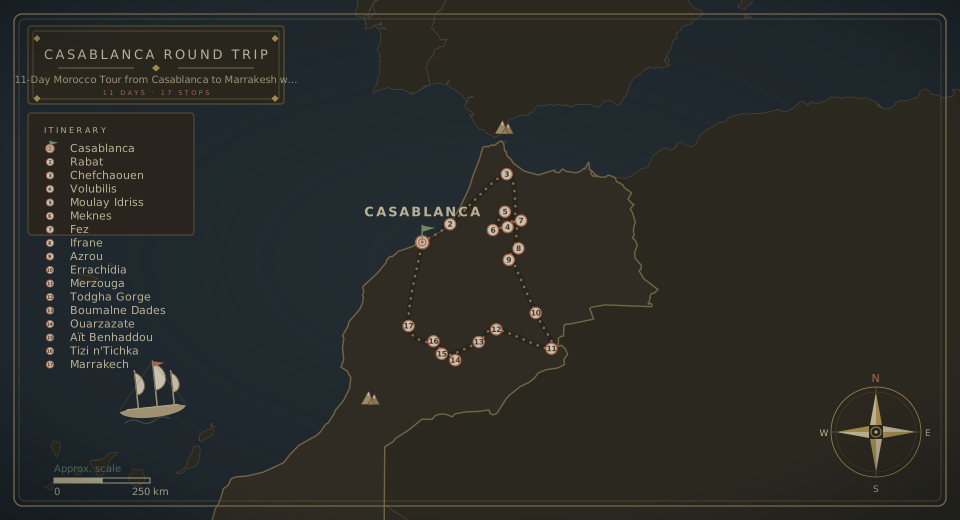
Tour route map
Round trip from Rabat 17 cities · 11 Days

The fine print

Trip details

What's Included

  • Pick-up and drop-off at your hotel or airport
  • Transport in a private 4x4 car or minibus with A/C and fuel
  • English- or Spanish-speaking driver-guide
  • 9 nights of accommodation in hotels, riads, and camp
  • Camel ride in the Sahara Desert (one camel per person)
  • Meals: breakfasts and dinners
  • Local guides in Fez and Marrakesh

What's Not Included

  • Dinners
  • Tips

Logistics

Meeting & route

Meeting point
Casablanca, Morocco
Tour start
Rabat, Morocco
Tour ends at the same location as the start point.
End of the journey

Your 11 days finish where they began, in Rabat.

Watch the tourHQ film Watch the film

Create your own adventure

Can't find the perfect tour? Tailor your dream trip.

  • Tell us your destination, dates and group size.
  • Our travel experts and local guides design a tailored itinerary, just for you.
  • Enjoy your trip with peace of mind, knowing everything is taken care of.
Plan my holiday

Say goodbye to travel stress.

Starting from

EUR 2,200 /person
Book This Tour

When

Travellers

Total