
Day 01
Arrival in Kolkata
Arrive in Kolkata and transfer to the hotel.
Stay overnight in Kolkata.


Explore the world with tourHQ
India · Wildlife Safari
The journey
Take this fascinating wildlife tour through Assam, one of the most beautiful and progressive states of India. Explore the pristine habitats of Manas, Nameri, and Kaziranga National Parks, where you can encounter remarkable mammals and birdlife, including the famous rhinos of Kaziranga. Unwind at the foothills of the Himalayas, enjoy jungle safaris and nature walks, savour Assam's tea culture, and discover the cultural side of the state in Guwahati.
Explore the pristine habitats of Manas, Nameri, and Kaziranga National Parks, where you can encounter remarkable mammals and birdlife, including the famous rhinos of Kaziranga.
From the itinerary
At a glance
Day by day
Arrive in Kolkata and transfer to the hotel.
Stay overnight in Kolkata.
After breakfast, drive to the airport for your flight to Guwahati. Arrive in Guwahati and receive a welcome lunch on arrival.
Continue to Manas National Park. Lying in the foothills of the Himalayas, it is one of the most stunning pristine wildlife habitats in India, comparable to the best in the world. It is also a UNESCO Natural World Heritage (endangered) site, a Project Tiger Reserve, an Elephant Reserve, and a Biosphere Reserve.
Stay overnight at Manas.
Embark on a full-day sightseeing tour in Manas, including an elephant ride and a jeep safari inside the forest.
Overnight stay at Manas.
After breakfast, drive to Nameri National Park. This 200 sq km park is located in the Sonitpur district, bordering Arunachal Pradesh, and it is also the core area of Nameri Tiger Reserve, which covers 344 sq km. More than 350 species of birds, including the White-winged Wood Duck, Ibisbill, and White-throated Fantail, can be found here.
Arrive and check in at Eco Camp. Spend the rest of the time at leisure.
Overnight at the hotel.
Early in the morning, go for a nature walk and birdwatching trip into the dense jungle with the forest guards.
Overnight at Eco Camp.
After breakfast, depart for Kaziranga National Park. Kaziranga has become synonymous with the successful conservation of the Great One Horn Rhinoceros and is also home to many other threatened species, including the Indian Elephant (Elephas maximus), Tiger (Panthera tigris), Hoolock Gibbon, and the Ganges dolphin (Platanista gangetica).
Arrive at Kaziranga and check in at the jungle resort.
Overnight at the resort.
Early in the morning, enjoy an elephant safari in the central (Kohora) range of Kaziranga. Later, return to the resort for breakfast.
In the afternoon, savour the tea culture of Assam at Kaziranga National Park. (Optional)
Late in the afternoon, enjoy an exclusive jeep safari in the western (Bagori) range of Kaziranga.
Overnight at the resort.
After breakfast, drive to Guwahati, arrive, and transfer to the hotel.
Visit the sacred temple, and later, the museum.
In the evening, head for a river cruise on the mighty Brahmaputra River.
Overnight at Guwahati.
After breakfast, drive to the airport for your flight to your onward destination.
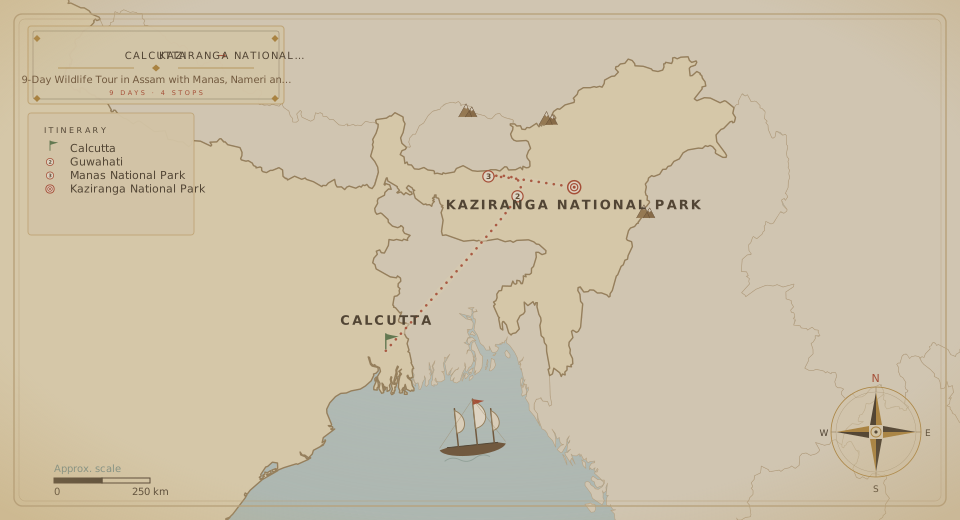
The route
The fine print
Manas National Park (India-Bhutan Border)
Nameri National Park
Kaziranga National Park
Guwahati
English-speaking Indian guide
Pygmy Hog Research Centre
Silk Village
River cruise
Boating and many more exciting options, if interested
A wildlife journey across the national parks of Assam, a green state in northeast India. After visiting a plethora of mammals and birdlife, including the famous rhinos of Kaziranga, get an introduction to the cultural vibe of the state in Guwahati as well.
Just for your knowledge and information:
A. Manas National Park:
Manas is the closest I have come to seeing paradise on earth in my life - but that was 25 years ago. Today, Manas looks like an aged diva wearing rags, though I think I still caught the familiar sparkle in the eye.
This Brahmaputra Valley semi-evergreen forest and terrestrial ecoregion is also the richest in species among all Indian wildlife areas and the only known home for the rare and endangered Assam Roofed Turtle, Hispid Hare, Golden Langur, and Pygmy Hog.
The focal point of Manas National Park is the enchanting Manas River, named after the serpent goddess Manasa. It is the largest Himalayan tributary of the mighty Brahmaputra. Coming down from the Bhutan Hills in the north, the crystal-clear waters of the Manas River run through the heart of the 500 sq km core area of Manas Park. The main tourist spot of Mothanguri, on the northern border of Manas with Bhutan, is situated on the banks of this river.
Situated on the north bank of the Brahmaputra River in Assam, Manas lies on the international border with Bhutan. It is bounded on the north by the Royal Manas National Park in Bhutan, on the south by the populous North Kamrup district, and on the east and west by the buffer forest reserves of the 2,840 sq km Manas Tiger Reserve.
The Manas River flows through the west of the park, where it splits into two separate rivers, the Beki and Bholkaduba.
Vegetation: The Burma Monsoon Forests of Manas lie on the border between the Indo-Gangetic and Indo-Malayan biogeographical realms and are part of the Brahmaputra Valley Biogeographic Province. The combination of Sub-Himalayan Bhabar Terai formation with riverine succession leading up to the Sub-Himalayan mountain forest makes it one of the richest biodiversity areas in the world.
Two major biomes are represented in Manas - the grassland biome and the forest biome.
It is replaced by moist deciduous forest away from watercourses, which is succeeded by semi-evergreen climax forest in the northern part of the park. A total of 543 plant species have been recorded from the core zone. Of these, 374 species are dicotyledons (including 89 trees), 139 species are monocotyledons, and 30 are Pteridophytes and Gymnosperms.
Fauna: Manas is the meeting point of the west and the east. Many species at the westernmost and easternmost points of their range represent a gateway for species exchange between the typically Indian and Malayan faunas.
A total of 55 mammals, 50 reptiles, and three amphibians have been recorded, with several species being endemic. Manas contains 21 of India's Schedule I mammals and at least 33 of its animals listed as threatened, by far the greatest number of any protected area. Some, like the Assam Roofed Turtle Kachuga sylhetensis, Golden Langur Presbytis geez, Hispid Hare Caprolagus hispidus, Pygmy Hog Sus salvanius, and the only pure strain of Asiatic Wild Buffalo Bubalus, are only found or best seen here.
Birdlife: The diverse habitat of Manas is an ideal home for a variety of specialized birds. Manas boasts the largest population of the endangered Bengal Florican globally and is also a great place to see the Great Hornbill. The national park lists around 380 species, and the adjoining hilly terrain in Bhutan can easily add a hundred birds to that total. Good birds to look for are Greater Adjutant, Black-tailed Crake, Red-headed Trogon, Swamp Francolin, Wreathed and Rufous-necked Hornbill, Marsh and Jerdon's Babblers, Pied Harrier, Rufous-rumped and Bristled Grassbirds, Hodgson's Bushchat, Rufous-vented Laughingthrush, Finn's Weaver, Ibisbill, and a variety of foothill species.
B. Nameri National Park:
The Nameri National Park of 200 sq km is located in the Sonitpur district, bordering Arunachal Pradesh.
Another important wildlife sanctuary of Arunachal Pradesh, the Pakhui (Pakke) Wildlife Sanctuary, adjoins the park at its northeastern point. The Jia-Bhoroli River and its tributaries, namely the Diji, Dinai, Doigurung, Nameri, Dikorai, and Khari, crisscross the park. During the rainy season, a few jheels also dot the area.
One can enjoy rafting on the Jia-Bhoroli River along the southwestern boundary.
C. Kaziranga National Park:
It has become synonymous with the successful conservation of the Great One Horn Rhinoceros (from the Greek word, 'rhino' means nose and 'ceros' means horn) / Unicornis (from the Latin word, 'uni' means one and 'cornis' also means horn) and is also home to many other threatened species.
There are also over 500 species of birds recorded in the park, including 25 species in the globally threatened category.
Over and above, there are 21 rare and endangered species. In winter, one can observe a large breeding population of Spot-billed Pelicans - about one thousand breeding nests are found in a place named Pelican Colony in the Eastern Range.
Among the reptiles, species like the Water Monitor Lizard (Varanus salvator), Indian python (Python molurus), Cobra (Naja naja), and King Cobra are found.
Note: We will visit the Pygmy Hog Research Centre at Nameri National Park or Guwahati.
If you have more days, we can add many places according to your interests.
Logistics
Your 9 days finish where they began, in Kolkata.
 Watch the film
Create your own adventure
Say goodbye to travel stress.
Starting from
When
Travellers
Total
—