Arrival in Lima
Upon arrival at Lima's international airport, you will be assisted and transferred to the hotel of your choice.
Take some time to rest at the hotel and prepare for your trip around this magical country.
Peru · Archaeology
The journey
Embark on an exciting journey through Peru's famous highlights, from wildlife-rich shores on the Peruvian coast to the enigmatic Nazca Lines seen from the air. Meet the Water Tribe on the Floating Islands of Uros, visit Colca Canyon - one of the deepest canyons in the world - and enjoy memorable boat excursions along the way. The tour also includes hot springs near Colca Valley and Machu Picchu, along with visits to churches, centuries-old convents, the Temple of the Sun, and remarkable archaeological sites in Machu Picchu and Ollantaytambo.

Embark on an exciting journey through Peru's famous highlights, from wildlife-rich shores on the Peruvian coast to the enigmatic Nazca Lines seen from the air.
From the itinerary
At a glance
Day by day
Upon arrival at Lima's international airport, you will be assisted and transferred to the hotel of your choice.
Take some time to rest at the hotel and prepare for your trip around this magical country.
After breakfast, set out on a sightseeing tour of the most attractive and important sites in Lima, the "City of Kings". The tour includes Lima's Historical Centre: Plaza San Martin, the Main Plaza, the Government Palace, the City Hall, the Cathedral and its Religious Art Museum, the Church of Santo Domingo with the tombs of Santa Rosa and San Martin de Porras, and the Colonial Balconies.
Visit the Convent and Church of San Francisco, the greatest monumental complex of colonial art in America.
See the Basilica of 21 altars, the Convent of Cloisters, the Capitulary and Clementine Rooms, the Chorus and Library of the Monks, a museum showing 11 paintings of the Rubens School, the Sacristy with paintings by Surbaran and Ribera, and its great patio decorated with 16th-century Seville tiles, Moorish arches, and underground Catacombs.
Also, go to El Olivar Park, with olive trees from Spain dating back to the 15th century, and the Central Park of Miraflores and Larcomar, a symbol of modern Lima.
Leave by bus for the Paracas Peninsula to discover the abundance of wildlife in a sanctuary on the Peruvian coast.
Enjoy a boat excursion to the Ballestas Islands to observe sea lions, boobies, pelicans, penguins, and other seabirds.
On the way back aboard the boat, see the "Candelabro" (Candelabrum), a giant figure etched in the sand on the side of a hill in the style of the Nazca Lines.
Proceed to Ica and visit Huacachina Oasis, surrounded by dunes. Ride dune buggy cars through the Ica Desert, up and down the dunes, where you can also practise sandboarding.
In the afternoon, continue by bus to the city of Nazca.
After an early breakfast, transfer to Nazca Airport for a 30-minute flight over the enigmatic Nazca Lines. These enormous drawings of animals, birds, and geometric figures remain etched in the desert and can only be appreciated from the air.
At 1.30 p.m., travel by bus to the white city of Arequipa, a journey of about 10 hours covering 640 km along the desert and coastal valleys. Arequipa received its name because of the white buildings constructed with the white rock that flows out of the Misti Volcano.
Upon arrival in Arequipa, meet the guides and transfer to the selected hotel.
Go on a sightseeing tour of Arequipa in the morning. Visit sites such as the Main Square, one of the most beautiful squares in Peru, and the Cathedral, a prime example of 19th-century Peruvian architecture.
Visit La Compañia Church, an ancient Jesuit temple that is perhaps the most important in Arequipa because of its history and tradition, with a beautiful façade of carved columns, laurel crowns, flowers, birds, and more.
Then travel to the Santa Catalina Convent, a "small town" built in the 17th century and opened to the public in 1970 after 400 years as a cloister. Travel back in time as you enter the cloister and see the numerous spacious patios and gardens, the kitchen, slave quarters, and stone washtubs of this convent. About 20 nuns, out of what were once 500, still live in one section of the convent.
Early in the morning, depart on a wonderful four-hour bus trip to Colca Canyon, one of the deepest canyons in the world at 3,400 m. On the way, drive across Pampa Cañahuas in the Aguada Blanca National Reserve, inhabited by herds of vicuñas and alpacas, South American camelids.
See beautiful pre-Columbian terraces that are still being cultivated by the native Collaguas. (Box lunch)
Upon arrival in Colca Valley, transfer to the selected lodge.
In the afternoon, it is recommended that you rest and acclimatize to the altitude. If you are in good shape, you will have free time to stroll around the lodge surroundings, or you may take a rejuvenating bath in the hot springs near the lodge.
Dinner at the selected lodge in Colca Valley.
Overnight at Colca Condor Cross - Chivay Valley.
Leave early in the morning for the "Condor's Cross", where the world's biggest bird can usually be seen.
On the way back, visit the colonial towns and churches of Yanque, Coporaque, Achoma, and Maca. It is a good opportunity to appreciate the life of these people, which has changed little since Inca times.
Lunch will be served at a local restaurant.
Overnight in Chivay Valley.
At 1.30 p.m., transfer on the route to Puno, which offers great natural scenery. Along this paved road, drive through small towns and past a beautiful lagoon called Lagunillas, where trout farms can be seen. If you are lucky, you might also spot Andean flamingos and many other Andean birds.
(Optional) If time permits, visit the highlight of this road - the burial towers of Sillustani, enormous cylindrical constructions built long before the Incas. The Sillustani Towers are perhaps the finest and most perfectly cylindrical constructions of ancient Peru; such perfection can be found nowhere else in South America.
If time permits, gain a better view of the life of pre-Inca civilizations. While exploring the area, marvel at the great beauty of Umayo Lagoon, located at the foot of the Sillustani natural platform.
Early in the morning, take a motorboat excursion on the waters of Lake Titicaca to the unique "Floating Islands" of the Uros. These ancient inhabitants of the lake, known as the Water Tribe, have built their own islands by periodically adding new layers of a type of reed called "Totoro" (Scirpus Totora), a vegetable fibre of the papyrus family. Their homes and boats are also made from this material.
Continue the motorboat trip to Taquile Island, inhabited by Quechua-speaking natives who have, over generations, developed an efficient and unique social system, as well as fine hand-weaving techniques. It is necessary to climb a stairway of more than 567 stone steps winding among green platforms to arrive at the town of Taquile, where you will take a break to eat.
After lunch in a local Taquile inn, walk through the various hills and archaeological sites of this 6 km-long island.
In the afternoon, return to Puno for an overnight stay at your hotel.
In the evening, you are free to explore on your own.
After an early breakfast, depart by bus to the city of Cusco. Travel along the High Plateau of Collao, stopping en route at the town of Ayaviri, an important livestock and textile centre.
Here, visit the impressive Temple of Kalasaya, ruins from the ancient Pucara Culture. Also on the way, stop in Raqchi, where you can see a spectacular Inca sanctuary built by the Inca Pachacutec and dedicated to the great Inca god Wiracocha.
About 70 km further on, pass through La Raya Ranch, where troops of vicuñas and llamas can be seen. During the trip, lovely Wacarpay Lake also offers spectacular views of the mountains reflected in its calm waters.
Proceed to the beautiful town of Andahuaylillas and visit the Church of San Pedro de Andahuaylillas, better known as the Sistine Chapel of the Americas because of its decorated polychrome ceiling.
Enjoy a buffet lunch in a quiet countryside restaurant, where you can savour the delightful culinary art of the region.
Continue your journey to Cusco and, upon arrival, transfer to your hotel. Dinner is on your own.
Overnight in Cusco.
After breakfast, spend the morning at leisure, or visit San Blas Street. Numerous artists and artisans reside in this artistic barrio of narrow streets, with a beautiful little plaza and paqcha. There are workshops of famous artisans such as Mendívil, Olave, and Mérida.
Visit Hatunrumiyoc, located close to Plaza Nazarenas and not far from Plaza de Armas. It is a narrow pedestrian street, famous for its Inca walls where huge stones are precisely carved to fit together without mud or concrete. About halfway down the street, you can find the masterpiece of the 12-angled stone.
Roam through the Central Market, or Mercado de San Pedro. It is one of the oldest markets in Cusco, founded in 1925. Despite its age, no significant changes have been made. San Pedro Market is about an eight-minute walk south of Plaza de Armas.
On your walk to the market, notice street vendors and ladies in traditional dress sitting by the roadside, selling nuts, popcorn, and other small bags of dried foods.
Spot more local shops (tiendas) selling the most random things. If you are looking for an alpaca jumper, freshly made juice, a bag of nectarines, some plantains to fry, Botifarra (ham sandwiches served on French bread), or some cheesy gifts for your family and friends back home, this is where you will find them.
In the afternoon, enjoy a guided sightseeing tour of Cusco, visiting the Main Square, the Cathedral, and the Temple of the Sun, or Korikancha.
Then drive out of the city to visit the Inca sites of Kenko, Tambomachay, Puca Pucara, and the impressive fortress of Sacsayhuaman, strategically built on a hill overlooking Cusco. Sacsayhuaman is famous for its enormous carved stones, some of them standing over 9 m/30 ft high and weighing more than 350 tons.
At 8.00 p.m., get ready to enjoy dinner accompanied by a folk show in a typical restaurant, where musicians play their melodies with Andean instruments. At the same time, traditionally dressed dancers entertain you with traditional Peruvian dances.
Set out on an early morning excursion to Urubamba, the Sacred Valley of the Incas. En route, you may stop at Awanakancha, a small camelid farm dedicated to the animals and the intricate textiles produced from their wool. A trip to this farm introduces you to the local fauna without venturing deep into the countryside.
On arrival at the farm, meet the resident animals - alpaca, llama, and vicuña. Separated by species and sex in large pens, the friendly animals are keen to meet visitors in the hope of receiving a tasty grassy snack.
After getting to know the animals, take some time to visit the small onsite exhibits, where you can understand how animal wool is refined and naturally dyed before finally being expertly woven into fabric, tapestry, clothing, and a variety of other products.
Observe as women from native communities offer live examples of traditional and intricate weaving techniques using basic tools and wooden looms.
Visit the picturesque Indian Pisac Market, held on Tuesday, Thursday, and Sunday. This is a shopping paradise where barter is still practised. Enjoy the unique atmosphere during a typical lunch.
In the afternoon, passing through the towns of Calca and Urubamba, visit the Inca Fortress and Citadel of Ollantaytambo, built to guard the entrance to this part of the valley and protect it from possible invasion by tribes from the Lower Jungle.
Walk through the quaint streets of the nearby town and get a good idea of what this strategic military, religious, and agricultural centre was like during the era of the Inca Empire.
Continue to Santa Maria with a winding ascent towards Abra Malaga. The snowy Veronica is located at an altitude of 4,316 meters, where you can enjoy the magnificent landscapes of Cusco's geography.
After a short 15-minute break at Abra Malaga, descend into the jungle through the different terrains that combine to create paradisiacal landscapes of majestic snow and warm forest on the Inca Trail to Machu Picchu.
At the height of Alfamayó, find a fully paved Inca trail in admirable condition. This is the place where the asphalt road begins.
Continue towards the district of Santa Maria, located at an altitude of 1,575 meters.
Wake up at 7.00 a.m. and find yourself in the midst of the jungle. After a hearty breakfast, start your day with a short but intense climb to the starting section of the Inca Trail. As you wind up and down precipitous cliffs over a stunning valley, your guide will transport you back to the time of the Incas, revealing some of what little we know about this ancient culture.
Descend to Quellomayo, where the group will stop for lunch and have some time to relax in hammocks. Keep an eye out for tasty fruits, especially the maracuja taste explosion, or passion fruit.
After lunch, continue the trek along the surging Urubamba River, crossing it at one point in a cart and pulley - safe yet thrilling!
Then walk to Santa Teresa Hot Spring, constructed on the slopes of the mountain on the banks of the Urubamba River. The thermal water complex has three pools of different sizes and depths, supplied with medicinal water that varies between 40ºC and 44ºC. It is an enjoyable place to rest after extensive walks such as Machu Picchu and Choquequirao.
Take a car ride to Machu Picchu Hydroelectric Station. From the Hydroelectric, it is a three-hour trek to Aguas Calientes, the "Town of Machu Picchu", for those who wish to walk.
Head to the bus station for your journey to the famous Inca Citadel of Machu Picchu, also known as "The Lost City of the Incas". The bus will drive up 6 km of winding road to the incredible site of Huayna Picchu, also known as Wayne Picchu (Quechua - "Young Peak").
See the Temple of the Moon, one of the three major temples in the Machu Picchu area. It is nestled on the side of the mountain and situated at a lower elevation than Machu Picchu.
Also visit the nearby Great Cavern, another sacred temple with fine masonry work. The other major local temples in Machu Picchu are the Temple of the Condor, Temple of the Three Windows, the Principal Temple, the "Unfinished Temple", and the Temple of the Sun, also called the Torreon.
Join a guided tour of the Citadel, visiting the Main Plaza, the Circular Tower, the Sacred Sun Dial, the Royal Quarters, the Temple of the Three Windows, and various burial grounds.
Enjoy a stroll through the town of Aguas Calientes and visit its hot springs with thermal waters.
Then go to Mandor Waterfall. It is an unforgettable adventure in an area of lush forest surrounding the town of Machu Picchu. Just follow the railway line from Machu Picchu Pueblo for a 45-minute hike. You will reach a railway crossing, from which you will see a small group of houses whose dwellers will tell you how to reach Mandor Waterfall.
Unwind at the hot springs of Machu Picchu. Hot sulphur springs bubble up from the rocky underground at varying temperatures. The hot spring offers natural resources for medical therapy and is also a great treatment for rheumatism. It helps get rid of stress and toxins, enhances your metabolism, and helps avoid high blood pressure. The average water temperature ranges from 38° to 46°C. There are also changing rooms, bathrooms, and a small snack bar.
At 2.30 p.m. or 7.00 p.m., take the train back to Cusco.
Upon arrival, transfer to your selected hotel for an overnight stay.
Transfer to Cusco airport for your flight to Lima and onward back home.
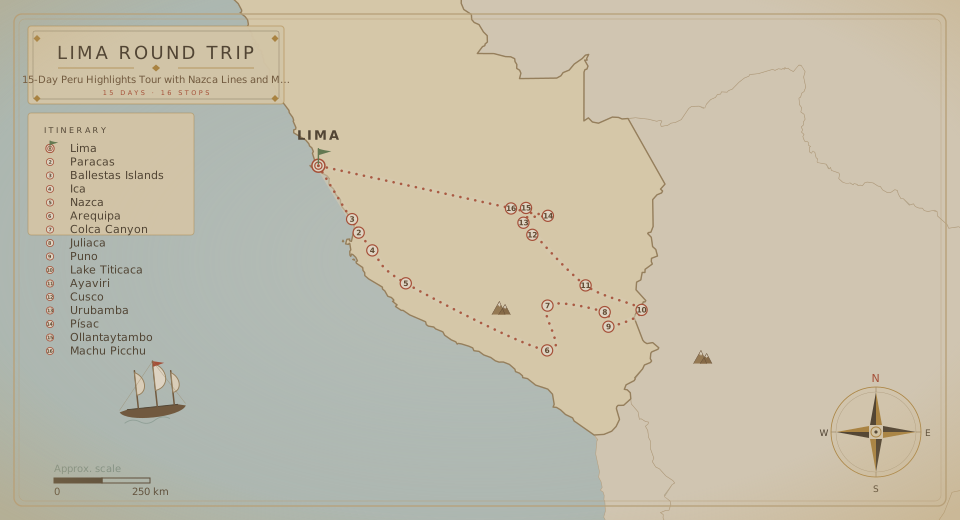
Where this trip takes you
Nazca Lines, Colca Canyon, Machu Picchu, Ballestas Islands
The route
The fine print
In Lima, a sightseeing tour.
In Paracas and Nazca, an excursion to the Ballestas Islands in Paracas and an overflight of the Nazca Lines.
In Arequipa, sightseeing tours and excursions through Arequipa's countryside.
In Colca, everything is included, including excursions and meals.
In Puno, a boating excursion on Lake Titicaca, lunch in Taquile, and a visit to Sillustani.
In Cusco, a sightseeing tour and visits to nearby ruins.
Dinner, including a folklore show.
In the Sacred Valley of the Incas, an excursion to Pisac and Ollantaytambo. Lunch is included.
In Machu Picchu, a guided visit to the Citadel, including lunch.
14 nights of accommodation.
All breakfasts and meals as described in the programme.
All applicable entrance tickets.
All transfers and land transportation.
Train ticket from Ollantaytambo - Aguas Calientes - Ollantaytambo.
Bus ticket from Aguas Calientes - Machu Picchu - Aguas Calientes.
Bus ticket from Lima - Paracas - Nasca - Arequipa - Puno - Cusco.
Airfare from Cusco to Lima.
All applicable taxes.
Daily tours with bilingual guides (English / Spanish), as described in the itinerary.
Axel Tippe tour leader en route from Sacred Valley - Santa Maria - Santa Teresa - Machupicchu - Cusco.
International flights
Baggage excess (Cusco - Puno bus)
Alcoholic drinks, soda, or bottled mineral water
Personal expenses
Tips
International or national personal telephone calls
Meals not mentioned in the itinerary
On the 1st day, no meals are included.
On the 2nd, 3rd, 5th, 8th and 14th days, only breakfast is included.
On the 4th, 7th, 9th, 10th and 13th days, breakfast and lunch are included.
On the 6th and 12th days, breakfast, lunch, and dinner are included.
On the 11th day, breakfast and dinner are included.
Often celebrated for their discoveries in math and science, the Mayans believed caves were a supernatural realm where their ancestors resided, along with the deities of nature such as rain, thunder, and lightning.
The Inca stonework was incredible, so much so that Spanish conquerors often used old Inca structures as foundations for their own buildings. Hatunrumiyoc is a great place to take a closer look at the Incas' skills.
The thermal baths of Santa Teresa differ mainly from the other springs of Peru because of their crystalline waters. These medicinal waters possess properties that help treat cutaneous ulcers, bone pain, and rheumatism. You can also submerge under cold streams from the Uripata lagoons in the thermal baths, which provides a comforting sensation. At the bottom of the pools, there is soft sand, and around the pools, you can contemplate rocks, vegetation, the sound of the river, and the mountain. The thermal baths of Santa Teresa are fully equipped with bathrooms, showers, dressing rooms, soccer fields, space for camping, a cafeteria, a kiosk for food and beverage supplies, and a viewpoint. It also has a hydromassage system.
The number of daily visitors allowed to enter Huayna Picchu is restricted to 200. It is a mountain in Peru around which the Urubamba River bends. It rises over Machupicchu, the so-called Lost City of the Incas, and divides it into sections. The Incas built a trail up the side of Huayna Picchu and built temples and terraces on its top.
The peak of Huayna Picchu is about 2,720 meters (8,920 ft) above sea level, or about 360 meters (1,180 ft) higher than Machu Picchu. According to local guides, the top of the mountain was the residence of the high priest and the local virgins. Before sunrise, the high priest and a small group would walk to Machu Picchu to signal the coming of the new day.
The Sun Gates of Machu Picchu boast a picture-perfect vantage point overlooking Peru's most famous ruins. Tourists flock to this outcrop high in the Andes Mountains to enjoy the same view featured on virtually every postcard depicting the Machu Picchu citadel. Also known as Inti Punku, the Sun Gates consist of two stones perched at the narrow passage in the mountain's crevice, just above Machu Picchu. The sunshine rises brilliantly through this portal each day.
Logistics
Your 15 days finish where they began, in Lima.
Watch the film
Create your own adventure
Say goodbye to travel stress.
Starting from
When
Travellers
Total
—