Tanzania · Trekking

14-Day Mount Kilimanjaro Climb and Tanzania Safari via Rongai

14 Days Round trip from Uhuru Peak Challenging pace

The journey

Trip highlights
  • 01 Ascend Mount Kilimanjaro via the less-traveled Rongai route through varied landscapes
  • 02 Reach Uhuru Peak, the highest point in Africa, for a spectacular sunrise over ice fields
  • 03 Explore Tarangire National Park, known for its elephants, baobab trees, and rich birdlife
  • 04 Spend two game-viewing days in the Serengeti, one of Tanzania's oldest and largest national parks
  • 05 Descend into the Ngorongoro Crater, home to black rhino, large herds, and resident predators

Embark on a 14-day adventure that combines an exhilarating Mount Kilimanjaro climb with a breathtaking wildlife safari in Tanzania. Begin in Moshi before ascending Kilimanjaro via the Rongai route, trekking through misty forest, moorland, alpine desert, and up to Uhuru Peak, the highest point in Africa. After your summit and descent, enjoy a rest day in Moshi before setting out on a 5-day safari through Tarangire National Park, Serengeti National Park, and the Ngorongoro Crater. This journey blends high-altitude achievement with outstanding game viewing, birdlife, and some of Tanzania's most iconic landscapes.

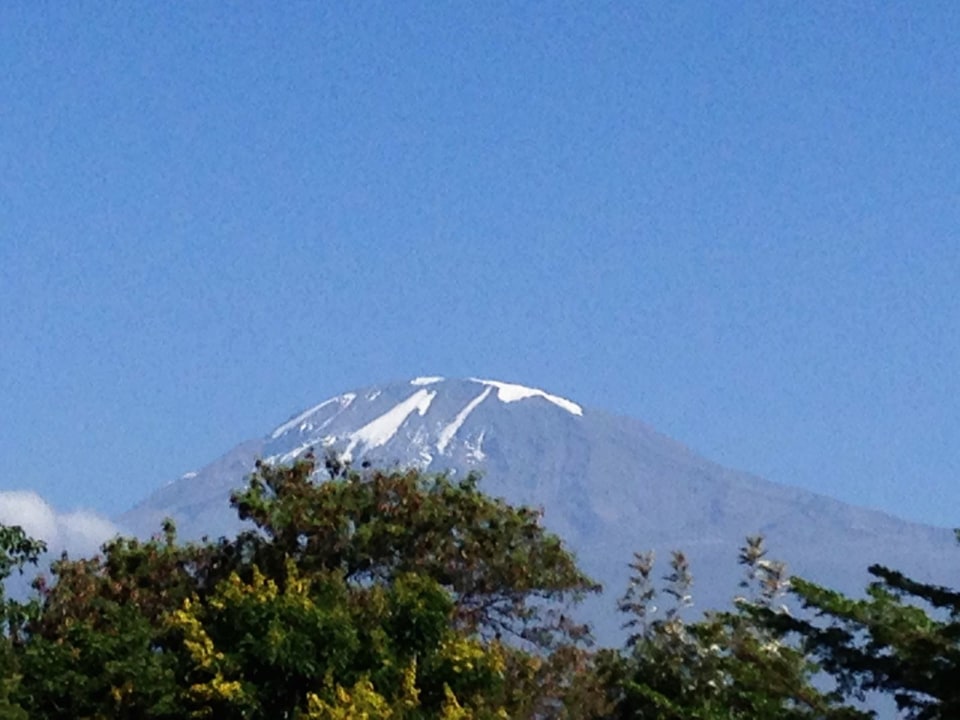
Once there, all your hard work will feel more than worth it as you are rewarded with a spectacular sunrise over ice fields and the Mawenzi peaks.

From the itinerary

At a glance

What this trip includes

Duration 14 Days
Tour type Shared
Activity level Challenging
Accommodation Included · Budget
Transport Included
Wheelchair access Not applicable
Cities Moshi, Mount Kilimanjaro, Serengeti National Park, Ngorongoro Conservation Area, Lake Manyara, Tarangire National Park, Marangu
Languages English, Swahili

Day by day

The itinerary

1
Day 01

Airport Pickup and Transfer to Moshi

  • Airport pick up and transfer to your hotel in Moshi.

Overnight accommodation in Moshi, including breakfast.

2
Day 02

Rongai Gate and Nalemoru to Simba Camp

Time: 3-4hrs / Distance: 6.5km / Altitude Gain: 700m

  • Pick up from your hotel and drive to Marangu Gate. On reaching Marangu Gate (1843m), complete park registration and continue driving to Nalemoru Gate (1950m), where you will meet your crew and begin your 6-day ascent of Mount Kilimanjaro.
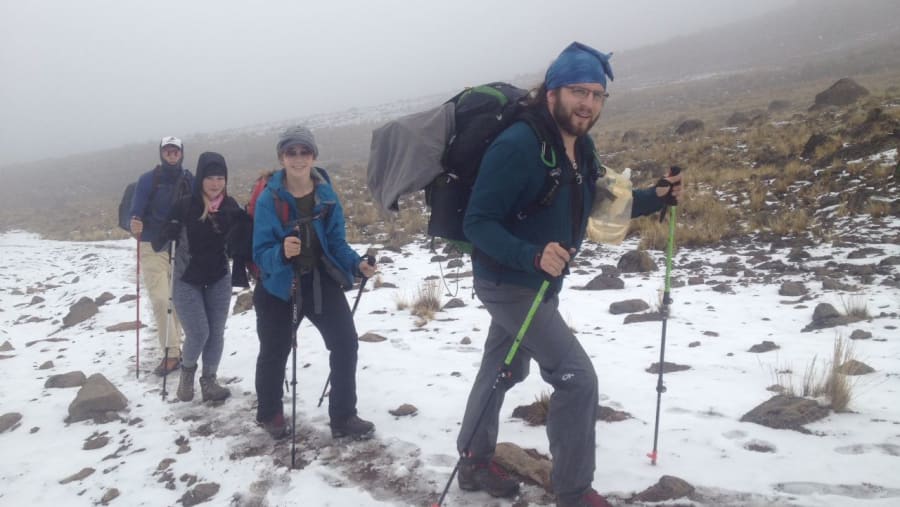
  • Enjoy a hot lunch at Nalemoru Gate. You will then start the trek along a winding path crossing maize fields before entering a dense, mist-covered forest area where blue monkeys, black-and-white colobus monkeys, and bush babies can be spotted.
  • The trek takes about 3-4 hours to reach Simba Camp (2650m), where you will spend the night.
3
Day 03

Simba Camp to Kikelewa Caves

Time: 6-7hrs / Distance: 9km / Altitude gain: 950m

  • After breakfast, the trek continues up towards Kibo, passing Second Cave for a stop and a hot lunch, then continuing on to Kikelewa Caves Camp (3600m) through a more open landscape of short moorland and heather vegetation.
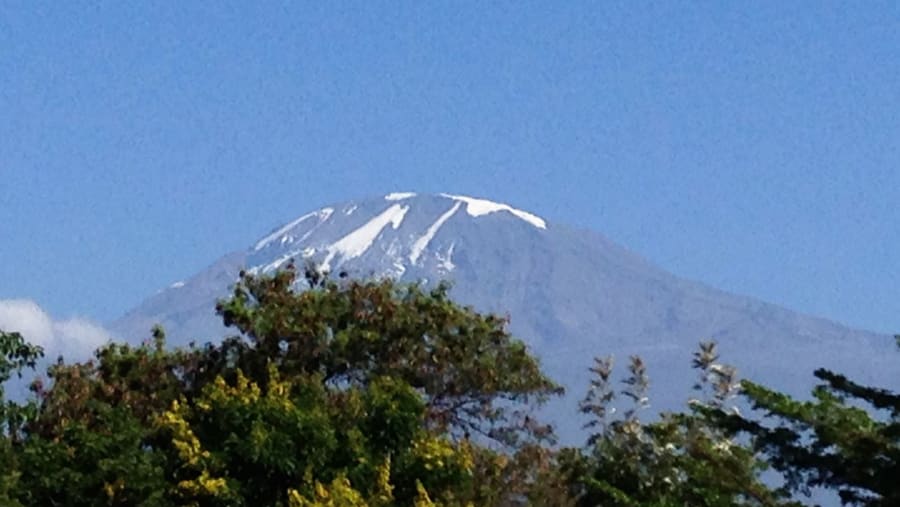
  • There will be better chances of seeing Kibo Peak, the summit peak. If you are lucky, you may also spot jackals and sometimes buffaloes. You will spend the night at Kikelewa Cave.
4
Day 04

Kikelewa Caves to Mawenzi Tarn

Time: 3-4hrs / Distance: 6km / Altitude gain: 370m

  • After breakfast, begin the trek to Mawenzi Tarn Hut at 4,330m.
  • A short incline through grassy slopes leads to a tangible sense of wilderness. You will leave the short vegetation behind and enter a low desert area before reaching your camp at Mawenzi Tarn Hut, where you will have a hot lunch and spend the rest of the day resting, or you may take a short excursion for acclimatization.
  • This is approximately a 3- to 4-hour trek covering a distance of 6km.
5
Day 05

Mawenzi Tarn to Kibo Hut

Time: 4-5hrs / Distance: 9km / Altitude Gain: 370m

  • The route becomes gradually steeper and rockier as you leave Mawenzi Tarn Hut.
  • You will head up through a stark landscape to 'The Saddle' - the broad lava-stone ridge - between Mawenzi and Kibo. Stunning views of the upper reaches of Kilimanjaro can be seen before arriving at Kibo Hut (4703m), where you will have a hot meal in the afternoon, enjoy a relaxing evening, and go to bed early so you are well rested to start hiking at midnight for your final ascent to the summit.
6
Day 06

Summit Day to Uhuru Peak and Descent to Horombo Hut

Time: 6-8hrs ascent, 5-6hrs descent / Distance: 5km ascent, 15km descent / Altitude Gain: 1195m, Altitude loss: 2195m

  • Setting off at midnight for the summit, this is the longest and most demanding day of the entire trek. The trail follows a long scree slope past Hans Meyer Cave and then turns into a single-file zigzag.
  • A short rocky path requiring some scrambling leads to Gillman's Point, situated on the crater rim at 5685m. This part of the hike is very steep and is the most challenging section of the route.
  • Once you reach Gillman's Point, it is another two hours to Uhuru Peak (5895m), the highest point in Africa.
  • Once there, all your hard work will feel more than worth it as you are rewarded with a spectacular sunrise over ice fields and the Mawenzi peaks.
  • We will spend a short time at Uhuru Peak before starting the descent to Kibo Hut for a break and a short rest. We will then continue to Horombo Hut for your last night on Kilimanjaro and a very well-earned sleep.
7
Day 07

Horombo Hut to Marangu Gate

Time: 5-6hrs / Distance: 20km / Altitude loss: 1900m

  • After breakfast, descend to Marangu Gate, retracing your steps past Mandara Hut, back through the magnificent rainforest, and finally reaching Marangu Gate.
  • Once at the gate, you will receive your summit certificates, enjoy a short celebration with your porters, and be driven back to your hotel, where you can have a hot shower, rest, and maybe even enjoy a Kilimanjaro beer or two.

Overnight accommodation in Moshi, including breakfast.

8
Day 08

Rest Day in Moshi

  • Today your driver-guide will give you a briefing on what to expect during your following 5-day safari.
  • You will also have a walking tour of Moshi and get to learn more about the local traditions and culture.

Overnight accommodation in Moshi, including breakfast.
9
Day 09

Moshi to Tarangire National Park

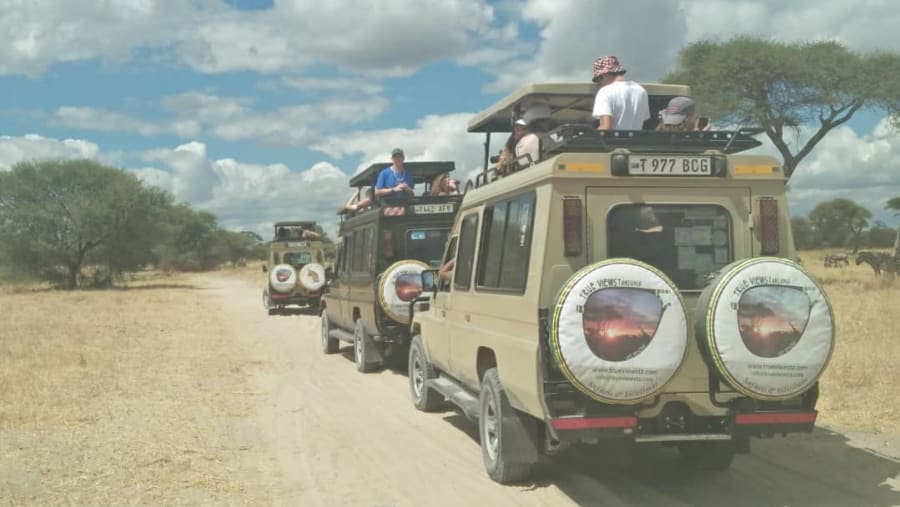
  • Early in the morning, drive from Moshi to Tarangire National Park, a journey of approximately 4 hours. Once at the gate, you will register and begin your mid-morning game drive. Tarangire National Park contains a range of different habitats, from grasslands and woods to low hills, scrub, and swampland in the south.
  • Tarangire lies southeast of Lake Manyara and is well known as the home of elephants, where it is not unusual to hear of hundreds of sightings in a day. It is also home to the mystical baobab trees, the elephants' favorite food. Other wildlife includes waterbucks, impalas, wildebeest, zebra, and buffalo.
  • The predators most commonly spotted here are lions and hyenas.
  • You will also see the stunning birds of East Africa, from the Fire Finch to the African Fish Eagle. The Tarangire River cuts through the park and connects to Lake Burunge in the west; it is the key to life in the dry season, when much of the migration congregates here.
  • We will stop at one of the many viewpoints in the park for a picnic lunch, then continue with an afternoon game drive.

Overnight and dinner at Haven Nature Campsite - camping.

10
Day 10

Tarangire to Serengeti National Park

  • After breakfast at the lodge, drive through the Ngorongoro Conservation Area towards the Serengeti plains, a journey of approximately 4-5 hours. As you transit through the Ngorongoro Conservation Area, the opportunities for game viewing are endless.
  • The Serengeti is one of Tanzania's oldest and largest national parks, covering an area of 14,763 square kilometres. The park is a World Heritage Site, with the earth's largest concentration of plains game - mainly wildebeest and zebra - which are especially abundant during the annual migration.
  • The population of plains game also includes buffalo, giraffe, and warthog, as well as a wide range of antelopes including Thomson's and Grant's gazelle, dik-dik, bushbuck, eland, and impala.
  • Apart from Ngorongoro, the Serengeti is one of the best places to see predators in action. Predators here include large clans of hyenas, lion prides, cheetahs, and the hardest to spot, leopards.
  • We will have a picnic lunch in the park before an afternoon game drive and then head to the lodge.

Overnight and dinner at Nyani Campsite - camping.

11
Day 11

Full-Day Game Drive in the Serengeti

  • After an early breakfast, begin a full day's game viewing in the north of the Serengeti. This is the best time to enjoy excellent wildlife viewing, as the animals wake and head out into the day.
  • In addition to the wildlife already mentioned, you may be lucky enough to see other scavengers, including jackals and vultures. There are also some 520 bird species to be spotted, including storks, ostriches, and many more.
  • We will enjoy a picnic lunch and continue with a full afternoon and early evening game drive.

Overnight and dinner at Nyani Campsite - camping.

12
Day 12

Serengeti to Ngorongoro Crater Rim

  • After an early breakfast, we will enjoy an early morning game drive. This is the best time to get excellent views of the animals as they wake and head out into the day.
  • In addition to the wildlife mentioned above, you may be lucky enough to see other scavengers, including jackals and vultures. There are also some 520 bird species to be spotted, including storks, ostriches, and many more.
  • After the morning game drive, leave the Serengeti and head back through the Ngorongoro Conservation Area towards the crater.
  • You will have plenty of opportunity for further game viewing en route.

Overnight and dinner at Simba Campsite - camping.

13
Day 13

Ngorongoro Crater and Return to Moshi

  • We will have breakfast at the lodge before descending into the 600-meter-deep crater. The crater has a 19-kilometre diameter, making it one of the world's largest unbroken and unflooded calderas.
  • The park covers approximately 300 square kilometres, where the landscape ranges from lush rainforest on the rim to bush savanna and acacia woodland.
  • Ngorongoro is home to the highly endangered black rhino and the largest herds of wildebeest, zebra, and buffalo.
  • Predators also live in the crater, and there is plenty of opportunity to spot a hunt. The predators found here include lions, hyenas, cheetahs, jackals, and serval cats.
  • We will enjoy a picnic lunch before leaving the crater, where plenty of wildlife can still be spotted. In the late afternoon, we will begin the drive back to Moshi.

Overnight accommodation in Moshi, including breakfast.

14
Day 14

Hotel Pickup in Moshi and Airport Transfer

  • Pick up from your hotel in Moshi and transfer to the airport for your departure flight.
Uhuru Peak, Mawenzi Tarn, Serengeti National Park, Tarangire National Park

Where this trip takes you

Uhuru Peak, Mawenzi Tarn, Serengeti National Park, Tarangire National Park

The route
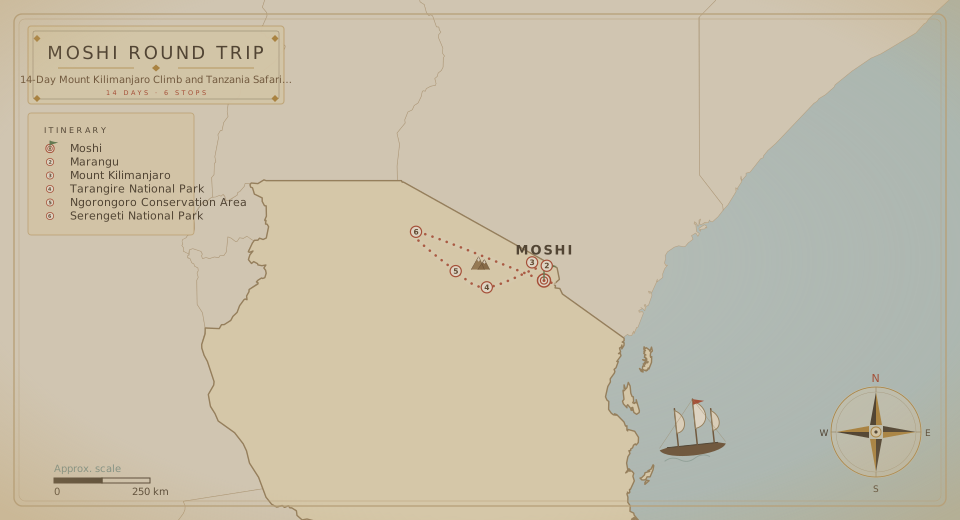
Where you'll travel

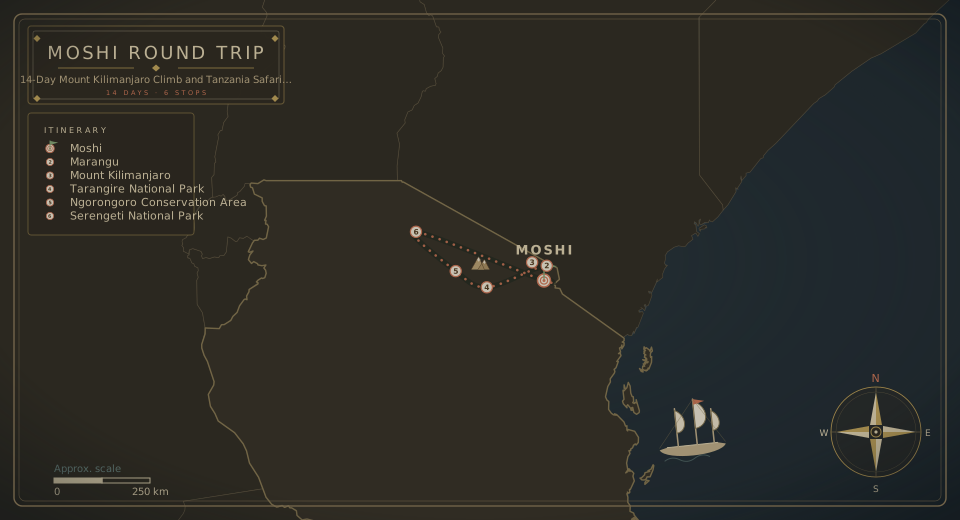
Tour route map
Round trip from Uhuru Peak 7 cities · 14 Days

The fine print

Trip details

What's Included

  • All National Park entry fees
  • Park rescue fees
  • Accommodation in Moshi before and after the Kilimanjaro trek - 3 nights
  • Camping accommodation on Mount Kilimanjaro, including camping equipment
  • Transport to and from the Kilimanjaro gate
  • All meals on Mount Kilimanjaro
  • Professional driver/guide (fluent in English), assistant guide, cook, and porters
  • All activities as specified in the itinerary
  • Pick up from and drop off at your accommodation in Moshi
  • Airport pick up on arrival day and airport drop-off at Kilimanjaro Airport

What's Not Included

  • Tips
  • Additional beverages/drinks
  • Items of a personal nature, such as toiletries
  • Personal travel insurance and evacuation fees
  • Visas

What to bring

  • Warm sleeping bag
  • Scarf
  • Camera
  • Warm gloves
  • Camel bag/water bottle
  • Thermal underwear
  • Head torch with extra batteries
  • Warm windproof jacket with hood
  • Walking poles
  • Waterproof jacket and over-trousers
  • Sunglasses
  • Warm sweater
  • Sun tan lotion and lip balm
  • Down jacket (for summit)
  • Day bag/rucksack
  • T-shirts for daily wear
  • Wash kit and towel
  • Trekking trousers for daily wear
  • Leggings (2 pairs)
  • Shorts (minimum 2 pairs)
  • Socks (at least 6 pairs)
  • Warm sleeping clothing
  • Comfortable trekking boots
  • Trainers
  • Gaiters

Know before you go

There are two distinct trekking seasons which constitute the best time to climb Kilimanjaro.

  • They are January-March and June-October.
  • January-March is generally colder than June-October, and there is a higher probability of encountering snow on the summit. For some, this might be seen as a negative, but the benefit of a January-March trek is that the slopes are often quieter at this time of year.
  • The June-October trekking season coincides with the summer holidays in Europe and North America, and hence certain routes are often quite busy.
  • March, April, and November are the wettest months on Kilimanjaro and are not ideal for trekking.
  • Snowfall and cold temperatures are common during December-May.

Logistics

Meeting & route

Meeting point
Uhuru Peak, Tanzania
Tour start
Uhuru Peak, Tanzania
Tour ends at the same location as the start point.
End of the journey

Your 14 days finish where they began, in Uhuru Peak.

Watch the tourHQ film Watch the film

Create your own adventure

Can't find the perfect tour? Tailor your dream trip.

  • Tell us your destination, dates and group size.
  • Our travel experts and local guides design a tailored itinerary, just for you.
  • Enjoy your trip with peace of mind, knowing everything is taken care of.
Plan my holiday

Say goodbye to travel stress.

Starting from

USD 3,330 /person
Book This Tour

Estimated room rates

Single Room $3,330.00 — $3,430.00
Double Sharing $3,330.00 — $3,430.00

When

Travellers

Total