Kathmandu Heritage and Sacred Sites Tour
At 8:30 a.m. or 9 a.m., take a short drive to Kathmandu Durbar Square for an hour-long tour.
In the morning, at approximately 8:30 a.m. and no later than 9 a.m., depart from the hotel for a short drive into the heart of Kathmandu city, followed by a short walk to Kathmandu Durbar Square.
Kathmandu Durbar Square, or the Palace Courtyard, is filled with historical and religious ancient beautiful pagoda-style monuments. This exciting area is listed as a UNESCO World Heritage Site, although some of the buildings were destroyed during the 2015 earthquake. However, renovation is taking place.
The tour takes you to the following interesting places: the Residence of the Living Goddess (Kumari Ghar), known as the Temple of Kumari, and the beautiful quadrangle courtyard with a Buddhist stupa in the center.
The residential quarters are located above the courtyard, where the chaste virgin Living Goddess called Kumari resides, with magnificent carved wooden balconies and window screens on this traditional building.
The young Living Goddess, or Kumari, gives audience and blesses you from her beautifully decorated windows.
Tour Hanuman Dhoka, the historic seat of past royals, the old Royal Palace Complex dedicated to the Malla and late Shah monarchs, designated as a World Heritage Site.
The ancient temples and palaces epitomize the religious and cultural lifestyle of the Nepalese. Enjoy views of Taleju Temple, built by late King Mahindra Malla in 1549 A.D.
Observe the Great Bell and Big Drums. The main golden gate is guarded by the Monkey-God called Hanuman, a faithful devotee of Lord Ram Chandra, the hero of the epic 'Ramayana.'
The tour also takes you to a unique temple built from the wood of a single tree and thus known as Kasthamandap, from which the name Kathmandu is derived. It is also known as Maru Satal and was built in 1596 A.D. by King Laxmi Narsingh Malla.
At 9:30 a.m. or 10 a.m., drive to Bouddhanath Stupa for an hour-long tour.
After a wonderful tour of old Durbar Square, walk to the car park and drive east from the city to reach the beautiful complex of the huge Bouddhanath Stupa.
It is listed as a World Heritage Site and is also the largest Buddhist shrine and stupa in South Asia.
For Buddhists, it is called a Chorten, which was built in the 6th century A.D. by King Man Deb. Perched on three-tiered terraces, when seen from above or from a bird's-eye view, it takes the shape of a lotus flower.
A sacred monument for Buddhist followers, this huge stupa is encircled by prayer wheels and a colorful market. It is also known as Little Tibet due to the local people of Tibetan origin who live around the area and share a similar culture.
Most interesting are Lord Buddha's eyes on the four cardinal directions, giving a vivid gaze in all directions, while the surrounding area is home to many monasteries of the Mahayana Buddhist faith.
At 12:30 p.m. or 1 p.m., enjoy a lunch break at a nice restaurant around Bouddhanath.
After a pleasant and interesting time, the guide will take you to a nice restaurant within the Bouddhanath complex, where you can enjoy lunch with the backdrop of Bouddhanath Stupa.
At 1 p.m. or 1:30 p.m., take a short drive to Pashupatinath Temple for a visit of less than an hour.
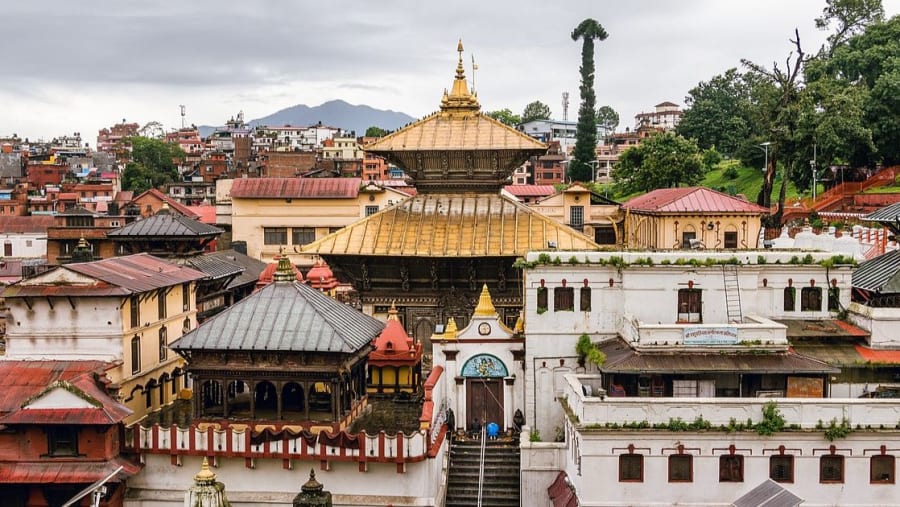
From Bouddhanath, a short drive brings you to the holy Hindu temple of Pashupatinath, a marvelous three-tier golden pagoda rooftop temple dedicated to Lord Shiva.
Non-Hindus are not allowed to enter the main temple premises; however, the guide will take you to a nice spot where you can catch a view of the temple and the religious activities of pilgrims and devotees on the opposite side of the Bagmati River.
The temple is flooded with pilgrims on the day of 'Shiva-Ratri' (the birth anniversary of Lord Shiva).
At 1:30 p.m. or 2 p.m., drive to Buddhanilkantha and visit the temple.
After an interesting time at the Pashupatinath temple area, drive north to the edge of the Kathmandu Valley rim to reach Buddhanilkantha, also called Narayanthan.
This magnificent Hindu temple is dedicated to Lord Vishnu, or Narayan, where you can witness Lord Vishnu lying on a bed of serpents in the middle of a pious pool, seeming to float on the water.
The surrounding pond represents the sea. According to belief, this beautiful sleeping statue of Lord Vishnu was built in the 5th century A.D. The late and past kings of Nepal were not allowed to visit this place for particular and unknown reasons.
Hence, to please the kings and royals, a replica of the sleeping Vishnu was built in Balaju Water Garden for the monarch.
At 2:30 p.m. or 3 p.m., the tour ends and you drive back to the hotel.
After enjoying the peaceful and tranquil environment and the great beautiful statue of Lord Vishnu lying on a bed of serpents, return to the car park for a short drive back to your hotel after a lovely and exciting Kathmandu city day tour experience.