Nepal · Trekking

18-Day Manaslu Circuit Trek through Villages and Larke-La Pass

18 Days Round trip from Kathmandu 44600 Hard pace

The journey

Trip highlights
  • 01 Immerse yourself in the rugged, pristine views of Mount Manaslu
  • 02 Experience the cultures, traditions, and lifestyles of Gurungs, Magars, Tamangs, and Tibetans
  • 03 Cross Larkya La Pass for a challenging yet rewarding high-altitude trek
  • 04 Walk through the Manaslu Conservation Area
  • 05 Explore Lho-Gaon with close views of Manaslu and a visit to the local monastery
  • 06 Reach Sama-Gaon, the largest village in the region, for acclimatization
  • 07 Trek to Samdo and experience life in a high-altitude village
  • 08 Climb to Dharamsala before crossing the challenging Larke-La Pass

Trek the Manaslu Circuit through remote mountain villages, Buddhist settlements, and dramatic Himalayan landscapes, from Macha-Khola and Jagat to Sama-Gaon, Samdo, and Dharamsala. This journey combines rich local culture with changing terrain, from cultivated fields and hot springs to alpine woodland, glacier-fed valleys, and high mountain passes. Along the way, enjoy close views of Mt. Manaslu, visit monasteries and traditional villages, and acclimatize in the largest settlement of the Manaslu Valley. The adventure culminates in the challenging crossing of Larke-La Pass before descending through beautiful forested trails to Dharapani and returning to Kathmandu.

Trek the Manaslu Circuit through remote mountain villages, Buddhist settlements, and dramatic Himalayan landscapes, from Macha-Khola and Jagat to Sama-Gaon, Samdo, and Dharamsala.

From the itinerary

At a glance

What this trip includes

Duration 18 Days
Tour type Private
Activity level Hard
Accommodation Included · Standard
Transport Included
Wheelchair access No
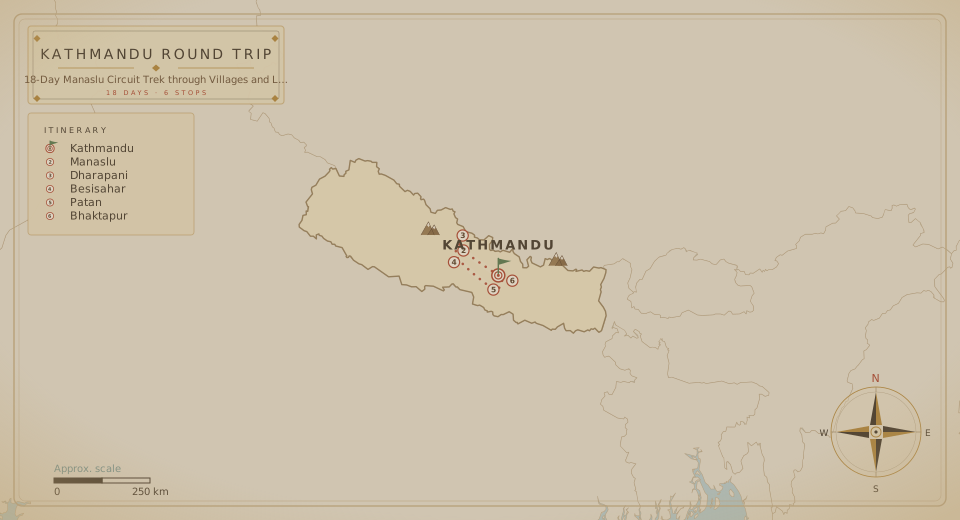
Cities Kathmandu, Manaslu, Bhaktapur, Patan, Besisahar, Dharapani
Languages English

Day by day

The itinerary

1
Day 01

Arrival in Kathmandu and Hotel Transfer

  • Upon your arrival at Tribhuvan International Airport, you will be escorted to your hotel by All Nepal Excursion's staff and guides.
  • After checking into your room and getting refreshed, join the briefing session provided by our guide or leader.
  • In the evening, enjoy a group dinner at a nice authentic Nepalese restaurant with a live cultural program to entertain you during dinner.
2
Day 02

Drive from Kathmandu to Macha-Khola

  • Early in the morning, depart from the hotel by 6 a.m. and catch a bus or jeep from Gongabu to Macha Khola. Enjoy an exciting drive toward Nepal's Mid-West, reaching the Gorkha district and heading past warm lowland farm villages and towns to Arughat Bazaar.
  • From here, another short drive takes you to your overnight stop in Macha-Khola village.
3
Day 03

Trek to Doban via Tatopani Hot Spring

  • From here onward, the trail leads into interesting farm villages and cultivated fields as the vegetation slowly changes with the gain in altitude. The morning walk takes you over a stream from which Machha Khola, or Fish Stream, gets its name, and the route continues upstream to Khola-Bensi village and Tatopani, a place with natural hot springs.
  • The walk continues as the valley turns narrow and steep, and the trail reaches a suspension bridge. After a short walk through a patch of forest, you arrive at Dovan, located on the high shelf of the Burigandaki River.
4
Day 04

Trek to Jagat

  • In the morning, walk toward a broad gravel field and cross the Lauri stream over a suspension bridge. The trail climbs to a high ridge and then descends into the valley of Yara Khola, continuing for another hour to reach Jagat.
  • Jagat is a nice-looking farm village of moderate size after Arughat. The people here are of mixed communities, including Magar, Chettries, Brahman, Manaslu Bhotia (Tibetan-looking tribes), and some Newar lodge owners and shopkeepers.
5
Day 05

Trek to Dyang via Philim

  • After Jagat, the walk descends toward the riverside and then climbs toward the terraced hillsides of Saguleri, facing views of Sringi Himal. The trail continues with ups and downs to a bridge over the Buri-Gandaki.
  • After crossing, the path winds up to Philim village, where you stop for a short break in this nice farm village with lovely cultivated fields and terraces.
  • After a refreshing stop, head higher through terraces of golden wheat and barley fields to a rocky ridge top covered with bamboo forest toward a place called Eklai Bhatti.
  • After a rest, continue toward the higher Manaslu area as the route diverts northwest to reach your overnight stop at Dyang, a small nice village with stronger Tibetan culture.
6
Day 06

Trek to Bihe Phedi

  • In the morning, walk around farm villages where the houses and terrain begin to reflect strong Tibetan culture and the Buddhist religion. After a few hours, the trail leads to Bihe, a small village for an overnight stop, where the people are more of Tibetan origin and follow ancient Buddhist culture.
  • Villagers raise buckwheat, wheat, barley, and potatoes as staple crops. Since trekking has become popular around the area, spinach, carrots, and cabbages are also grown.
7
Day 07

Trek to Namrung

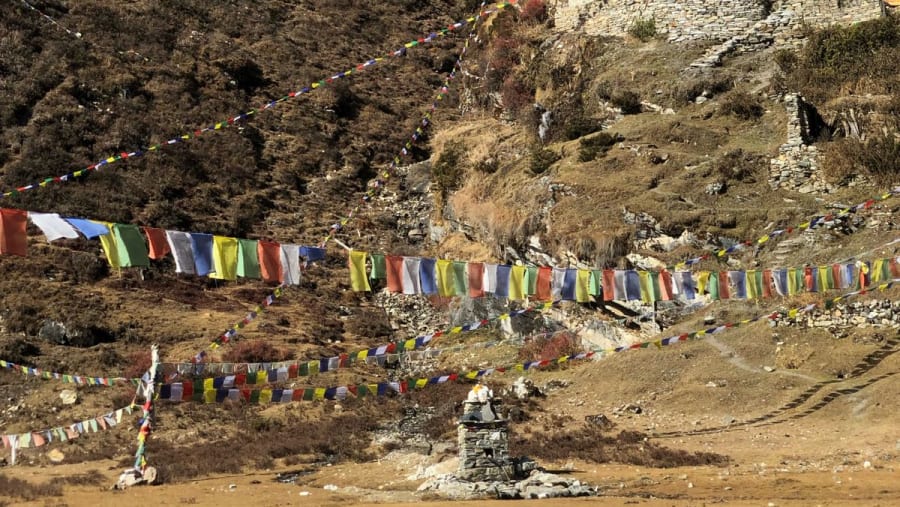
  • From here, the air gets cooler as the walk continues for a few hours through a steep-sided scenic valley. Along the way, you come across Mani prayer stone walls, and the trail leads to Ghap for a possible lunch stop.
  • After Ghap, the altitude increases as the route heads into alpine woodland, where the path meanders into a steep climb. The valley opens up with extensive pastures, and you cross a large stream flowing from the glacier of Lidana.
  • Walk facing views of Manaslu, locally known as Kutang Himal, along with Pang Phuchin 6,335 m, Saula Himal 6,235 m, and many unnamed peaks above 6,000 m.
  • From here, the walk continues uphill past farm villages to reach Namrung for an overnight stop. The village is also called Sho Namrung.
8
Day 08

Trek to Lho-Gaon

  • After spending the night at Namrung, continue walking through farm fields and yak herders' huts as the route leads into a high and scenic valley all the way to Lho Gaon, a nice village for an overnight stop.
  • An attractive village of the Manaslu region, Lho offers close views of Manaslu's towering north face. Around Lho, visit its monastery with numerous chhorten and Mani walls, along with views of Ganesh Himal toward the east.
9
Day 09

Trek to Sama-Gaon

Enjoying time at Lho-Gaon, the morning walk from here is much easier, with a slow and gradual climb and constant mountain views with Peak 29 ahead. After a few hours of uphill walking, reach a small forest at Shala village facing views of Phungi, Manaslu, and Himal Chuli, and then continue for a few more hours to end the day at Sama-Gaon village, with views of Mt. Manaslu.

Sama-Gaon is the largest village in the Manaslu Valley, where locals are mostly farmers cultivating buckwheat and barley, the main crops in this high and harsh terrain. Potatoes and some high-altitude vegetables are also grown. Villagers around the high Manaslu Valley descended from southwest Tibet more than 400 years ago, and their customs and culture preserve an ancient Buddhist heritage similar to their Tibetan origins.

The local villagers are still active in trade and bartering across the border with Tibet, taking a few days to reach the frontier of Nepal and Tibet. In fact, the village lies on the old Trans-Himalayan Salt Trade route between the two countries.

10
Day 10

Acclimatization Day at Sama-Gaon

  • Today is a free day for acclimatization before the climb to high Manaslu Base Camp. With time for a short hike around Sama-Gaon, see houses adorned with Tibetan heritage, enjoy views of the peaks, and visit the old monastery.
11
Day 11

Trek to Samdo

  • After Sama-Gaon, enjoy a pleasant morning walk of a few hours to reach the last village of the Manaslu Valley. The trail starts with a slow climb, allowing time for a short break to enjoy the surrounding wonderful views of peaks and dramatic terrain.
  • As the walk continues, it finally ends at Samdo village with a short climb to a small flat plateau where the village is located. This moderate-sized village has more than forty houses and about two hundred villagers living in this high, harsh country.
12
Day 12

Trek to Dharamsala or Larke Base

  • Leaving the last village of the Manaslu Valley and the higher areas of Gorkha district, the walk leads toward the end of the valley, facing views of snow-capped peaks, including Mt. Manaslu.
  • The walk continues across icy streams to reach Larke Phedi at the bottom of the pass, also known as Dharmasala, meaning 'travelers rest house/shade'.
  • At Larke Phedi, the afternoon is free for short walks and preparations for the next early morning's long climb and descent across the high Larke-La Pass into the Manang area.
13
Day 13

Cross Larke-La Pass and Descend to Bhimthang

  • After an overnight stay at Larke Phedi, start early in the morning as the climb leads up steep slopes past a few huts of Dharmasala. Walk over moraine made up of rocks and boulders, which can be especially arduous in snowy conditions when finding the right path is more difficult.
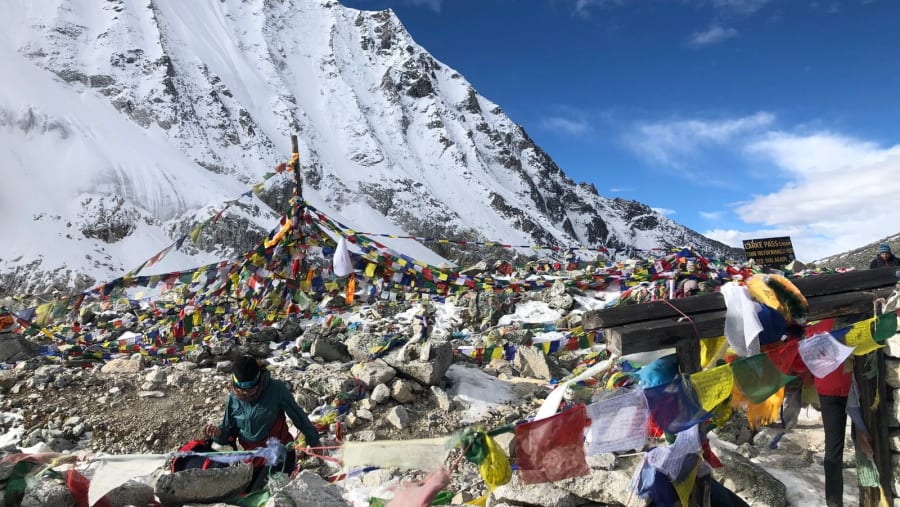
  • The climb continues across the ablation area of the Larke North Glacier, facing views of Cho Danda and Larke Peak, before reaching the top of Larke-La, festooned with thousands of colorful Buddhist prayer flags.
  • From the top, enjoy a panorama of Himlung, Cheo Himal, Kang Guru, Annapurna II, and a series of Manaslu peaks.
  • After enjoying the breathtaking views, make a long descent back into green vegetation and tree lines after passing the small place of Larcia. Continue on a moraine ridge to Tambuche at 3,900 m, at the bottom of the pass, and then take a short walk to Bhimthang for the overnight stay.
  • Bhimthang is a magnificent place located on a wide green valley with a number of lodges adorned with Mani prayer walls, surrounded by tall green trees of rhododendron, pine, and oak.
14
Day 14

Trek to Goha

  • From Bhimthang, the rest of the journey becomes easier, with downhill walks and short climbs on the route to Goha and Dharapani villages. In the morning, enjoy views of the peaks as you head toward alpine woodland.
  • Walk through beautiful forested areas to reach a small clearing in the midst of woodland at Goha for an overnight stop within a small cattle and yak herders' summer pasture and temporary settlement.
  • The walk follows a downhill trail through the forest to reach the nice village of Tilje, a pleasant place by the raging Marysangdi River.
15
Day 15

Trek to Dharapani Village

  • In the morning, continue toward the end of your marvelous walk. After crossing a suspension bridge, make a short steep climb to reach the large and lovely village of Dharapani, located at the junction of the famous Annapurna Circuit trail and the Around Manaslu trekking route.
  • Dharapani lies on a river gorge with lovely tree lines, and a motorable road has been constructed here over the past few years. The village provides excellent lodges for an overnight stop.
16
Day 16

Drive Back to Kathmandu

  • After breakfast at Dharapani, depart for Kathmandu on a jeep ride of 5-6 hours on an interesting and exciting journey, following the route past the large town of Besisahar. From Besisahar, continue by shared jeep or bus transportation to Kathmandu.
  • As the drive continues, the road winds up to the top spot on the outskirts of Kathmandu Valley and the city. A short drive from there brings you to your hotel, with the afternoon free for individual activities and shopping.
17
Day 17

Leisure Day in Kathmandu

  • Enjoy a free day at leisure in Kathmandu, where you may join an exciting tour around interesting places and visit the World Heritage Sites of Kathmandu, Patan, and Bhaktapur.
18
Day 18

International Departure

  • On your last day in the land of the world's highest mountains and exciting cultures, depart from the hotel according to your international flight time. All Nepal Treks staff and guide will transfer you to the airport, concluding your grand experience and adventure on the Around Manaslu Trek.
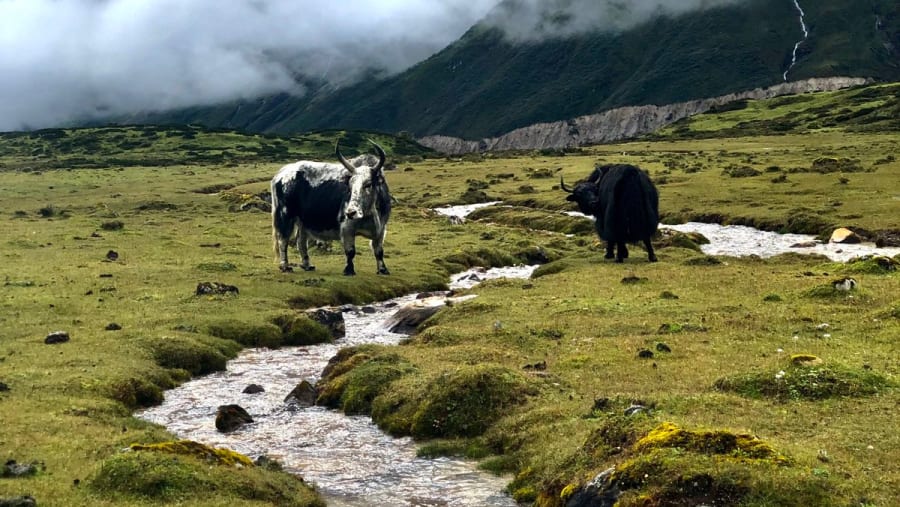
Lho-Gaon, Sama-Gaon, Larke-La Pass, Mt. Manaslu

Where this trip takes you

Lho-Gaon, Sama-Gaon, Larke-La Pass, Mt. Manaslu

The route

Where you'll travel

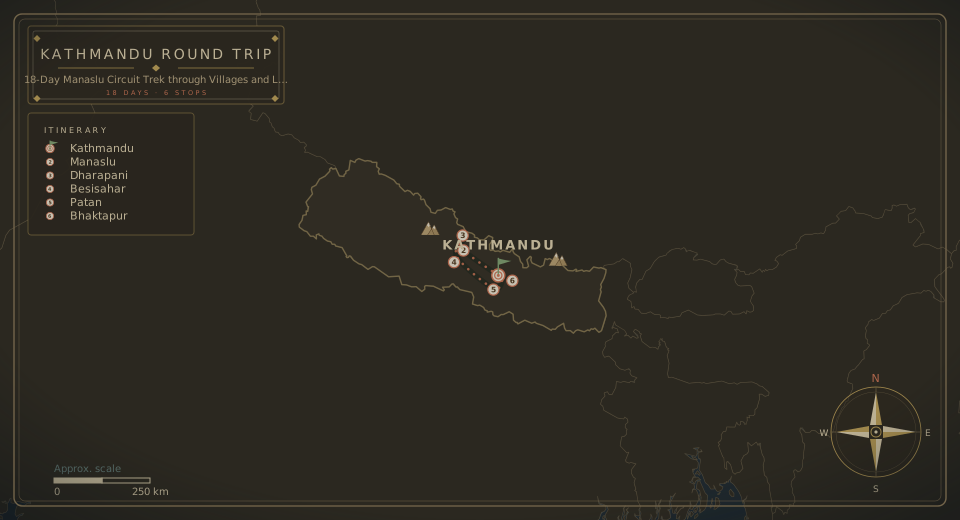
Tour route map
Round trip from Kathmandu 44600 6 cities · 18 Days

The fine print

Trip details

What's Included

  • All arrival and departure transfers from the airport to the hotel and vice versa
  • Full-day sightseeing tours in Kathmandu by private vehicle
  • 3-star standard hotel in Kathmandu on a bed and breakfast basis (unless booked for a single room supplement)
  • Twin-sharing accommodation in the best available lodge on the trek on a full-board basis with breakfast, lunch, and dinner
  • Shared bus transportation from Kathmandu to Soti Khola and bus transportation from Dharapani to Kathmandu
  • Applicable trekking and national park or conservation permit fees
  • Group briefing and orientation program on the do's and don'ts of the trip
  • International air ticket reconfirmation
  • Basic first aid and medical kits
  • Experienced English-speaking skilled guide

What's Not Included

  • Entrance fees for sightseeing places
  • Lunch and dinner during your stay in Kathmandu
  • International airfare and Nepal entry visa
  • Personal travel and medical insurance
  • Expenses of a personal nature, gratuity, and airport tax
  • Personal trekking gear and equipment, including down or duvet jackets and sleeping bags
  • Emergency evacuation by any means of transportation and personal medical kit
  • If you return early from the trip or break up the journey due to personal or medical reasons, you must bear the extra expenses in Kathmandu or en route, as there will be no refund from the company in such situations

What to bring

Packing for the MCT trek requires careful planning to ensure that all the necessary items are included in your bags. You should pack light but efficiently, according to what you need. Before the trek begins, it is important to know the weather conditions of the Annapurna region, as this helps you pack clothing suitable for the conditions. Here is a basic packing list:

  • Clothes:
  • Hiking pants and shorts
  • Long-sleeve and short-sleeve shirts
  • Fleece jacket or down jacket for cold temperatures
  • Waterproof and windproof jackets
  • Insulated hat and gloves
  • Hiking socks, boots, and sandals
  • Gear and equipment:
  • Sleeping bag, sleeping pad, or mattress
  • Trekking stick and headlamp with extra batteries
  • Water bottles and sunglasses with UV protection
  • Sun hat and sunscreen
  • Miscellaneous items:
  • First aid kit with essential medications
  • Toiletries (toilet paper, wet wipes, hand sanitizer, etc.)
  • Quick-dry towel, snacks, and energy bars
  • Camera, power bank, and trekking map

Know before you go

How long does the trek take?

The trek typically takes 14-18 days, depending on your itinerary, acclimatization days, and pace. This includes travel time to and from the trailhead.

What is the best time to trek Manaslu Circuit?

The best times are during the pre-monsoon (March to May) and post-monsoon (September to November) seasons. These periods offer the most stable weather and clear views.

How much does the Manaslu Circuit Trek cost?

Costs range from $1,500 to $3,000 per person, depending on the tour operator, group size, and inclusions. This typically covers permits, guides, porters, accommodation, and meals.

How do I book the trek?

You can book through trekking agencies specializing in the Himalayas or directly with tour operators offering Manaslu Circuit packages. Early booking is recommended, especially during peak trekking seasons.

What permits are required for the Manaslu Circuit Trek?

You need a TIMS (Trekkers' Information Management System) card and a Manaslu Restricted Area Permit. Additionally, you'll need a special permit for the Annapurna Conservation Area if your trek crosses into that region.

How can I obtain the permits?

Permits are usually arranged by your trekking agency. They will help with the application process and ensure you have the necessary documents before starting your trek.

Is the trek safe?

The trek is generally safe when conducted with reputable guides and proper preparation. However, altitude sickness is a risk, so proper acclimatization is crucial. Ensure you have a knowledgeable guide and follow safety guidelines.

What health precautions should I take?

You should be in good physical condition and have no serious health issues. It's advisable to consult a doctor before trekking, especially if you have pre-existing conditions or concerns about high altitude.

What should I do if I experience altitude sickness?

If you experience symptoms of altitude sickness, such as headache, nausea, or dizziness, inform your guide immediately. They will assess your condition and may recommend descending to a lower altitude or taking rest days.

What type of accommodation can I expect?

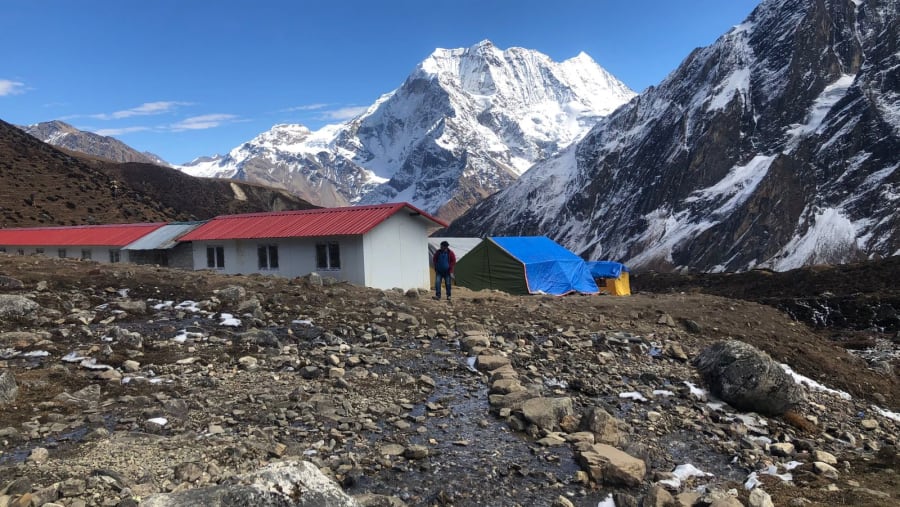
Accommodation is generally in teahouses or lodges along the trail. These provide basic facilities including beds, meals, and communal areas. In some remote areas, the facilities may be more basic.

What should I pack for the trek?

Pack warm, layered clothing, a good pair of trekking boots, a sleeping bag, trekking poles, and essentials like sunscreen, a hat, and a water bottle. Personal gear lists are usually provided by your trekking agency.

How challenging is the trek?

The Manaslu Circuit Trek is considered moderately difficult to challenging due to its high altitude and varied terrain. It involves long trekking days, steep ascents, and high-altitude passes like the Larkya La (5,160 meters).

What kind of food is available on the trek?

Teahouses along the trek offer a range of food, including local Nepali dishes, Tibetan cuisine, and some international options. Meals usually consist of dal bhat (lentil soup with rice), noodles, and soup.

Is it safe to drink water on the trek?

It's generally advisable to drink treated or purified water. You can use water purification tablets or filters, or buy bottled water along the trail. Ensure you follow hygiene practices to avoid waterborne illnesses.

Is travel insurance required?

Yes, travel insurance is highly recommended. It should cover trekking at high altitudes, medical emergencies, and trip cancellations. Some trekking agencies may require proof of insurance.

How do I get to the starting point of the trek?

The trek usually starts from Soti Khola or Arughat, which are accessible by road from Kathmandu. Travel time by road can take 7-10 hours, depending on road conditions.

What if I need to change my plans during the trek?

Flexibility is important in high-altitude treks. Communicate with your guide if you need to change plans. They can assist with rescheduling or arranging alternative routes if necessary.

Manaslu, also known as Mount Manaslu, is located high in the Manaslu Himalayas in Nepal and is the eighth-highest mountain in the world, at an altitude of around 8,163 meters (26,781 feet) above sea level. Proper accommodation and a consistent trekking pace are important to prevent altitude sickness. Manaslu, which means "Mountain of the Spirit" in the local language, is known for its amazing beauty and challenging climbing routes. It is bordered by Annapurna Base Camp to the west and Ganesh Himal to the east. The Around Manaslu Trek is a famous and challenging trekking excursion that takes you around the majestic Mount Manaslu, offering amazing views of snow-covered peaks, picturesque landscapes, and a chance to experience the unique culture and traditions of the region. The situation is similar to the Everest Base Camp Trek, which attracts trekkers from around the globe, while the Manaslu Circuit Trek typically sees fewer trekkers along the route. This trek is full of unforgettable adventures, offering the opportunity to experience nature in remote areas. It is physically challenging, culturally rich, and filled with breathtaking and varied Himalayan scenery.

The Manaslu Circuit Trek requires considerable physical effort, so trekkers should be physically fit, healthy, and mentally strong. It involves long trekking days, and the trail can include steep ascents and descents, as well as crossings of various high mountains that are rocky and rugged at times. Some trekkers face high-altitude sickness, which can make the trek physically demanding. Proper preparation, training, and acclimatization are therefore very important before the trek begins. Responsible and careful management is essential to avoid altitude sickness. You should carry some medical supplies and medicine. You also need warm clothes, sun protection, clothing that allows you to move and walk comfortably on mountain trails, a sleeping bag, and other necessary equipment, as well as your personal belongings and some cash, since ATMs may not be easily available. You may have a porter to carry heavy items, which can be very helpful on the trek. Along the route, teahouses and lodges run by local communities are available for accommodation, where you will have breakfast, lunch, and dinner. For your safety, it is important to undertake the Manaslu Circuit Trek with a licensed trekking agency and a well-experienced guide. They will provide necessary assistance, take care of your safety, and make essential arrangements along the route.

Logistics

Meeting & route

Meeting point
Tribhuvan International Airport (KTM), International Terminal, Kathmandu, Nepal
Tour start
Kathmandu 44600, Nepal
Tour ends at the same location as the start point.
End of the journey

Your 18 days finish where they began, in Kathmandu 44600.

Watch the tourHQ film Watch the film

Create your own adventure

Can't find the perfect tour? Tailor your dream trip.

  • Tell us your destination, dates and group size.
  • Our travel experts and local guides design a tailored itinerary, just for you.
  • Enjoy your trip with peace of mind, knowing everything is taken care of.
Plan my holiday

Say goodbye to travel stress.

Starting from

USD 1,450 /person
Book This Tour

When

Travellers

Total