5-Day Private Great Migration Safari with Mara River & Maasai Visit

5 Days Round trip from Arusha Moderate pace

The journey

Trip highlights
  • 01 Explore Tarangire National Park's elephants, baobab trees, and tree-climbing African pythons
  • 02 Look for the great migration in the Serengeti and the Mara River area
  • 03 Spend a full day on game drives in Northern Serengeti's Wagakuria region
  • 04 Experience the wildlife and dramatic scenery of the Ngorongoro Crater
  • 05 Visit a Maasai village and learn about the community's social and economic life

Unwind and take in the diversity of the Serengeti's environment, culture, and wildlife on this 5-day safari through northern Tanzania. Explore Tarangire National Park, famous for its large numbers of elephants, baobab trees, and tree-climbing African pythons, then continue to the Serengeti and the Mara area for a chance to witness the great migration across the Mara River. Descend into the stunning Ngorongoro Crater for a full day of game viewing, and round out the journey with a visit to a Maasai village to interact with the locals and learn about their community.

Book this 5-day Private Great Migration Safari with Mara River & Maasai Visit with Serengeti Wildlife Safaris, a licensed Tanzania tour operator based in Arusha since 2017. Every itinerary can be tailor-made to your travel dates, budget and interests, and combined with Serengeti and Ngorongoro safaris, Kilimanjaro climbs or Zanzibar beach stays.

At a glance

What this trip includes

Duration 5 Days
Tour type Private
Activity level Moderate
Accommodation Included · Standard
Transport Included
Wheelchair access Yes
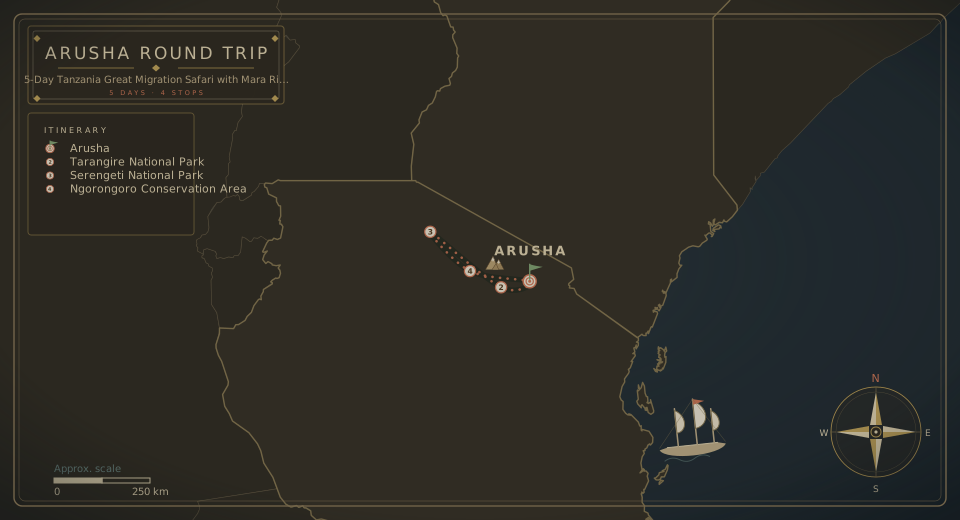
Cities Arusha, Masai Mara, Serengeti National Park, Ngorongoro Conservation Area, Tarangire National Park
Languages English, Swahili

Day by day

The itinerary

1
Day 01

Arusha to Tarangire National Park Safari

  • Your safari starts in Arusha, where your guide will pick you up in town or at your hotel before proceeding to Tarangire National Park.
  • You will have lunch at a picnic site, where you may also see some animals passing nearby.
  • After lunch, continue with a game drive in the park. Tarangire takes its name from the Tarangire River, which runs through the park and serves as the only source of water for wild animals during the dry season. The park is famous for its many elephants, baobab trees, and tree-climbing African pythons.
  • In the late afternoon, drive to Karatu for dinner and an overnight stay.
2
Day 02

Journey to Serengeti National Park

  • After an early breakfast, you will head towards the Serengeti.
  • The route passes through the Rift Valley and up into the vast plains of the Serengeti. Founded in 1951, Serengeti National Park is the oldest national park in Tanzania. It is the heart of a vast ecosystem whose species-rich animal world is unique. Together with the Ngorongoro Conservation Area and Kenya's Masai Mara National Reserve, Serengeti National Park forms one of the largest natural migration systems for wild animals. Across these three conservation areas, there are over 1.4 million gnus, almost 300,000 Thomson's gazelles, about 200,000 zebras, and several thousand topis moving with the rainy seasons toward areas of greenery and lush meadows. With about 3 million larger mammals, the Serengeti is the national park with the richest wildlife in the world.
  • You will enjoy a game drive en route to your accommodation for dinner and an overnight stay at Tanzania Bush Camp.
3
Day 03

Full-Day Game Drive in Northern Serengeti

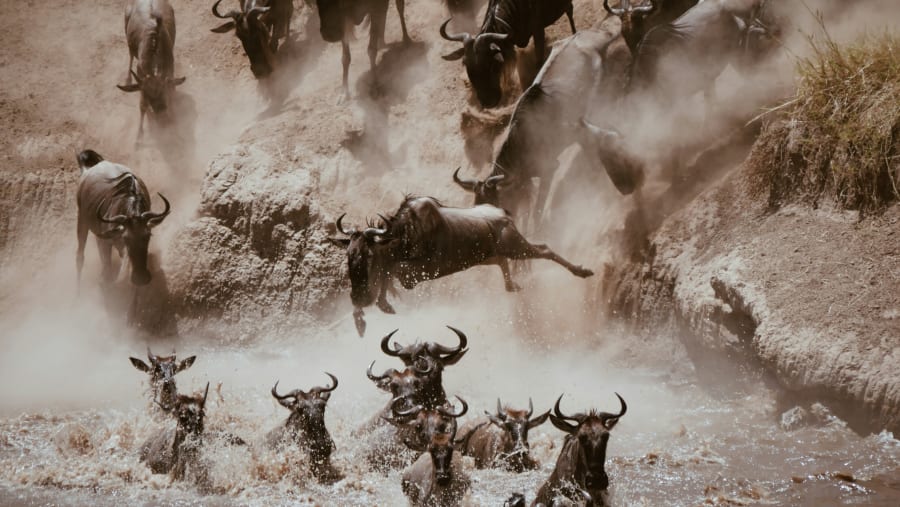
  • After breakfast, you will set out on a full-day game drive to view the great migration in the Mara area. Resident wildlife numbers are exceptionally high in the Wagakuria area. The key feature here is the Mara River, and there is a great chance to see herds crossing the river to the north one day and back to the south a few days later.
  • Please note that witnessing a river crossing can be very difficult, and it is sometimes a matter of luck. A herd may be seen next to the river and only decide to cross a few days later. This is a stunning region with kopjes, woodland, riverine vegetation, and open plains, similar to Kenya's Masai Mara National Reserve.
4
Day 04

Serengeti to Ngorongoro Crater Game Viewing

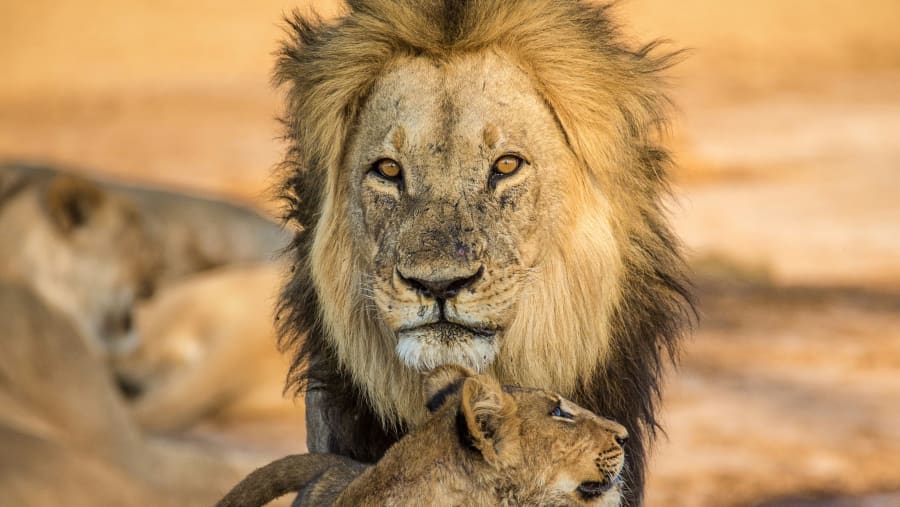
  • After an early breakfast, you will descend into the crater for a full day of game viewing. The crater teems with zebras, buffaloes, lions, wildebeest, baboons, elephants, flamingos, ostriches, hippos, and the rare black rhinos. The beautiful colours and dancing clouds make the crater feel almost surreal. Because of its natural beauty, the Ngorongoro Crater has been chosen as one of Africa's Seven Natural Wonders.
  • In the late afternoon, you will return to your accommodation for dinner and an overnight stay.
5
Day 05

Maasai Village Visit and Return to Arusha

  • Your day will start with a pick-up from your hotel to the outskirts of a Maasai village, where the local guide will welcome you. These local guides are highly knowledgeable about the ins and outs of the community, so they will be able to share the social and economic aspects of community life. There are many activities to choose from, and you can maximize your visit by taking part in most of them. Be ready with your camera to capture memorable photos, and make sure to ask questions along the way, as the guide will be happy to answer them.
  • During your visit, you are likely to experience village life firsthand. After the tour in the afternoon, your driver-guide will drive you back to Arusha at the end of your tour.

The route

Where you'll travel

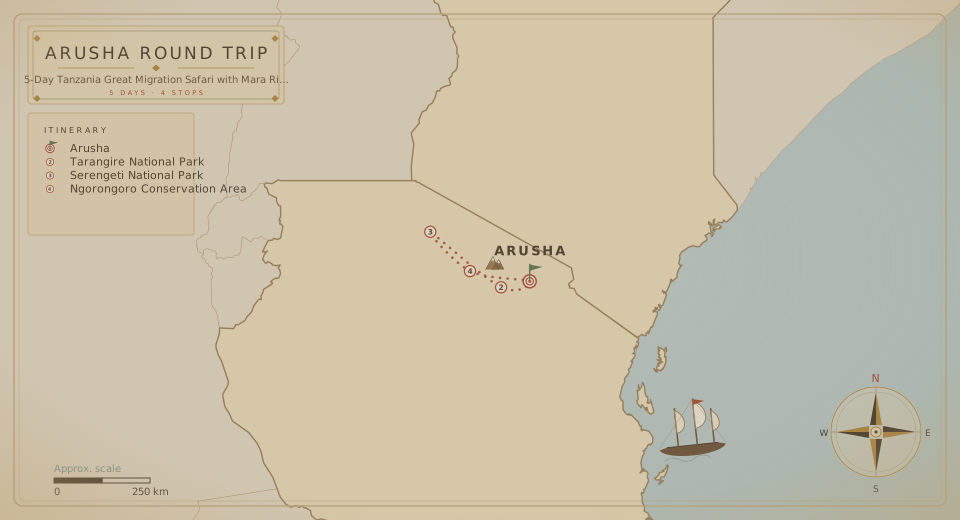
Tour route map
Round trip from Arusha 5 cities · 5 Days

The fine print

Trip details

What's Included

  • Quality safari jeep
  • Mid-range accommodation
  • Air-conditioned car
  • Professional guide
  • Beer
  • Drinking water
  • All meals on safari
  • Free accommodation on arrival
  • Taxes / VAT
  • Bath towels
  • Drinking water on all days
  • Park fees

What's Not Included

  • Visa
  • Passport
  • Laundry
  • Tips
  • International flights
  • Tipping guideline: USD 10–15 per person per day for your guide

What to bring

  • Choose a duffel bag or soft-sided bag. Ideally, the fabric should be hardy and waterproof, and the bag should be lockable. Put anything of value in a separate day pack, such as a backpack. Anything of real sentimental or monetary value should ideally be left at home.

  • Pack for hot days and cool nights. Tanzania can be hot and dusty by day, but it is often cool and crisp by night. Layers are ideal for safari days. Pack clothing that can keep you cool but protect you from the sun and biting insects. Choose mid-tone colours and avoid white or bright colours that may distract the animals, as well as dark colours like black and blue, as these can attract tsetse flies. The best colours are the safari classics: olive, green, and khaki. For evenings at lodges, you can stay in your casual gear, as even luxury lodges do not expect smart wear out in the bush. Check the temperature before you travel to ensure you have warm clothing for the season. It is always a good idea to bring a waterproof coat, whatever the season.

  • Be careful not to overpack, so think carefully about what shoes to take. As long as you are not going on a safari that requires a lot of walking, you will be fine with some light hiking boots and some sports sandals. Sandals are also great for walking around the camp at night. You may also like to take flip-flops for the showers.

  • The African sun can be brutal, so be sure to bring a good pair of sunglasses to protect your eyes. You'll also need a hat that shades your face and covers your ears and neck for maximum sun protection. Of course, take plenty of high-protection sun cream and lip salve.

  • This is a suggested list of first aid supplies:

  • Antiseptic ointment

  • Antihistamine cream and tablets

  • Nurofen or equivalent painkiller

  • Eye drops

  • Anti-diarrhea treatment

  • A couple of bandages

  • Medication for personal allergies, asthma, etc.

  • Insect repellent containing Deet

  • Rehydration sachets or vitamin tablets

  • Assorted plasters

  • Photography and electrical equipment

  • Strong bag or carry case to protect the camera - zip-lock or plastic bags are useful for dusty or sandy conditions.

  • Spare or extra batteries

  • Memory or storage media (2 memory cards in case one gets corrupted)

  • Binoculars. These will be essential when you are out spotting wildlife.

  • It is forbidden in Tanzania to take photos of anything military. Bridges, border posts, and airports are also sensitive, so be careful or be prepared to have your film or camera confiscated. Please act with discretion and respect when taking photos of people - it is always better to ask first before you snap away.

  • All our safari vehicles have power and charging points. Please bring travel adaptors to ensure they are suitable for your appliances and devices.

  • Most lodges and tented camps have Wi-Fi.

  • Some campsites have Wi-Fi, but this should not be relied upon.

  • The signal strength is variable.

  • Buying a SIM card with data is possible. If you want to use it on your phone, you must ensure it is unlocked. You can also buy a reasonably cheap phone in Tanzania for this purpose.

  • There are Vodacom and Airtel shops in Arusha that will be able to help and advise with this.

  • All towns and cities have their share of petty crime, and sensible precautions need to be taken. Wearing expensive jewellery or watches and carrying cameras will draw unnecessary attention. You may find a simple money belt more discreet than a bag.

  • Always be aware of your surroundings, and when approached by people you do not know, be very careful. At night in towns, it is best to use a taxi rather than walk around the streets. Single women, in particular, need to be careful, and we suggest that it is safer to be in a group.

Know before you go

Your safety on safari: Our 4x4 Land Cruisers are checked and serviced before every trip, every vehicle carries a first aid kit, and our guides are first-aid trained. Guides carry radios to stay in contact where there is no internet, including with park rangers, and you can reach our Arusha office at any time by WhatsApp or phone call.

  • A Serengeti Wildlife Safaris representative will collect you from the airport and take you to your accommodation in Arusha for the night.

  • We are happy to book accommodation before and after your safari if needed.

  • Flying into Arusha or Kilimanjaro airports is quite straightforward - English is widely spoken and used for signs and directions.

  • Arusha Airport is a 30-minute drive from Arusha.

  • Kilimanjaro Airport is roughly a one-hour drive from Arusha. If you are arriving in Kilimanjaro on an international flight, clearing immigration can be a lengthy process.

  • The local currency is the Tanzanian shilling. US dollars and euros are widely accepted. Most places will not accept older US dollar bills printed before 2006.

  • If you intend to use your credit or debit card to withdraw funds, we suggest taking more than one card with you, as you may find that your card is not accepted at the first ATM. Visa and Maestro cards are usually the best options.

  • We recommend informing your bank that you will be using your card abroad to avoid it being blocked.

  • ATMs are available in Arusha and allow you to withdraw local currency.

  • We advise you to arrive in Arusha at least one day before your trip begins. Return flights can be booked for the late afternoon or evening of the final day of your safari, but please ensure your guide is aware of this so that you can arrive at the airport in plenty of time for your flight.

  • Please check with the relevant embassy in your country for up-to-date visa and passport information. Make sure your passport will not expire within six months of your trip and that it has at least three clear pages.

  • You will probably need a visa to enter Tanzania. Check with your country's government travel website to find out how to get your visa. Most visas can be bought on arrival in the country.

  • You will require vaccinations for your trip. As we are not medically trained, we are unable to give detailed advice on vaccination requirements. However, the following vaccinations are normally recommended for Tanzania:

  • Tetanus

  • Polio

  • Hepatitis A

  • Typhoid

  • Rabies

  • Yellow fever

  • Malaria

  • Yellow fever is compulsory when entering Tanzania from a country with yellow fever.

  • Vaccination certificates are often checked at immigration. If you are entering Tanzania from a country that does not have yellow fever, vaccination is not needed. Please visit the World Health Organization website for an up-to-date list.

  • In some areas we visit, there is a risk of contracting malaria. You should know that whatever malaria tablets you take offer only partial protection. They must be coupled with physical efforts to avoid being bitten, which is the best prevention. Malaria-carrying mosquitoes come out at sunset, so you should wear long sleeves and trousers from this time. Exposed skin, especially ankles, should have insect repellent containing Deet applied.

  • We strongly recommend that you have extensive travel insurance to cover your trip. It is also wise to leave a copy of your insurance policy with a friend or relative for safekeeping. Your policy should include adequate medical emergency and repatriation coverage.

  • There is a well-established tipping culture in Tanzania. Guides: if you feel you have received good service, a typical tip is USD 10-15 per person per day. Guides work incredibly long hours, and tips supplement their income significantly. Anything you can afford is appreciated.

  • Tipping in accommodation is also discretionary. Most accommodation will have a tip box at reception. We recommend putting something in at the end of your stay rather than giving individuals money. Depending on the level of service, we recommend USD 10 per day for a group of 2.

  • In Tanzania, the year is loosely divided into the short rains in November and the long rains from March to May. The rains usually last one or two hours each day, followed by hot sunny weather. Nights can be surprisingly cold at higher altitudes, such as Ngorongoro Crater.

Accommodation before and after your safari can be arranged if needed.

Logistics

Meeting & route

Meeting point
Arusha, Tanzania
Tour start
Arusha, Tanzania
Tour ends at the same location as the start point.
End of the journey

Your 5 days finish where they began, in Arusha.

Watch the tourHQ film Watch the film

Create your own adventure

Can't find the perfect tour? Tailor your dream trip.

  • Tell us your destination, dates and group size.
  • Our travel experts and local guides design a tailored itinerary, just for you.
  • Enjoy your trip with peace of mind, knowing everything is taken care of.
Plan my holiday

Say goodbye to travel stress.

Starting from

USD 3,181.20 /person
Book This Tour

When

Travellers

Total