Tanzania · Trekking

7-Day Mount Kilimanjaro Lemosho Route Trek to Uhuru Peak

7 Days Round trip from Arusha Moderate pace

The journey

Trip highlights
  • 01 Trek through the lush Afromontane Rainforest on the Lemosho Route
  • 02 Take in breathtaking views from the Shira Plateau and Lava Tower
  • 03 Conquer the Barranco Wall above the Karanga Valley
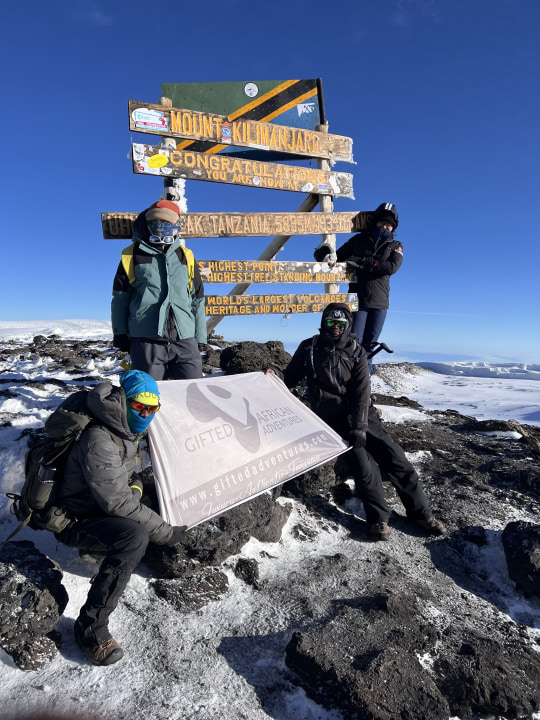
  • 04 Watch a glorious sunrise from Uhuru Peak, the Roof of Africa

Experience a scenic 7-day trek on Mount Kilimanjaro via the Lemosho Route, beginning with a drive from Arusha to the lush Afromontane Rainforest. Ascend through diverse ecological zones, from podocarpus forests and the dramatic Shira Plateau to the striking Lava Tower and the picturesque Barranco Valley. Conquer the Barranco Wall, acclimatize at Karanga and Barafu camps, and make your summit bid before dawn for a glorious sunrise at Uhuru Peak, the Roof of Africa. Descend through wonderful rainforest scenery to Mweka Camp before returning to Arusha.

Conquer the Barranco Wall, acclimatize at Karanga and Barafu camps, and make your summit bid before dawn for a glorious sunrise at Uhuru Peak, the Roof of Africa.

From the itinerary

At a glance

What this trip includes

Duration 7 Days
Tour type Private
Activity level Moderate
Accommodation Included · Standard
Transport Included
Wheelchair access No
Cities Arusha, Mount Kilimanjaro
Languages English

Day by day

The itinerary

1
Day 01

Arusha to Londorossi Gate and Forest Camp

  • From Arusha, set out by vehicle for the long drive to the starting point of the Lemosho Trail, Londorossi Gate.
  • Approaching the mountain from the west, the Lemosho Route starts in the Afromontane Rainforest, the first of four ecological zones you encounter on Kilimanjaro.
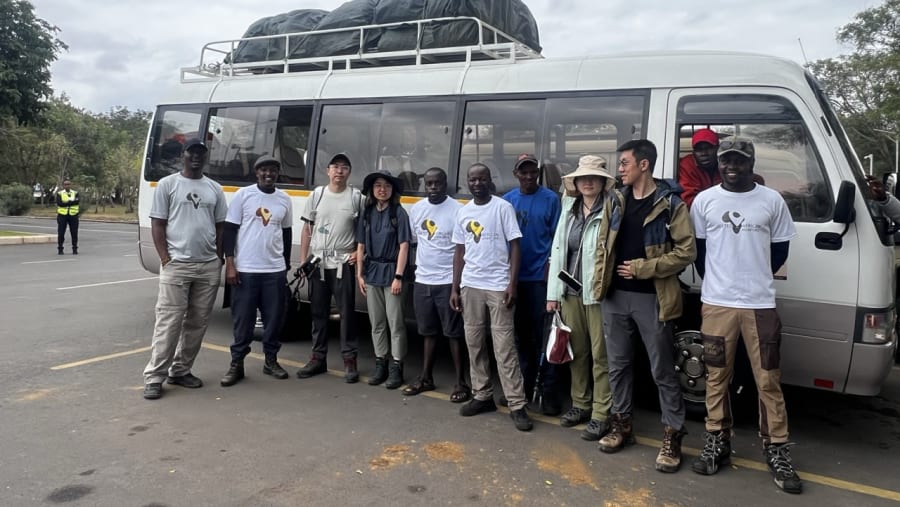
  • Here, you meet the rest of your crew and set off at a leisurely pace while keeping your eyes peeled for wildlife. Lunch is taken on the trail, and camp is reached in mid-afternoon. Overnight at Forest Camp.

Accommodations: Kilimanjaro Camping

Meals Included: Breakfast, Lunch, Dinner

7,742 ft to 9,498 ft, 4 miles, approx. 3-4 hours
2
Day 02

Forest Camp through the Shira Plateau to Moir Hut

  • From the forested slopes of Lemosho, you ascend through a podocarpus and juniper forest and then break out onto a zone of heather and lichen-draped volcanic rock and the Shira Plateau, which used to be Kilimanjaro's third peak before it collapsed. Lunch is taken on the trail, and you arrive in camp in mid-afternoon.
  • Enjoy the breathtaking view of Kibo, the peak of Kilimanjaro, from this vantage point. Overnight at Moir Hut.

Accommodations: Kilimanjaro Camping

Meals Included: Breakfast, Lunch, Dinner

9,498 ft to 11,500 ft, 5 miles, approx. 5-6 hours

3
Day 03

Moir Hut via Lava Tower to Barranco Camp

  • From Moir, you traverse the slopes of Kibo. Here, relatively few flora or fauna can survive the extreme temperature ranges and conditions that typify this zone. Lunch is normally taken close to a volcanic rock formation known as the Lava Tower.
  • If you feel very strong, there is an optional ascent of the 300-foot-tall Lava Tower before descending to Barranco Camp in the afternoon, passing through the strange yet beautiful 'Garden of the Senecios' (giant groundsel), which also features many giant lobelias. The Barranco Valley is one of the prettiest areas of the entire trail. Overnight at Barranco Camp.

Accommodations: Kilimanjaro Camping

Meals Included: Breakfast, Lunch, Dinner

13,800 ft to 15,223 ft (Lava Tower), down to 13,044 ft, 7 km, 4-6 hours

4
Day 04

Barranco Wall to Karanga Camp

  • You now have a relatively short day to reach Karanga Camp after conquering the intimidating Barranco Wall. Be prepared to use all four limbs as you traverse the wall to the top of the Karanga Valley.
  • From here, follow a path that sojourns through many inclines and declines to Karanga Camp, arriving in the late afternoon. Our selection of Karanga Camp is strategic - significant time at altitude is essential for safe acclimatization.
  • Particularly spectacular are the sunsets, with views of the southern glacial valleys and ice fields towering over 3000 feet above you. Overnight at Karanga Camp.

Accommodations: Kilimanjaro Camping

Meals Included: Breakfast, Lunch, Dinner

13,044 ft to 13,123 ft, 3 miles, 4-5 hours

5
Day 05

Karanga Camp to High Barafu Camp

  • Today is another half-day ascent to Barafu Camp. Once again, lunch is taken at this high camp, allowing plenty of time to relax before the summit bid.
  • In this desolate alpine desert, strong winds sometimes rip over the camp, yet splendid views of Mawenzi Peak are the norm in the evenings. A relatively early dinner is taken before resting for the evening. Overnight at Barafu Camp.

Accommodations: Kilimanjaro Camping

Meals Included: Breakfast, Lunch, Dinner

15,288 ft to 19,341 ft to 12,467 ft, 3 miles ascent, 7 miles descent, 7-8 hours ascent, 4-6 hours descent

6
Day 06

Midnight Summit Bid to Uhuru Peak and Descent to Mweka

  • Depart just before midnight for the final summit bid. Patience and persistence are the name of the game to reach the summit, and this is the coldest, windiest section of your adventure. Most likely by dawn, as the first rays of light appear across the Tanzanian landscape, you arrive near the rim at Stella Point, at 18,652 ft.
  • Here, you are rewarded with the most glorious sunrise you will ever see, appearing over Mawenzi Peak. Ascending via Stella Point affords a relatively short final section to Uhuru Peak, the Roof of Africa. Take as many pictures as you can.
  • After a short celebration at the summit, the ebullient trek begins. Go slowly and enjoy the wonderful rainforest scenery as you head towards Mweka Camp, arriving before dusk. With every step, the air has more and more oxygen, so although your legs will be jelly, your heart will be light. Overnight at Mweka Camp.

Accommodations: Kilimanjaro Camping

Meals Included: Breakfast, Lunch, Dinner

12,467 ft to 5,380 ft, 6 miles, 3-4 hours

7
Day 07

Mweka Camp Descent and Return to Arusha

  • After breakfast, you descend once again through the montane forest.

  • After saying farewell to your crew at around midday, you are picked up and transferred back to your hotel for a well-deserved shower and a celebratory dinner.

Hours trekking: 4-7

Afromontane Rainforest, Shira Plateau, Lava Tower, Uhuru Peak

Where this trip takes you

Afromontane Rainforest, Shira Plateau, Lava Tower, Uhuru Peak

The route

Where you'll travel

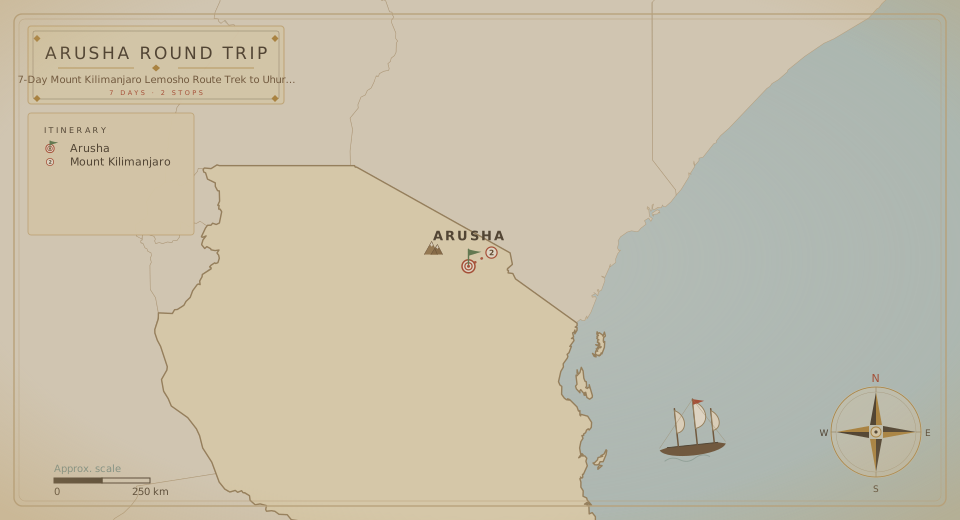
Tour route map
Round trip from Arusha 2 cities · 7 Days

The fine print

Trip details

What's Included

  • Quality, waterproof, four-season private mountain sleeping tents
  • Professional, experienced mountain guides
  • All park fees, airport transfers, and rescue fees
  • All meals while on the mountain
  • Guides, porters, cook salaries, and park fees
  • Quality mess tents with table and chairs
  • Large portions of fresh, healthy, nutritious food
  • Clean, purified drinking water
  • Oximeter
  • Medical kit
  • Emergency oxygen
  • Crisis management and safety procedures
  • Fair and ethical treatment of porters
  • Accommodation in Arusha
  • Portable toilet

What's Not Included

  • Flights
  • Alcoholic and soft drinks
  • Visa fees
  • Tips and personal spending money for souvenirs, etc.
  • Travel insurance

What to bring

  • Sunglasses - Your sunglasses should have 100% UV protection and reduce glare and visible light. The frames should be lightweight and have a wrap-around design for enhanced grip and staying power. Additionally, side shields are recommended to block peripheral light.
  • Water/windproof jacket - Your water/windproof jacket is your outer water-repellent layer. Gore-Tex, seam-sealed, is recommended, as is a hood for added warmth.
  • Water/windproof pants - Your water/windproof pants will be worn on summit days and rainy afternoons. They are essential for warmth, should be Gore-Tex lined, and have lower leg zips.
  • Water/windproof mittens or gloves - These are used in extreme temperatures and are primarily worn on summit days. Be sure your gloves or mittens have wrist cords and reinforced palms to maintain grip during wet conditions. A removable liner is essential for drying, washing, and replacing.
  • Look for items that will add less volume to your overall pack. We will be using porters to carry our equipment; however, they are limited in the amount each can carry. Heavy synthetic materials will be very limiting and could cause issues when packing up for the hike.
  • Two pairs of synthetic warm-weather trekking socks - These socks are for trekking in the warmest part of the day since they are made of Coolmax® fabric. What is Coolmax®? Coolmax® wicks moisture, dries quickly, and breathes well, keeping your feet dry and preventing blisters.
  • Four pairs of heavier synthetic or wool blend socks - Your wool socks are ideal for around camp when the temperature drops and on cold mornings. Merino wool is very comfortable and dries quickly, with fewer odors than synthetic blends.
  • Two pairs of long underwear tops - This will be your base layer for colder mornings, evenings, and days when the temperature drops considerably. The material is lightweight, tight-fitting, moisture-wicking, and comfortable.
  • Two pairs of long underwear bottoms - This will be your bottom base layer for colder mornings, evenings, and days when the temperature drops considerably. The material is lightweight, tight-fitting, moisture-wicking, and comfortable.
  • Warm pants - These pants are ideal for evenings around the camp and cold days on the trail. Typically made of lightweight fleece and Wind Pro material, they should offer added warmth in case of cold nights or high winds on the summit.
  • Fleece top - This Polartec® 200-weight top will provide added warmth in the evenings and on cold morning starts. Please look for fleece material and stay away from cotton sweatshirts. Ideally, this item is worn over the thermal base layer and underneath your water/windproof jacket.
  • 2 pairs of shorts/pants for hiking - We will hike in these convertible shorts/pants every day. They should be made of lightweight, quick-drying nylon. Some come with UPF and mosquito protection.
  • Two pairs of long- or short-sleeve shirts for the trail - In warmer climates, we should wear your trekking shirt early in the climb. It is moisture-wicking, lightweight, and designed for multi-day hikes.
  • Mid-layer top - This shirt is a long-sleeve version of the one provided above. The long-sleeve trail shirt offers added warmth, more protection from the sun, and an additional layer for evenings and early morning starts.
  • Warm hat - This fleece or wool hat is ideal for evenings and will be valuable in cold weather and temperatures on the summit. The hat should be tight-fitting with minimal loose ends.
  • Lightweight gloves - Fleece gloves are essential. Look for gloves that are Polartec® 200 weight with a leather-reinforced palm. For more protection, windproofing is available and will add an extra layer of warmth.
  • Balaclava - The balaclava provides added warmth on summit days and colder evenings. It should be made of synthetic or wool, lightweight, and close-fitting.
  • Sun hat - Your sun hat should be worn at the lower camps and should provide ample coverage for the face. A full-brimmed hat is good for added shade and increased sun protection. Additionally, a neck scarf should also be considered to protect the back of the neck.
  • Waterproof, breathable gaiters - Your gaiters should be lightweight and durable. Look for Gore-Tex-lined gaiters that can fit over your boots. Velcro or adjustable sides for easy access are recommended.
  • Down jacket - An 800-fill down jacket will add much-needed warmth for cold evenings and layers for summit day. Down is recommended for its compressibility and comfort around camp in the early nights on the climb. The guides wear brands such as Patagonia, Mountain Hardware, Marmot, and North Face.
  • Less is more!!! It is vital to bring the essential gear discussed above, but it is more important to refrain from bringing items that are not recommended. Items to avoid are cotton socks, jeans, multiple pairs of shoes, and heavy sweatshirts. Look for items made of moisture-wicking and quick-drying fabrics rather than cotton fabrics.
  • Head lamp - Petzl® and Black Diamond® make several small and efficient headlamp models. Look for ones that have multiple lighting levels and LED bulbs, and use AAA batteries.
  • Please bring at least three spare batteries to ensure ample lighting on your summit attempt.
  • Shoes (Teva Camp, Crocs, Sandals) - These are great for around camp after a long day on the trail. They can also be used for creek crossings that may be higher than the boot. Flip-flops work well in warmer climates but are not as effective during cold nights.
  • Sunscreen with 30 SPF or higher is recommended, as well as waterproof and sweatproof. Eight ounces will be plenty, and we typically carry one with 45+ SPF for our faces and a 30 SPF for other exposed areas. Banana Boat, REI, Kinesis, and All Terrain are good options.
  • Two wide-mount water bottles - A 1-litre water bottle is essential for hydrating at lunch, around the camp, and refilling throughout the day. Stay away from glass and heavy metals and look for lexan® for durability.
  • Pillow - A Thermarest® pillow that compresses down or folds into itself is ideal. A good benchmark for size and weight is 18 x 14 inches and 9 ounces total.
  • Dry bag - A 20-litre dry bag is great for ensuring your items are safe in case of rain. It can hold cameras, wallets, money, and other valuables.
  • Trekking poles - Collapsible poles are great for steep downhill terrain and assistance uphill. If you have knee problems, they reduce the impact on your joints by 20-30%. An excellent soft foam grip will help prevent blisters, and poles with an aluminium shaft are durable and lightweight.
  • Camp towel - The camp towel should be made of a polyester-nylon blend that dries quickly and compacts tightly in your pack. The large size (50 x 27 inches) is a good size and can be used to wash up at the end of the day. Stay away from house or beach towels.
  • Sleeping bag - A sleeping bag is an insulated covering for a person. It is essentially a lightweight quilt that can be closed with a zipper to form a tube. The bag functions as lightweight, portable bedding in situations where a person is sleeping outdoors, especially when climbing Kilimanjaro.

Know before you go

  • On arrival at Kilimanjaro Airport (JRO), you will be met on time and transferred to the hotel in Arusha. After check-in, you will meet the climbing guide for a briefing and gear check, ready for the next day's climb.
  • Solid hiking boots - Boots should have high ankle support and a solid Vibram®, or equivalent, sole. Gore-Tex® or other waterproofing is recommended for wet days and added insulation. Be sure to break your boots in at least four weeks before departure. Additionally, bring a spare set of laces.

Logistics

Meeting & route

Meeting point
Arusha Region, Tanzania
Tour start
Arusha, Tanzania
Tour ends at the same location as the start point.
End of the journey

Your 7 days finish where they began, in Arusha.

Watch the tourHQ film Watch the film

Create your own adventure

Can't find the perfect tour? Tailor your dream trip.

  • Tell us your destination, dates and group size.
  • Our travel experts and local guides design a tailored itinerary, just for you.
  • Enjoy your trip with peace of mind, knowing everything is taken care of.
Plan my holiday

Say goodbye to travel stress.

Starting from

USD 2,597 /person
Book This Tour

When

Travellers

Total