Uganda · Trekking

8-Day Rwenzori Mountains Climbing Adventure to Margherita Peak

8 Days Round trip from Bundibugyo Hard pace

The journey

Trip highlights
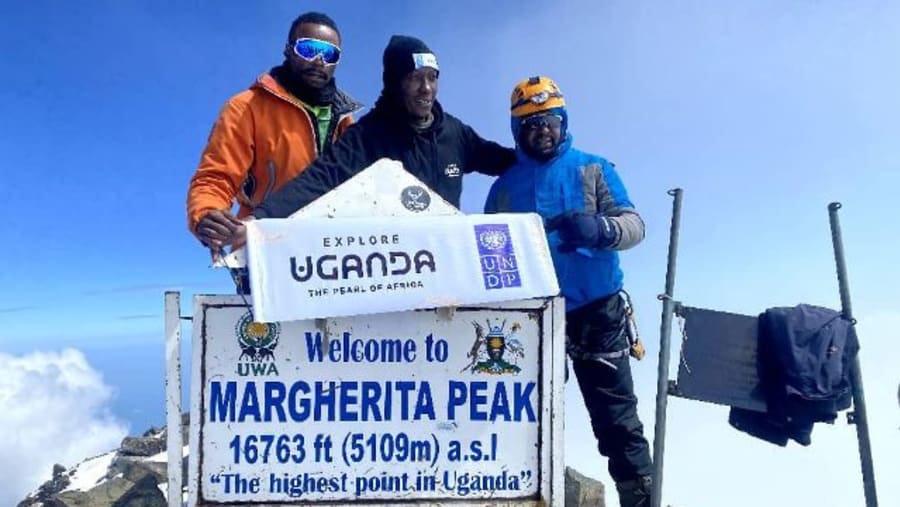
  • 01 Conquer Margherita Peak, the highest point in Uganda at 5,109 meters
  • 02 Hike through lush forests, bamboo trails, muddy slopes, and dramatic valleys in the Rwenzori Mountains
  • 03 Take in breathtaking views of Mount Speke, Mount Stanley, and Mount Baker from high-altitude camps
  • 04 Cross glacier terrain and tackle the steep section near Scott-Elliot Pass
  • 05 Experience the local culture of the Bakonzo people along the trail

Embark on an exhilarating 8-day expedition to conquer the majestic Rwenzori Mountains in Uganda. This challenging hiking safari takes you through lush forests, bamboo trails, muddy and steep terrain, dramatic valleys, narrow streams, and high-altitude camps with panoramic views of Mount Speke, Mount Stanley, and Mount Baker. The adventure builds to the ascent of Margherita Peak at 5,109 meters, the highest point in Uganda, with glacier crossings and the stunning Scott-Elliot Pass along the way. Ideal for physically fit and experienced hikers, this trek is one of the most demanding mountain adventures in Africa.

The adventure builds to the ascent of Margherita Peak at 5,109 meters, the highest point in Uganda, with glacier crossings and the stunning Scott-Elliot Pass along the way.

From the itinerary

At a glance

What this trip includes

Duration 8 Days
Tour type Private
Activity level Hard
Accommodation Included · Standard
Transport Included
Wheelchair access No
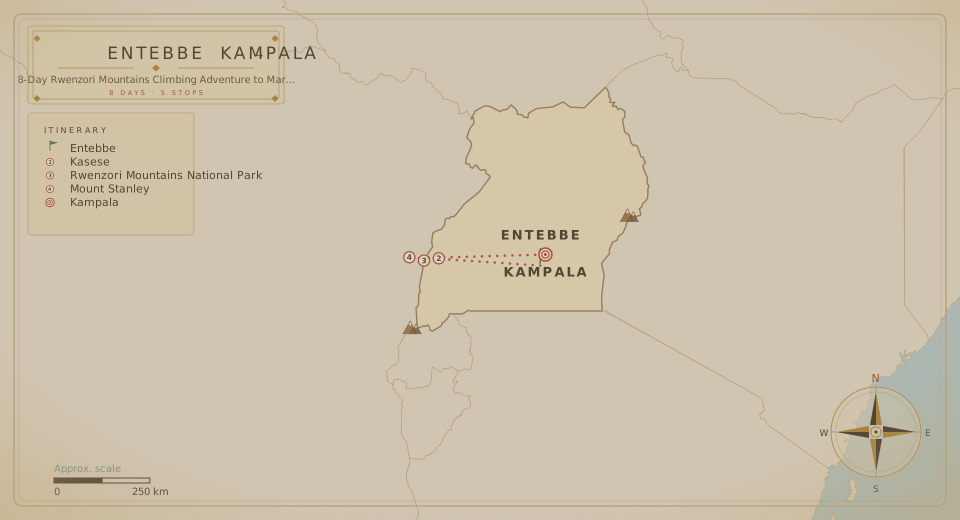
Cities Kampala, Entebbe, Kasese, Mount Stanley, Rwenzori Mountains National Park
Languages English

Day by day

The itinerary

1
Day 01

Transfer to Rwenzori Mountains National Park

  • After breakfast, your 8-day Rwenzori Mountains climbing tour begins with pickup by your driver-guide from your hotel in Entebbe, followed by the drive to the Rwenzori Mountains in Kasese.
  • Dinner and overnight stay at Sandton Hotel in Kasese.
2
Day 02

Hike from Nyakalengija Camp to Nyabitaba Hut

  • You will be at the starting point at the Rwenzori Mountaineering Services offices at Nyakalengija Camp by 7:00 am for a briefing. This also gives you ample time to check whether there is any hiking equipment you do not have so that you can hire it from here.
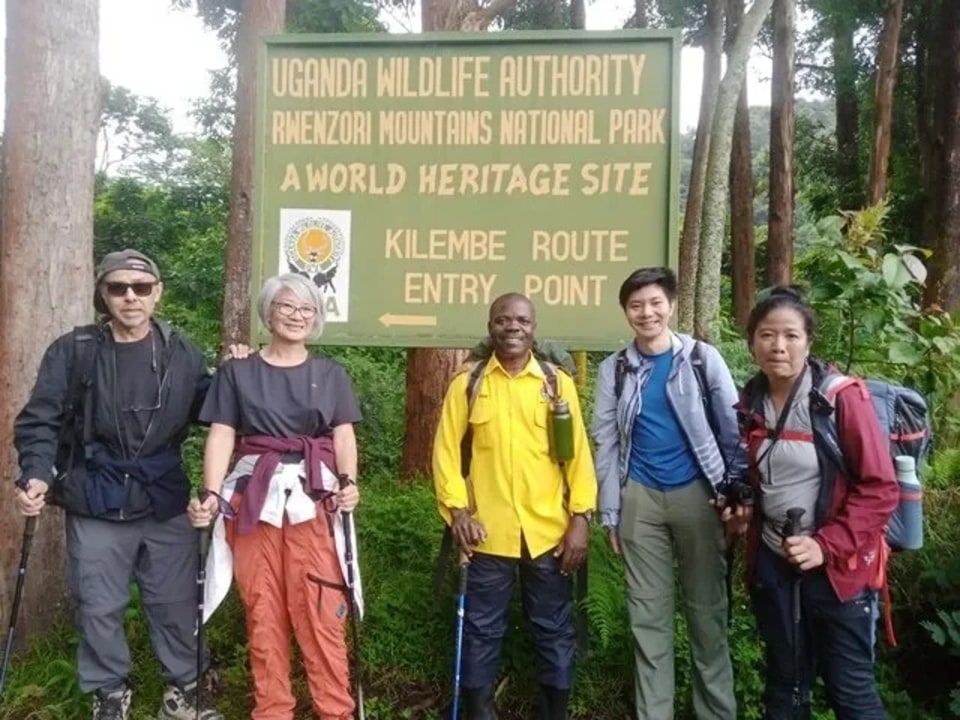
  • We then begin climbing the Rwenzori Mountains from 5,400 feet (1,646 m). The hike takes you through typical forest, mud, wattle, and the Bakonzo homesteads. Along the way, expect to see different types of primates.
  • Dinner and overnight at Nyabitaba Hut, 2,652 meters above sea level.
3
Day 03

Hike from Nyabitaba to John Matte Hut

  • After breakfast, start from Nyabitaba to John Matte Hut at 3,380 meters. After crossing the bridges over both the Bujuku and Mubuku rivers, you begin hiking the central circuit in an anticlockwise direction, which is very challenging.
  • After passing through the challenging section, continue through the bamboo forested area, which is less difficult, all the way to Nyamuleju Hut.
  • Dinner and overnight at Nyabitaba Camp.
4
Day 04

Hike from John Matte to Bujuku Hut

  • Start the day from John Matte Hut and cross another bridge over the Bujuku River to the lower Bigo Bog. There is a steep section past the hut that leads up to Upper Bigo, with a stop for lunch at a beautiful narrow stream on the upper end of the bog, which is very interesting.
  • You will be seeing Mount Speke in the north, Mount Stanley to the west, and Mount Baker in the south.
  • Dinner and overnight at Bujuku Hut/Camp at 3,962 meters.
5
Day 05

Hike from Bujuku to Elena Hut

  • We leave Bujuku Hut and follow a new trail. This trail rises and falls twice before finally climbing steeply through magical and varied vegetation to about 4,372 meters up to Scott-Elliot Pass. There is a very steep section that requires climbing by ladder, but the distance is short and the ladder is very strong.
  • After the hike to Elena Hut at 4,430 meters, continue with a few steps below the pass before reaching Elena Hut/Camp, which is also known as the base camp for hiking 5,109 meters up to Margherita Peak on Mount Stanley, which may require another day.
  • Depending on weather conditions, snow and wind can occur at any time of the day.
  • Dinner and overnight at Elena Camp.
6
Day 06

Summit Margherita Peak and descend to Kitandara Hut

  • After breakfast, we start the hike with the aim of reaching Margherita Peak at 5,109 meters, continuing to the base of the Mount Stanley Glacier in order to reach the summit. The full-day hike takes about 6 to 7 hours, but this depends on one's fitness and speed. In other words, this hike is only for physically fit and experienced hikers.
  • We climb onto the glacier, cross to the Stanley Plateau, and proceed with the ascent. You should be acclimatized to fog, high altitude sickness, and cool weather as you hike to the summit of Margherita Peak, the highest peak of the Rwenzori Mountains in Uganda. Once you make it to the top of Mount Rwenzori, you prepare for the return through one of the most interesting parts of the hike, passing the Scott-Elliot Pass with million-dollar views back to Bujuku Lake and Mount Speke, then down to the Kitandara Lakes.
  • Dinner and overnight at Kitandara Hut/Camp.
7
Day 07

Descend from Kitandara via Freshfield Pass

  • Today we hike down from Kitandara on a trail that ascends steeply up the headwall and spreads out from the base of Mount Baker. As you continue, enjoy views toward DR Congo and the western side of Mount Stanley to the north as you trail down to the base camp for the historic expedition by the Duke of Abruzzi in 1906.
  • Dinner and overnight at Guy Yeoman Camp.
8
Day 08

Descend to Nyakalengija and transfer to Entebbe or Kampala

  • We hike to Nyabitaba, which takes about 5 to 6 hours, so if you are able to start early, it is possible to continue all the way down to Nyakalengija and complete the 8-day Rwenzori Mountain hiking circuit in Uganda.
  • Dinner and overnight in Entebbe or Kampala, or take a late flight back home.
Margherita Peak, Scott-Elliot Pass, Bujuku Lake, Mount Speke

Where this trip takes you

Margherita Peak, Scott-Elliot Pass, Bujuku Lake, Mount Speke

The route

Where you'll travel

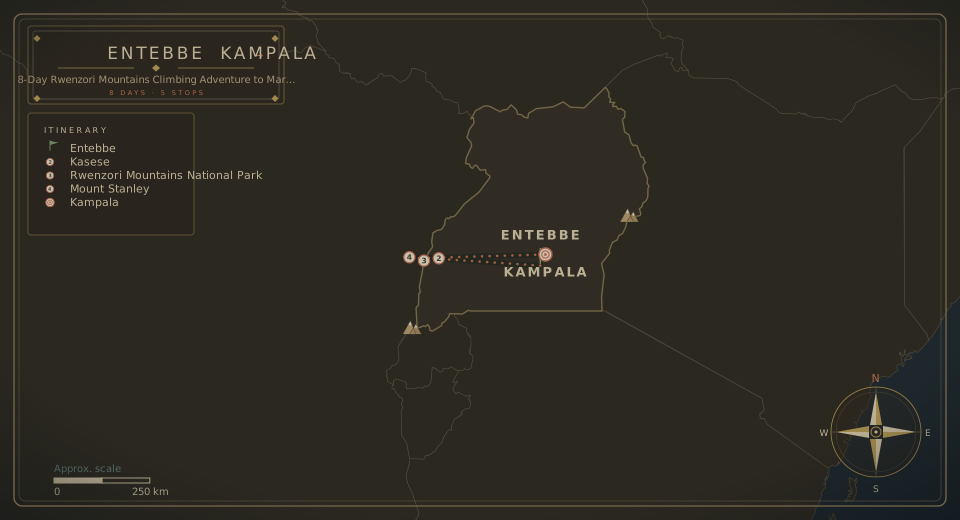
Tour route map
Round trip from Bundibugyo 5 cities · 8 Days

The fine print

Trip details

What's Included

  • Meet-and-greet services and airport transfers to and from Entebbe Airport
  • Accommodation and meals on safari as above
  • One hiking permit each
  • Drinking water in the safari vehicle
  • Services of a driver-guide
  • All park entry fees and set activities on the itinerary

What's Not Included

  • Visas
  • Personal travel insurance and items of a personal nature
  • Charter or scheduled flights are optional extras
  • All expenses of a personal nature, such as tips and drinks

What to bring

List of what to bring for Mt Rwenzori hiking and climbing

  1. Your own sleeping bag

    As you prepare for the Mt Rwenzori hike, take note that nights in the Rwenzori Mountains are very cold, so it is worth buying yourself a quality sleeping bag to keep you warm at night because of the high altitude. If you are hiking to the top of Mt Rwenzori, we recommend bringing a sleeping bag with a minimum rating of -10 degrees Celsius (15 degrees Fahrenheit) so you can enjoy this amazing hike.

  2. Large duffle bag for all your stuff

    We recommend a large duffle bag because it helps you carry all your belongings in one bag, making it easier for porters to carry. The duffle bag must be big enough, but should not exceed 20 kg, and should hold your sleeping bag, clothing, and other personal items you might need while up in the mountain.

  3. Small backpack bag

    It is also good to have a small or medium backpack for carrying your important personal items like cameras, phones, laptops, travel documents, and other essentials. This backpack must be lightweight because any extra weight is a huge issue on long hikes like Mt Rwenzori. Please also remember to bring a rain cover, and a side mesh for your water bottle is highly recommended because it reduces weight strain.

  4. Carry some T-shirts

    When travelling, T-shirts are always recommended because they take up little space and are easy to dry when needed. This is one of the reasons for carrying some T-shirts to use during your safari in Africa.

  5. Ski jacket is recommended

    In the case of Mt Rwenzori, if you are planning to hike up to Mount Baker or Mount Stanley, we recommend that you bring a ski jacket for the snow and ice. The ski jacket must be water-resistant to do the job well.

  6. Body belt

    A body belt is useful for keeping your valuables like money, travel documents, and other small personal items. Although it is not very comfortable, it is a safe and easy way of keeping your most valuable items on you.

  7. Pair of trekking pants or trousers

    One or two pairs of trekking trousers for use during your hike will be a good thing to bring with you. For those who love wearing shorts, you can bring zip-off pants or trousers that can easily be converted into shorts for comfort. For those who love jeans, they are not recommended because jeans can easily soak up a lot of water during the hike and take a long time to dry, which you may not like if it rains as you hike up Rwenzori.

  8. A pair of trekking poles is recommended

    Trekking poles help support your joints as you hike up and down the Rwenzori mountain ranges. These trekking poles help reduce strain on your joints by a good percentage, which is a nice thing to have on the hike to Rwenzori. It is recommended that you choose a lightweight pole that can easily be adjusted in height.

  9. Few pairs of socks

    Hiking to the summit of the Rwenzori Mountains requires daily hikes of about 4 to 5 hours minimum, so you need to pack a few pairs of socks. You may need to change socks each day during the hike, and sometimes during cold nights as you get farther up the mountain and approach the summits, you will surely need a clean pair of socks to keep you warm.

  10. Waterproof rain poncho

    A rain poncho is very handy because it provides the best rain cover for both you and your backpack. A rain poncho works well because it is lightweight, waterproof, and easy to fold into a tiny package without needing to wait for it to dry first.

  11. Waterproof walking or hiking boots

    If you are a hiker, the first thing to tick off your list of what to bring for Mt Rwenzori hiking and climbing is a good pair of hiking boots. Since the hike is done on foot, a good hiking boot is worth investing in because it is the only way of getting up Mount Rwenzori.

  12. Waterproof ankle gaiters

    Rwenzori hiking takes you through muddy areas as well as across rivers and streams, which is part of the experience of hiking Mount Rwenzori. A pair of good waterproof ankle gaiters to keep mud and water away from your shoes will be a useful addition to your packing list.

  13. 2 pairs of waterproof garden hand gloves

    Garden hand gloves are very good because they protect your hands and fingers from the very cold weather up in the mountain.

  14. Cleaning essentials

    It is also recommended to bring your cleaning essentials like a toothbrush, toothpaste, soap, and deodorant, among others. You can bring these from home or buy them in Uganda before you start hiking.

  15. Travel medium towel

    This kind of towel is really good because it dries quickly and can also be used to dry your face and hands after rain.

  16. A few packets of wet wipes

    We recommend that you bring wipes or buy them before you start hiking because once you begin, you will sweat a lot, so wipes will be helpful.

  17. Tissue or toilet paper

    Before you start hiking, toilet tissue is always provided, but some people have their own preference for tissue and toilet paper. If you are one of those people, please remember to bring extra because it is better to have more than to run out while up in the mountain.

  18. Lip balm for ladies

    For ladies, and some men who may need it, lip balm is recommended because once you start hiking higher and higher in the Rwenzori Mountains, some people get dehydrated, which can cause chapped lips. Lip balm helps moisturize dry or chapped lips and can work for both women and men.

  19. Insect repellant

    For all our clients, we recommend that you bring insect repellant. If you forget, you will have to buy it before you start the trip. This is because mosquito bites are not pleasant, and there are also other insects as you go higher up the mountain, so insect repellant will help keep them away while you enjoy the hike.

  20. Sunscreen

    This will help protect your skin from direct sun during the hike, but it is advisable to bring sunscreen that is sweat-resistant because the hike makes you sweat all the time.

  21. Malaria tablets

    Malaria is a common disease in Africa. As you plan your African trip, it is recommended to first visit your doctor for advice on the best way to avoid getting it while you are travelling.

  22. Your regular medication and other extra medication

    Some people have regular medication, so we remind them not to forget it because some medicines are very hard to find once you have started the hike. It is advisable to first visit your doctor for advice.

  23. Plasters or adhesive dressing

    Hiking to the summit of Mt Rwenzori requires climbing for a few hours each day, which can sometimes lead to blisters that need to be properly treated with good-quality plasters and bandages, just in case you need them.

  24. Energy-giving snacks

    A good hiker needs good energy-giving snacks to provide that extra bit of energy to push harder when the body starts to get tired. Hiking a mountain like Mt Rwenzori is not easy for most people, especially those who are not experienced hikers.

  25. Headlamp

    As you plan to hike Mount Rwenzori, it is important to keep in mind that there is no electricity on the mountain, so a torch or headlamp is the main source of light at night. We recommend a headlamp because it leaves your hands free compared to a torch, which you have to keep holding.

  26. Ice axe (if hiking to the top of the summit)

    For those hiking to the summit of Mount Stanley or Mount Baker, depending on which trail you use to the peaks, all routes go through snow in order to reach the top. An ice axe is the perfect snow tool to help as you hike up and down. You may not have to bring it from your country because you can easily hire one before the start of the hike.

  27. Crampons (if hiking to the top of the summit)

    For stability in the snow, we recommend that you wear crampons on your hiking shoes. These are very useful as you hike in the snow-capped areas toward the peak of Mount Baker or Mount Stanley. The best crampons for hiking Mt Rwenzori are marked as C2 and C3, so please remember that when buying them.

  28. Scarf to warm your neck (neck warmer)

    It is always good to keep yourself warm while you are up in the mountain, so carrying a scarf or neck warmer is one of the small things you need to add to your packing list.

Know before you go

Frequent Questions

  1. What is the latest date we can book so that we are assured of getting a permit to see the gorillas and chimpanzees?

    The trekking permits, especially gorilla permits in Uganda, are in very high demand, yet only a limited number is available, which makes stating a specific deadline very difficult. Since it is not possible to tell accurately whether permits available now will still be available in the next days, weeks, or months, clients are usually encouraged to make a down payment whenever possible. This helps the company secure permits and accommodation right away.

  2. How long are the walks for the gorillas?

    The walk for gorillas may take between 2 and 6 hours before the actual encounter, depending largely on the movement of the gorillas. The chance of encounter is 99%. Usually, the trackers go ahead and locate the gorillas, then direct the ranger guide to lead the trek to the location. Once with the gorillas, you will be allowed one unforgettable hour of encounter.

  3. Can you tell me something about tipping?

    How much to tip, for example the driver-guide, ranger, or hotel staff, is always difficult to say for sure, as it depends largely on the level of gratitude one has felt and, of course, the budget. Nonetheless, it could be USD 10, 15, 20, etc. per day, or combined for the driver-guide and given at the end as you say "Goodbye".

  4. We are vegetarians. Can that be accommodated?

    The answer is always yes. Uganda, being an agricultural economy, boasts multiple food options while on your trip. Almost everyone can find something to choose from. Whether it is a gluten-free diet, vegetarian, or halal, there will always be an offer to cater to one's preference. If you do not have any dietary restrictions, you are even luckier.

  5. Does this price include the tracking permit fees?

    It is always yes, given the fact that almost all our safari itineraries are costed including fees for all park entries and major proposed activities. Whenever the cost for an activity is not included in the itinerary, then such activity is listed as optional.

  6. How much deposit is required, and are the payments progressive or paid a certain time in advance?

    [a] We always request our esteemed clients to make a down payment of 60% to enable us to start preparation for the trip, such as buying trekking permits and making commitment deposits to the suggested accommodations. [b] The remaining 40% can be paid 2 weeks before the start of the trip to enable us to finalize preparations before arrival.

  7. What are the payment options for this safari?

    To proceed, payment can be made either by bank transfer or credit card. Normally, our esteemed clients communicate their preferred mode, and the details to proceed are then provided.

  8. Could you also let me know if ATM cash machines are available outside Entebbe?

    Yes, ATM cash machines are available outside Entebbe. It is possible to withdraw money from an ATM at the airport or in major towns along your safari route. If you plan to use an ATM card or credit card, it would be good to notify your bank that you will be using your credit or debit card for cash withdrawals from an ATM in Uganda. In case you wish to have some local currency, the assigned tour driver-guide can always lead you to a nearby forex point.

  9. What are our options for transportation?

    Road transfer is commonly used because it is quite affordable. For those who are interested, air transfer is possible to some selected destinations such as Murchison, Bwindi, Kidepo, Kasese, Jinja, and Tororo, if seats are still available and one is comfortable with the cost.

  10. How many people are on the trip at one time, and what sort of vehicle are we in?

    [a] We offer private tailored safaris. That means you will be assigned a driver-guide and safari vehicle, and you will not be joined by another client. [b] We provide either a safari van or a safari Land Cruiser. Either vehicle is comfortable enough.

  11. Can you also collect us from the airport?

    It is a yes. You can be sure of meeting our driver-guide or representative patiently waiting for you in the arrival section of the airport. This is what we do from time to time, so there is no need to worry at all.

  12. Do I need a visa to enter Uganda?

    Please check to see if you belong to visa-exempt nationalities, meaning nationals of countries that do not pay for Uganda visas.

  13. Is it better to apply for a tourist visa before we come or get it at the airport?

    It is better and recommended that you get the visa before arrival. Your details will be verified, and you will receive an email confirmation within 24 hours. The East Africa visa is ideal when visiting Rwanda or Kenya too. If you are visiting only Uganda, then apply for the Uganda Tourist visa, which costs USD 50 and is also payable online.

  14. I understand that gorilla trekking offers different routes. How physically strenuous are these?

    Gorilla trekking has different routes, as the gorilla families are in their natural habitat and are therefore not found in the same locations every day. One can expect an average trekking time of 2 to 3 hours before reaching the gorilla group, but there are cases where a trekking group walks only 1 hour, while others take 6 hours. An average physically fit person can manage any route and length of the trek with ease. Additionally, local trekking support staff are available and may help in carrying bags and/or giving support while ascending and descending.

  15. What happens if we do not see any gorillas? Do we get our money back? Can we go again the following day?

    Luckily, no traveller has ever missed seeing gorillas. The chance of seeing gorillas in Uganda is 99%. [b] In the unfortunate event that you fail to see the gorillas, the company does not refund the money because the permit(s) would already have been paid for. The travel company only helps to secure permits on behalf of clients and has no control over them. [c] Unless with special permission, permits are only valid for the date on which they were secured.

  16. Can you clarify the type of accommodation?

    All our esteemed clients' accommodation is always planned and reserved in either en suite cottages (rooms) or safari tents.

  17. What kind of clothing do you recommend?

    Keep it simple, plain, and practical for your comfort while on safari. If you are hiking, gorilla trekking, or chimp tracking, pack strong trekking shoes or jungle boots, long-sleeved shirts for protection from thorns and insects, long stockings if wearing shorts, and comfortable jeans, pants, or trousers. Others may include a hat or cap, khaki clothing, and comfortable shorts, dresses, and blouses for female travellers. A rain jacket also comes in quite handy.

  18. Can we be picked up from our hotel in Kampala or Entebbe other than the airport?

    The answer is yes. If you are already staying in the country before the safari start date, all we need is your hotel address, and the assigned driver-guide will pick you up right from your hotel to start the trip. Otherwise, we shall be happy to pick you up from the airport.

  19. Could you book us a hotel on arrival for an extra night just to get over our jet lag?

    The answer is always a big yes, and we are always delighted to offer such accommodation at no cost, but excluding meals.

  20. I'd like to get a SIM card for my phone. Which company do you use?

    There are several telecommunication companies in Uganda. However, the most commonly used are MTN and Airtel Uganda. You can acquire a SIM card from either.

  21. Is Uganda a safe country for tourists?

    Contrary to what many think, Uganda is one of the safest tourist destinations on the continent. "In Uganda, we never once had the feeling of being ripped off," said a traveller giving her account of the trip into Uganda.

  22. Are drones allowed to take pictures while in the park?

    Drones are only allowed when one is on a filming or commercial photography trip, which must be arranged, paid for, and approved by the park authority in advance. Anyone found using a drone without proper authorization shall be liable to a penalty.

  23. Does changing a tracking sector affect the probability of seeing the gorillas?

    The probability of encountering gorillas remains at 99% in all 4 sectors of Bwindi and the nearby Mgahinga Gorilla National Park. No need to worry at all.

  24. Is it possible to have a copy of the gorilla permit, which is the most expensive thing on our trip?

    If you would like to have the permit, the assigned driver-guide can hand it over to you. Otherwise, he will keep it and hand it over at the point of tracking.

  25. Do we go alone to the gorillas or in a group?

    You will be in a group of at least 8 people.

  26. Do you offer the Flying Doctor's service?

    Unfortunately, we do not offer Flying Doctor's service. However, we do have medical insurance that covers our clients while on safari. In case of a health emergency, our driver-guide can rush clients to a nearby medical facility. For a very critical emergency, we can seek support from the Uganda Wildlife Authority for an airlift, if required, or any other means they can offer.

  27. What is the best time to travel to Uganda?

    The months of December to February and June to September are considered the best times to visit Uganda, but some intermittent rain is possible due to unpredictable seasonal changes. All the same, one can still visit Uganda even in the months considered low season, and the encounter and experience are still outstanding. The low season months also have fewer travellers, which means the parks are not crowded.

  28. Can this trip go for a solo traveller? I am a bit concerned about safety, as I am alone. Could you comment on that, please?

    The answer is yes. [b] As far as safety is concerned, there is no need to worry at all. We always assign our esteemed clients very professional, dedicated driver-guides who endeavour to make their stay memorable. We have hosted many solo travellers before, and none has reported a bad experience. We also keep in contact throughout to be sure that all is going well.

  29. Do you know by now which gorilla family we shall visit?

    Unfortunately, we do not know that in advance. The gorilla family for you to trek is never specified to us. You get to know during the briefing.

  30. Do the cars get close to the animals? Can you see them well enough?

    Yes, it is possible to get close and see animals well enough. However, it is important to note that off-track game viewing is not allowed, and failure to adhere to this attracts a penalty.

The 8 Days Climbing Rwenzori Mountains is an exciting activity for those who love hiking. The Rwenzori Mountains are very famous for being the fourth-highest mountain in Africa and for their slippery trails, muddy terrain, steepness, and frequent rain.

Mt Rwenzori's steep terrain and high altitude make it one of the most challenging hiking safaris in Africa. The recommended best time to hike Rwenzori Mountain is during the dry months of June, July, August, December, January, and February. It is advisable to bring your hiking gear, such as hiking boots, warm socks, warm gloves, a warm sleeping bag, and rain gear, among other essentials.

Logistics

Meeting & route

Meeting point
Entebbe, Uganda
Tour start
Bundibugyo, Uganda
Tour ends at the same location as the start point.
End of the journey

Your 8 days finish where they began, in Bundibugyo.

Watch the tourHQ film Watch the film

Create your own adventure

Can't find the perfect tour? Tailor your dream trip.

  • Tell us your destination, dates and group size.
  • Our travel experts and local guides design a tailored itinerary, just for you.
  • Enjoy your trip with peace of mind, knowing everything is taken care of.
Plan my holiday

Say goodbye to travel stress.

Starting from

USD 3,945 /person
Book This Tour

When

Travellers

Total