


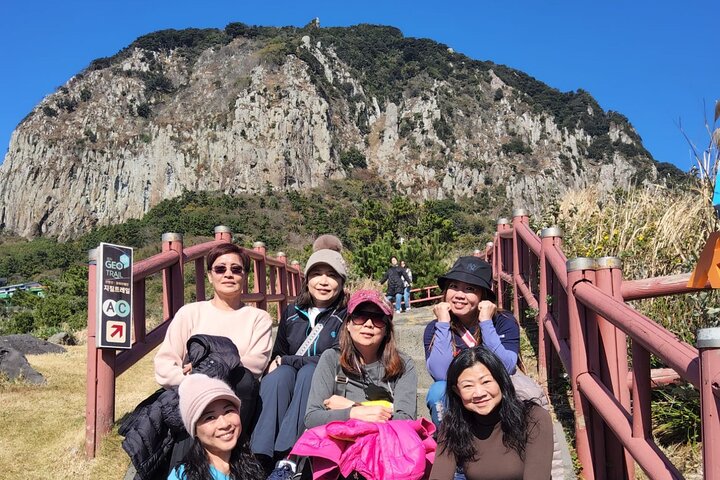
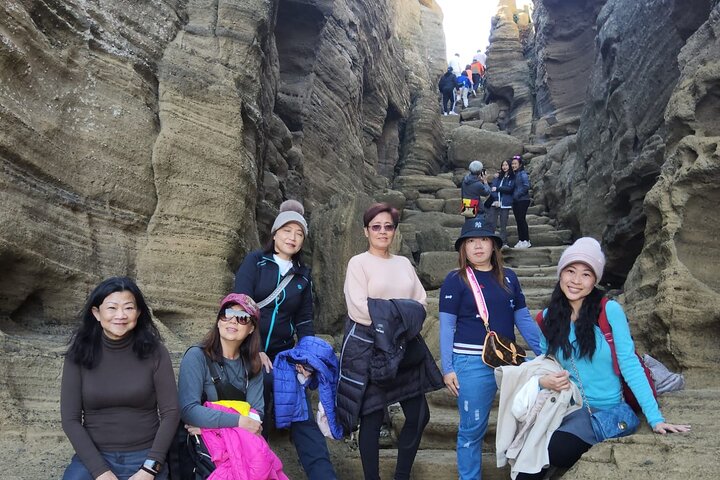
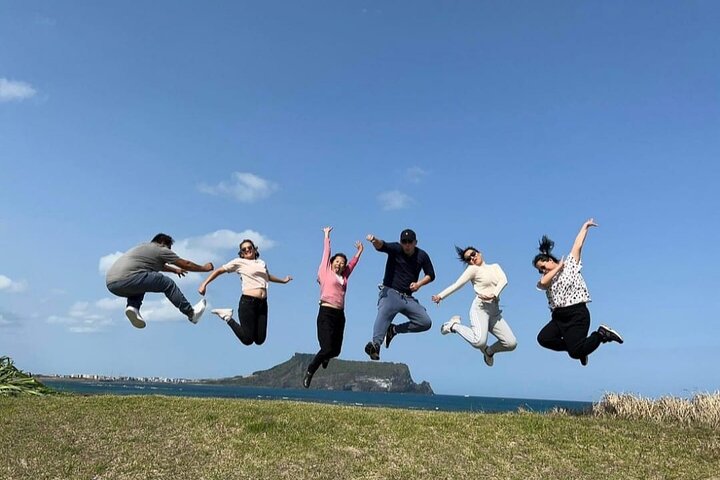
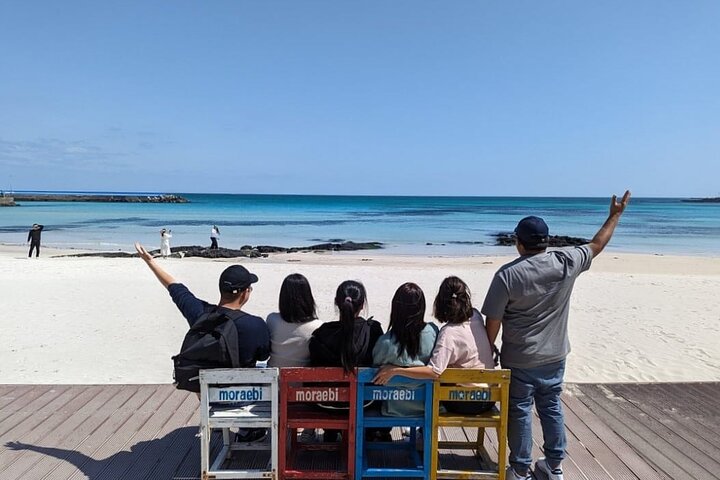
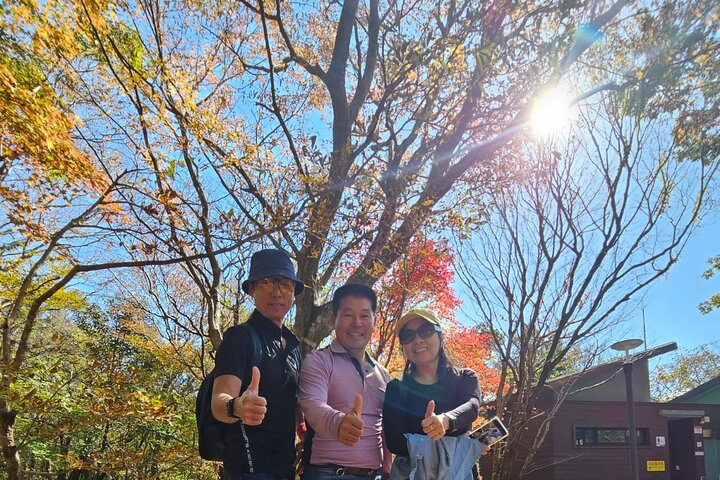
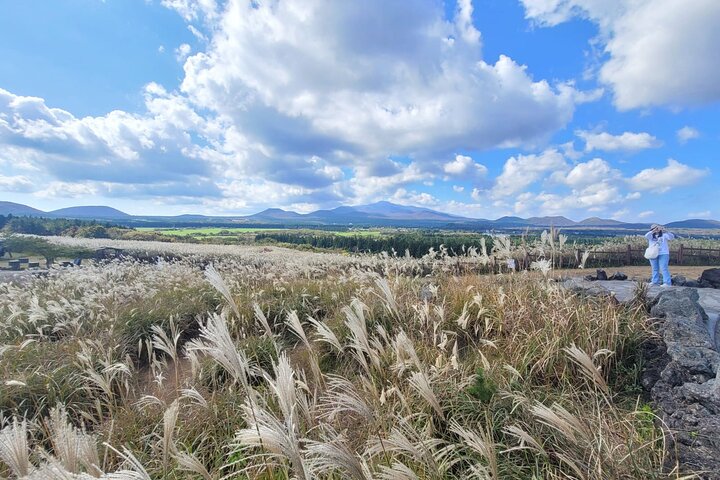
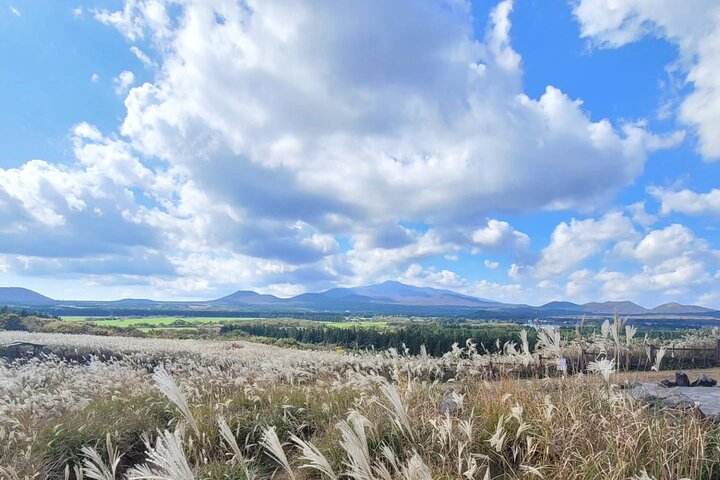
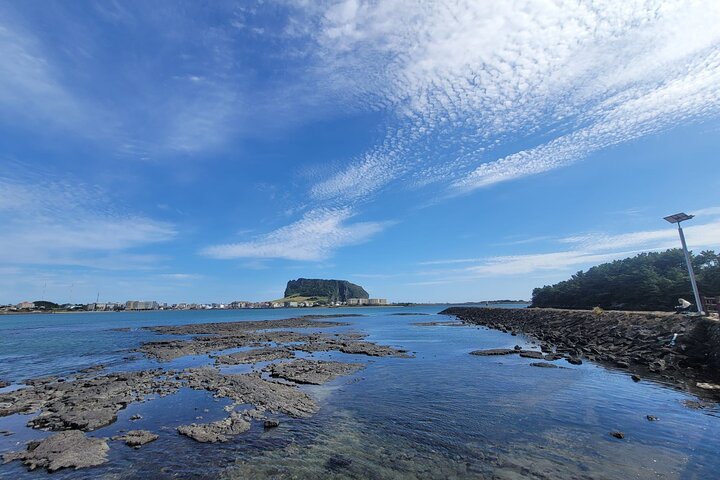
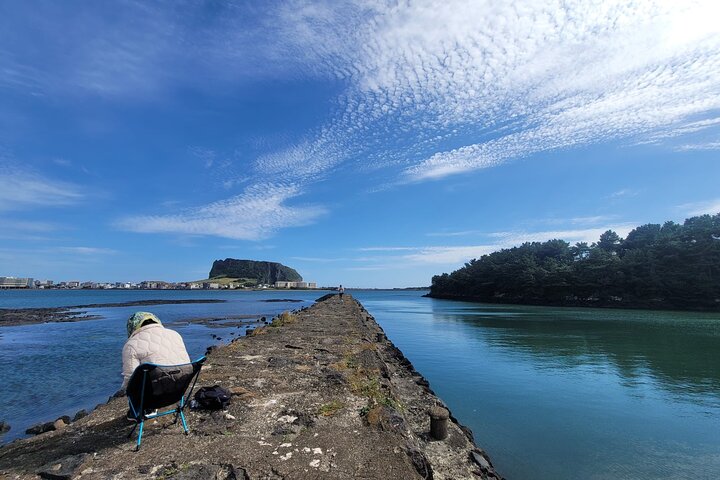
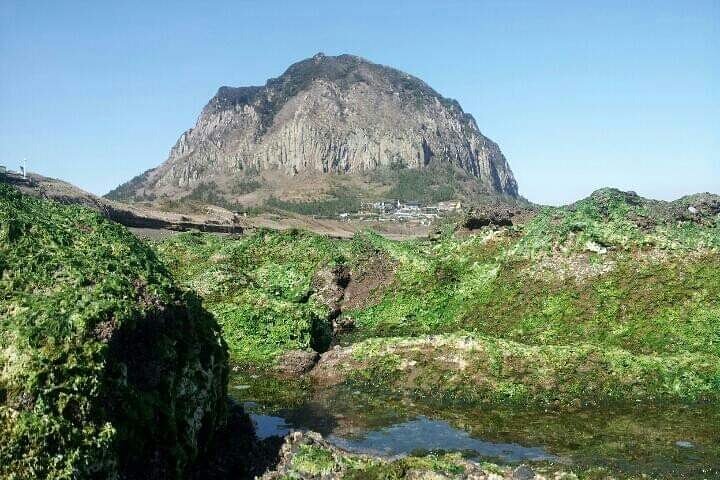
Private jumbo taxi tour - East of jeju island만장굴( Manjanggul Lava Tube) Of all the oreum on Jeju, Geomunoreum is the only parasitic cone to be designated as a UNESCO World Natural Heritage site. The oreum holds over 20 caves within its body, although only Manjanggul Lava Tube is open to the public. With its profoundly mysterious and grand appearance, taking a step inside the cave is like stepping into Hades’ underworld. Follow the tunnel of articulate lava rock formations, and you will soon reach a giant rock pillar that indicates the end of the cave. The cave’s temperature fluctuates within 11-21℃ regardless of season, allowing visitors to enjoy the magnificent cave all year round월정리 해변(Woljeong-ri Beach) Well known for its beautiful scenery, white sand and emerald water, Jeju Woljeong-ri Beach has a road filled with tea houses and coffee shops. This is a great stopover during your trip to Jeju Island, and one of few places to enjoy an exotic view.성산일출봉(seongsan illchulbong) Seongsan Ilchulbong Tuff Cone, a landmark attraction of Jeju, was formed about 5,000 years ago from an eruption of magma on the ocean floor. It is especially famous as a sunrise viewing spot, known to be one of the top ten exquisite sceneries of Jeju Island.Besides viewing the sunrise, Seongsan Ilchulbong Tuff Cone is also known to be an excellent trekking spot. The Seongsan-Ojo Trail connects two villages by crossing the peak. Another popular trail, the Jijil Trail, offers a closer look at the UNESCO-designated geopark as well as Jeju’s local culture. Walking along one of these paths is recommended to really experience the area; walking all the way to the summit offers views of both the vast volcanic crater in the center and the blue ocean surrounding the area. To complete your trip, head to Seongsanpo Port to watch haenyeo (female divers) at work.섭지코지(Seopjikoji) A short drive from Seongsan Ilchulbong Peak will take you to Cape Seopjikoji. The name comes from the Jeju dialect for a “Cape of Small Land” due to its peculiar cliff formation that protrudes into the ocean. The picturesque harmony of the hill and ocean attract tourists all year round. You might even be able to sight Jeju ponies grazing on the field of grass.Walking northeast along the cliff, you will arrive at Bulgeunoreum Parasitic Cone, offering an exquisite view of a white lighthouse with the dark blue sea in the background. Additional noteworthy attractions of Cape Seopjikoji are the Glasshouse and Yumin Art Gallery, two masterpieces designed by world-renowned architect Ando Tadao. The two buildings blend in remarkably well with the surrounding nature.성읍민속마을 (Seongeup FILK Village) The entire village, which preserves the living site of the people of old Jeju, has been designated as an Important Folklore Cultural Heritage. Though it can be considered a folk village of sorts, it differs from regular folk villages in that people still live in it to this day. The village residents act as volunteer guides to offer visitors all sorts of information. The Saw-leaf Zelkova and Japanese hackberry in the center of the village are worth taking time to see.산굼부리(Sangumburi Crater) Sangumburi Crater differs from the 360 or more parasitic cones of Jeju in that it was not formed when the materials ejected from the eruption stacked.Instead, it is a maar-type parasitic cone that was formed as a crater with a hole in it when many materials were ejected.The inner area is 300,000㎡, while the interior bottom circumference is 756m, and the exterior circumference is 2,070m. Nearly vertical, the crater is approximately 130m tall, making it slightly larger and deeper than Hallasan Mountain.In autumn, when the ridges of Sangumburi Crater are colored gold by waves of silvergrass, the planted cedar becomes the dominate species that take up most of the eastern and western slopes, with Sawtooth oak in the surrounding area.Furthermore, Korean Fir has been planted to form a forest path. Excluding these lush forests, colonies of Eulalia grass cover large patches of the crater.사려니숲 (Saryeoni Forest) Saryeoni Forest Path is a forest walking trail that starts from Bijarim-ro and goes through Mulchat Oreum Volcanic Cone and Saryeoni Oreum Volcanic Cone. Its starting point is located at National Road No. 1112, which is thick with cedars. A variety of species of trees grow in the forest, such as Konara Oak, Red-Leaved Hornbeam, Snowbell, Hinoki Cypress, and cedar. The average altitude is 550m. This is one of the hidden 31 views of Jeju-si. It is popular among tourists who love hiking, because the nature of the forest hasn’t been tampered with.해녀박물관 Jeju haenyeo are the strong mothers of Jeju and the spiritual pillars of Jeju residents. Also, the life of the Jeju haenyeo community is a model that humanity should aim for. Jeju haenyeo formed a merit-based community and democratically decided through discussions. She not only cared for the elderly and infirm, such as Halmang Badang and Geseok, and raised funds with her material profits to contribute to society, such as villages and schools. She also came up with various contraptions to coexist with the sea, such as beach sweeping, gold snatching, and dialysis. Jeju haenyeo culture was recognized for its value and was registered as a UNESCO Intangible Cultural Heritage of Humanity on November 30, 2016 (local time).Eco Land Theme Park is located in Gyorae Gotjawal, It is a mysterious forest where northern limit plants and southern limit plants coexist due to its high heat retention and moisturizing effect. You can feel the greatness of the forest that covered the rock and blocked the sky with the desperate and fierce power of life on top of the lava rock, making it a paradise for animals and plants. While enjoying the 4.5km train journey, you can experience insects, animals, and various plants that live in the mysterious forest of Gotjawal. It is a space where we can learn the infinite benefits that nature gives us. Our Ecoland theme park does not violate the providence of nature and cherishes even a single blade of grass. We want to be a bridge that connects humans and nature.In the volcanic land of stones and rocks, the roots are long in the crevices of rocks to find a single ray of light.
South Korea · Geological Wonders
3 Days Private jumbo taxi Tour in Jeju Island with Mr.Ko (Suhong)
The journey
- 01 Private 3-day jumbo taxi tour around Jeju Island
- 02 Explore the east, west, and south regions of Jeju
- 03 Visit UNESCO-listed sites including Manjanggul Lava Tube and Seongsan Ilchulbong
- 04 See scenic beaches such as Woljeong-ri, Hyeopjae, and Handam
- 05 Discover volcanic landscapes, cliffs, waterfalls, and forest trails
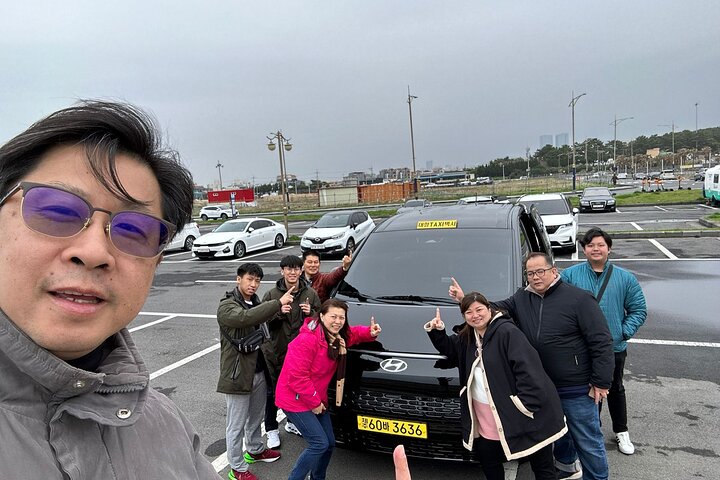
- 06 Enjoy private pickup and drop-off in Jeju-si or Jeju Cruise Terminal
- 07 Travel with an experienced local driver
- 08 Admission fees, fuel, parking fees, and insurance included
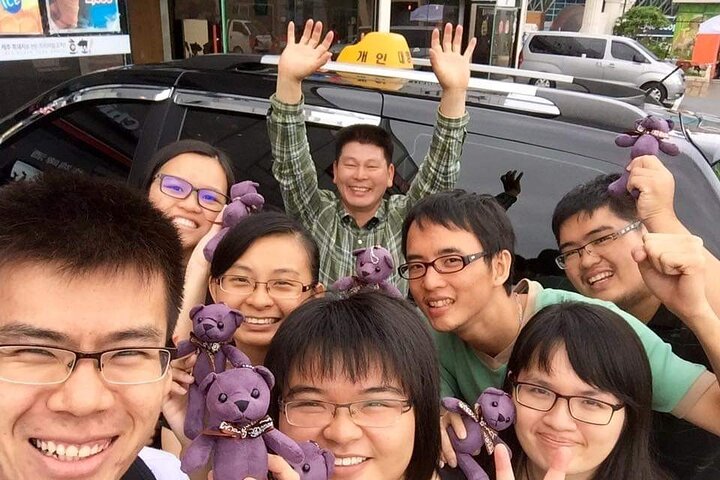
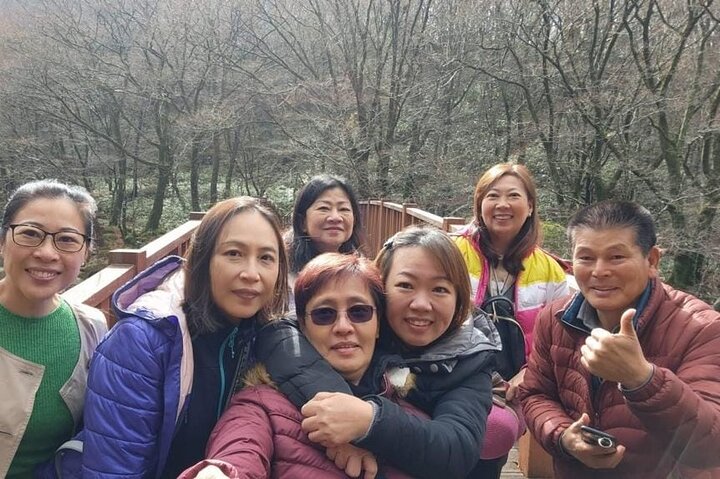
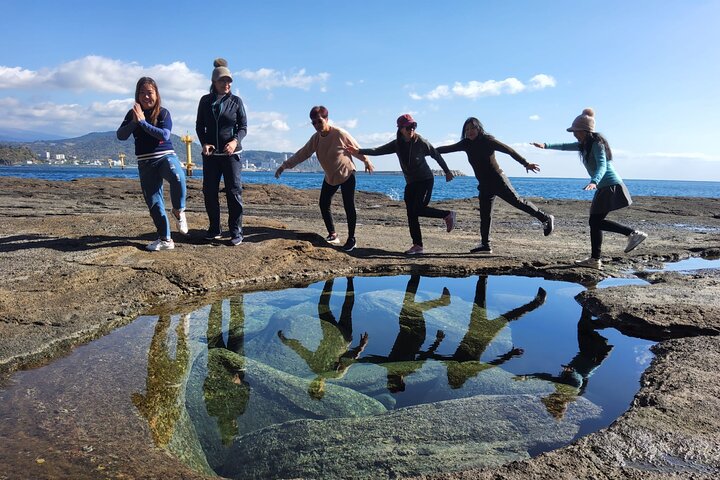
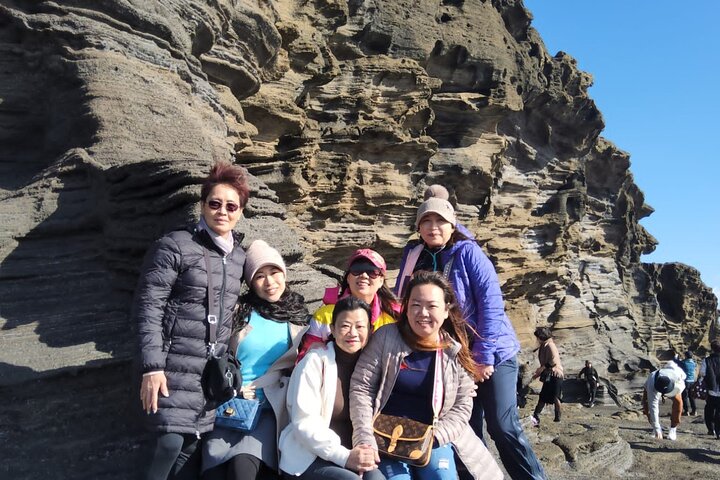
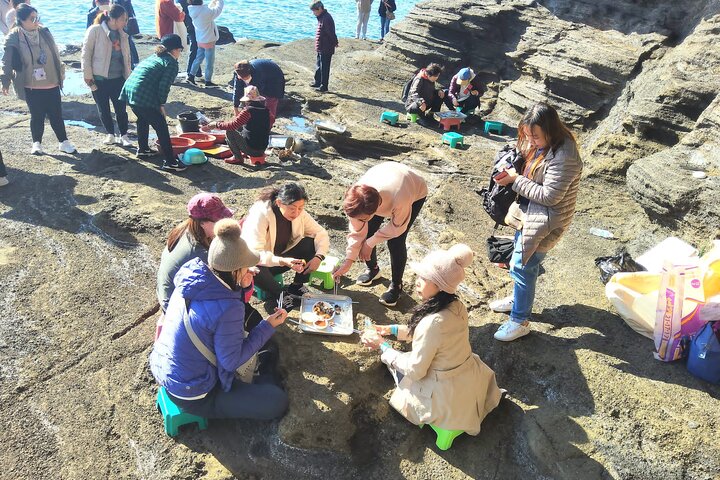
Discover Jeju over three days on a private jumbo taxi tour that explores the island’s east, west, and south. From UNESCO-listed natural heritage sites and volcanic landscapes to scenic beaches, waterfalls, forest trails, and cultural stops, this experience is designed to help you see Jeju’s most memorable highlights in comfort.
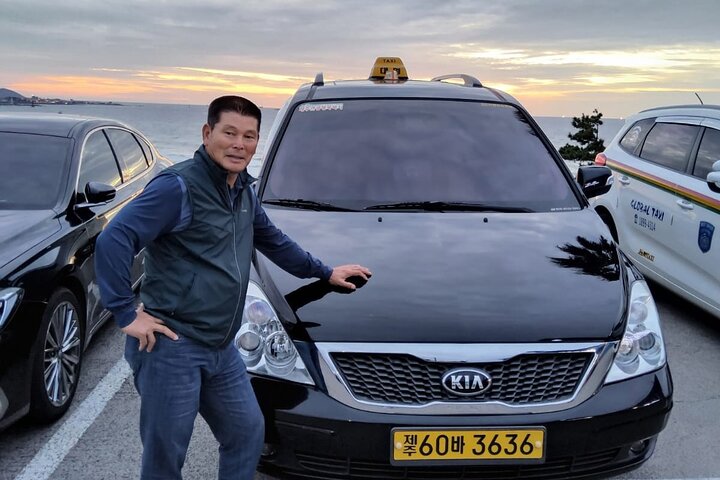
Travel with an experienced local driver who focuses on a smooth and enjoyable journey while showing you major attractions, hidden photo spots, and local favorites along the way. With private transport included, it’s a relaxed way to experience the diverse beauty of Jeju Island.
With its profoundly mysterious and grand appearance, taking a step inside the cave is like stepping into Hades’ underworld.
From the itinerary
At a glance
What this trip includes
Day by day
The itinerary
private Jumbo taxi tour - West of jeju islandHyeopjae Beach is adjacent to Hallim Park, 32 km west of Jeju City. The white sandy beach mixed with shell powder, Biyangdo Island floating in the front sea, the beautiful cobalt-colored sea and the dense pine forest all harmonize together, and the scenery is very beautiful. The white sandy beach is about 200m long, 60m wide, average water depth is 1.2m, and the slope is 3-8 degrees. The water depth is shallow and the slope is gentle, so it is suitable as a beach for families. In addition, various convenient facilities are well equipped, and camping is possible in the pine forest. The southwest coast of this beach is connected to Geumneung Beach, and residents call the two beaches together Hyeopjae Beach.Sinchang Windmill Coastal Road Sinchang Windmill Coastal Road is on the northwest side of Jeju Island and has a distinctive offshore wind farm as a prominent landmark. The white windmills and emerald waters along the winding shoreline are a refreshing example of the autumn landscape and an environmentally friendly way to generate electricity. This road is also one of the most beautiful places to view the sunset from Jeju, so be sure to bring your camera!
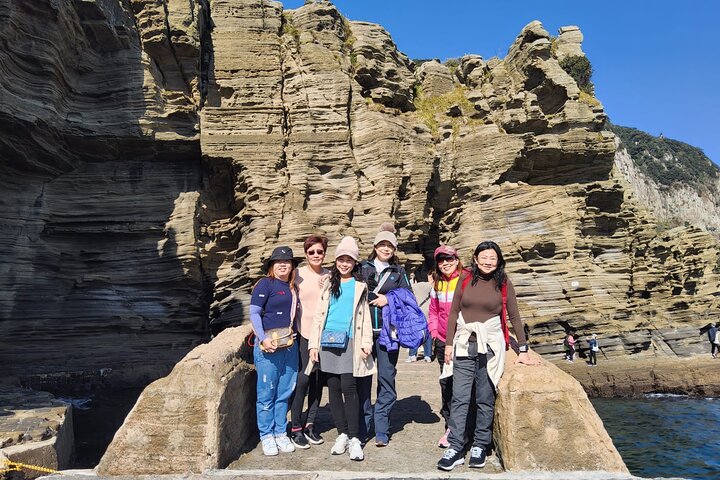
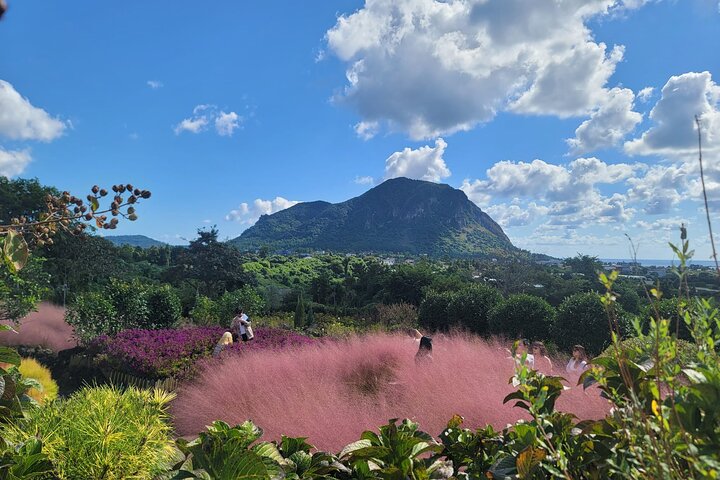
You can also find an Ecological Experience Center walking course on the coastal road. The observation deck built midway along the walking course is a convenient place to rest and enjoy the view. Walk along the Sinchang Windmill Coastal Road and leave with many pleasant memories, and of course a photo or two!용머리해안 (Yongmeori Coast) The Yongmeori Coast got its name because the beach looks like a dragon that is jumping into the ocean with its head raised (“Yong” means dragon and “Meori” means head in Korean).Yongmeori is a sandstone bed created by layers of sand that have been deposited for tens of millions of years. The mysterious scenery of the coast is enough to make anyone who witnesses it exclaim in wonder.At the foot of the coast is a Hamel Monument. This monument was established by the Embassy of the Netherlands and the Korean Foundation on April 1st, 1980 to strengthen the diplomatic ties between Korean and the Netherlands, as well as to commemorate the dedication and hard work of Hendrick HamelOsulloc Tea Museum, which is adjacent to the Seogwang tea field in Jeju, is the first tea museum in Korea opened in 2001 by AMOREPACIFIC to introduce and widely disseminate tea and Korean traditional tea culture. It is a cultural space that harmonizes East and West, tradition and modernity, and consists of a tea museum, a nature-friendly rest area, and a cafe space where you can enjoy delicious and diverse menus using tea.한담해변 (Handam Beach) Handam Beach is spread out along the coastline from Aewol-ri Village, which is at the northwestern edge of Jejudo Island, to Gwakji Gwamul Beach. Jeju Special Self-Governing Province made this beach in 2001 as a part of the coastline improvement plan in order to give the islanders and tourists more diverse opportunities to enjoy the ocean. The plan’s priority was to create a harmony with the surrounding view. There is a 1.2km long winding trail that is paved along the beautiful coastline that was made to be as close to the ocean as possible. This is a very popular place because visitors can enjoy a relaxing walk along the vast blue ocean. In July 2009, Jeju-si designated 31 sites that represent Jejudo Island besides the already famous tourist sites and Handam Beach was chosen as one of these 31 hidden views of Jeju-si.송악산(Songaksan Mountain’s peak) Consisting of a cinder cone in the middle of the crater and its tuff ring, Songaksan Mountain’s peak, which can also be considered as its mouth, has a depth of 69m and has completely preserved its active form.While it was previously unknown to visitors outside of those with archaeological reasons, recently it has become part of a well-known tour course and now many narrow paths lead to it.Songaksan Mountain was used as Japan’s forward operating base during its invasion of China, the last line of defense during the final hours of WWII. Ruins of airfields, hangars, and anti-aircraft artillery are scattered throughout, with 15 coastal trenches below the coastal cliff, four or five of which have naturally decomposed and pose falling hazards.It has high preservation value because the cave was built using the shore cliff, and the trenches are located by the seaside to create excellent oceanic view.수월봉(Suwolbong Geo Trail) The scenery of setting sun at this volcanic cone is comparable to the view of the sunset at Sarabong Volcanic Cone. At the observatory located at the peak of Suwolbong Peak, visitors can see Chagwido Island, Songaksan Mountain, Dansan Mountain, and Jukdo Island in one glance, and can even observe Sarabong with binoculars. Suwolbong holds a legend called Nokdumul that tells of a story of a brother and sister’s love for their parents. According to the legend, the siblings, Nokgo and Suwol, were collecting 100 different herbs to cure their mother’s sickness, but weren’t able to find the last herb, Acanthopanax senticosus. When they learned that the last herb grew on Suwolbong Peak’s cliff, Suwol, the sister, climbed the cliff to harvest it
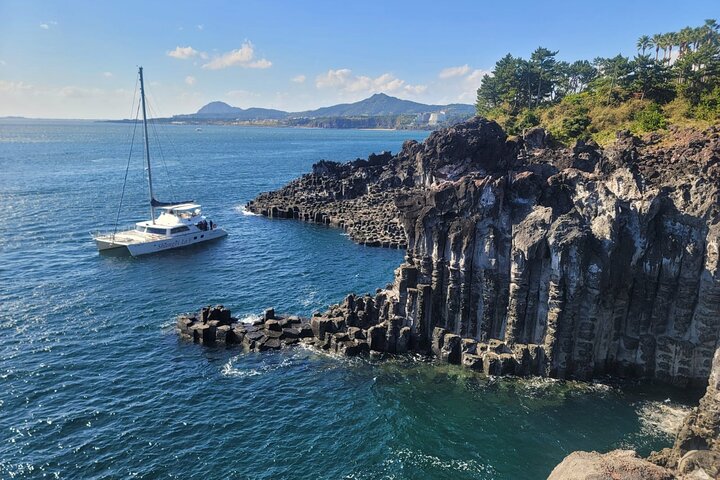
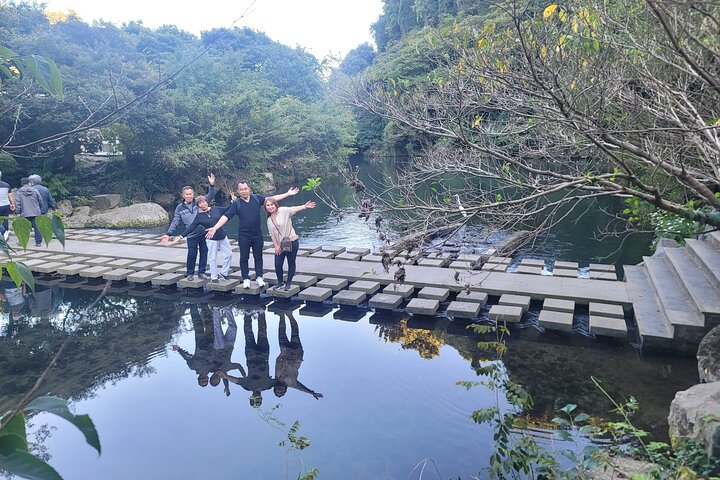
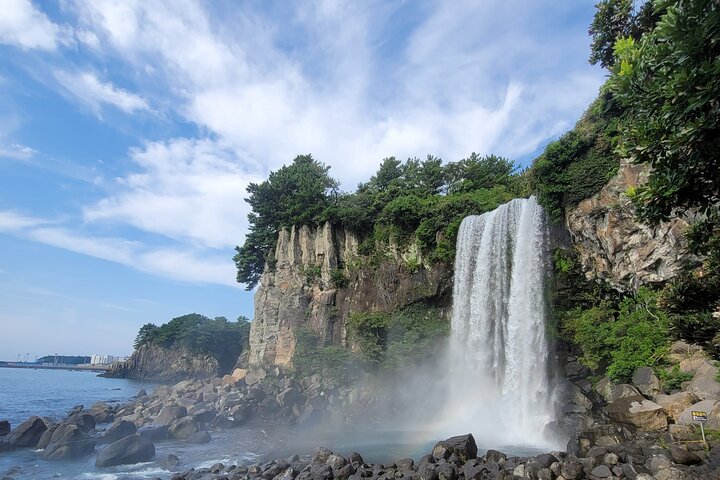
private Jumbo taxi tour - South of jeju island도깨비도로(Mysterious Road) This fun spot is called the Jeju Mysterious Road or Dokkaebi Road. It earned its name because when you place a car on this steep road, the car does not roll down but it goes up, defying gravity. This is actually an optical illusion, in which the surroundings trick the eye and make the road look like it is tilted in the opposite direction.Eoseungsaengak (Eoseungsaeng Volcanic Cone), a parasitic volcano of Hallasan Mountain, can be climbed from the Eorimok District of Hallasan Mountain National Park. From Cheonwangsa Temple, take the 1100 Road from Cheonwangsa Temple to Seogwipo. It takes about an hour round trip from Eorimok to the top of Eoseungsaengak Peak. The hiking trail is made of log stairs, and the floor is laid with wide wooden boards as a measure to prevent soil loss at the summit. At the beginning of the trail, there is a sign that reads "Eoseungsaengak Hiking Trail". The origin of the name Eoseungsaeng came from "the place where the king's horse flies", and there is an interesting legend related to it. A central official was exiled after being falsely accused of treason. This official died here, worrying only about the king and the country, but he said, "I will be reborn and become a horse ridden by the king to support the king." He died without speaking.주상절리(Jusangjeolli Cliff) Jeju Jungmun Resort is blessed with not only beautiful natural scenery but also with numerous entertainment and convenience facilities catering to both domestic and international tourists. Jusangjeolli Cliff, near the International Convention Center Jeju, delivers a sight to behold with its gigantic rock pillars running along the costal line.Oedolgae, the starting point of Jeju Olle Trail Course 7, is a stone pillar that rises 20m high from the sea. Standing alone on the sea, it was named ‘Oedolgae’. It is also called ‘General Stone’ and ‘Grandma Rock’, and there is a story that General Choi Yeong decorated this rock like a general when fighting against the Yuan Dynasty and made the enemy self-destruct. For the origin of the name 'Grandma Rock', read the legend below. Not only the visible rocks, but also the life of Jeju people waiting for the people of the sea can be seen. These stone pillars are believed to have been created during a volcanic eruption. A chimney-shaped stone pillar in which the surrounding rocks are eroded by waves and only such strong rocks remain is called a sea stack in scientific terms. Pine trees grow naturally on the top of Oedolgae, giving a picturesque impression. Depending on the viewing direction, it shows a different appearance, and you can feel the beauty of nature.정방폭포( Jeongbangpokpo Falls) Seogwipo, which includes the entire southern half of Jeju, exhibits a great amount of sunshine and warm temperatures, attracting crowds of tourists all year round. One attraction many people choose to visit is Jeongbangpokpo Falls, one of the top three waterfalls on Jeju Island. The water falls 23 meters straight down off the cliff and into a pool before flowing to the sea.Located on the cliff behind Jeongbangpokpo Falls is Waljong Art Gallery. This gallery is dedicated to the Korean artist Lee Wal Jong, who settled in Jeju decades ago. The gallery is filled with his inspiring artworks, expressing the beauty of Jeju in his own unique way. The strategic location and glass-walled second floor also offer visitors an amazing view looking over the sea.Seogwipo Olle Market is the largest market in Seogwipo-si and a traditional market that was created spontaneously in the early 1960s. Starting with a 120m arcade in 2001, a total of 620m arcade arcades have been installed to play a pivotal role in Seogwipo's economy. The parking lot here provides maximum convenience to customers by introducing a 1-hour free parking system, and is equipped with a delivery system that delivers goods to the desired location for free for the convenience of customers who purchase products at the market. It is also equipped with an outdoor performance hall and a park with a fountain for future potential customers, teenagers.카멜리아힐 (Camellia Hill) Located in Sangchang Village, Andeok-myeon, the 20-hectare park holds some 6,000 camellia trees and over 500 different species of wildflowers, trees and other plants, like hydrangeas. It’s about an hour by bus to the southwest of Jeju City.Camellia Hill also has facilities like a gallery for camellia-themed crafts, green houses, a multipurpose seminar room, and more.
The fine print
Trip details
What's Included
- we offer pick-up and drop-off services from your located in Jeju
- we offer pick-up and drop-off services from Jeju Cruise Terminal
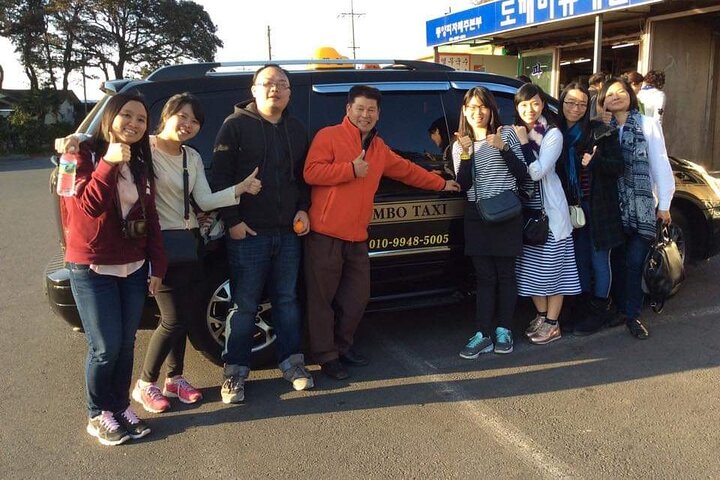
- Driver (Mr. KO Suhong) and Jumbo Taxi The fuel and parking fees are included in the price
- Mr.ko is already booked, you will be assigned another friendly driver.
- Insurance included
- Entry / Admission fee
What's Not Included
- Lunch / Personal Expenses / Food and Drinks
- Gratuities are recommended, but not compulsory
Know before you go
- Not wheelchair accessible
- Not stroller accessible
- Not suitable for pets
- No public transportation nearby
- Infants must not sit on laps
- Infant seats unavailable
- If Manjanggul Cave is closed (on the first Wednesday of every month), Jeju Haenyeo Museum will be offered as an alternative tour
- If you cannot enter Yongmeori Coast due to bad weather, it will be replaced with another location
- This is a private tour / activity . Only your Group will participate
- Manjanggul Cave, a World Natural Heritage site, will reopen on May 30, 2026.
- The driver waits for you at the pick-up point or YOUR Hotel.
- When picking up at Jeju Airport, Driver will wait at Jeju Airport Arrival Gate 1.
- Hold your name card.
- When picking up at Jeju Cruise Terminal, Driver will be waiting for you at the Cruise Terminal Exit. Hold your name card.
Logistics
Meeting & route
Your 3 days finish where they began, in Pickup service provided in Jeju-si..
 Watch the film
Create your own adventure
Can't find the perfect tour? Tailor your dream trip.
- Tell us your destination, dates and group size.
- Our travel experts and local guides design a tailored itinerary, just for you.
- Enjoy your trip with peace of mind, knowing everything is taken care of.
Say goodbye to travel stress.