

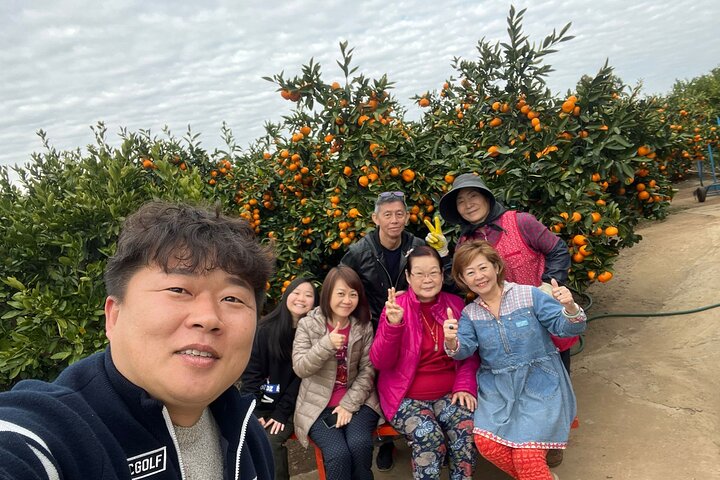
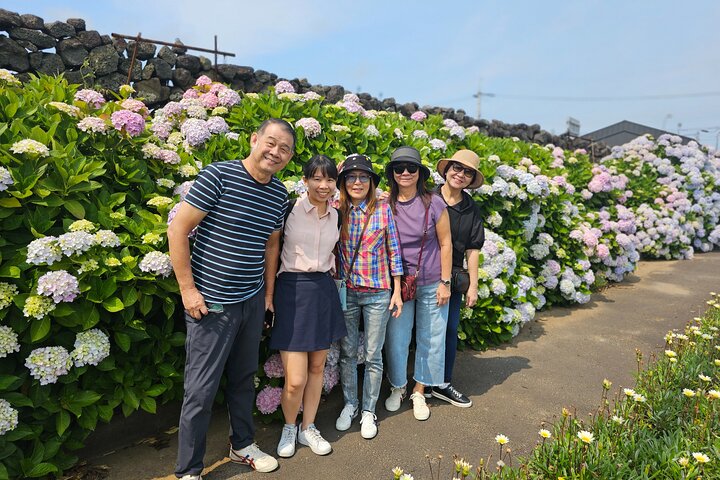
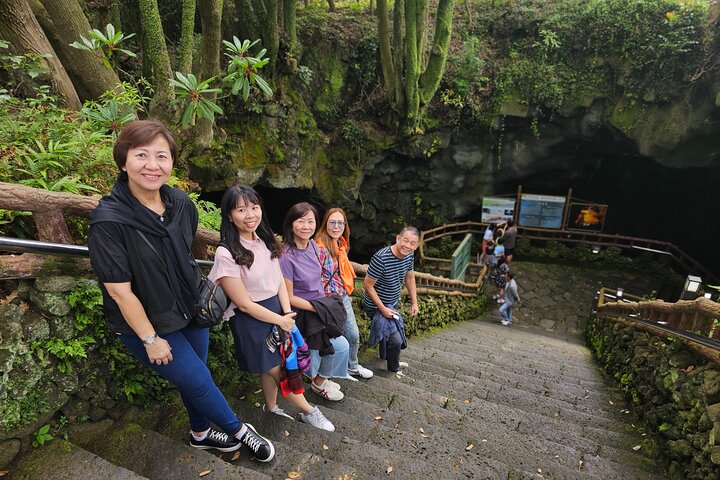
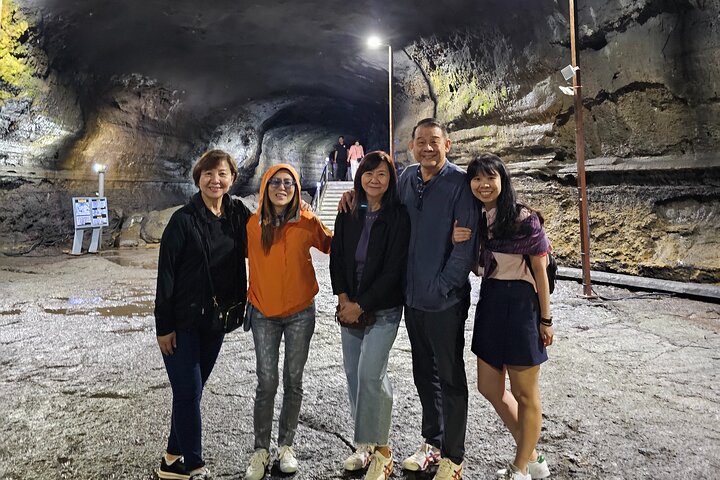
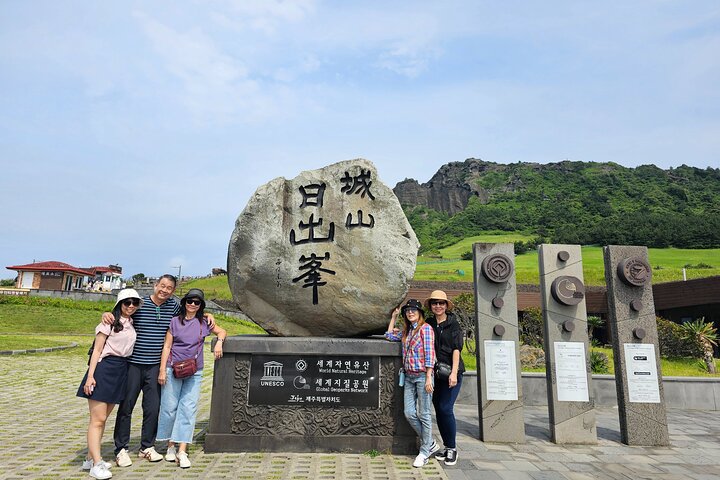
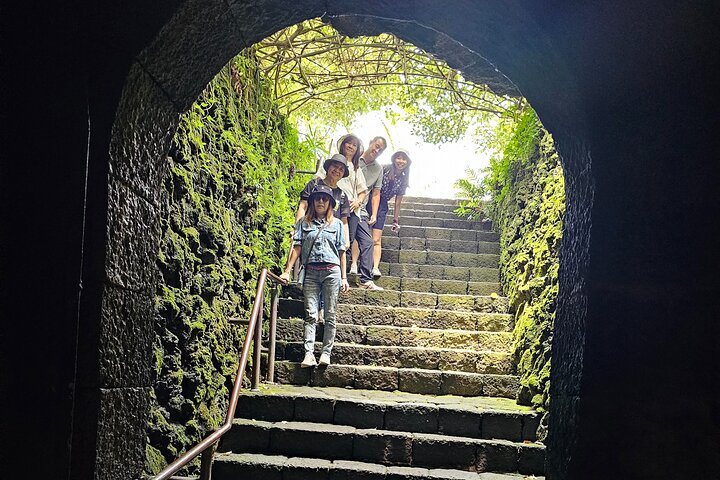
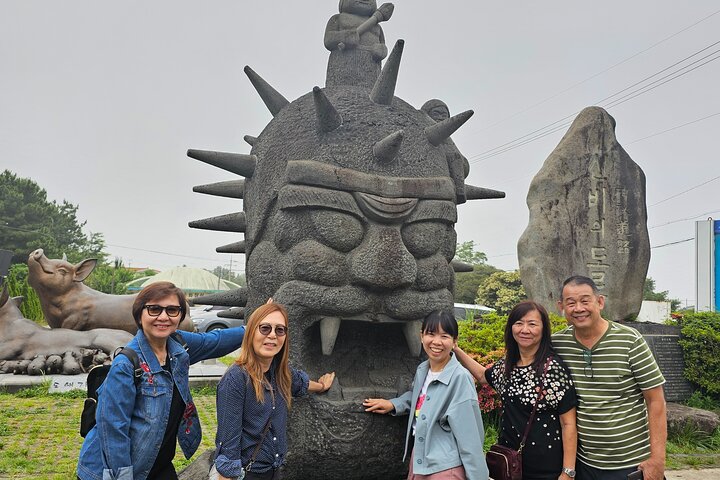
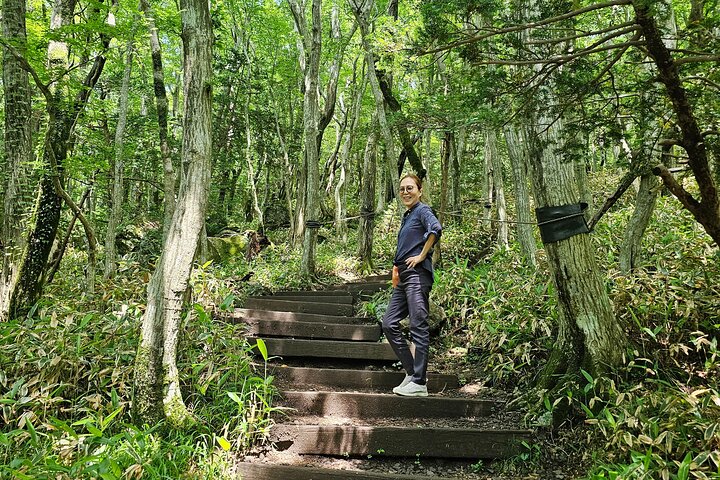
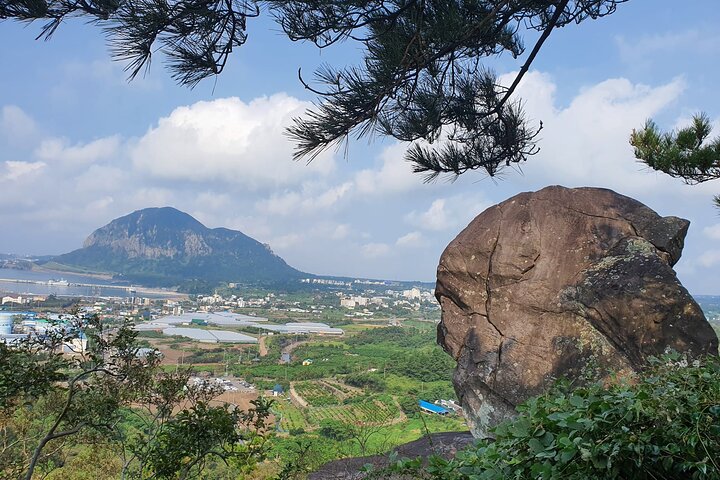
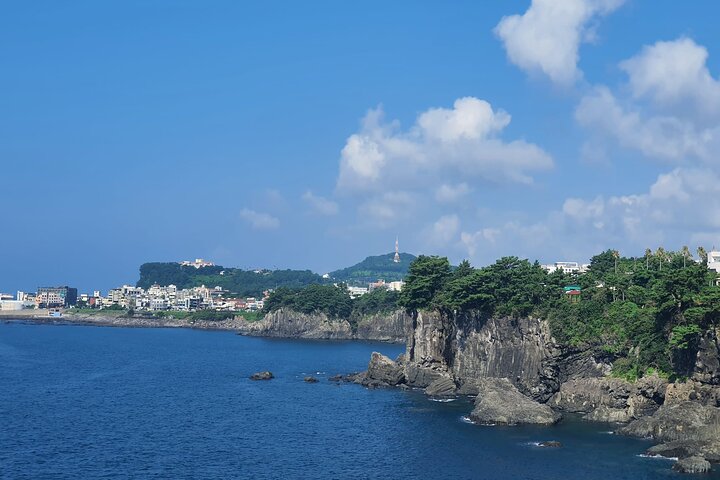
(seongsan illchulbong) Seongsan Ilchulbong Tuff Cone, a landmark attraction of Jeju, was formed about 5,000 years ago from an eruption of magma on the ocean floor. It is especially famous as a sunrise viewing spot, known to be one of the top ten exquisite sceneries of Jeju Island. Besides viewing the sunrise, Seongsan Ilchulbong Tuff Cone is also known to be an excellent trekking spot. The Seongsan-Ojo Trail connects two villages by crossing the peak. Another popular trail, the Jijil Trail, offers a closer look at the UNESCO-designated geopark as well as Jeju’s local culture. Walking along one of these paths is recommended to experience the area; walking to the summit offers views of both the vast volcanic crater in the center and the blue ocean surrounding the area. To complete your trip, head to Seongsanpo Port to watch Hengyeo (female divers) at work.( Manjanggul Lava Tube) Of all the oreum on Jeju, Geomunoreum is the only parasitic cone to be designated as a UNESCO World Natural Heritage site. The forum holds over 20 caves within its body, although only the Manjanggul Lava Tube is open to the public. With its profoundly mysterious and grand appearance, taking a step inside the cave is like stepping into Hades’ underworld. Follow the tunnel of articulate lava rock formations, and you will soon reach a giant rock pillar that indicates the end of the cave. The cave’s temperature fluctuates within 11-21℃ regardless of season, allowing visitors to enjoy the magnificent cave all year roundIf you walk along Jeju Olle Course 19, you will come across Hamdeok Beach, which has an emerald jewel. Hamdeok Beach, located in Hamdeok-ri, Jocheon-eup, Jeju-si, is also called ‘Hamdeok Seoubong Beach’ because of Oreum (Seoubong Peak) standing right next to the beach. It is only 20km away from Jeju Airport, but the moment you arrive here, you feel like you are in another country. The tall palm trees that welcome you from the entrance, the emerald sea that contrasts with the white sand, and the clear water and white waves that make even the sand and seaweed transparent are like that. Among the numerous beaches in Jeju Island, if you choose three places with the most beautiful sea color, it is Hyeopjae Beach, Gimnyeong Beach, and Hamdeok Beach. The water is clear and the water depth is shallow, so it is also a good summer resort for families. The west side of the beach is connected by an overpass, so you can experience walking on the sea.Jeju haenyeo are the strong mothers of Jeju and the spiritual pillars of Jeju residents. Also, the life of the Jeju haenyeo community is a model that humanity should aim for. Jeju haenyeo formed a merit-based community and democratically decided through discussions. She not only cared for the elderly and infirm, such as Halmang Badang and Geseok, and raised funds with her material profits to contribute to society, such as villages and schools. She also came up with various contraptions to coexist with the sea, such as beach sweeping, gold snatching, and dialysis. Jeju haenyeo culture was recognized for its value and was registered as a UNESCO Intangible Cultural Heritage of Humanity on November 30, 2016 (local time).The entire village, which preserves the living site of the people of old Jeju, has been designated as an Important Folklore Cultural Heritage. Though it can be considered a folk village of sorts, it differs from regular folk villages in that people still live in it to this day. The village residents act as volunteer guides to offer visitors all sorts of information. The Saw-leaf Zelkova and Japanese hackberry in the center of the village are worth taking time to see.Sangumburi Crater differs from the 360 or more parasitic cones of Jeju in that it was not formed when the materials ejected from the eruption stacked. Instead, it is a maar-type parasitic cone that was formed as a crater with a hole in it when many materials were ejected. The inner area is 300,000㎡, while the interior bottom circumference is 756m, and the exterior circumference is 2,070m. Nearly vertical, the crater is approximately 130m tall, making it slightly larger and deeper than Hallasan Mountain. In autumn, when the ridges of Sangumburi Crater are colored gold by waves of silver grass, the planted cedar becomes the dominant species that takes up most of the eastern and western slopes, with Sawtooth oak in the surrounding area. Furthermore, Korean Fir has been planted to form a forest path. Excluding these lush forests, colonies of Eulalia grass cover large patches of the crater. The colonies of silver grass make up the representative scenery of Sangumburi Crater(Jeongbang Falls) Jeongbang Falls is one of Jejudo Island’s top 3 falls, along with Cheonjiyeon Falls and Cheonjeyeon Falls. It is the only fall in Korea where water falls directly into the sea. The fall is 23m high and the two streams of waterfall that fall down the black cliff create a thrilling sound and a wonderful view. Moreover, the cliffs and old pine trees around the fall create a picturesque view, and this view was chosen as one of the Ten Scenic Sights of Yeongju with the name “Jeongbanghapok.” It is said that the words ‘Seobulgwacha’ are engraved on the cliffs of Jeongbang Falls. According to legends, a man named Seobul came to the island in search of an elixir plant on the orders of China’s Qin Shu Huangdi a long time ago. Unable to find the elixir plant, he headed west to return to China and became captivated by the site of Jeongbang Falls, leading to him writing “Seobulgwacha’ on the cliff.(Oedolgae) Oedolgae, the starting point of Jeju Olle Trail Course 7, is a stone pillar that rises 20m high from the sea. Standing alone on the sea, it was named ‘Oedolgae’. It is also called ‘General Stone’ and ‘Grandma Rock’, and there is a story that General Choi Yeong decorated this rock like a general when fighting against the Yuan Dynasty and made the enemy self-destruct. For the origin of the name 'Grandma Rock', read the legend below. Not only the visible rocks but also the life of the Jeju people waiting for the people of the sea can be seen. These stone pillars are believed to have been created during a volcanic eruption. A chimney-shaped stone pillar in which the surrounding rocks are eroded by waves and only such strong rocks remain is called a sea stack in scientific terms. Pine trees grow naturally on the top of Oedolgae, giving a picturesque impression. Depending on the viewing direction, it shows a different appearance, and you can feel the beauty of nature.(Jusangjeolli Cliff) Jeju Jungmun Resort is blessed with not only beautiful natural scenery but also numerous entertainment and convenience facilities catering to both domestic and international tourists. Jusangjeolli Cliff, near the International Convention Center Jeju, delivers a sight to behold with its gigantic rock pillars running along the coastal line.(Yongmeori Coast) The Yongmeori Coast got its name because the beach looks like a dragon that is jumping into the ocean with its head raised (“Yong” means dragon and “Meori” means head in Korean). Yongmeori is a sandstone bed created by layers of sand that have been deposited for tens of millions of years. The mysterious scenery of the coast is enough to make anyone who witnesses it exclaim in wonder. At the foot of the coast is a Hamel Monument. This monument was established by the Embassy of the Netherlands and the Korean Foundation on April 1st, 1980 to strengthen the diplomatic ties between Korea and the Netherlands, as well as to commemorate the dedication and hard work of Hendrick HamelOsulloc Tea Museum, which is adjacent to the Seogwang tea field in Jeju, is the first tea museum in Korea opened in 2001 by AMOREPACIFIC to introduce and widely disseminate tea and Korean traditional tea culture. It is a cultural space that harmonizes East and West, tradition and modernity and consists of a tea museum, a nature-friendly rest area, and a cafe space where you can enjoy delicious and diverse menus using tea.You can find the largest seafood market in Jeju-si, a place that includes Sanjicheon Fountain. Dongmun Market Place consists of Dongmun Street Market, Dongmun Traditional Market, and Dongmun seafood market. You can buy all different kinds of seasonal fish and pickled fish here, among other things.
South Korea · Geological Wonders
Small group tour FULL - PACKAGE Tour to All Areas in Jeju Island
The journey
- 01 Full-day Jeju Island sightseeing experience
- 02 Visit UNESCO-listed Seongsan Ilchulbong
- 03 Explore the famous Manjanggul Lava Tube
- 04 See Jeju’s volcanic craters, cliffs, and waterfalls
- 05 Enjoy coastal scenery including Hamdeok Beach and Oedolgae
- 06 Learn about Jeju haenyeo culture
- 07 Pickup and drop-off in Jeju included
- 08 Entrance fees to natural tourist sites included
Discover Jeju’s dramatic volcanic landscapes, coastal scenery, and living cultural heritage on this full-day tour designed to help you make the most of your time on the island. With pickup in Jeju and entrance fees to natural attractions included, this experience brings together some of Jeju’s best-known UNESCO and scenic highlights in one convenient day.
Depending on your schedule and departure area, the itinerary can be adjusted to suit your stay. Along the way, explore landmark sites such as Seongsan Ilchulbong and Manjanggul Lava Tube, admire beaches, cliffs, waterfalls, and crater landscapes, and experience the unique culture that makes Jeju so memorable.
Discover Jeju’s dramatic volcanic landscapes, coastal scenery, and living cultural heritage on this full-day tour designed to help you make the most of your time on the island.
From the itinerary
At a glance
What this trip includes
Day by day
The itinerary
The fine print
Trip details
What's Included
- we offer pick-up and drop-off services from your located in Jeju
- CAR and The fuel and parking fees are included in the price
- Speaking Simple English Driver or Speaks Korean Driver or japanese or Chinese Driver
- Entry / Admission fee (Includes only natural tourist site )
- Insurance included
What's Not Included
- Personal Expenses
- Gratuities are recommended, but not compulsory
- Lunch
Know before you go
- Not wheelchair accessible
- Not stroller accessible
- Not suitable for pets
- No public transportation nearby
- Infants must not sit on laps
- Infant seats unavailable
- If Manjanggul Cave is closed (on the first Wednesday of every month), Jeju Haenyeo Museum will be offered as an alternative tour
- Manjanggul Cave, a World Natural Heritage site, will reopen after May 30, 2026.
- The driver waits for you at the pick-up point or YOUR Hotel.
- When picking up at Jeju Airport, Driver will wait at Jeju Airport Arrival Gate 1.
- Hold your name card.
- When picking up at Jeju Cruise Terminal, Driver will be waiting for you at the Cruise Terminal Exit. Hold your name card.
Logistics
Meeting & route
Your 9 hours finish where they began, in Pickup service provided in Jeju-si..
 Watch the film
Create your own adventure
Can't find the perfect tour? Tailor your dream trip.
- Tell us your destination, dates and group size.
- Our travel experts and local guides design a tailored itinerary, just for you.
- Enjoy your trip with peace of mind, knowing everything is taken care of.
Say goodbye to travel stress.