



Luxembourg Old Town and 1000 Years of City Secrets
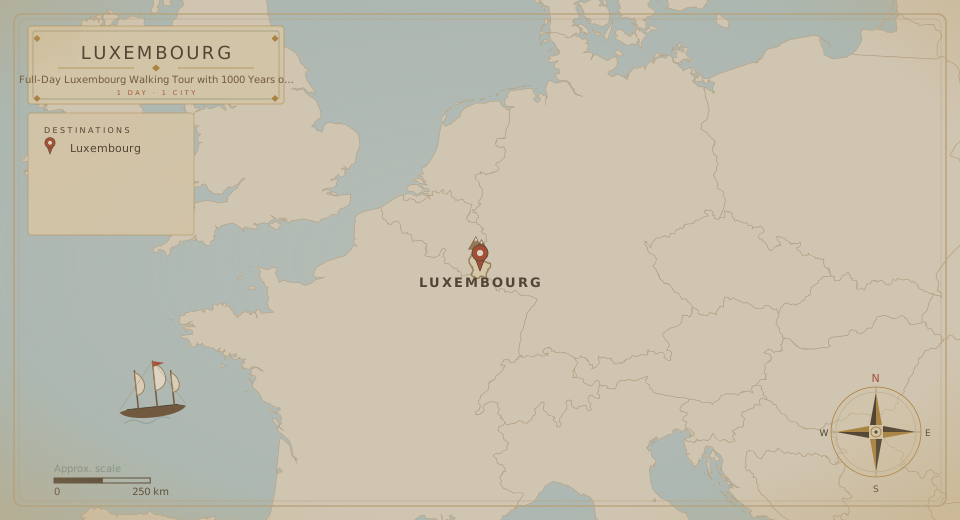
The suggested meeting point is Luxembourg Main Train Station or your hotel in the city of Luxembourg. Upon request, the meeting point can be customised and agreed according to the customer's preferences, for example somewhere in the city centre.
The whole itinerary will be carried out following the stops listed below:
Cathedral Notre-Dame de Luxembourg - a sacral building of high national importance from the 17th century and the final resting place of Luxembourg's monarchs and John the Blind.
Grand Duke of Luxembourg Palace and Luxembourg Parliament - the residence of the Grand Duke of Luxembourg, with honoured guards.
St. Michael's Church and Fish Market - the oldest Christian religious building in Luxembourg, dating from the 10th century, beside the former medieval city fish market.
Casemates du Bock and Le Chemin de la Corniche - natural fortifications on rocky cliffs, with a system of caves and tunnels, and a walking path along the top of the former city walls.
Pont du Stierchen - a controversial bridge and one of the two famous bridges over the River Alzette, also nicknamed the "Spooky Bridge".
Tutesall / Neumünster Abbey / St. John's (on the stone) Church - a lowertown area near the River Alzette, famous for its religious history and known for St. John the Baptist Church, the former monks' cloister, and the city prison.
1st Trier Gate (Jacob Tower alias "Dinselpuert") - a rectangular tower with a drawbridge and a cannon casemate, formerly part of the city walls known as the Wenzel Walls, and the gate to the inner part of the city from the 15th century.
Rham Plateau - an elevated area above the River Alzette, across from the Bock Casemates, once settled by ordinary citizens and later used for military infrastructure and various city social institutions until the 19th century. It offers excellent views over the central part of the city and the Petrusse Valley.
CIPA - a unique housing complex for 220 senior citizens, as well as a nursing home on a historical site.
Biesserpuert
Maierchen - part of the third enclosure of the City of Luxembourg, built in the 15th century.
Grund Lock - a military water construction with a defensive role from the Austro-Hungarian era (1731).
Petrusse Valley - a green city area along the River Petrusse above the Petrusse Casemates, a favourite local place for recreation and relaxation.
Chapelle Saint-Quirin (Quirinus Chapel) - one of the oldest religious sites, dating back to Roman and early Christian times, partially built into the cliff in 1355 and dedicated to St. Quirinius, once the patron saint of Luxembourg.
Viaduct Passerelle - the oldest city bridge, dating from the 19th century.
Pont d'Adolphe (Adolphe's Bridge) - the city's second bridge and one of its most famous landmarks.
Plateau de Saint-Esprit - a site housing a number of courts and legal offices, consolidating all of Luxembourg City's judicial buildings (not EU institutions).
"Den Huelen Zant" Tower - ruins of the northern fortress towers, nostalgically commemorating the old times before the second part of the 18th century and Luxembourg's independence.
Pont Grande-Duchesse Charlotte (Grand Duchess Charlotte Bridge) - the third and youngest city bridge, dedicated to Grand Duchess Charlotte and also known in black chronicles.
WW2 monuments:
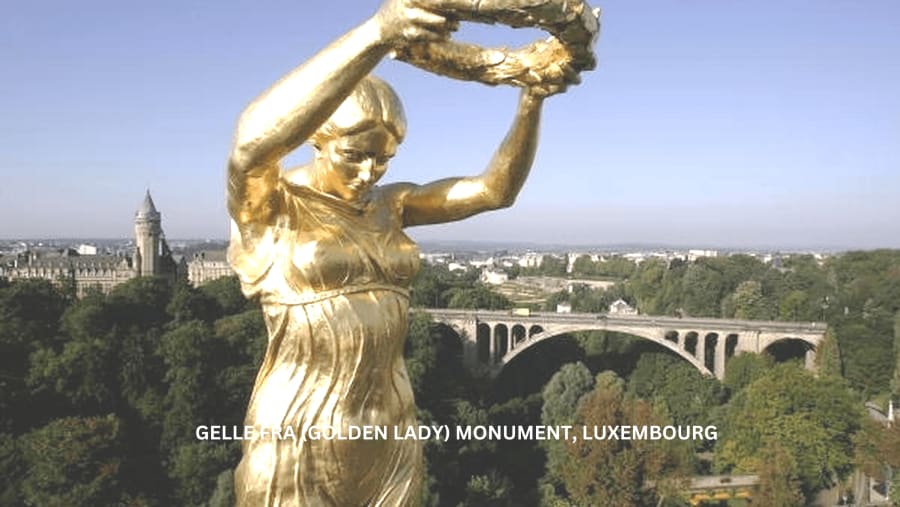
Monument du Souvenir / Gëlle Fra (Monument of Remembrance) - a war memorial dedicated to the thousands of Luxembourgers who volunteered for service in the armed forces of the Allied Powers during WW1, WW2, and the Korean War.
Monument National de la Solidarité Luxembourgeoise (National Monument of Solidarity) - commemorates the dead of the Second World War and recalls the resistance and solidarity of the Luxembourg nation in the face of Nazi occupation.
Kaddish Monument (Holocaust Remembrance) - commemorates the fate of the Jews living here who fell victim to the anti-Semitic persecution and extermination policies of the Nazi occupying power.
Museum-Memorial of Deportation (optional) - located near the train station and former gathering and departure points for young Luxembourgers forced into German labour ("RAD") and military service during the Nazi occupation of Luxembourg (1940-1945).
Luxembourg American Military Cemetery (optional) - a WW2 American military cemetery containing 5,074 American soldiers who died in the Battle of the Bulge in 1944-45, at the end of the Second World War, fighting against Nazi Germany.