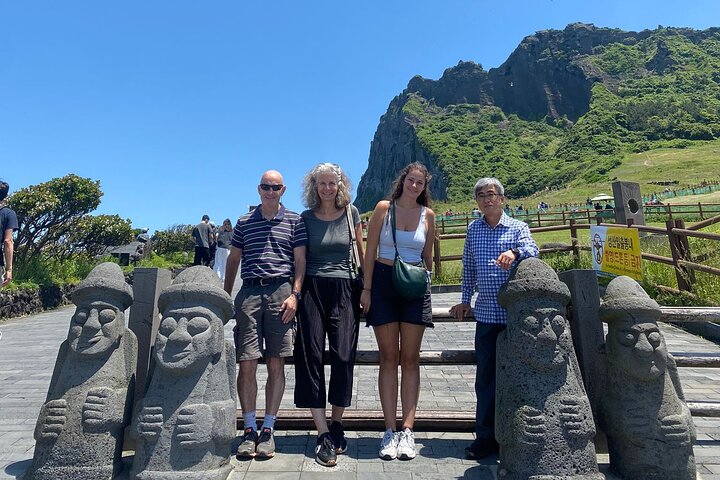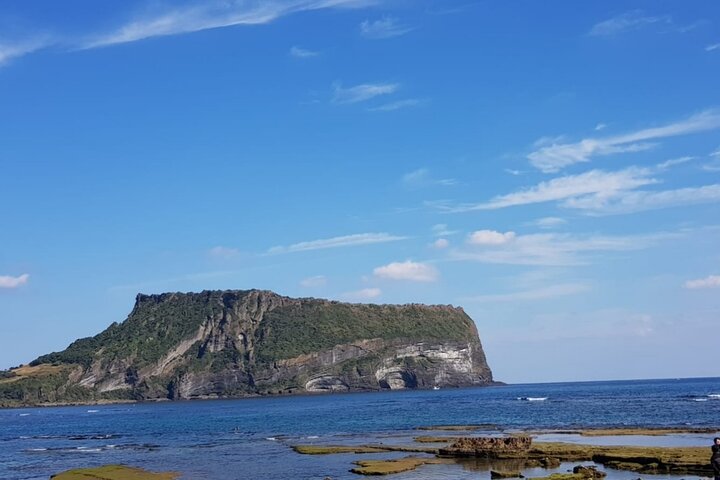
성산일출봉(seongsan illchulbong) Seongsan Ilchulbong Tuff Cone, a landmark attraction of Jeju, was formed about 5,000 years ago from an eruption of magma on the ocean floor. It is especially famous as a sunrise viewing spot, known to be one of the top ten exquisite sceneries of Jeju Island.Besides viewing the sunrise, Seongsan Ilchulbong Tuff Cone is also known to be an excellent trekking spot. The Seongsan-Ojo Trail connects two villages by crossing the peak. Another popular trail, the Jijil Trail, offers a closer look at the UNESCO-designated geopark as well as Jeju’s local culture. Walking along one of these paths is recommended to really experience the area; walking all the way to the summit offers views of both the vast volcanic crater in the center and the blue ocean surrounding the area. To complete your trip, head to Seongsanpo Port to watch haenyeo (female divers) at work.만장굴( Manjanggul Lava Tube) Of all the oreum on Jeju, Geomunoreum is the only parasitic cone to be designated as a UNESCO World Natural Heritage site. The oreum holds over 20 caves within its body, although only Manjanggul Lava Tube is open to the public. With its profoundly mysterious and grand appearance, taking a step inside the cave is like stepping into Hades’ underworld. Follow the tunnel of articulate lava rock formations, and you will soon reach a giant rock pillar that indicates the end of the cave. The cave’s temperature fluctuates within 11-21℃ regardless of season, allowing visitors to enjoy the magnificent cave all year round
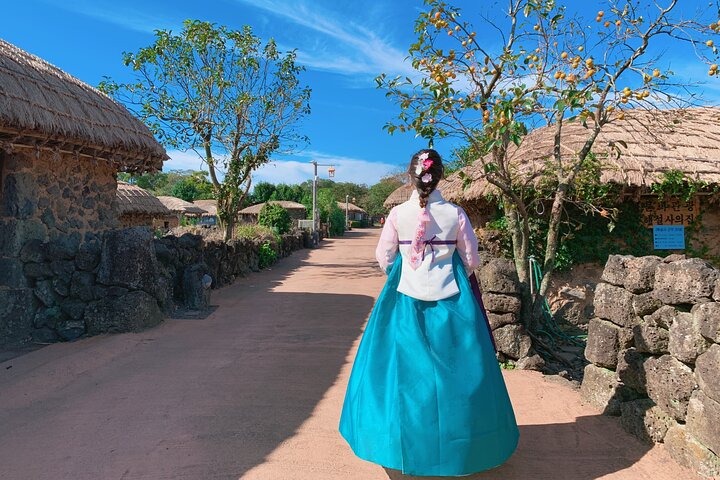
If Manjanggul Cave is closed (on the first Wednesday of every month), Jeju Haenyeo Museum will be offered as an alternative tour산굼부리(Sangumburi Crater) Sangumburi Crater differs from the 360 or more parasitic cones of Jeju in that it was not formed when the materials ejected from the eruption stacked.Instead, it is a maar-type parasitic cone that was formed as a crater with a hole in it when many materials were ejected.The inner area is 300,000㎡, while the interior bottom circumference is 756m, and the exterior circumference is 2,070m. Nearly vertical, the crater is approximately 130m tall, making it slightly larger and deeper than Hallasan Mountain.In autumn, when the ridges of Sangumburi Crater are colored gold by waves of silvergrass, the planted cedar becomes the dominate species that take up most of the eastern and western slopes, with Sawtooth oak in the surrounding area.Furthermore, Korean Fir has been planted to form a forest path. Excluding these lush forests, colonies of Eulalia grass cover large patches of the crater.월정리 해변(Woljeong-ri Beach) Well known for its beautiful scenery, white sand and emerald water, Jeju Woljeong-ri Beach has a road filled with tea houses and coffee shops. This is a great stopover during your trip to Jeju Island, and one of few places to enjoy an exotic view.성읍민속마을 (Seongeup FILK Village) The entire village, which preserves the living site of the people of old Jeju, has been designated as an Important Folklore Cultural Heritage. Though it can be considered a folk village of sorts, it differs from regular folk villages in that people still live in it to this day. The village residents act as volunteer guides to offer visitors all sorts of information. The Saw-leaf Zelkova and Japanese hackberry in the center of the village are worth taking time to see.해녀박물관 Jeju haenyeo are the strong mothers of Jeju and the spiritual pillars of Jeju residents. Also, the life of the Jeju haenyeo community is a model that humanity should aim for. Jeju haenyeo formed a merit-based community and democratically decided through discussions. She not only cared for the elderly and infirm, such as Halmang Badang and Geseok, and raised funds with her material profits to contribute to society, such as villages and schools. She also came up with various contraptions to coexist with the sea, such as beach sweeping, gold snatching, and dialysis. Jeju haenyeo culture was recognized for its value and was registered as a UNESCO Intangible Cultural Heritage of Humanity on November 30, 2016 (local time).
If Manjanggul Cave is closed (on the first Wednesday of every month), Jeju Haenyeo Museum will be offered as an alternative tour