Tanzania · Trekking

8-Day Kilimanjaro Hike via Lemosho Route to Uhuru Peak from Moshi

8 Days Round trip from Moshi Hard pace

The journey

Trip highlights
  • 01 Cross the Shira Plateau, once Kilimanjaro's third peak before it collapsed
  • 02 Climb past Lava Tower and descend into Barranco Camp for key acclimatization
  • 03 Scale the Barranco Wall and continue along the South Circuit to Barafu Camp
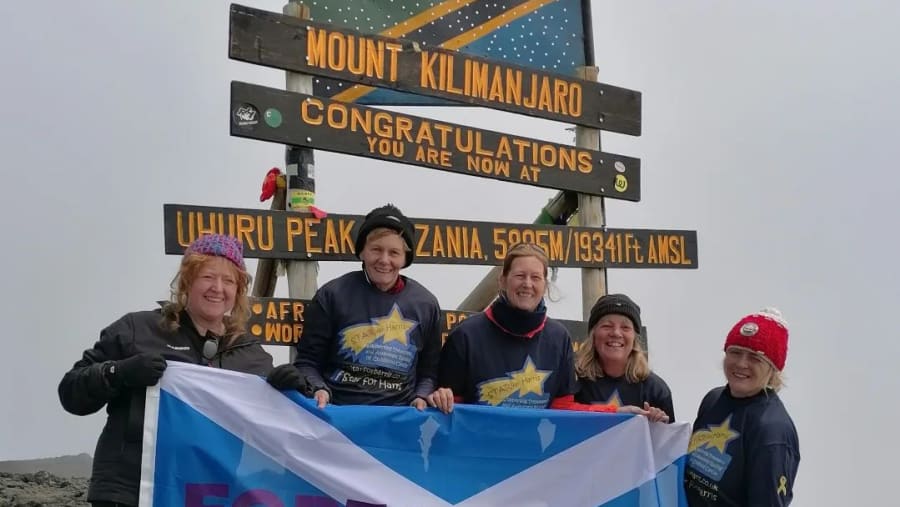
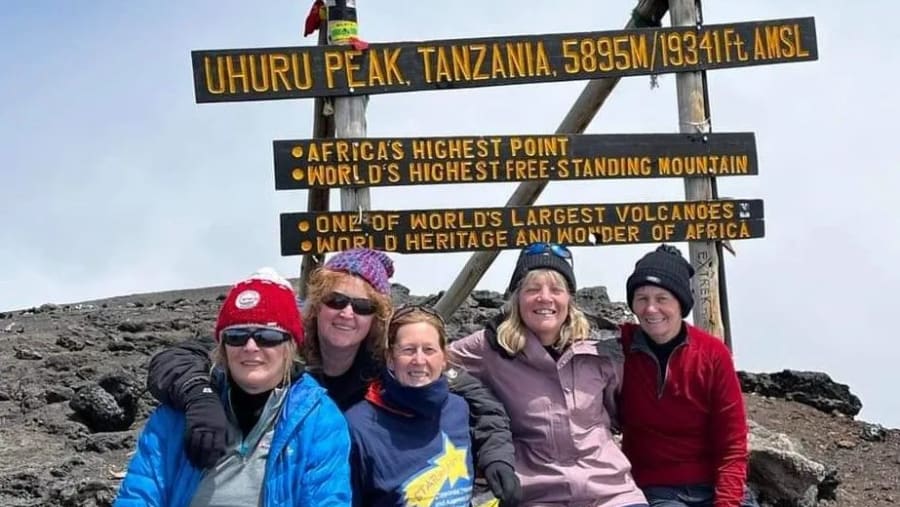
  • 04 Summit Uhuru Peak, the highest point on Mount Kilimanjaro and in Africa
  • 05 Watch for a magnificent sunrise near Stella Point during the summit push
  • 06 Descend through forest on the Mweka Trail and collect your summit certificate

Lemosho starts in lush, fertile rainforest, the first ecological zone you encounter on Kilimanjaro, before the trek climbs across the Shira Plateau, once Kilimanjaro's third peak before it collapsed. This 8-day route is designed to support acclimatization as you move through changing landscapes, including moorland, semi-desert, and the ice-capped summit zone. Along the way, you tackle key sections such as Lava Tower, Barranco Wall, and Barafu Camp before making your summit attempt to Uhuru Peak. The descent follows the Mweka Trail back to Moshi.

At Stella Point, stop for a short rest and be rewarded with one of the most magnificent sunrises you are ever likely to see.

From the itinerary

At a glance

What this trip includes

Duration 8 Days
Tour type Private
Activity level Hard
Accommodation Included · Standard
Transport Included
Wheelchair access Not applicable
Cities Moshi, Mount Kilimanjaro
Languages English, German, Spanish, Swahili

Day by day

The itinerary

1
Day 01

Moshi to Mti Mkubwa Camp via Londorossi Gate

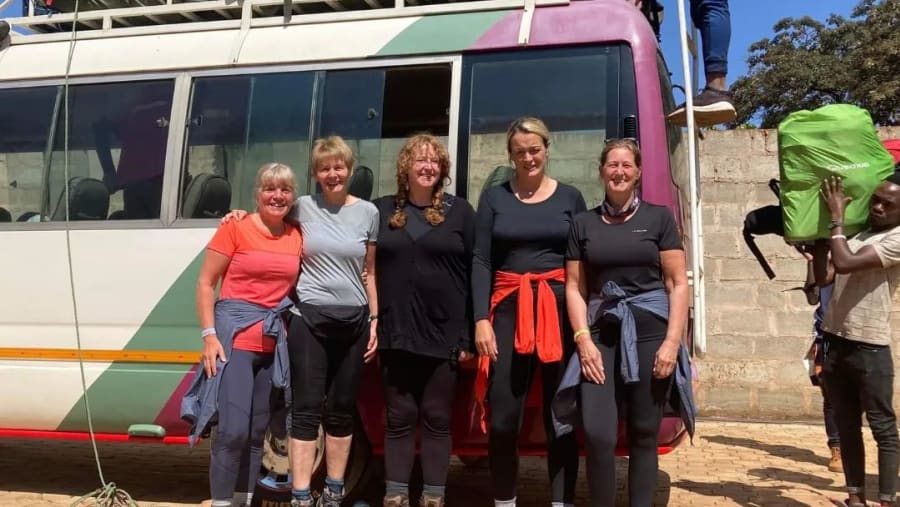
  • After breakfast and a briefing, drive to Londorossi Park Gate, about a 3-hour drive from Moshi.
  • From here, a forest track requiring a 4WD vehicle leads to Lemosho Glades.
  • Walk along forest trails to Mti Mkubwa (Big Tree) Campsite.

Elevation: 1830m/6000ft to 2650m/8700ft

Distance: 6km/4mi

Hiking Time: 2-3 hours

Habitat: Montane Forest

Meals: Lunch and Dinner

2
Day 02

Mti Mkubwa Camp to Shira 1 Camp

  • After breakfast, continue as the trail gradually steepens and enters the giant heather moorland zone.
  • After crossing several streams, continue over the Shira Ridge.
  • Then descend gently to Shira 1 Camp, located by a stream on the Shira Plateau.

Elevation: 2650m/8700ft to 3500m/11,500ft

Distance: 8km/5mi

Hiking Time: 4-5 hours

Habitat: Moorland

Meals: Breakfast, Lunch and Dinner

3
Day 03

Shira 1 Camp to Shira 2 Camp

  • After breakfast, enjoy a gentle hike across the plateau to Shira 2 Camp on moorland meadows by a stream.
  • A variety of hikes are available on the plateau, making this an excellent acclimatization day.

Elevation: 3500m/11,500ft to 3850m/12,600ft

Distance: 8km/5mi

Hiking Time: 4-5 hours

Habitat: Moorland

Meals: Breakfast, Lunch and Dinner

4
Day 04

Shira 2 Camp to Barranco Camp via Lava Tower

  • From the Shira Plateau, continue east up a ridge, passing the junction toward the peak of Kibo.
  • As the trek continues, the direction changes to the southeast toward the Lava Tower, called the "Shark's Tooth" (elevation 4650m/15,250ft).
  • Shortly after the tower, reach the second junction that goes to the Arrow Glacier.
  • Continue down to Barranco Camp.
  • Although you end the day at nearly the same elevation as where you began, this day is very important for acclimatization and helps your body prepare for summit day.

Elevation: 3850m/12,600ft to 4000m/13,000ft

Distance: 8km/5mi

Walking Time: 5-6 hours

Habitat: Semi-desert

Meals: Breakfast, Lunch and Dinner

5
Day 05

Barranco Camp to Karanga Camp

  • After breakfast, leave Barranco.
  • Continue on a steep ridge up the Barranco Wall to the Karanga Valley.
  • Reach the junction that connects with the Mweka Trail.

Elevation: 4000m/13,000ft to 4050m/13,250ft

Distance: 5km/3mi

Climbing Time: 3-4 hours

Habitat: Alpine Desert

Meals: Breakfast, Lunch and Dinner

6
Day 06

Karanga Camp to Barafu Camp

  • Continue up to Barafu Camp.
  • By this stage, you have completed the South Circuit, which offers views of the summit from many different angles.
  • Here, make camp, rest, enjoy dinner, and prepare for summit day.

Elevation: 4050m/13,250ft to 4700m/15,350ft

Distance: 4km/2mi

Climbing Time: 3-4 hours

Habitat: Alpine Desert

Meals: Breakfast, Lunch and Dinner

7
Day 07

Barafu Camp to Uhuru Peak and down to Mweka Camp

  • Very early in the morning, between midnight and 2 am, continue to the summit between the Rebmann and Ratzel glaciers.
  • Head in a northwesterly direction and ascend through heavy scree toward Stella Point on the crater rim.
  • This is the most mentally and physically challenging portion of the trek.
  • At Stella Point, stop for a short rest and be rewarded with one of the most magnificent sunrises you are ever likely to see.
  • Faster hikers may view the sunrise from the summit.
  • From Stella Point, you may encounter snow all the way during the 1-hour ascent to the summit.
  • Once at Uhuru Peak, you have reached the highest point on Mount Kilimanjaro and the continent of Africa.
  • From the summit, begin the descent by continuing straight down to Mweka Camp, stopping at Barafu for lunch.
  • You may want gaiters and trekking poles for the loose gravel on the way down.
  • Arrive at Mweka Camp and enjoy your last evening on the mountain.

Elevation: 4700m/15,350ft to 5895m/19,340ft

Down to 3090m/10,150ft

Distance: 5km/3mi up / 13km/8mi down

Hiking Time: 5-7 hours up / 5-6 hours down

Habitat: Stone scree and ice-capped summit

Meals: Breakfast, Lunch and Dinner

8
Day 08

Mweka Camp to Moshi via Mweka Gate

  • After breakfast, continue the descent to Mweka Park Gate.
  • At the gate, you will receive your summit certificates.
  • At lower elevations, conditions can be wet and muddy.
  • Gaiters and trekking poles will help you navigate the trail.
  • Shorts and T-shirts will probably be enough to wear, but keep rain gear and warmer clothing handy.

Elevation: 3090m/10,150ft to 1680m/5500ft

Distance: 10km/6mi

Hiking Time: 3-4 hours

Habitat: Forest

Meals: Breakfast

Shira Plateau, Lava Tower, Barranco Wall, Stella Point

Where this trip takes you

Shira Plateau, Lava Tower, Barranco Wall, Stella Point

The route

Where you'll travel

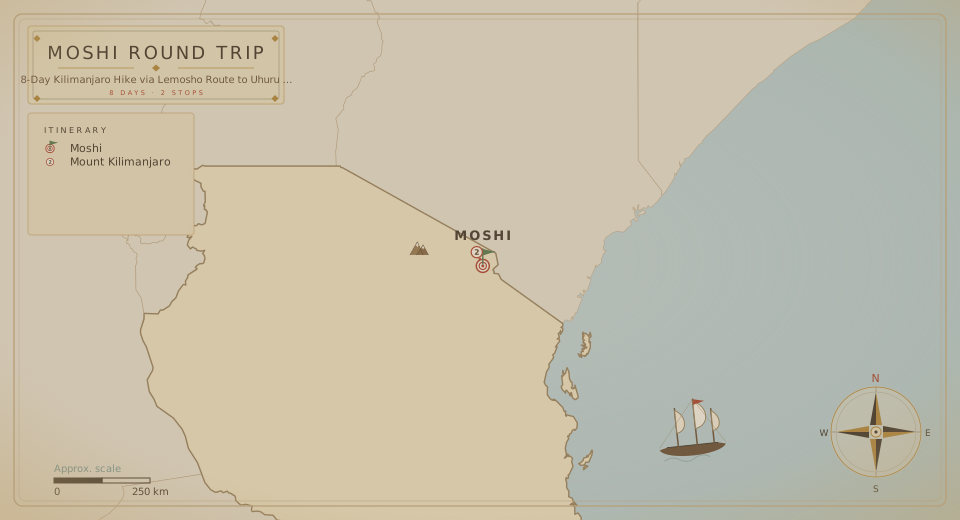
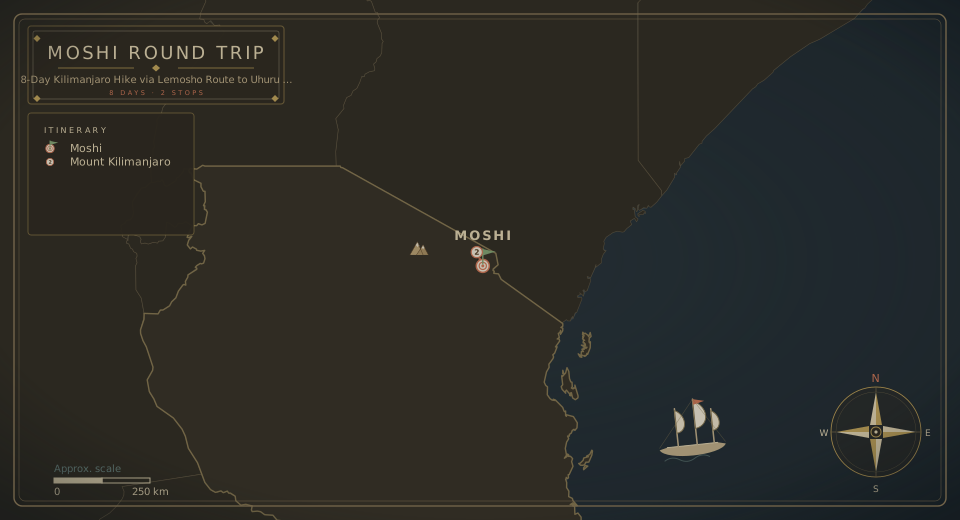
Tour route map
Round trip from Moshi 2 cities · 8 Days

The fine print

Trip details

What's Included

  • Pick-up and drop-off at Kilimanjaro International Airport (JRO)
  • Pre- and post-trek accommodation at a standard hotel in Moshi
  • Transportation to and from the Kilimanjaro gate
  • Park entry fees, camping fees, and rescue fees
  • Professional mountain tour guides, cook, and porters
  • Three meals a day during the mountain trek
  • Bottled water on the first day of the climb, with enough boiled, treated, and filtered water throughout the trek
  • Mountain 4-season sleeping tents on a double-occupancy basis
  • Sleeping mattress, foam, 1.5 inches thick
  • Mess tent, table, chairs, and lanterns
  • Portable oxygen tank and pulse oximeter

What's Not Included

  • Lunches, dinners, and drinks at your hotel before and after the climb
  • Travel insurance
  • Flights
  • Laundry services
  • Tips and gratuities
  • Items of a personal nature, i.e. beverages

What to bring

  • One of the essential prerequisites of a successful summit attempt is being properly equipped. Ensure that you are well equipped. Print the checklist below and mark it off; it will be essential to your climbing preparation. Please remember to limit the weight of your duffel bag and its contents, to be carried by the porters on the climb, to 15 kg (32 lbs.) or less. Your sleeping bag will count toward the 15 kg limit; however, the sleeping mat, tents, etc., will not count toward the 15 kg limit. Extra luggage, including clean clothes after your climb, can be left at the hotel in Moshi. Please feel free to contact us with any further questions regarding the checklist.
  • Ensure you have everything you need to help you successfully summit the Roof of Africa.
  • Travel Documents
    • Valid passport and visa
    • Airline ticket
    • International health card with immunizations
    • Travel insurance
    • Medical insurance
    • US cash/travellers' cheques/credit card
  • Essential Items
    • Duffel bag - large enough for all climbing gear and clothing, to be carried by the porters; an extra bag to be left at the hotel with extra gear
    • Small luggage lock - to lock zippers
    • Day backpack - between 2.0-3.5 litres, large enough to carry your water, camera, raincoat, lunch pack, snacks, and warm clothing
    • Sleeping bag
    • Ski-pole/walking stick
    • Water bottles/containers
    • Kilimanjaro map (can be bought at the park gate)
  • High Altitude Gear
    • Waterproof, breathable, and windproof jacket (outerwear like Ventex or Gore-Tex)
    • Waterproof, breathable, and windproof pants (outerwear)
    • Polar fleece (middle layer)
    • Thermal underwear (under layers)
    • Mittens or warm gloves
    • Glove liners (if necessary)
    • One pair of thermal socks
    • Balaclava
    • Gaiters
    • Thermal water flask
  • Hiking Gear
    • Shorts
    • Hiking pants
    • Regular underwear
    • T-shirts
    • Raincoat or poncho
  • Footwear
    • Water-resistant semi-stiff hiking boots - mid-weight boots work great
    • Shoes for overnight camps - i.e. sneakers, running shoes, etc.
    • Socks - several pairs for the climb
    • Liner socks - to keep your feet dry and limit the risk of blisters
  • Equipment
    • Sun hat or similar (with a brim)
    • Collapsible ski-sticks (optional but highly recommended)
    • Water bottles - two or three (total capacity at least 4 litres)
    • Headlamp, a good strong one with spare batteries and an extra light bulb
    • Water purification tablets
    • Sunglasses, good-quality dark lenses for the climb, with a securing strap
    • Flashlight (torch) with spare batteries
  • Personal Items
    • Toilet kit (soap, toothbrush, toilet articles, wet wipes, etc.)
    • Towel
    • Sunscreen and lip protection, SPF 30+
    • Ziploc bags to protect the camera, binoculars, etc., from dust
    • Toilet paper
    • Money belt for passport and valuables
  • Medical and First Aid Supplies
    • Headache tablets
    • Altitude Sickness - Diamox (if not allergic to sulpha)
    • Diarrhoea - Imodium
    • Nausea - Valid
    • Malaria - prophylaxis
    • Water purification tablets
    • Painkillers
    • Muscular sprains
    • Abrasions, blisters, and cuts - plaster, bandages
    • Antiseptic cream - Betadine
    • Flu and colds
    • Eye drops
    • Insect repellent
  • Optional Items
    • Camera, extra lenses, memory cards, and spare batteries
    • Binoculars
    • Powdered sports drinks for the climb (e.g. Game or isotonic drinks)
    • Pocket knife
    • Notebook and pencil
    • Plastic bags to keep clothing dry (masking tape)
    • Energy snacks and sweets
    • Video camera, tapes/memory cards, battery packs, and tripod

Know before you go

  • Acute Mountain Sickness is also referred to as "Altitude Sickness," and as the name indicates, the illness is commonly encountered at exceptionally high altitudes, such as the summit area of Mount Kilimanjaro. AMS, once apparent, can be most effectively treated by immediately taking the affected person to a lower altitude. Often, a drop as little as 500m will be sufficient. The symptoms of AMS include, in the order customarily experienced, headaches, nausea, anorexia, exhaustion, lassitude, rapid pulse, insomnia, swelling of the hands and feet, and reduced urine output.
  • Climbers can take precautions to minimize the severity of the illness by maintaining a slow, steady pace from day one, including an extra day of acclimatization at a high altitude and drinking at least 3-4 litres of water daily. Preventative medicine is also available, and you should consult your physician for specialist advice. The fluid build-up may cause a condition known as oedema, which can affect the lungs (pulmonary), prevent effective oxygen exchange, or affect the brain (cerebral), resulting in swelling of the brain tissue. The latter can be lethal if not treated immediately or if symptoms are ignored. Probably 70% of all people climbing Kilimanjaro will suffer to some extent from AMS. You should familiarize yourself with this condition and take preventative care.

Logistics

Meeting & route

Meeting point
Moshi, Tanzania
Tour start
Moshi, Tanzania
Tour ends at the same location as the start point.
End of the journey

Your 8 days finish where they began, in Moshi.

Watch the tourHQ film Watch the film

Create your own adventure

Can't find the perfect tour? Tailor your dream trip.

  • Tell us your destination, dates and group size.
  • Our travel experts and local guides design a tailored itinerary, just for you.
  • Enjoy your trip with peace of mind, knowing everything is taken care of.
Plan my holiday

Say goodbye to travel stress.

Starting from

USD 1,150 /person
Book This Tour

Estimated room rates

Single Room $1,150.00 — $2,300.00
Double Sharing $1,150.00

When

Travellers

Total