
Afghanistan · Walking Tours

6-Day Kabul Highlights Tour with Old City Walks and Istalif Visit

6 Days Round trip from Kabul Moderate pace

The journey

Trip highlights
  • 01 Walk through Kabul's Old City, including Murad Khane, Birds Market, Kite Market, and Shorbazar
  • 02 Visit Shah-e Do Shamshira Mosque, Eid Gah Mosque, Pul-e Kheshti Mosque, and Kart-e Sakhi Shrine
  • 03 See major historic landmarks such as Timor Shah Mausoleum, Bala Hissar, the Great Walls of Kabul, and Shewaki Stupa
  • 04 Explore royal and cultural sites including Chihilsutun Palace, the National Gallery, and the National Archives of Afghanistan
  • 05 Drive out to Qargha Lake, Paghman Valley, and the Arch of Victory at the foot of the Hindu Kush
  • 06 Visit Istalif village, known for handmade glazed pottery and the historic Istalif Palace

Explore Kabul and its surroundings through six distinct days of history, architecture, markets, religious landmarks, and cultural heritage. Walk through Kabul's Old City, visit major mosques, mausoleums, archives, palaces, lakes, valleys, and ancient fortifications, and discover places linked to Afghanistan's royal, Buddhist, and Islamic past. The tour also includes local Afghan cuisine and an excursion to Istalif, long famed for its handmade glazed pottery. It offers a broad introduction to the capital's past and present, from bustling bazaars to historic monuments and scenic retreats.

Explore Kabul and its surroundings through six distinct days of history, architecture, markets, religious landmarks, and cultural heritage.

From the itinerary

At a glance

What this trip includes

Duration 6 Days
Tour type Private
Activity level Moderate
Accommodation Not included
Transport Not included
Wheelchair access No
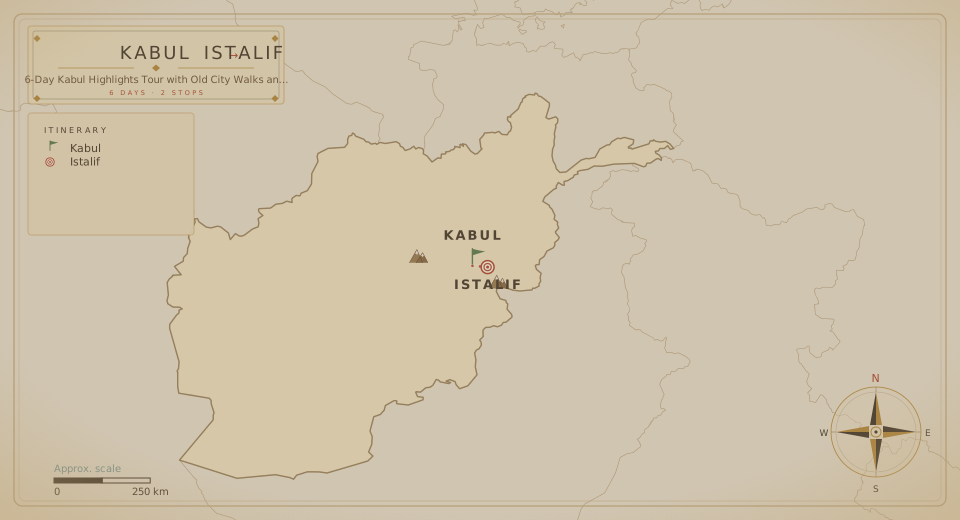
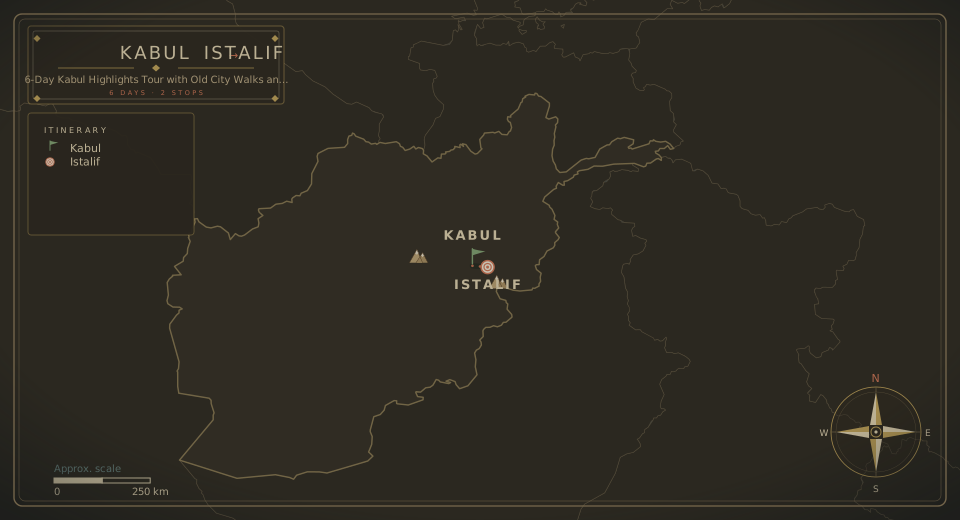
Cities Kabul, Istalif
Languages English, Persian, Russian

Day by day

The itinerary

1
Day 01

Arrival and Walking Tour of Kabul's Old City

  • Arrival - Kabul International Airport (KBL): We will safely pick you up and transfer you, along with your luggage, to the best hotel in the city centre for check-in. Then, you can choose this option for the full-day tour.

Option 1:

  • Gun & Sewing Machine Market: A delightful little entrance behind the Masjed-e Olya Rotbe Andarabi mosque opens up to reveal a gun and sewing machine market, with perfect gifts for her and him.
  • Shah-e Do Shamshira Mosque: The Mosque of the King of Two Swords, as the name is translated, is a two-story yellow building situated on the banks of the Kabul River. It was constructed in the 1920s during the reign of King Amanullah, whose rule was marked by dramatic political and social change as he tried to modernize Afghanistan. The design of this mosque is quite unusual for Islamic religious architecture. Its Italian decorative stucco creates an interesting effect that some describe as 'Afghan Baroque'.
  • Next to the Shah-e Do Shamshira Mosque is the burial place of an Arab commander who fell in battle when the Arabs entered Kabul at the end of the 7th century.
  • Timor Shah Mausoleum (Timorshahi): Another surviving monument in central Kabul is the Mausoleum of Timor Shah Durrani, one of the eminent characters in Afghanistan's history. From his father, he inherited a unified Afghan kingdom in 1772 and later moved the capital city from Kandahar to Kabul. Thus, he is the founding father of the capital of the modern Afghan state. You will see street vendors and can buy old Afghanistan postcards for nominal money to keep as souvenirs.
  • Money Market: Where else in the world but the Kabul Hawala (money) market will you find people sitting on and surrounded by piles of cash with not a security guard in sight? If you are interested in collecting coins, you can buy Afghanistan coins in this market for a few bucks.
  • Lunch at Bach-e Broot (70-Year-Old Restaurant): It serves up a delightful menu of Afghan cuisine. Beyond the cages and crowds, tucked between crumbling buildings, sits Kabul's oldest restaurant, a spot that has been serving chainaki, a traditional lamb stew, and feeding the area for nearly 70 years. Bacha Broot occupies one of the market's few remaining original structures, the others having long ago been destroyed by war and the Soviet invasion.
  • Kabul's Old City: Venturing deep into the corners and warrens of Kabul's Old City, you will step over gullies of exposed sewer pipes and tiptoe around an open swath of earth where men are laying the foundation for a new building.
  • There, in a small part of Kabul's Old City called Murad Khane, centuries-old homes and courtyards are being restored. Long ago, craftsmen carved these structures out of wood. Years of war, poverty, and neglect had left the place all but withered and full of trash.
  • The perfect city jaunt starts at the Ariana Cinema, down Nadir Pashton Road to the river, then along the gold & goods markets that line the Kabul River.
  • Take in Murad Khane, the old city, including the extensive restoration of the neighbourhood by Turquoise Mountain Arts.
  • You will be visiting the centuries-old mud market, including Birds Market, Kite Market, Shorbazar (singers' quarters), Kah Foroshi (Grass Market), Rekah Khana (Blacksmiths), and more of Kabul's Old City.

Walking: 6-8 hours

Overnight: Best Hotel in Kabul city

2
Day 02

Walking Tour of Kabul's Old and New City

  • Chicken Street: Chicken Street & Flower Street are useful landmarks, if only to know where in the city to visit. Visitors arrive with dreams of buying pieces of Lapis Lazuli, antiques, and Afghan rugs.
  • The Arg Presidential Palace & The Clock Tower: The Arg ('citadel') is the presidential palace of Afghanistan, located in Kabul. Since the 2021 abolition of the Afghan presidency by the Taliban, it has served as the meeting place of the Cabinet of Afghanistan.
  • Eid Gah Mosque: Located in one of the wealthiest areas of Kabul, Eid Gah Mosque is the second largest mosque in the city. 'Eid Gah' is translated as 'prayer ground'. This mosque has hosted many religious ceremonies and festivals attended by Kings and Emirs. The historic announcement of Afghanistan's independence was made here in 1919. Moghul ruler Babur ordered the construction of the Eid Gah Mosque and had Persian architects build it with precious stones from the provinces of Punjab and Sindh. The mosque's architecture reflects its rich Muslim heritage. One feature unique to its architecture is its very long and narrow layout.
  • Pul-e Kheshti Mosque: This is the largest mosque in Kabul and is located in the old downtown area of the city. It was built at the end of the 18th century and has been renovated and restored several times. Pul-e Kheshti Mosque is easily identified by its large blue dome. The current design of the mosque is a mix of international modern style with accents of traditional Afghan tiling.
  • National Gallery of Kabul: The National Gallery of Kabul is home to a great collection of historic pictures and paintings by Afghan artists of the 20th century. The National Gallery and other cultural institutions in the city have suffered from wars, but many works were preserved, overpainted, and restored. Over 120 paintings from the National Gallery were saved to prove that a nation stays alive as long as its culture is alive.
3
Day 03

From Kabul's Great Walls to Chihilsutun Palace

  • The fin de siècle Emir of Afghanistan Abdul Rahman Khan Mausoleum: Abdul Rahman Khan was Emir of Afghanistan between 1880 and 1901. He was a strong ruler and gained the name of the 'Iron Emir'. His tomb sits in the Mausoleum in Zarnegar Park, translated as the park adorned with gold. This building used to be a palace that was later converted into a mausoleum for the Emir. There is a beautiful red dome atop the mausoleum that sits on a whitewashed drum.
  • Across from the park, you'll see the Abdul Rahman Mosque. It is not to be confused; the benefactor of the mosque has no relation to the Iron Emir.
  • The Great Walls of Kabul: You will visit a long ancient wall stretching out like an elongated dragon along the ridge of the mountain, Sherdarwazah. The wall begins at Artal Bridge and stretches all the way to Bala Hissar (Kabul Citadel). It is believed that the wall dates back to the Hephathalite era when King Zanburak Shah ruled this area and Kabul was his capital.
  • Chihilsutun Forty Columns: Chihilsutun is a historic palace with gardens located about 3.6 kilometres east of Darulaman Palace in Kabul. It was built in 1796 by Emperor Zaman Shah Durrani. The palace and neighbourhood are part of District 7 of the city. Chihilsutun is a historical site to be seen.
  • National Archives of Afghanistan: At the end of the 19th century, Abdu Rahman Khan built a palace for his son. Today, that structure is home to Afghanistan's National Archive. There are over 15,000 documents in the Archives, including newspapers, photographs, old currency, and various Quran books from the Durrani period. Many important documents, whether originals or copies, are displayed for visitors to see. Among them, you will see the treaty signed with the British Empire in 1919 that gave Afghanistan complete independence.
  • Kart-e Sakhi Shrine Blue Mosque: Sakhi Shah-e Mardan Shrine, or Ziyarat-e Sakhi, is a shrine and mosque located in the Kart-e Sakhi area of Kabul. It is associated with the place to which the cloak of the Islamic prophet Muhammad (PBUH) was brought and with a visit from Ali, the son-in-law and cousin of Prophet Muhammad (PBUH). The shrine is located at the foot of Asamayi Hill, now better known as Television Hill. To its north and west is the Sakhi Cemetery.

Driving: 6-8 hours

Overnight: Best Hotel in Kabul city
4
Day 04

From Bala Hissar Citadel to Shewaki Stupa

  • Bala Hissar (High Fort), Citadel of Kabul, is an ancient fortress located south of the old city of Kabul, Afghanistan. Its construction date is estimated to be around the 5th century AD.
  • Bala Hissar was originally divided into two parts: the lower fortress, containing the stables, barracks, and three royal palaces, and the upper fortress, the actual fort bearing the name Bala Hissar, which housed the armoury and the dungeon of Kabul, known as the 'Black Pit' (the Siyah Chal).
  • Shewaki Stupa, Buddhist-era built heritage: The stupa at Shewaki, 11 kilometres south of Kabul, dates from the 3rd to 5th centuries CE and forms part of a religious route that Buddhist pilgrims took from the Indian lowlands to Bamiyan. Shewaki is the site of Shahbahar (King's Vihara), one of Afghanistan's major Hindu temples. Shahbahar was a Buddhist stupa during the Kushan dynasty and a Hindu temple during the Kabul Shahi's reign.

Driving: 6-7 hours

Altitude: 1,798 meters

Overnight: Best Hotel in Kabul city
5
Day 05

From Qargha Lake to Paghman Valley

  • The fin de siècle Emir of Afghanistan Palace: Built as a summer residence for King Abdul Rahman Khan of Afghanistan (1880-1901), the graceful, domed palace glimmers on top of a hill to the north of Kabul city. It was used as the kingdom palace before the present-day Presidential Palace was built. The palace is now Kabul's most attractive restaurant and hotel. The stucco and mirror-studded decoration inside the palace represent the original. The terrace provides a spectacular 360-degree view of the Kabul Valley.
  • Qargha Lake Reservoir: This is a popular place to bring the family, kick back, and enjoy a delicious Afghan meal on the shore of Qargha Lake. On the assumption that lightning doesn't strike twice, this area is perfectly safe.
  • Paghman Valley at the bottom of Hindukush: Paghman is a town at the bottom of the Hindu Kush Mountain, also known as the summer capital of Afghanistan, turned into a holiday retreat. Palaces, gardens, and cultural and historic treasures abound in Paghman. It was built as a weekend and summer resort with a European flair at the beginning of the century by King Amanullah Khan. It was meant to be Afghanistan's most beautiful city and summer capital. Wide avenues are lined by fir, poplar, and nut trees along a torrent, which flows past an Arch of Triumph, wide lawns, impressive brick buildings, and a golf course.
  • L'Hotel Bahar: Located near the monumental gate 'Arch of Victory', similar to the Arc de Triomphe in Paris, as a memorial to Afghanistan's 1919 war of independence from Britain, this oasis of peace sits amid the clogged population of Kabul city and covers 5 acres. The King formally ordered, supervised, and opened the completed royal Bahar Hotel, which includes majestic 100+ year-old native walnut trees preserved on the periphery of the garden, offering them as its focal point. Gutted and eerily empty, now there is nothing left of what was once the King's hillside pastel pink Bahar Hotel. The spectacular walnut trees and this garden are now maintained and rebuilt.
  • Everything starts in the early 20th century, when nobles travelled to Paghman Valley at the foot of the Hindu Kush Mountains to take the natural water for its health benefits, then take a few bottles home. This icon of Afghan taste has been passed down to become today's Jabriel Spring Natural Mineral Water, nurtured for 100 years.
  • Tip: Be warned that even in the summer, the water is pretty frosty.

Driving: 7-8 hours

Altitude: 2,129 meters

Overnight: Best Hotel in Kabul city
6
Day 06

Drive from Kabul to Istalif Village

  • Istālif is a village 49 kilometres northwest of Kabul, situated at an elevation of 1,693 metres (5,554 ft) in the Shamali Plains, southwest of the notorious Bagram Airfield and America's prison. For millennia, Istalif has been famous for its handmade glazed pottery.
  • Istalif was always renowned as one of the most beautiful places in Afghanistan - Emperor Babur fell in love with it in the 16th century and used to hold parties in his rose garden and summer house there. Alexander Burnes, a British political agent to Dost Mohammed in the 19th century, came here to relax amid the plane and walnut trees. He described the mountain streams as full of fish, and the orchards and vineyards as the richest.
  • Istalif Palace is one of the most fascinating historical monuments in Afghanistan and is being restored by the Afghan government.
  • The two-story hotel is built on a hillside 49 km northwest of Kabul city in the Istālif district, lying on 5,420 meters of land overlooking the valley and the Bagram Airfield. Guests may dine in the garden or find luxury comfort amongst stunning tall plane trees.
  • The original Victorian-style blueprint for the palace was brought from England during King Amanullah Khan's reign; however, construction work on the site started during King Mohammad Zahir Shah's reign. The palace once housed kings and travellers from around the world.

Driving: 2-3 hours (one way)

Altitude: 1,693 meters

Overnight: Istalif Royal Palace Hotel

Kabul's Old City, Bala Hissar Citadel, Qargha Lake Reservoir, Istalif Palace

Where this trip takes you

Kabul's Old City, Bala Hissar Citadel, Qargha Lake Reservoir, Istalif Palace

The route

Where you'll travel

Tour route map
Round trip from Kabul 2 cities · 6 Days

The fine print

Trip details

What's Included

  • English-speaking Kabul guide
  • Meal

What's Not Included

  • Afghanistan Visa Invitation Letter
  • Security guard
  • Hotel (accommodation)
  • Doctor on board
  • Car hire

Logistics

Meeting & route

Meeting point
Kabul, Afghanistan
Tour start
Kabul, Afghanistan
Tour ends at the same location as the start point.
End of the journey

Your 6 days finish where they began, in Kabul.

Watch the tourHQ film Watch the film

Create your own adventure

Can't find the perfect tour? Tailor your dream trip.

  • Tell us your destination, dates and group size.
  • Our travel experts and local guides design a tailored itinerary, just for you.
  • Enjoy your trip with peace of mind, knowing everything is taken care of.
Plan my holiday

Say goodbye to travel stress.

Starting from

USD 119 /person
Book This Tour

When

Travellers

Total