

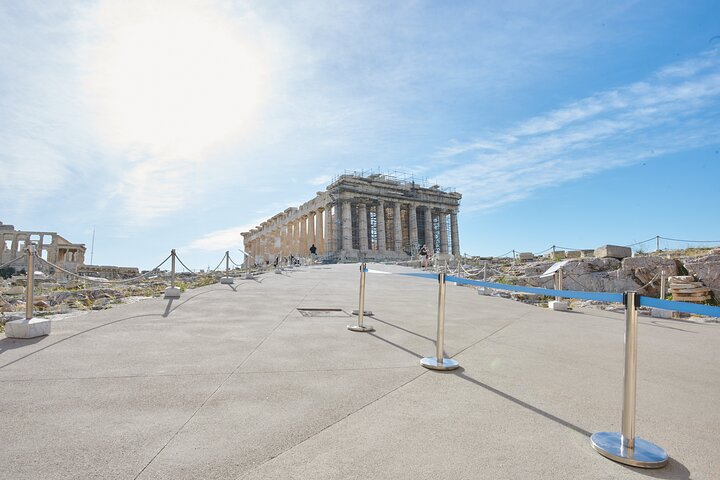
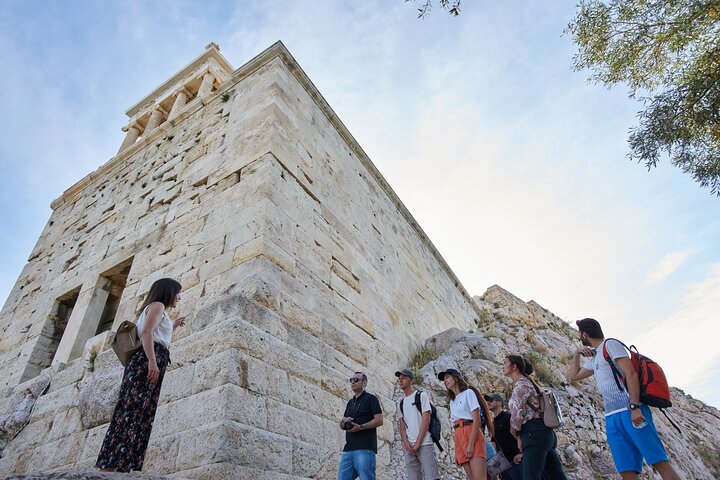

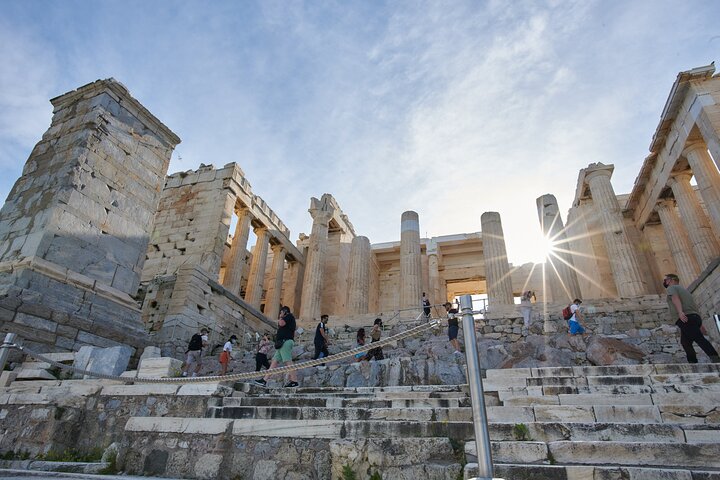
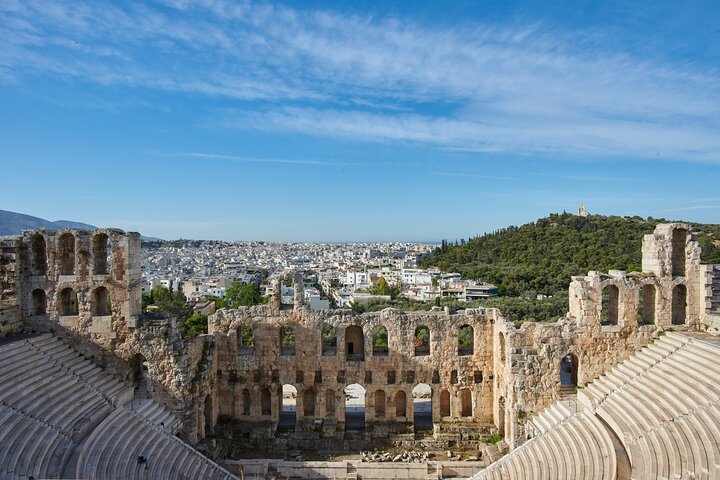
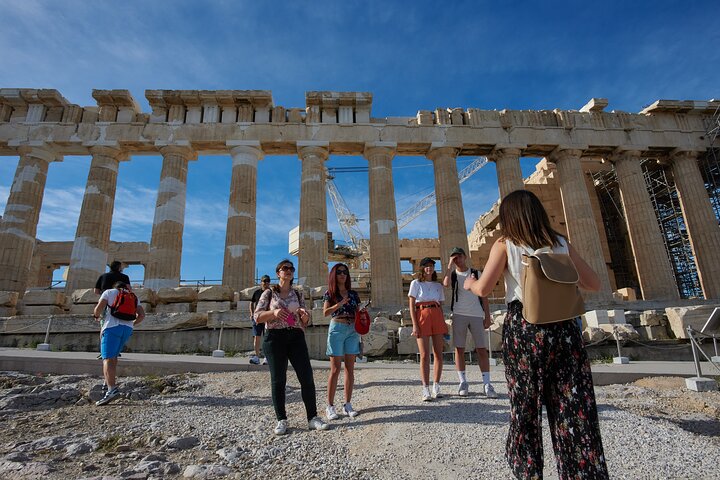
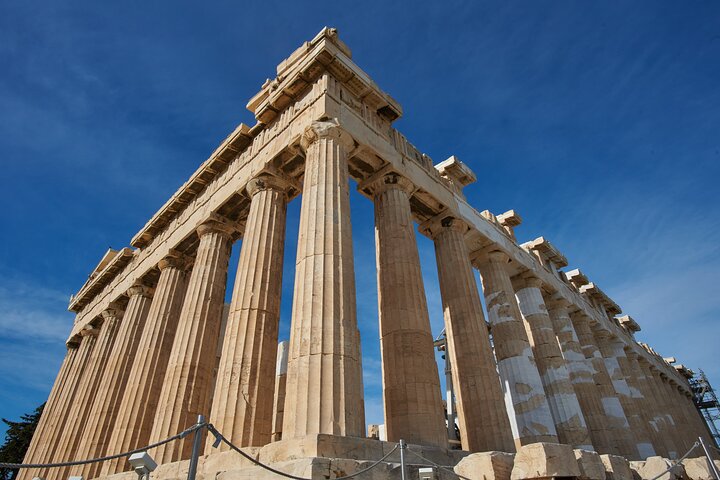
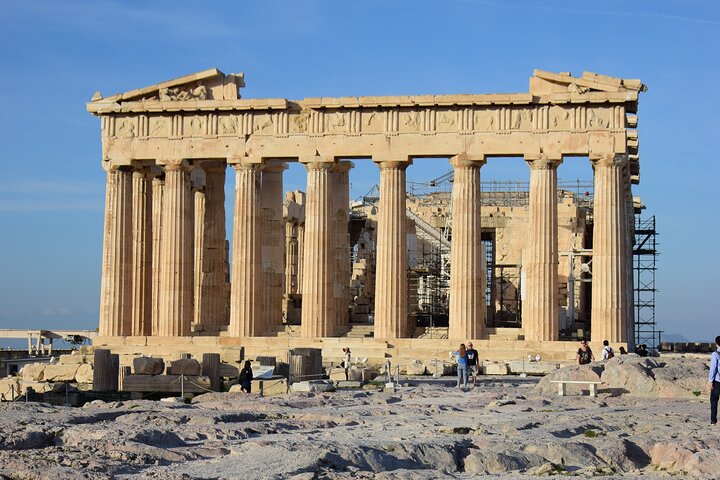
The Acropolis hill (acro – edge, polis – city), so-called the “Sacred Rock” of Athens, is the most important site of the city and constitutes one of the most recognizable monuments of the world. It is the most significant reference point of ancient Greek culture, as well as the symbol of the city of Athens itself as it represents the apogee of artistic development in the 5th century BCE. During Perikles’ Golden Age, ancient Greek civilization was represented in an ideal way on the hill and some of the architectural masterpieces of the period were erected on its ground.The Propylaea is the monumental entrances to the sacred area dedicated to Athena, the patron goddess of the city. Built by the architect Mnesicles with Pentelic marble, their design was avant-garde. To the south-west of the Propylaea, on a rampart protecting the main entrance to the Acropolis, is the Ionian temple of Apteros Nike or Wingless Victory.The temple of Athena Nike, designed by the architect Kallikrates, was built between 426 and 421 BC on a bastion at the southwestern edge of the Acropolis. It replaced older temples whose remains are preserved inside the bastion. As the name implies, the statue of Athena Nike was situated in the temple as a symbol of victory. Nike usually had wings, but in this case, the statue did not have them, so it was named Athena Apteros, which means "wingless".It is the most important and characteristic monument of the ancient Greek civilization and still remains its international symbol. It was dedicated to Athena Parthenos (the Virgin), the patron goddess of Athens. It was built between 447 and 438 B.C.E. The temple is built in the Doric order and almost exclusively of Pentelic marble. It is peripheral, with eight columns on each of the narrow sides and seventeen columns on each of the long ones.The sculptural decoration of the Parthenon is a unique combination of the Doric metopes and triglyphs on the entablature and the Ionic frieze on the walls of the cella. The metopes depict the Gigantomachy on the east side, the Amazonomachy on the west, the Centauromachy on the south and scenes from the Trojan War on the north. The Parthenon, the Doric temple, the pinnacle of Pericles’ building program is beyond question the building most closely associated with the city of Athens, a true symbol of ancient Greek culture and its universal values.The elegant building known as the Erechtheion was erected in 421-406 BC. The name derives from Erechtheus, the mythical king of Athens, who was worshipped there. The temple was made of Pentelic marble, the frieze of Eleusinian grey stone with white relief figures attached to it and the foundations of Piraeus stone.The stone paving of this propylon was thought to preserve the traces made by Poseidon’s trident when it hit the ground and produced salt water. Finally, another door on the south facade of the western temple opened onto the porch of the Karyatides, a pi-shaped structure with six female statues instead of columns to support the roof. Five of them are in the Acropolis Museum and another in the British Museum those on the building are casts. The frieze probably depicted scenes related to the mythical kings of Athens.The Theatre of Dionysus is an ancient Greek theatre in Athens. It is built on the south slope of the Acropolis hill, originally part of the sanctuary of Dionysus Eleuthereus. The first orchestra terrace was constructed on the site around the mid- to late-sixth century BC, where it hosted the City Dionysia.
Greece · Architecture
Acropolis Guided Tour with Skip-the-Line Access Evening Visit
The journey
- 01 Skip-the-line access to the Acropolis
- 02 Evening guided visit to Athens’ most iconic landmark
- 03 Explore the Parthenon, Erechtheion, and Theatre of Dionysus
- 04 Learn from a licensed tour guide
- 05 Small-group experience
- 06 Discover the history, mythology, and architecture of ancient Athens
Discover the Acropolis on a guided evening visit and explore one of the world’s most celebrated ancient sites with skip-the-line access. Led by a licensed guide, this small-group experience offers a deeper look at the monuments that define Athens and the legacy of classical Greece.
Walk through the sacred hill and learn the stories behind landmarks including the Parthenon, the Erechtheion, and the Theatre of Dionysus. With expert commentary on history, mythology, and architecture, this tour is an engaging way to experience the Acropolis in a more relaxed atmosphere.
Walk through the sacred hill and learn the stories behind landmarks including the Parthenon, the Erechtheion, and the Theatre of Dionysus.
From the itinerary
At a glance
What this trip includes
Day by day
The itinerary
The route
Where you'll travel
The fine print
Trip details
What's Included
- Licensed Tour Guide
- Skip the Line Acropolis Ticket
- Small Group Guided Acropolis
What's Not Included
Hotel pickup and drop-off
Know before you go
- WHEELCHAIR ACCESSIBLE
- STROLLER OR PRAM ACCESSIBLE
- PUBLIC TRANSPORTATION NEARBY
- Not suitable for pets
- Infants must not sit on laps
- Infant seats unavailable
- Not wheelchair accessible
Logistics
Meeting & route
Your 2 hours finish where they began, in Athens.
 Watch the film
Create your own adventure
Can't find the perfect tour? Tailor your dream trip.
- Tell us your destination, dates and group size.
- Our travel experts and local guides design a tailored itinerary, just for you.
- Enjoy your trip with peace of mind, knowing everything is taken care of.
Say goodbye to travel stress.