

Lublin
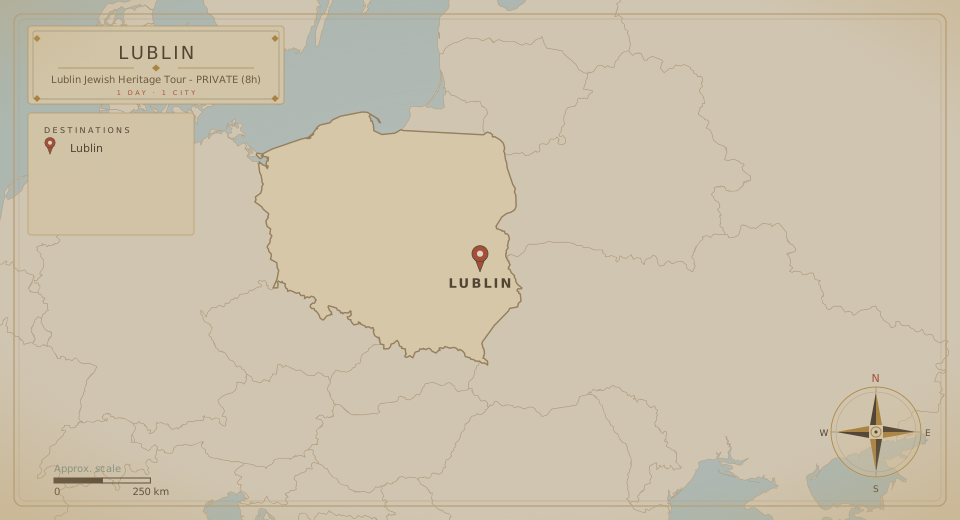
Lublin is full to the brim with culture, history and delicious food and has a very welcoming vibe. Located in southeast Poland, known as “gate to the East”, Lublin is the region's largest city with a thriving cultural scene and is an important educational & scientific centre. Wander the streets of the cobbled streets of the city's Old Town and take in panoramic views from The Trinity Tower.
A tale of Two Gates and a rich Jewish history
To reach the Old Town, you can pass through one of two gates, positioned at opposite ends of the quarter in what little remains of the historical city walls. To the south-west of the Old Town stands the Kraków Gate, which, as its name suggests, was the point of entry for visitors from Krakow. Its red-brick base is crowned with an elegant white tower with a pointy roof, and its interiors house part of the provincial Lublin History Museum, which is definitely one to visit. On the other side of the Old Town, the beautiful, pale yellow Grodzka (Town) Gate, was once known as the Jewish gate, owing to the fact that it linked the part of the city belonging to Christians to the Jewish quarter. In the 16th and 17th centuries, after King Stephen Báthory founded Europe’s only Jewish parliament, called the Council of Four Lands, Lublin was actually the seat of the strongest Jewish community in Poland, and boasted a thriving Jewish and Hebrew culture, which was sadly completely destroyed during the Holocaust. Nobel Prize winner Isaac Bashevis Singer, who had ties to the Lublin region and especially the Biłgoraj shtetl where his grandparents lived, immortalised the atmosphere of bygone times in his novel The Magician of Lublin.
You can get a better appreciation of what the Jewish quarter looked like thanks to a model at the Grodzka Gate – NN Theatre Centre. Photographs from those times can also be viewed at the Alter Hotel and the Jewish yeshiva, home to two preserved Jewish cemeteries. Anyone especially interested in Jewish culture and history should definitely follow the Heritage Trail of the Lublin Jews.
The boundaries of the getto in Podzamcze
The border of the ghetto is part of the Remembrance Trail, commemorating the existence of the ghetto in Podzamcze during the Lublin occupation, established by the Germans on March 24, 1941. About 35,000 Jews were imprisoned in the ghetto fenced with a barbed-wire fence. The creation of the ghetto was a fundamental act of excluding the Jewish community from the life of the city and its isolation from other inhabitants.
43 concrete tiles were placed in the area where the ghetto border ran. Their number symbolically refers to the fact that 43,000 Jews lived in Lublin before the war. Moreover, murals were created in selected places within the ghetto area. They create a story about a Jewish town in Lublin – about its life and extermination.
"Not/Memory of the Place"
One of the most significant and forgotten places in Lublin related to the extermination of Jews is the no longer existing railway ramp of the former municipal slaughterhouse at Zimna Street. From there, from March 16 to April 14, 1942, the Jews were transported to the death camp in Bełżec. Installation of “Not/Memory of the Place” on the plot located on the site of the former railway ramp.
There is a metal container on the plot, which can be entered from ul. Zimna through a pierced wall. Thanks to the holes in the shape of Hebrew letters cut in the walls of the container, we can see the space of the plot. The last letter of the Hebrew alphabet is cut in the roof of the container. You can see the sky through it. The space, where the installation was created, was separated from the entire area of the former ramp. The container closing wall is made of rusty sheet metal. Rust is supposed to emphasize the process of memory destruction and death taking place here.
Jakub Glatsztejn’s house
Jakub Glatsztejn’s house, ul. Jateczna 25. Lublin became a symbolic place of extermination of Jews in his works. In the piece “Lublin, my holy town” he presented the image of the Lublin Jewish town, which is dying out forever. Its text is placed on a nearby mural.
The Lamp of Memory
The Podwale district was for centuries home to Lublin’s Jews. Here was the Jewish quarter, which during World War II was turned into a ghetto by the Nazis. Today, in this place, one of the last surviving pre-war lanterns shines its eternal light, never going out, reminding of the non-existent Jewish Town and its inhabitants.
Road to Umshlagplatz
This part of the Remembrance Trail commemorates the path taken by Jews led to the railway ramp at ul. Zimna. They were taken to the death camp in Bełżec from there. Columns of walking Jews ran along the following streets: Ruska, Kalinowszczyzna, Turystyczna up to the municipal slaughterhouse at ul. Zimna, where there was a railway ramp. The place where they were gathered before marching to the ramp was the Maharshal synagogue.
The Memorial Trail is marked out by 21 boards with the letters of the Hebrew alphabet, the last 22nd letter is in the space of the art installation located on the Umschlagplatz.
Old Town
The Old Town - south of the castle, you’ll find this charming Old Town, which fortunately emerged largely unscathed from the war. Although it has since undergone several renovations, it still boasts as much as 70 percent of its original buildings. This most historical part of town delights visitors both visually, with its eye-catching, colourfully decorated Renaissance and classical houses, and also through the delicious tastes and smells of the regional dishes served by numerous restaurants and cosy cafés. Just one square kilometre of the Old Town is packed with as many as 110 historic buildings. Don’t worry – you don’t have to see them all in a day! They include the old Town Hall and the Basilica of the Dominican Order, representing styles from Gothic to classical and housing the famous painting The Fire of Lublin as well as the magnificent Tyszkiewicz and Firlej chapels. There’s also the Stary (Old) Theatre, the second oldest in Poland after the one found in Kraków, which offers a varied and dynamic repertoire.
Right next to the cathedral, the Trinity Tower, with its emblematic turquoise spire, rises 65 metres above ground level. If your energy levels allow it, the 207 steps winding up to the terrace at the top reward you with unrivalled panoramic views of the city. And just behind the tower lies the stone of misfortune. The story behind its name is that the town executioner beheaded an innocent man on it, and to this day the stone is said to give off bad vibes... judge for yourself but don’t say we didn’t warn you! In the basement rooms of the Lubomelski burgher house, better known as the Wine Cellar Under Fortuna, you’ll discover exhibitions, presentations and galleries covering Lublin’s past and, most importantly, exquisite frescos dating all the way back to the Renaissance, that are unique in Poland due to their secular nature.