Day 01
Arrival and Trek Briefing in Moshi
Arrive in Moshi, Tanzania, a town near Kilimanjaro National Park.
Meet your tour operator and guide for a briefing on the trek.
Overnight at a hotel in Moshi.


Explore the world with tourHQ
Tanzania · Trekking
The journey
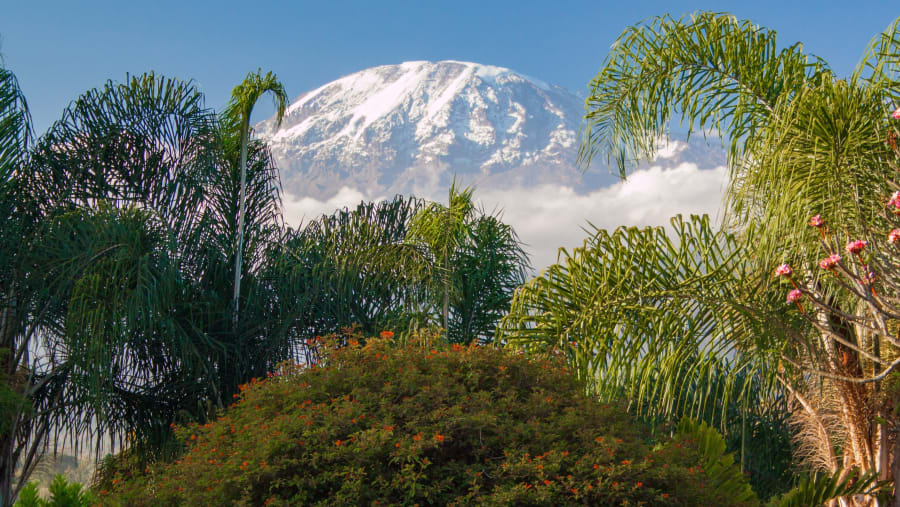
Embark on a 7-day Mount Kilimanjaro trek via the Marangu Route, hiking through diverse landscapes from lush rainforests to alpine desert. This route includes an acclimatization day at Horombo Hut before your exhilarating midnight summit attempt to Uhuru Peak, the highest point in Africa. Along the way, stay in mountain huts and experience one of Tanzania's most iconic trekking adventures.
This route includes an acclimatization day at Horombo Hut before your exhilarating midnight summit attempt to Uhuru Peak, the highest point in Africa.
From the itinerary
At a glance
Day by day
Arrive in Moshi, Tanzania, a town near Kilimanjaro National Park.
Meet your tour operator and guide for a briefing on the trek.
Overnight at a hotel in Moshi.
After breakfast and a short drive to Marangu Gate, complete the park formalities.
Begin your trek through the rainforest to Mandara Hut.
Hike for about 3-5 hours.
Dinner and overnight stay at Mandara Hut.
Continue your trek through the rainforest and into the heather and moorland zone.
Hike for about 5-7 hours.
Dinner and overnight stay at Horombo Hut.
Spend a day at Horombo Hut to acclimatize to the altitude.
You can take a day hike to Zebra Rocks or simply relax and enjoy the beautiful scenery.
Dinner and another night at Horombo Hut.
Trek across the alpine desert to reach Kibo Hut, the base camp for the summit attempt.
Hike for about 5-7 hours.
Dinner and overnight stay at Kibo Hut.
Start your summit attempt very early, usually around midnight.
Hike to Gilman's Point (5,681m/18,640ft) and continue to Uhuru Peak, the highest point in Africa.
Descend to Kibo Hut for a short rest, then continue down to Horombo Hut.
The summit day is long and can take 11-15 hours or more.
Dinner and overnight stay at Horombo Hut.
Descend through the rainforest to Marangu Gate.
Complete the necessary paperwork and receive your summit certificates.
Transfer back to your hotel in Moshi for a well-deserved rest and celebration.
Where this trip takes you
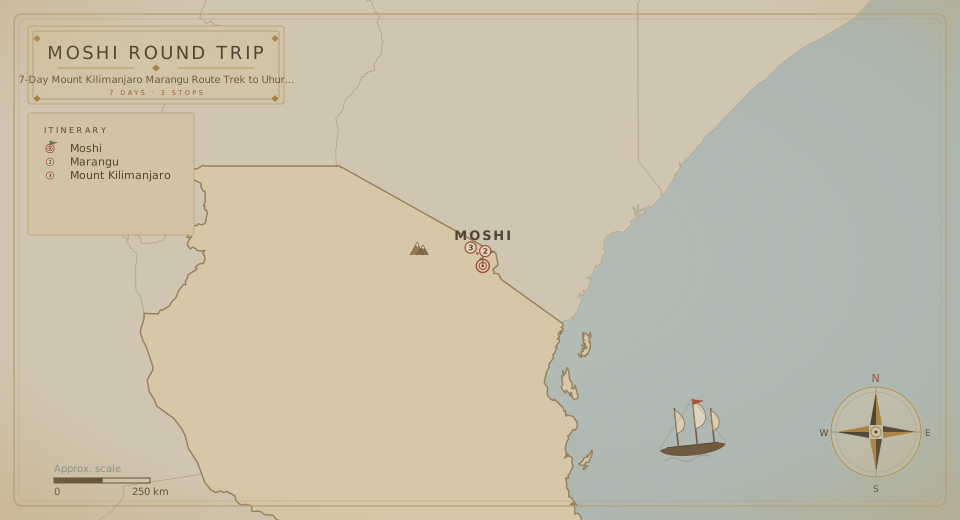
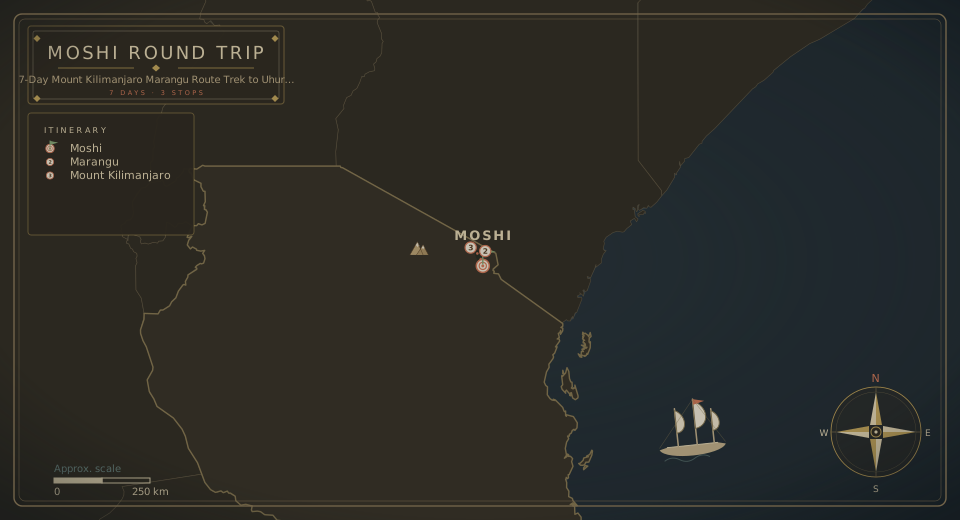
Moshi, Marangu Gate rainforest, Kibo Hut alpine desert, Uhuru Peak
The route
The fine print
Transfers from arrival to departure (airport pick-up and drop-off)
Three meals per day and two litres of mineral water
All entrance fees during the trek
Professional local guide
Crew salaries - guide, assistant guides, cook, and porters
All accommodation on the mountain
Pre- and post-trek accommodation in town - one night before and one night after the trek (B&B)
Sleeping mattress
Walking poles
Hot water for washing
Transfers from the hotel to Marangu Gate and from Mweka Gate to the hotel in Moshi
International flight from your home country
Domestic flight
Travel and medical insurance - highly recommended
Shopping, alcohol, souvenirs, and other personal expenses
Entry visa for Tanzania
Tips for the crew
Laundry services
Trekking gear - missing gear can be rented on this day
Trekking gear - gear that is missing can be rented on this day.
The best time to climb Mount Kilimanjaro in Tanzania is during the dry seasons, which provide the most favorable weather and trekking conditions. The two primary dry seasons are:
Late June to October (also known as the Long Dry Season):
This is the peak trekking season on Kilimanjaro.
Clear skies and minimal rainfall make for excellent visibility and stable conditions.
The trails are generally drier and less muddy.
The temperature is milder, and there is less likelihood of encountering extreme cold on the summit.
This is a popular time to climb, so you might encounter more trekkers on the trail, and advance bookings are recommended.
December to mid-March (also known as the Short Dry Season):
This is another good time to climb Kilimanjaro.
While there may be occasional showers, it is generally drier than the wet season.
The mountain is less crowded during this period, providing a quieter experience.
You might encounter some snow on the upper slopes, adding to the scenic beauty.
The wet seasons, which are best avoided for climbing Kilimanjaro, are:
April to early June (the Long Rainy Season):
This is the wettest time of the year, with heavy rainfall.
Trails can be slippery, and visibility may be limited due to cloud cover.
It is not recommended for trekking due to the challenging conditions.
Mid-March to late May (the Short Rainy Season):
While not as wet as the long rainy season, this period still experiences rain and cloudy conditions.
Trails can be muddy and less stable.
Keep in mind that the weather on Mount Kilimanjaro can be unpredictable, and even during the dry seasons, you may encounter some rain and snow at higher elevations. It is crucial to be prepared for changing conditions and consult with a reputable tour operator who can provide guidance on the best time for your specific trek. Additionally, acclimatization and physical fitness are essential considerations regardless of the season, so be sure to plan accordingly.
Logistics
Your 7 days finish where they began, in Moshi.
 Watch the film
Create your own adventure
Say goodbye to travel stress.
Starting from
Estimated room rates
When
Travellers
Total
—