

Poznan
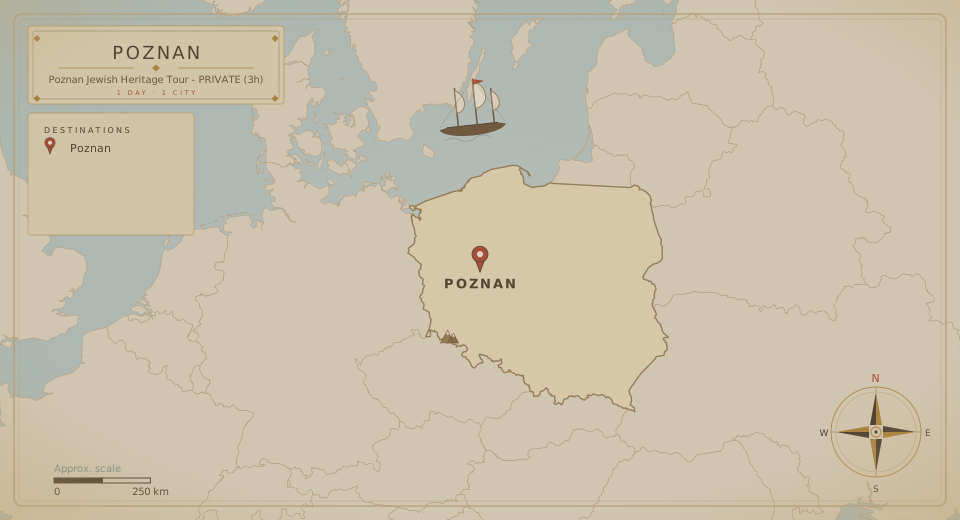
Poznan is the capital of Wielkopolska province, nowadays a major economic, commercial, scientific, cultural and tourism hub in Western Poland. It is famous for the country’s most important trade-fair complex and possibly the most spectacular Renaissance Town Hall you’ll ever see. Its picturesque Old Town amazes tourist all year round, even during winter time when Christmas markets and Ice Festival make it a perfect place to visit. In 2019 Poznań was voted 5th best city on the Best European Travel Destinations list. And it’s worth to mention that Best European Travel Destinations chose Poznan as one of the best Christmas markets destination for 2021. In Poznan you will find also origins of Polish state, Poland’s only painting by Claude Monet and the delicious regional sweet St. Martin croissants. Make no mistake, this 1,000-year-old city on the River Warta has much to be proud of – it even has its own local dialect.
The former Jewish district
In the 13th century, Poland began founding cities based on the model of German town law. In 1253, the Wielkopolska dukes Przemysl I and Boleslaw the Pious jointly established Poznan on the left bank of the Warta River. The city was soon populated by settlers who, having been given special rights and obligations, comprised a new social stratum – burghers. These settlers included Jews who, as subjects of the duke and followers of a different religion, were not permitted to participate in public life in the city. The Jewish community occupied the area delimited by today’s Zydowska, Szewska and Mokra Streets in the north of medieval Poznan. The Jews organised themselves into a distinct community, whose members were primarily engaged in trade and handicrafts. According to records, Poznan’s first synagogue was established in the late 14th century at the intersection of today’s Dominikanska and Szewska Streets. By the 15th century, the Jewish community featured a cemetery, a mikva and a religion school.
Wolnosci Square (Freedom Square)
One of the most popular tourist places in Poznan. It is surrounded by historic, buildings: Bazar Hotel, National Museum, Raczynski Library and the former German theater, now called the Arkadia. In the past, the square was known as Musza Mountain. For several hundred years there was a Jewish cemetery there. Today, this place is teeming with life, and numerous cultural events take place there. The square is especially famous for the annual "Poznan Bethlehem" Christmas market - one of the most popular in Poland.
New Synagogue
The monumental Neo-Romanesque building featured numerous oriental details. The shrine was built in 1907 at the initiative of the Poznan orthodox community, headed by rabbi Wolf Feilichenfeld. Local Jews referred to the Large Synagogue as “red” for the colour of its external redbrick walls. The synagogue was devastated and rebuilt by the Germans during World War II into an indoor swimming pool for soldiers of Werhmaht. After the end of the war, the building no longer fulfiled its religious functions. Completely ruined was returned to the Jewish community in 2002.
Akiwa Eger’s square
Small square in front of the New Synagogue. In 2008 named after Akiwa Eger - an outstanding chief rabbi of the Poznan Jewish community, to honor his achievements. In his time, Poznań’s Jewish Talmud (Yeshiva) school became one of the largest and most famous in Europe. Akiva Eger educated entire generations of students who went on to lead Jewish communities in various parts of the Continent. Eger was a widely-esteemed moral authority who acted for the good of the people in both theory and practice. Akiva Eger left behind a substantial intellectual legacy - to this day, his works are studied by Jews who seek to explore the intricacies of faith and law.
Square of the Righteous Among the Nations
The Square is located nearby to the former Municipal Stadium, which during the Second World War the Germans transformed into a labor camp. The name of the square commemorates Polish community, who risked their own lives and the lives of their relatives to save Jews during World War II.
Glogowska street Cemetery
The cemetery was established in 1804 after the liquidation of the cemetery in Musza Gora (today Wolnosci Square area). During World War II, the Germans completely devastated and destroyed the cemetery area, and the tombstones were used to pave roads. After the war this area was incorporated into the Trade Fair grounds. In recent times, however, steps have been taken to commemorate its existence with a memorial site on Glogowska street, which consists of the reconstructed graves of Rabbi Akiva Eger, his wife and son, and two other Poznan rabbis.
Forced labor camps for the Jews
As the Germans carried out their plan to obliterate the Jewish population, Poznan became one big labor camp between 1940 and 1943. The free labor force was to help rebuild the Warta Country in keeping with Nazi ideas. Dozens of camps and subcamps designed to contain Jewish prisoners were set up in and around Poznań. The local Polish population risked their lives trying to save the prisoners by delivering medications, food and warm clothing to them. A central role in the camp system was played by a facility set up in May 1941 in the Municipal Stadium at Dolna Wilda Street. The stadium camp held ca. 1000 prisoners, who were exploited by private German companies. Plagued by disease and famine, the camp became a place of horror. The Germans also used the stadium for public executions, more than one hundred of which were performed before the camp was shut down in August 1943. After the liberation of the camp, at Krolowej Jadwigi street, a monument was erected with the inscription: "The Municipal Stadium was a Nazi camp for the extermination of Polish citizens of Jewish origin from Poznan and the surrounding area.
Local Flavours
If you’ve got a sweet tooth, you’re going to love the St. Martin croissants, that are listed by the European Commission as a Protected Geographical Indicator. Made from Danish pastry dough according to a very strict recipe, the main filling ingredient is white poppy seeds and they’re often topped with icing. To give you an idea of its importance, there actually exists an interactive Poznan Croissant Museum. Here you can learn the story of just how this baked goodie became the sweet symbol of the Wielkopolska province, by watching an animated cartoon version of the “croissant history of Poznan”, which is presented under the polychromed wooden ceiling of a Renaissance tenement in the Old Town Market Square. In this museum not only you can taste the famous croissants, but you can even take part in making them if you fancy it. Of course there are many other local dishes that you need to try, for example “pyra z gzikiem” a local dialect name for baked potato with cottage cheese dip, “czernina” black soup, or something a little fancier, like Poznan-style duck, which comes with delicious potato dumplings, baked apple and red cabbage.