
Poland · City Tours

Poznan Panoramic Tour PRIVATE (4h)

4 Hours Round trip from Pickup service provided in Poznań. Easy pace

The journey

Trip highlights
  • 01 Private 4-hour panoramic tour of Poznan
  • 02 Visit Cathedral Island, one of the oldest parts of the city
  • 03 See the Renaissance Town Hall in the Old Market Square
  • 04 Explore the charming streets of Poznan’s Old Town
  • 05 Discover baroque landmarks including the Parish Church
  • 06 Pass Mickiewicz Square, the Opera House, and the Imperial Castle

Discover Poznan on a private panoramic tour that combines comfortable transport with guided walks through the city’s most important historic quarters. Over four hours, explore a city shaped by royal beginnings, Renaissance splendour, grand churches, and elegant 19th- and 20th-century architecture.

From Cathedral Island and the Gothic cathedral of Saints Peter and Paul to the colourful Old Market Square and the famous Town Hall with its billy goats, this experience offers a well-rounded introduction to Poznan’s heritage. Along the way, you’ll also pass landmarks such as Freedom Square, the Imperial Castle, and the Castle District while learning what else to discover in the city after your tour.

One of Town Hall's towers hosts two small billy goats, which butt their heads together every day at noon.

From the itinerary

At a glance

What this trip includes

Duration 4 Hours
Tour type Private
Activity level Easy
Accommodation Not included
Transport Included
Wheelchair access Not applicable
City Poznan
Languages English, French, German, Italian, Polish, Russian, Spanish

Day by day

The itinerary

1
Day 01

Poznan

Poznan is the capital of Wielkopolska province, nowadays a major economic, commercial, scientific, cultural and tourism hub in Western Poland. It is famous for the country’s most important trade-fair complex and possibly the most spectacular Renaissance Town Hall you’ll ever see. Its picturesque Old Town amazes tourist all year round, even during winter time when Christmas markets and Ice Festival make it a perfect place to visit. In 2019 Poznań was voted 5th best city on the Best European Travel Destinations list. And it’s worth to mention that Best European Travel Destinations chose Poznan as one of the best Christmas markets destination for 2021. In Poznan you will find also origins of Polish state, Poland’s only painting by Claude Monet and the delicious regional sweet St. Martin croissants. Make no mistake, this 1,000-year-old city on the River Warta has much to be proud of – it even has its own local dialect.
2
Day 02

Ostrow Tumski Cathedral Island

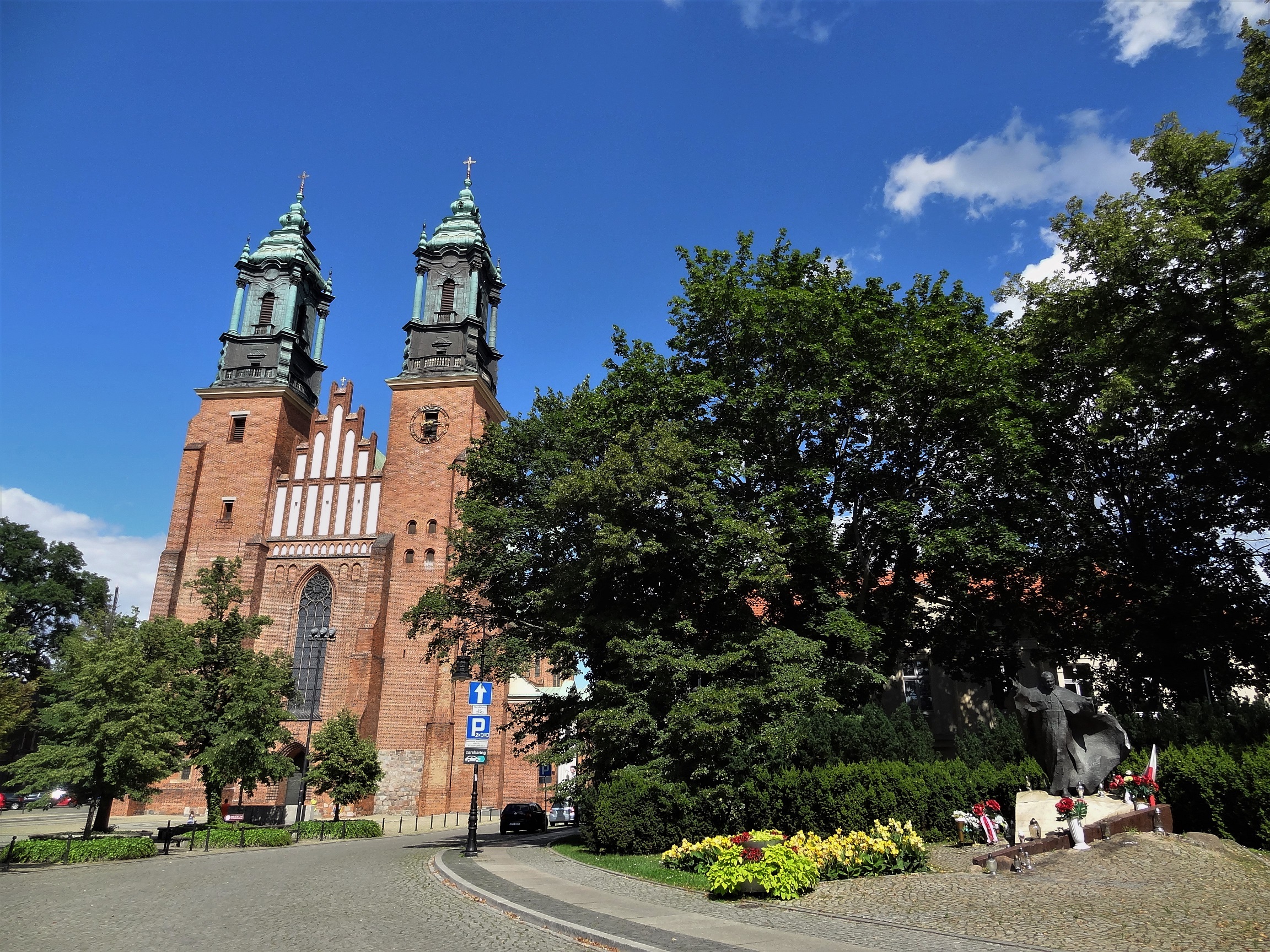
The oldest part of the city is Cathedral Island called Ostrow Tumski, situated in the fork of the River Warta and its tributary, the Cybina. A powerful fortified town existed here from at least the 9th Century - some even say it’s the birthplace of Poland itself. The country’s oldest cathedral, the majestic cathedral of Saints Peter and Paul, stands there to this day. There are remnants of tombs in its vaults – probably the resting place of Poland’s first rulers, Mieszko I and his son Boleslaus the Brave. Where better to learn about the ancient history of a city than in one of its most ultramodern buildings? The dramatic white Porta Posnania Interactive Heritage Centre, which you enter via a spectacular footbridge that crosses the river, has won several architectural competitions and is one of the key sites on the Royal-Imperial Route. This popular tourist route links Cathedral Island with the Old Town and the city centre and is a great way to experience the city.

3
Day 03

Old Town

Old Town is the centermost neighbourhood of the city covering the area of the once walled medieval city of Poznan. In its centre you will find the Old Market Square boasting of dozens of colourful, picturesque houses and a real gem of the city - the historic Town Hall. It represents the glory of Poznan, from its foundation in 1253 being an exquisite example of Renaissance architecture. One of Town Hall's towers hosts two small billy goats, which butt their heads together every day at noon. Strolling along charming streets you can discover the impressive baroque churches like Fara basilica, St Antony church and the Franciscan Church with a miniature model of medieval Poznan. At the western end of the Old Town is the Przemysl Hill on which the King's castle once stood. The medieval Royal Castle in Poznan has been recently reconstructed and now from its tower you can enjoy an almost unrivalled panorama of the Old Town. Just few steps further you will find the Freedom Square surrounded by 19th century historical buildings like: National Museum, Raczynski Library, Bazar Hotel and Arcadia.

4
Day 04

The Poznan Town Hall

The Poznan Town Hall - One of the most beautiful Renaissance secular buildings (not only) in Poland is the symbol of the city. Worth mentioning is the building’s façade’s three-storied arcade loggia. The Town Hall’s major attractions are the famous billy goats, striking at noon on the tower, as well as its rich interior and exterior decoration. The interior hosts Museum of the History of the City of Poznan. Its focal point is the Grand Hall, also known as the Revival Hall. It rests on two sandstone pillars, supporting the ceiling, which in turn is ornamented with polichromed sculptures. These range from crests, biblical symbols and mythological scenes to exotic animals and planets.

5
Day 05

Parish Church (fara)

Parish Church (fara) - St Stanisław the Bishop’s Parish Church is a superior example of Baroque architecture. Initially the Jesuit temple, its construction proceeded in stages since 1651 till the middle of the 18th century and required the demolition of some selected fragments of city walls as well as fi lling the moat. The marvelous main altar and entrance portal was designed by Pompeo Ferrari. The building is a three-nave church with galleries over the lateral naves and massive columns in the main nave. The church strikes as monumental, pompous, literally saturated with all sorts of ornaments (e.g. sculptures, paintings, moulding) yet, all these elements instantiate an ideal example of artistic symbiosis. The nearly hypnotic play of light in the church gives the impression of its inside being slightly submerged in subtle fog.

6
Day 06

Castle District

The district was created in the place of the liquidated fortifications of the Poznan Fortress, on their western section. As at the beginning of 20th century Poznan was in German hands the aim of creating an architectural ensemble in such a monumental form was to shape a synthetic prime-German showpiece of the new capital of the Germanic East. All elements of the program were subordinated to the idea of raising the city to a higher level and attract state bureaucracy to settle down in Poznan. With the approval of Wilhelm II the last German Emperor and King of Prussia works started in 1904 and in 1910 the former Imperial Castle was completed. Looking rather like a real medieval fortress, the early 20th-Century neo-Romanesque building is considered to be Europe’s youngest castle built for a crowned ruler. Nowadays it houses the Zamek Culture Centre. The Museum of the Poznan Uprising, which took place in June 1956 (a division of the Wielkopolska Museum of Independence) is also located here. A monument commemorating this first mass workers’ protest in communist Poland, which was bloodily suppressed, can be found in the nearby Adam Mickiewicz Square. In the vicinity you can admire Collegium Maius building, the Opera House and the Mickiewicz University. Another tourist attraction to be opened soon is The Enigma Codebreakers Centre - an interactive exhibition dedicated to those, who have made a successful attempt to break the cipher, which as it was thought, was impossible to break. The success, which was based on a talent and work of some extraordinary talented Polish mathematicians, had the beginning in 1929 in Poznan.

7
Day 07

Local Flavours

If you’ve got a sweet tooth, you’re going to love the St. Martin croissants, that are listed by the European Commission as a Protected Geographical Indicator. Made from Danish pastry dough according to a very strict recipe, the main filling ingredient is white poppy seeds and they’re often topped with icing. To give you an idea of its importance, there actually exists an interactive Poznan Croissant Museum. Here you can learn the story of just how this baked goodie became the sweet symbol of the Wielkopolska province, by watching an animated cartoon version of the “croissant history of Poznan”, which is presented under the polychromed wooden ceiling of a Renaissance tenement in the Old Town Market Square. In this museum not only you can taste the famous croissants, but you can even take part in making them if you fancy it. Of course there are many other local dishes that you need to try, for example “pyra z gzikiem” a local dialect name for baked potato with cottage cheese dip, “czernina” black soup, or something a little fancier, like Poznan-style duck, which comes with delicious potato dumplings, baked apple and red cabbage.

The route

Where you'll travel

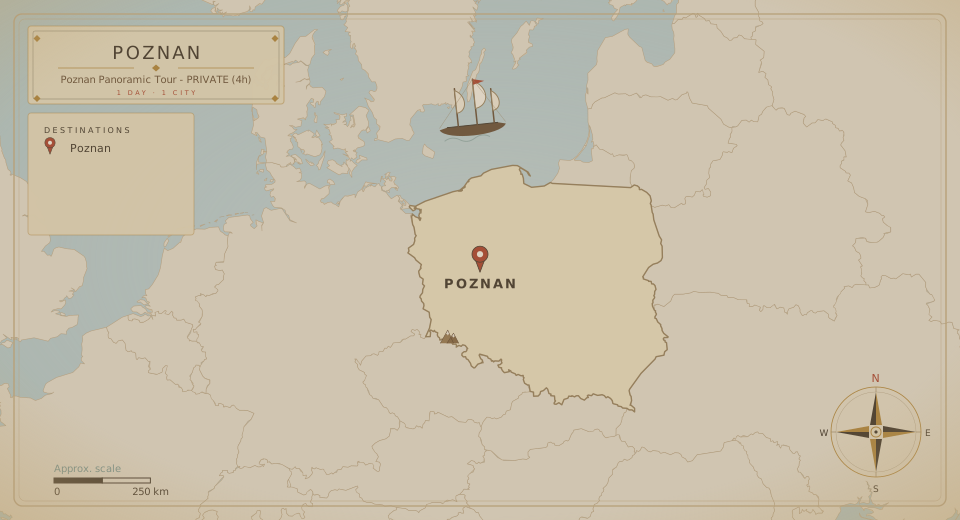
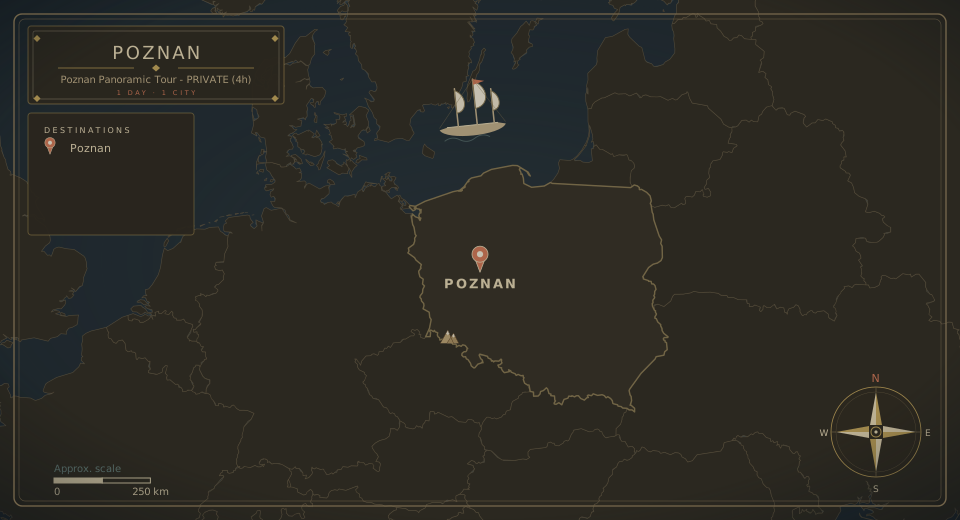
Tour route map
Round trip from Pickup service provided in Poznań. 1 city · 4 Hours

The fine print

Trip details

What's Included

  • Guide 4h
  • Transportation during the tour

What's Not Included

  • ENTRY OR ADMISSION FEE
  • TIP OR GRATUITY

Logistics

Meeting & route

Meeting point
Pickup service provided in Poznań.
Tour start
Pickup service provided in Poznań.
Tour ends at the same location as the start point.
End of the journey

Your 4 hours finish where they began, in Pickup service provided in Poznań..

Watch the tourHQ film Watch the film

Create your own adventure

Can't find the perfect tour? Tailor your dream trip.

  • Tell us your destination, dates and group size.
  • Our travel experts and local guides design a tailored itinerary, just for you.
  • Enjoy your trip with peace of mind, knowing everything is taken care of.
Plan my holiday

Say goodbye to travel stress.