


The Warsaw Jewish Cemetery
The Warsaw Jewish Cemetery is one of the largest Jewish cemeteries in Europe and in the world. Located on Warsaw's Okopowa Street and abutting the Christian Powązki Cemetery, the Jewish necropolis was established in 1806 and occupies 33 hectares (83 acres) of land. The cemetery contains over 250,000 marked graves,[1] as well as mass graves of victims of the Warsaw Ghetto. Although the cemetery was closed down during World War II, after the war it was reopened and a small portion of it remains active, serving Warsaw's existing Jewish population.
Royal Route
The former Royal Route stretches from Zamkowy Square to Trzech Krzyży Square. Must-see sights on the Route include: St. Anne's Church (and the view from the church tower), the Polonia House (once the Museum of Industry and Trade, where Maria Skłodowska-Curie worked), the Radziwiłł Palace (the current residence of the President of Poland), the Warsaw University campus with Kazimierzowski Palace, Czapski Palace (Academy of Fine Arts) and elegant stores and restaurants on Nowy Świat Street — an extension of Krakowskie Przedmieście Street.
Warsaw Ghetto
Warsaw Ghetto — an area that was sealed off from the rest of the city by the Nazis in 1940 in order to isolate the Jewish community. Approximately 400,000 Jews were forced to live in an area of just 2.6 square kilometres in appalling conditions. A quarter of the ghetto's inhabitants died during the first two years. Liquidation activities began in 1942 — mass executions took place and transports from Umschlagplatz (a transfer square) moved approximately 300,000 ghetto residents to extermination camps. In April 1943, when Nazi forces entered the area of the ghetto to finish the liquidation, an uprising started, which lasted less than a month. After the uprising had been put down the ghetto area was completely destroyed.
The Ghetto Heroes Monument
The Ghetto Heroes Monument is a monument in Warsaw commemorating the Warsaw Ghetto Uprising of 1943 during the Second World War. It is located in the area which was formerly a part of the Warsaw Ghetto, at the spot where the first armed clash of the uprising took place. The monument was built partly of Nazi German materials originally brought to Warsaw in 1942 by Albert Speer for his planned works. The completed monument was formally unveiled in April 1948.
Nożyk Synagogue
Nożyk Synagogue - the synagogue was built between 1898-1902 on the initiative of Zalman and Rywka Nozyk and was located at 6 Twarda Street. Originally it was inside the Jewish Ghetto during World War II but when the ghetto was made smaller following deportations, it was located on the outside where it served as a fodder house and a stable. After the war, when survivors returned, the synagogue was damaged but still intact and remained the only Jewish place of worship on the left bank of the River Vistula in the former bustling Jewish part of the city.
POLIN Museum of the History of Polish Jews
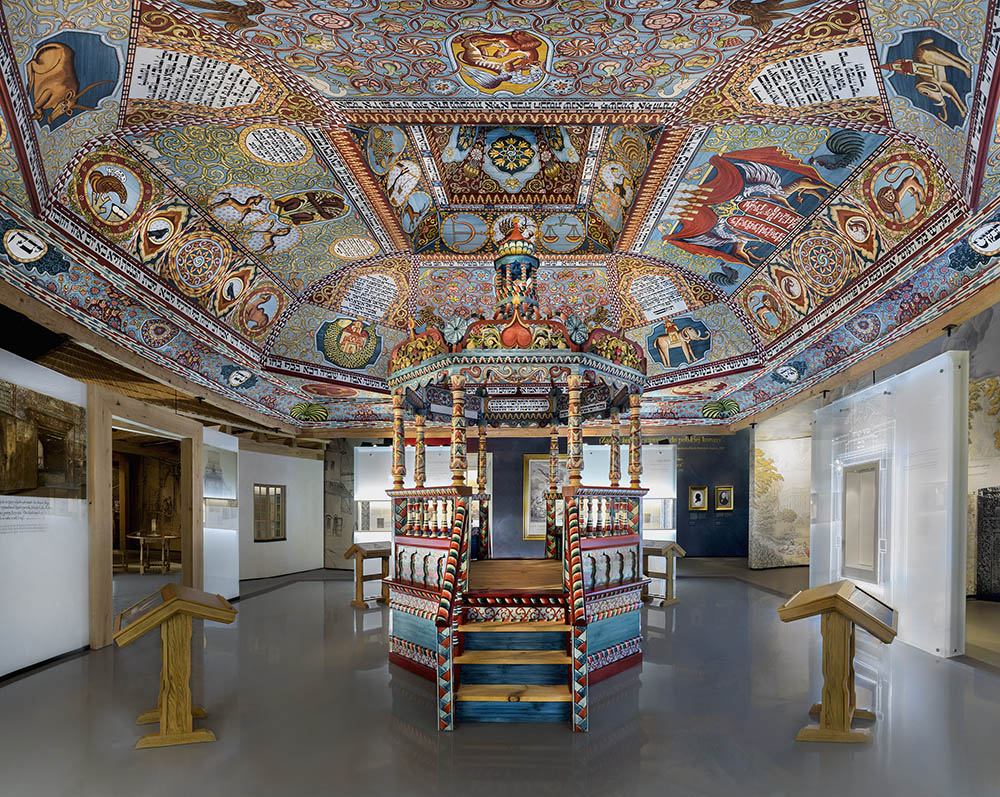
POLIN Museum of the History of Polish Jews stands in what once was the heart of Jewish Warsaw. A place where streets that no longer exist were once bustling with life. It was the hub of city life, with cafés, theaters, cinemas, cabarets, shops and boutiques, schools, synagogues and markets crowded into every corner. One could hear laughter, shouting and conversations: in Yiddish, Hebrew, Polish. During World War II, the Germans turned this area into the Warsaw Ghetto. After the war, it became a place haunted by ruins. A gap in space and memory, crying to be filled. Its building stands in a symbolic place. The edifice, facing the Monument to the Ghetto Heroes, surrounded on all sides by grey apartment buildings raised after the war on the ruins of the Ghetto, illuminates a square once teeming with life and filled with the district's Polish and Jewish inhabitants. The simple, cool, static mass, clad in copper and glass, is split by an undulating, living, dynamic fissure. A chasm, rift, symbolizing the traumatic break in the thousand-year history of Polish Jews – the Holocaust. A break, but not an end.