Tanzania · Trekking

7-Day Kilimanjaro Shira Route Trek with Uhuru Peak Sunrise

7 Days Round trip from Moshi Moderate pace

The journey

Trip highlights
  • 01 Trek through shrubs and giant heather to Shira 1 Camp
  • 02 Explore grassy moorland and the stunning Shira Cathedral
  • 03 Ascend toward Lava Tower through dramatic volcanic scenery
  • 04 Climb the famous Barranco Wall and descend into Karanga Valley
  • 05 Reach Uhuru Peak for a magnificent sunrise above Mawenzi

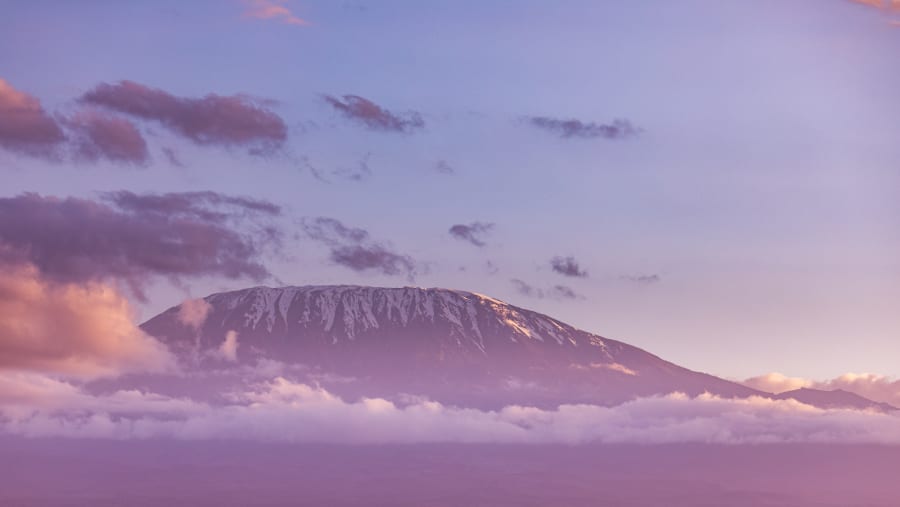
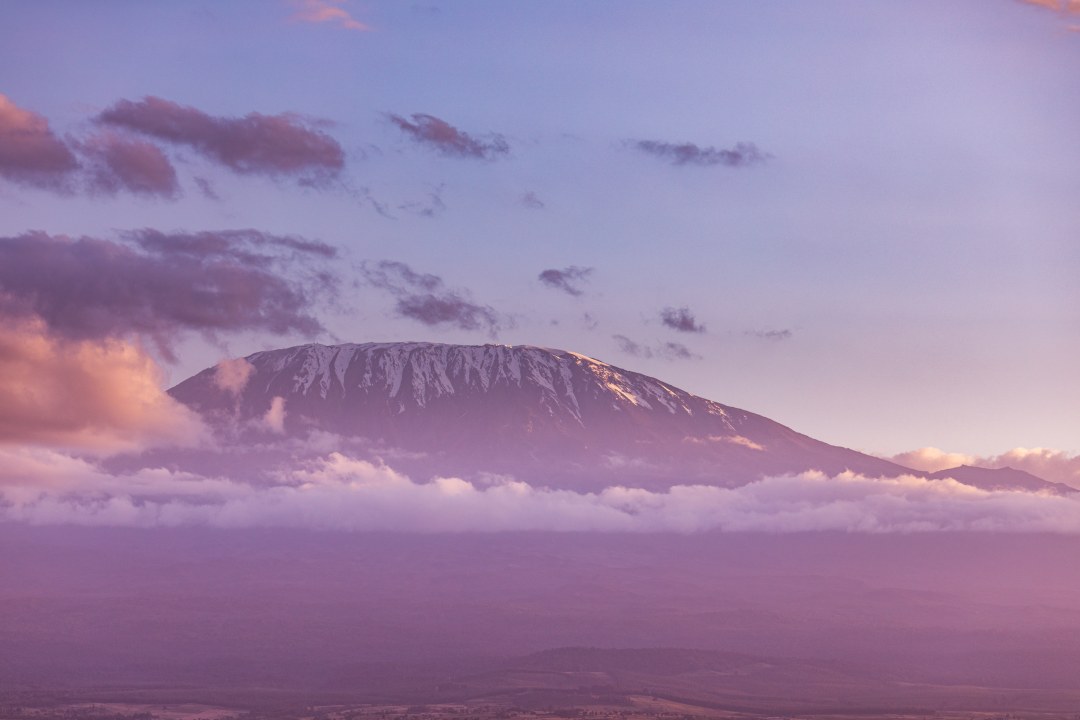
Embark on a 7-day trek via the Shira Route to reach the majestic summit of Mount Kilimanjaro. Traverse diverse landscapes of shrubs, giant heather, grassy moorland, volcanic rock formations, and valleys as you acclimatize along the mountain. Conquer the famous Barranco Wall, follow the Southern Circuit with views of the summit from many angles, and experience the awe-inspiring sunrise from Uhuru Peak, the highest point in Africa.

Near Stella Point (18,900 ft), you will be rewarded with the most magnificent sunrise you will ever see coming over Mawenzi Peak.

From the itinerary

At a glance

What this trip includes

Duration 7 Days
Tour type Shared
Activity level Moderate
Accommodation Included · Budget
Transport Included
Wheelchair access Yes
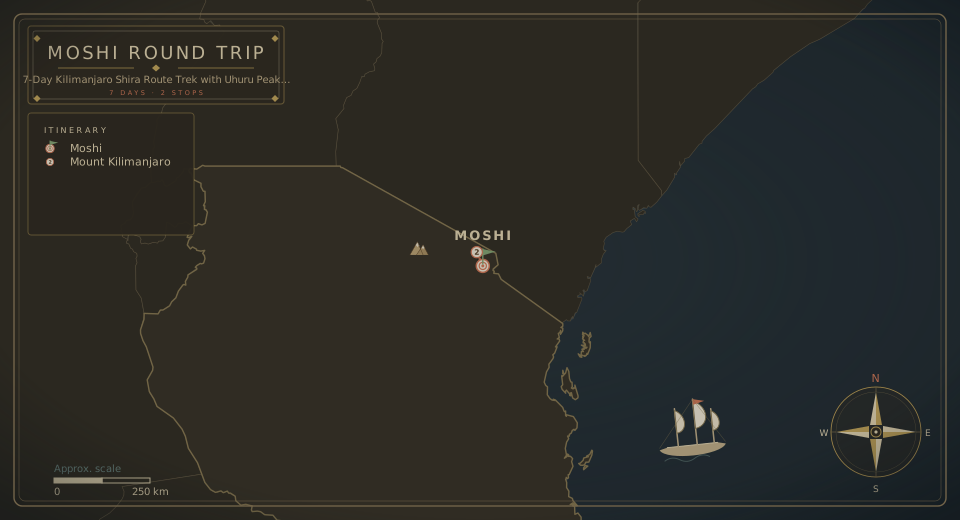
Cities Moshi, Mount Kilimanjaro
Languages English, Swahili

Day by day

The itinerary

1
Day 01

Londorossi Gate to Shira 1 Camp

We depart Moshi for Londorossi Gate, a drive of about 4 hours, where we complete the entry formalities while the guides and porters prepare the equipment. We then continue up a steep path to Moram, the starting point of the hike. The trek begins through shrubs and giant heather until we reach Shira 1 Camp.
2
Day 02

Shira Plateau to Shira 2 Camp

Today is a fairly easy day designed to help with acclimatization. We begin by exploring the plateau's grassy moorland and volcanic rock formations. Then we take a scenic path to Shira Cathedral, a huge buttress of rock surrounded by steep spires and pinnacles, before settling at Shira 2 Camp.

3
Day 03

Lava Tower and Barranco Camp

We continue east up a ridge and then head southeast toward Lava Tower, a 300 ft tall volcanic rock formation. We descend to Barranco Camp through the strange but beautiful Senecio Forest to an altitude of 13,000 ft. Although you begin and end the day at the same elevation, the time spent at a higher altitude benefits acclimatization.

4
Day 04

Barranco Wall to Karanga Camp

We begin the day by descending into a ravine to the base of the Great Barranco Wall. Then we climb the non-technical but steep, nearly 900 ft cliff. From the top of the Barranco Wall, we cross a series of hills and valleys until we descend sharply into Karanga Valley. One more steep climb leads us up to Karanga Camp. This is a shorter day meant for acclimatization.

5
Day 05

Karanga Camp to Barafu Camp

We leave Karanga and reach the junction that connects with the Mweka Trail. We continue up to the rocky section of Barafu Hut. At this point, you have completed the Southern Circuit, which offers views of the summit from many angles. Here we make camp, rest, and enjoy an early dinner to prepare for summit day - the two peaks of Mawenzi and Kibo are visible from this position.

6
Day 06

Summit Push to Uhuru Peak and Descent to Mweka Camp

We begin our push to the summit very early in the morning, around midnight. This is the most mentally and physically challenging portion of the trek. The wind and cold at this elevation and time of day can be extreme. We ascend in the darkness for several hours while taking frequent but short breaks.

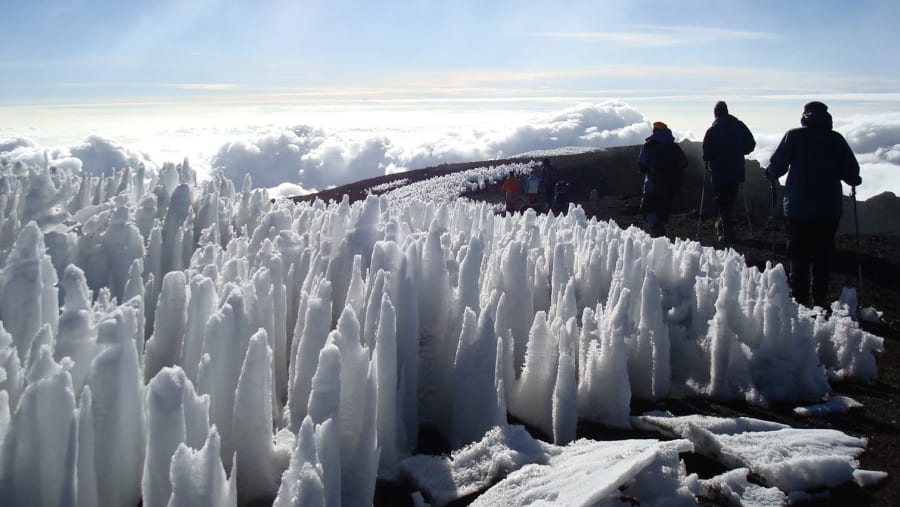
Near Stella Point (18,900 ft), you will be rewarded with the most magnificent sunrise you will ever see coming over Mawenzi Peak. Finally, we arrive at Uhuru Peak, the highest point on Mount Kilimanjaro and the continent of Africa.

From the summit, we descend, continuing straight down to the Mweka Hut campsite, stopping at Barafu for lunch. The rocky trail can be hard on the knees, so trekking poles are helpful. Mweka Camp is situated in the upper forest, and mist or rain can be expected in the late afternoon. Later in the evening, we enjoy our last dinner on the mountain and a well-earned sleep.

7
Day 07

Mweka Camp to Mweka Gate

After breakfast, we descend to Mweka Park Gate to receive your summit certificates. At lower elevations, it can be wet and muddy, so gaiters and trekking poles will help. Shorts and T-shirts will probably be plenty to wear, but keep rain gear and warmer clothing handy. A vehicle will meet you at Mweka Gate to drive you back to your hotel in Moshi.

Shira 1 Camp grassy moorland, Shira Cathedral rock buttress, Lava Tower volcanic formation, Uhuru Peak sunrise over Mawenzi Peak

Where this trip takes you

Shira 1 Camp grassy moorland, Shira Cathedral rock buttress, Lava Tower volcanic formation, Uhuru Peak sunrise over Mawenzi Peak

The route

Where you'll travel

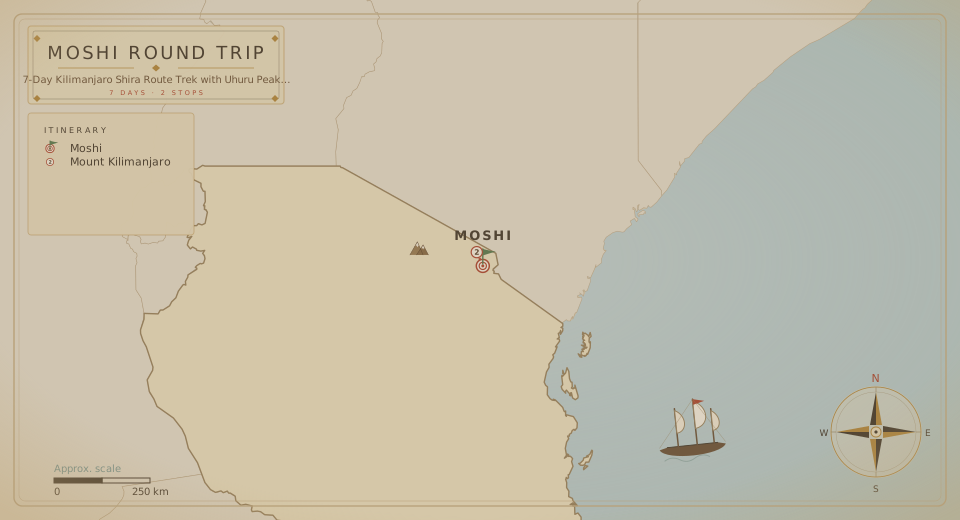
Tour route map
Round trip from Moshi 2 cities · 7 Days

The fine print

Trip details

What's Included

  • Private transport to and from Kilimanjaro International Airport and your accommodations in Moshi
  • Two nights of accommodation in Moshi
  • Transportation to and from the Kilimanjaro gate
  • Park entry fees
  • Camping fees
  • Team Kilimanjaro Rescue fees
  • 18% VAT on tour fees and services
  • 4-season mountain tents
  • Double-layered sleeping mats
  • Friendly and professional mountain guides, cook, and porters
  • 3 hot meals daily while on the mountain
  • Enough treated and filtered drinking water throughout the trek
  • Hot water for washing
  • Fair wages for the mountain crew as approved by the Kilimanjaro National Park Authority (KINAPA) and the Kilimanjaro Association of Tour Operators (KIATO)
  • Government taxes
  • Portable oxygen tanks and an oximeter
  • Emergency first-aid kit

What's Not Included

  • Lunches, dinners, and drinks at your hotel before and after the climb
  • Travel insurance
  • Flights
  • Laundry (available at the hotel)
  • Personal items and toiletries
  • Tips for guides, porters, and cooks

What to bring

  • Technical Clothing
    • 1 - Waterproof jacket, breathable, with hood
    • 1 - Insulated jacket, synthetic or down
    • 1 - Soft jacket, fleece or soft-shell
    • 2 - Long-sleeve shirts, lightweight, moisture-wicking fabric
    • 1 - Short-sleeve shirt, lightweight, moisture-wicking fabric
    • 1 - Waterproof pants, breathable (side zipper recommended)
    • 2 - Hiking pants
    • 1 - Fleece pants
    • 1 - Shorts (optional)
    • 1 - Long underwear, moisture-wicking fabric
    • 3 - Underwear, moisture-wicking fabric recommended
    • 2 - Sports bras (women)
  • Accessories
    • 1 - Sunglasses or goggles
    • 1 - Backpack cover, waterproof (optional)
    • 1 - Water bottle (Nalgene, 32 oz.)
    • 1 - Water bladder (Camelbak type, 3 liters)
    • 1 - Towel, lightweight, quick-dry (optional)
    • 1 - Pee bottle, to avoid leaving the tent at night (recommended)
    • Stuff sacks, dry bags, or plastic bags in various sizes to keep gear dry and separate
  • Headwear
    • 1 - Brimmed hat, for sun protection
    • 1 - Knit hat, for warmth
    • 1 - Balaclava or Buff, for face coverage (optional)
    • 1 - Gloves, warm (waterproof recommended)
    • 1 - Gloves, thin
  • Footwear
    • 1 - Hiking boots, warm, waterproof, and broken-in
    • 1 - Gym shoes, to wear at camp (optional)
    • 3 - Socks, wool or equivalent
    • 1 - Gaiters, waterproof (optional)
  • Equipment
    • 1 - Sleeping bag, warm, four seasons*
    • 1 - Trekking poles, collapsible (highly recommended)*
    • 1 - Headlamp, with extra batteries
    • 1 - Duffel bag, 50-90L capacity, for porters to carry your equipment
    • 1 - Daypack, 30-35L capacity, for you to carry your personal gear *may be rented on location
  • Other
    • Toiletries
    • Prescriptions
    • Sunscreen
    • Lip balm
    • Insect repellent containing DEET
    • First-aid kit
    • Hand sanitizer
    • Toilet paper
    • Wet wipes (recommended)
    • Snacks, lightweight, high-calorie, high-energy (optional)
    • Electrolytes, powder or tablets (optional)
    • Camera, with extra batteries (optional)
    • Paperwork: trip receipt, passport, visa (available at JRO), immunization papers, and insurance documents

Know before you go

  • When people think of climbing a mountain, they often conjure up images of a brave soul clinging to a vertical rock face with bare hands, or an intrepid alpinist dressed head to toe in a down suit, taking step after step in deep snow with an axe in hand while roped to teammates. Neither of these applies to Mount Kilimanjaro, despite its formidable height.
  • Mount Kilimanjaro does not require any technical skills. It is known as a walk-up mountain because, quite simply, you walk up it.
  • There is no need for mountaineering equipment such as harnesses, ice axes, or ropes because there is no danger of falling off a cliff or into a crevasse.
  • Furthermore, there are no parts of the trail where one has to be exceptionally skilled in rock climbing.
  • Unless you take the Western Breach Route, you do not need technical equipment such as helmets, ice axes, ropes, and crampons.

Logistics

Meeting & route

Meeting point
Kilimanjaro Region, Tanzania
Tour start
Moshi, Tanzania
Tour ends at the same location as the start point.
End of the journey

Your 7 days finish where they began, in Moshi.

Watch the tourHQ film Watch the film

Create your own adventure

Can't find the perfect tour? Tailor your dream trip.

  • Tell us your destination, dates and group size.
  • Our travel experts and local guides design a tailored itinerary, just for you.
  • Enjoy your trip with peace of mind, knowing everything is taken care of.
Plan my holiday

Say goodbye to travel stress.

Starting from

USD 1,900 /person
Book This Tour

Estimated room rates

Single Room $1,900.00 — $2,240.00
Double Sharing $1,900.00 — $2,120.00

When

Travellers

Total