Tanzania · Trekking

7-Day Kilimanjaro Trek via Rongai Route with Uhuru Peak Summit

7 Days Round trip from Rongai Moderate pace

The journey

Trip highlights
  • 01 Trek the quieter Rongai Route on Kilimanjaro's northern side
  • 02 Camp beneath the jagged spires of Mawenzi at Mawenzi Tarn
  • 03 Use an acclimatization day on Mawenzi Ridge to prepare for summit night
  • 04 Reach Uhuru Peak, the highest point in Africa
  • 05 Cross the Saddle between Mawenzi and Kibo through a rocky lunar landscape

Experience a 7-day Kilimanjaro trek via the Rongai Route, approaching Africa's highest peak from the quieter northern side of the mountain. Hike through farmland, forest, heath, and alpine desert as you make your way from Rongai Gate to Mawenzi Tarn, Kibo Hut, and finally Uhuru Peak. This itinerary includes an acclimatization day to help your body adjust before summit night, when you climb to Gilman's Point and continue to the top. Descend via Horombo Hut and Marangu Gate, ending the adventure back in Moshi.

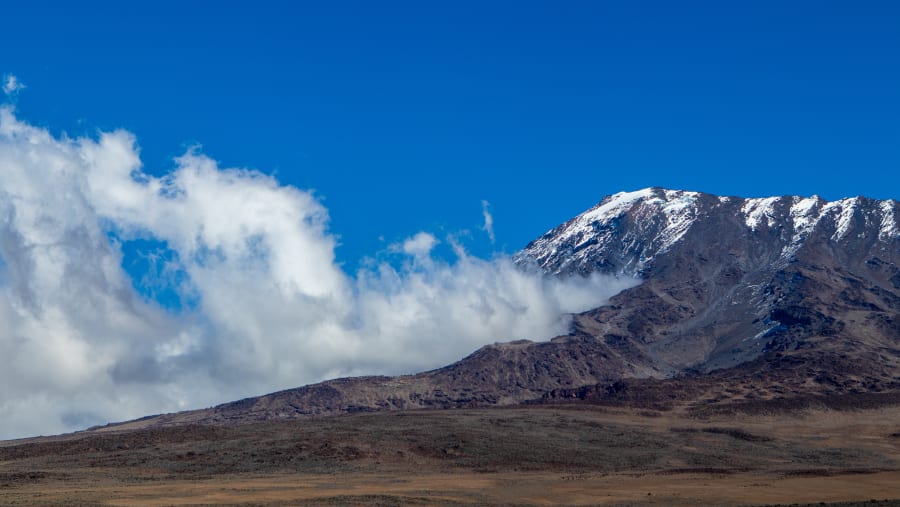
Continuing on, we now ascend to Uhuru Peak, which is the highest point in Africa.

From the itinerary

At a glance

What this trip includes

Duration 7 Days
Tour type Private
Activity level Moderate
Accommodation Included · Standard
Transport Included
Wheelchair access Yes
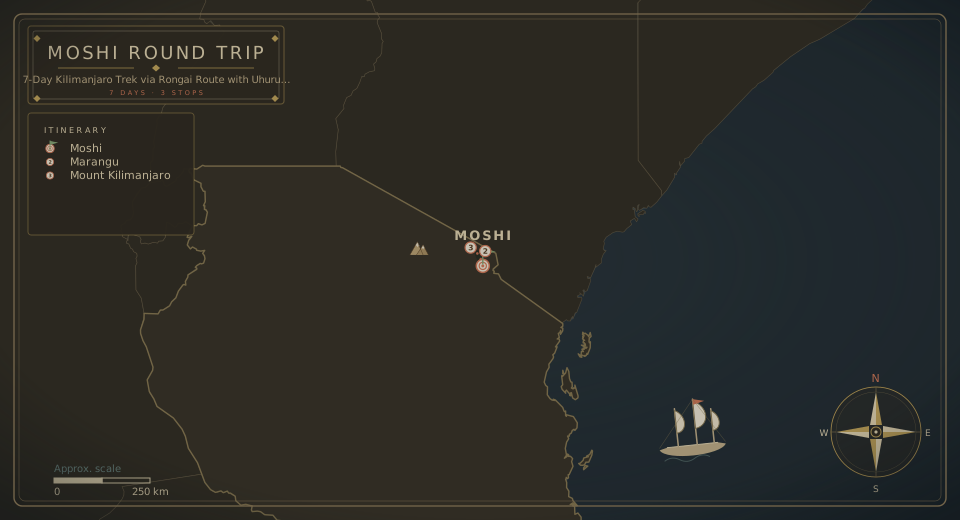
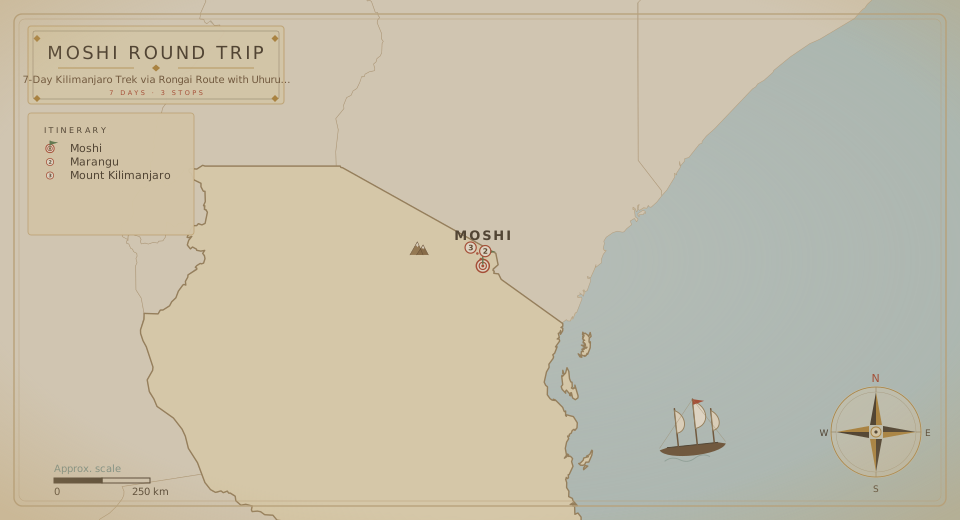
Cities Moshi, Mount Kilimanjaro, Marangu
Languages English, German, Italian, Spanish

Day by day

The itinerary

1
Day 01

Rongai Gate to Rongai Cave Camp

After breakfast, collect the bags that are supposed to go to Kilimanjaro while leaving the rest at the hotel. Then drive to Marangu Gate to obtain permits or to Rongai Gate, passing through the wooden village of NaleMoru, where the trailhead begins. The trail winds through corn and potato fields, then climbs gently through the forest, home to a variety of wildlife, including the black and white colobus monkey. Camp for the night at Rongai Cave.
2
Day 02

Rongai Cave to Second Cave and Kikelewa Cave

After breakfast, our guides will start the medical checkup to ensure that you can trek safely on the second day. The hike begins with a steady incline and reaches 2nd Cave while en route to Kikelewa Cave, where you will have your hot lunch at 2nd Cave. Proceed to Kikelewa Cave, where you will arrive in the late evening. Views of Kibo and the Eastern Ice Fields on the crater rim begin to emerge.

3
Day 03

Kikelewa Cave to Mawenzi Tarn Hut

The trekking today is short and steep, up a grassy slope. Views of the wilderness area are stunning. As we exit the heath zone and enter the alpine desert zone, the landscape changes dramatically. Camp is situated beneath the jagged spires of Mawenzi. The remainder of the day can be spent relaxing or exploring the area.

4
Day 04

Acclimatization at Mawenzi Tarn Hut

After a late breakfast, our guides will do the medical checkup to be sure you are ready for the next day. This is an acclimatization day. We hike steadily up a ridge with fantastic views on both sides, and the landscape is rugged and rocky. After spending a few moments exploring Mawenzi Ridge, we head back to Mawenzi Tarn for camp and a hot lunch. These extra days on the trail allow our bodies to acclimatize and assist with summit day.

5
Day 05

Mawenzi Tarn to Kibo Hut

After the early morning breakfast and the medical checkup, you will leave camp for Kibo Hut. As we traverse the Saddle between Mawenzi and Kibo Peaks, the trail climbs gradually across the rocky lunar landscape. Our campsite for the night sits at the bottom of the Kibo crater wall. The remainder of the day is spent resting and preparing for the final ascent in the early morning at midnight.

6
Day 06

Summit Uhuru Peak and Descend to Horombo Hut

The trekking starts early in the morning at midnight. Begin the climb to the summit on steep and heavy scree or snow up to Gilman's Point, located on the crater rim (elev. 5700 m/18,700 ft). Continuing on, we now ascend to Uhuru Peak, which is the highest point in Africa. There are unbelievable views at every turn, and you can take pictures at the summit to show your friends and family.

From here, we descend, stopping for lunch and resting at Kibo before continuing to Horombo Hut for the last camping. The beginning of this climb is done in the dark and requires headlamps or flashlights. It will be very cold until you descend, so you need all your warm layers. This is the most difficult part of the trek, with many switchbacks. Going slowly, pole pole, and with an optimistic attitude will get you there.

7
Day 07

Descend from Horombo Hut to Marangu Gate

After breakfast, a steady descent takes us down through the moorland to Mandara Hut. Continue descending through a lush forest path to the National Park gate at Marangu. At lower elevations, it can be wet and muddy. Gaiters and trekking poles will help. Shorts and T-shirts will probably be plenty to wear, but keep rain gear and warmer clothing handy.

This will be the last day of your trekking. At the gate, you will get the Kilimanjaro certificate, which your guides will give you. At that time, your team will be singing the Kilimanjaro songs plus the traditional songs. A vehicle will meet you at Marangu Gate to drive you back to your hotel in Moshi for a hot shower and rest.

Mawenzi Tarn, Saddle between Mawenzi and Kibo, Kibo Hut, Uhuru Peak

Where this trip takes you

Mawenzi Tarn, Saddle between Mawenzi and Kibo, Kibo Hut, Uhuru Peak

The route

Where you'll travel

Tour route map
Round trip from Rongai 3 cities · 7 Days

The fine print

Trip details

What's Included

  • Private transport to and from Kilimanjaro International Airport to your accommodations in Moshi
  • Two nights of accommodation in Moshi
  • Transportation to and from the Kilimanjaro gate
  • Park entry fees
  • Camping fees
  • Team Kilimanjaro Rescue fees
  • 18% VAT on tour fees and services
  • 4-season mountain tents
  • Double-layered sleeping mats
  • Friendly and professional mountain guides, cook, and porters
  • Three hot meals daily while on the mountain
  • Enough treated and filtered drinking water throughout the trek
  • Hot water for washing
  • Fair wages for the mountain crew as approved by the Kilimanjaro National Park Authority (KINAPA) and Kilimanjaro Association of Tour Operators (KIATO)
  • Government taxes
  • Portable oxygen tanks and ox meter
  • Emergency first-aid kit

What's Not Included

  • Lunches, dinners, and drinks at your hotel before and after the climb
  • Travel insurance
  • Flights
  • Laundry (available at the hotel)
  • Personal items and toiletries
  • Tips for guides, porters, and cooks (this is a guide to tipping on the mountain)

What to bring

  • 1 waterproof jacket, breathable, with hood
  • 1 insulated jacket, synthetic or down
  • 1 soft jacket, fleece or soft-shell
  • 2 long-sleeve shirts, lightweight, moisture-wicking fabric
  • 1 short-sleeve shirt, lightweight, moisture-wicking fabric
  • 1 waterproof pants, breathable (side zipper recommended)
  • 2 hiking pants
  • 1 fleece pants
  • 1 shorts (optional)
  • 1 long underwear, moisture-wicking fabric
  • 3 underwear, moisture-wicking fabric recommended
  • 2 sports bras (women)

Know before you go

  • You can expect severe variations in temperature. Be prepared for hot and humid conditions in the forests and below-freezing conditions, ice rain, and wind at higher altitudes. You should wear thermal underwear, hiking boots, warm thick gloves, and good-quality thermal socks.
  • Can beginners climb Kilimanjaro?
    • Yes, and to have the best Mt. Kilimanjaro climbing experience as a beginner, you should be fully aware of the conditions, seasonal climates, costs, and requirements to prepare yourself for this challenge.
  • Is Kilimanjaro a difficult hike?
    • Climbing Kilimanjaro on most days is not very hard because the trails are not steep; it is mostly about dealing with the altitude. However, summit night is extremely difficult, as this is the coldest and windiest section of your adventure. Expect an ascent of 4,084 ft with 49% less oxygen and a descent of nearly 6,870 ft.
  • What I wish I knew before climbing Kilimanjaro?
  • Six things I wish I had known before climbing Kilimanjaro:
    • Every single camp is cold.
    • You may find it hard to sleep.
    • Your skin and lips take a beating.
    • You need to pee all the time.
    • The water in your hydration pack freezes on summit day.
    • You feel 'off' when high up the mountain.
  • Do you need oxygen to climb Kilimanjaro?
    • Kilimanjaro's altitude is a significant challenge, but climbers do not need supplemental oxygen to climb Kilimanjaro or reach the summit. To reach the summit, you use the acclimatization method of walking slowly, "pole pole," climbing high, and sleeping low.

Logistics

Meeting & route

Meeting point
Moshi, Tanzania
Tour start
Rongai, Tanzania
Tour ends at the same location as the start point.
End of the journey

Your 7 days finish where they began, in Rongai.

Watch the tourHQ film Watch the film

Create your own adventure

Can't find the perfect tour? Tailor your dream trip.

  • Tell us your destination, dates and group size.
  • Our travel experts and local guides design a tailored itinerary, just for you.
  • Enjoy your trip with peace of mind, knowing everything is taken care of.
Plan my holiday

Say goodbye to travel stress.

Starting from

USD 1,490 /person
Book This Tour

Estimated room rates

Single Room $1,490.00 — $1,650.00
Double Sharing $1,490.00 — $1,610.00

When

Travellers

Total