Nepal · Trekking

15-Day Everest Base Camp Trek from Kathmandu with Kalapathar

15 Days Round trip from P7GR+PW8 Moderate pace

The journey

Trip highlights
  • 01 Experience breathtaking panoramic views of the Himalayas throughout the trek
  • 02 Enjoy the vibrant culture and warm hospitality of the Sherpa people
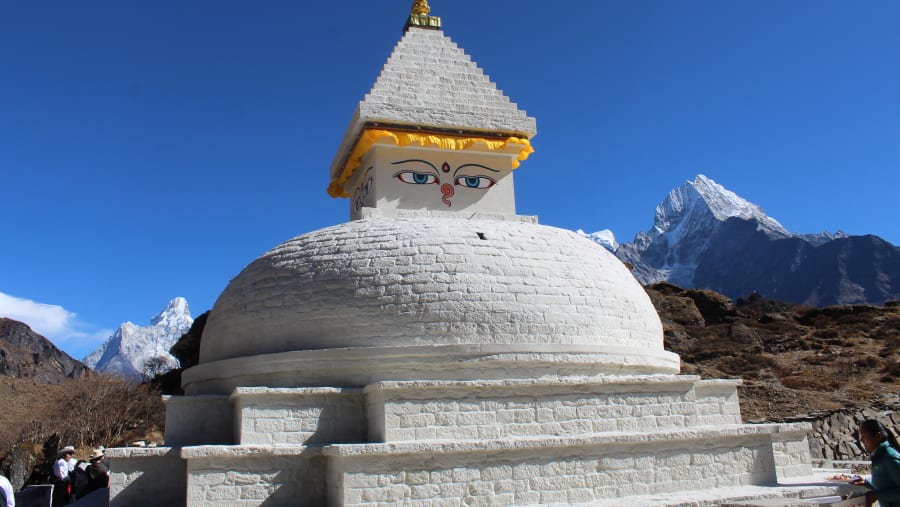
  • 03 Visit the famous Tengboche Monastery with spectacular mountain vistas
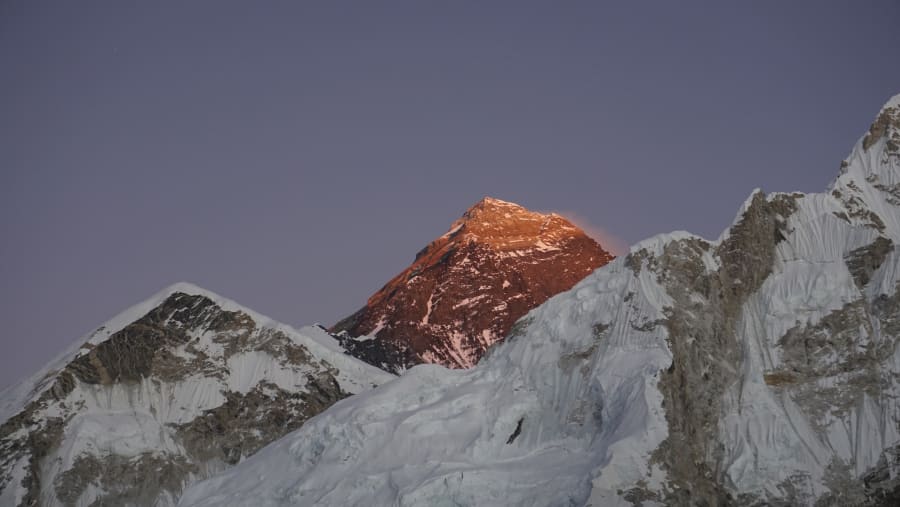
  • 04 Hike to Kalapathar for unparalleled views of Everest and surrounding peaks
  • 05 Explore the bustling Namche Bazaar, the trade hub of the Khumbu region

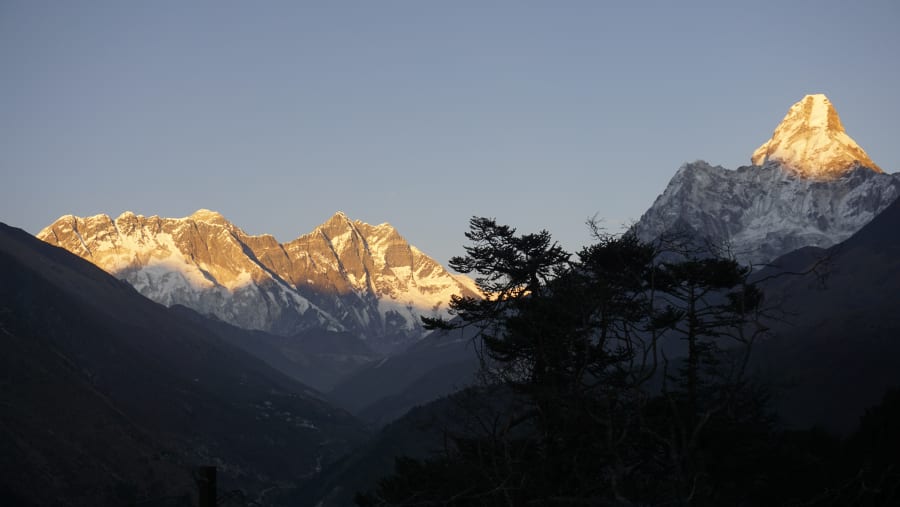
Embark on a thrilling 15-day journey through the breathtaking Himalayas, starting in Kathmandu. Trek through lush valleys, cross roaring rivers, and witness the majestic peaks of Everest, Lhotse, and Ama Dablam. Experience the rich Sherpa culture, visit ancient monasteries, and acclimatize to the high-altitude landscapes of Namche Bazaar and Dingboche. Reach Everest Base Camp and stand atop Kalapathar for unparalleled mountain views.

Reach Everest Base Camp and stand atop Kalapathar for unparalleled mountain views.

From the itinerary

At a glance

What this trip includes

Duration 15 Days
Tour type Private
Activity level Moderate
Accommodation Included · Standard
Transport Included
Wheelchair access No
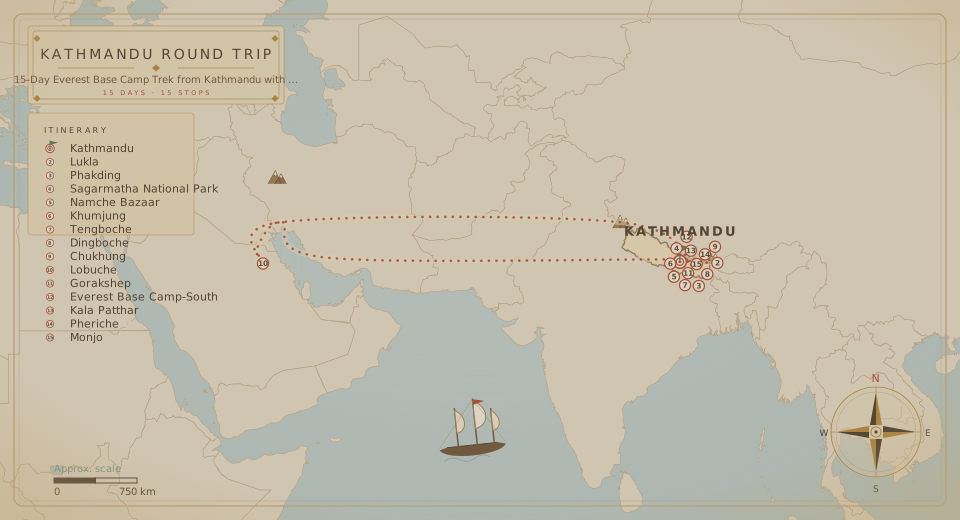
Cities Kathmandu, Everest Base Camp-South, Lukla, Dingboche, Namche Bazaar, Tengboche, Phakding, Lobuche, Kala Patthar, Gorakshep, Sagarmatha National Park, Monjo, Chukhung, Pheriche, Khumjung
Languages English, French, German, Hindi, Nepali, Norwegian

Day by day

The itinerary

1
Day 01

Arrival in Kathmandu and Hotel Check-in

  • Welcome to Kathmandu, an ancient city rich in cultural heritage, vibrant, and diverse in every sense of the word.
  • Our guide will receive you at the Tribhuvan International Airport (TIA) gate with your name on a board.
  • He or she will brief you about your schedule and the information you might need most while driving toward your hotel.
  • We make sure you are comfortable and leave the rest of the day free for you to relax.
2
Day 02

Flight to Lukla and Trek to Chumoa

  • Our early morning flight by Twin Otter aircraft takes us to Lukla, the most popular as well as notorious mountain airstrip in the world.
  • It was originally conceived by Sir Edmund Hillary's Himalayan Trust as a runway to transport materials for building schools and hospitals. Lukla is now one of the busiest runways in Nepal.
  • On the flight, we may witness magnificent bird's-eye views of some of the highest mountain peaks in the world, including Kanchenjunga, Lhotse, and Makalu, the world's 3rd, 4th, and 5th highest respectively.
  • On arrival, we meet our Sherpa guide and pick up our trail after a cup of tea.
  • Surprisingly, the high-altitude trek begins by descending to the river at Phakding.
  • Further on, we choose one of several good lodges in the wooded area at Chumoa, close to the entrance of Sagarmatha National Park.
3
Day 03

Trek to Namche Bazaar

  • The early start of our hike will allow us to ascend Namche Hill first thing in the morning.
  • At about halfway up the hill, the gap between the woods will allow us to get a glimpse of Mount Everest for the first time. If the weather is clear at the top, the South-West face will be visible behind the long Lhotse-Nuptse ridge. Namche is the most prosperous and active hub of the Khumbu region.
  • A bazaar is held every Friday and Saturday.
  • The wares on display include meat, grains, and vegetables, shoes, hand-woven aprons, trekking gear, and your choice of cafeteria for coffee, bakeries, and also pubs to hang out for some drinks.
  • Thamserku (6648 m), Kwangde Ri (6187 m), and Khumbila (5707 m) surround the natural bowl that Namche sits in.
4
Day 04

Acclimatization in Namche

  • We take the day off to allow our bodies to adjust to the rarefied atmosphere before ascending to higher altitudes.
  • The secret to safe acclimatization is to 'climb high, sleep low'.
  • So, it is safe for the more energetic among us to hike up the hill behind Namche to the airstrip at Syangbouche, to Khunde, Khumjung village, or stroll across to the museum behind the police post.
  • Others may prefer to 'chill out' and visit one of the lodges for a freshly baked cinnamon roll. Namche is a busy and bustling trading place, and there is always plenty going on.
5
Day 05

Trek to Tengboche Monastery

  • We start our hike early in the morning, and the trail follows one of the most beautiful wide paths used by travelers and locals, made by the initiative of a single man named Passang Sherpa.
  • There are spectacular views of Ama Dablam (6696 m), Khangtega (6779 m), the Mount Lhotse wall, and Mount Everest (8848 m).
  • Keep a lookout too for pheasants in the undergrowth and Himalayan tahr on the high cliffs.
  • We cross the Dudhkoshi River at Phungi Thanga and climb through the afternoon among the rhododendron forest to the saddle at the top of the hill. Surprisingly, in front of us is Tengboche, the principal monastery of the Khumbu area, and the views from here are unforgettable.
6
Day 06

Trek to Dingboche Valley

  • We follow the path down from Tengboche through the rhododendron forest to Deboche and cross an exciting bridge with the roaring Imja Khola beneath our feet.
  • A gradual climb takes us to the village of Lower Pangboche.
  • We are now in the heart of Khumbu, with beautiful views across to Ama Dablam. The afternoon stroll takes us along a path that hugs the valley wall and then across wide plains to a split in the valley.
  • The Khumbu breaks left, up to Pheriche, but we take a detour right to the hamlet at Dingboche at the start of the Imja Tse valley.
7
Day 07

Acclimatization Hike from Dingboche

  • This morning will be different from the rest of the days.
  • We have one extra day to enjoy the exhilarating scenery and adjust our bodies to this elevation.
  • We keep the backpack unpacked and carry our day bag with essential water and energy bars while hiking up to Nagarjuna Peak (5083 m). The hike to the peak is 3 to 4 hours uphill.
  • The higher the better, as we can have the best view of the Himalayas around us and also allow our bodies to become more familiar with the altitude.
  • Those of you who would not prefer an uphill hike at all can take an easy gradual hike to Chukhung Valley, where the Imja Tse River starts and you will be closer to one of the most famous peaks, 'Island Peak'.
8
Day 08

Trek to Lobuche Village

  • We climb up to the ridge behind Pheriche and stay high, mesmerized by the views of Tawoche and Cholatse, until we reach the tea houses at Dughla.
  • A steep, stiff ascent to the terminal moraine of the Khumbu Glacier is now tackled. The top of the climb is marked by a series of stone monuments commemorating some of the climbers who did not return from expeditions to this region.
  • A rough but obvious trail cuts across left, away from the glacier, to our campsite at Lobuche, a windswept collection of huts tucked in a narrow meadow between the glacier and Lobuche Peak (6156 m).
  • The Lhotse Ridge is simply awesome from this angle.
9
Day 09

Trek to Everest Base Camp

  • A long day and an early start.
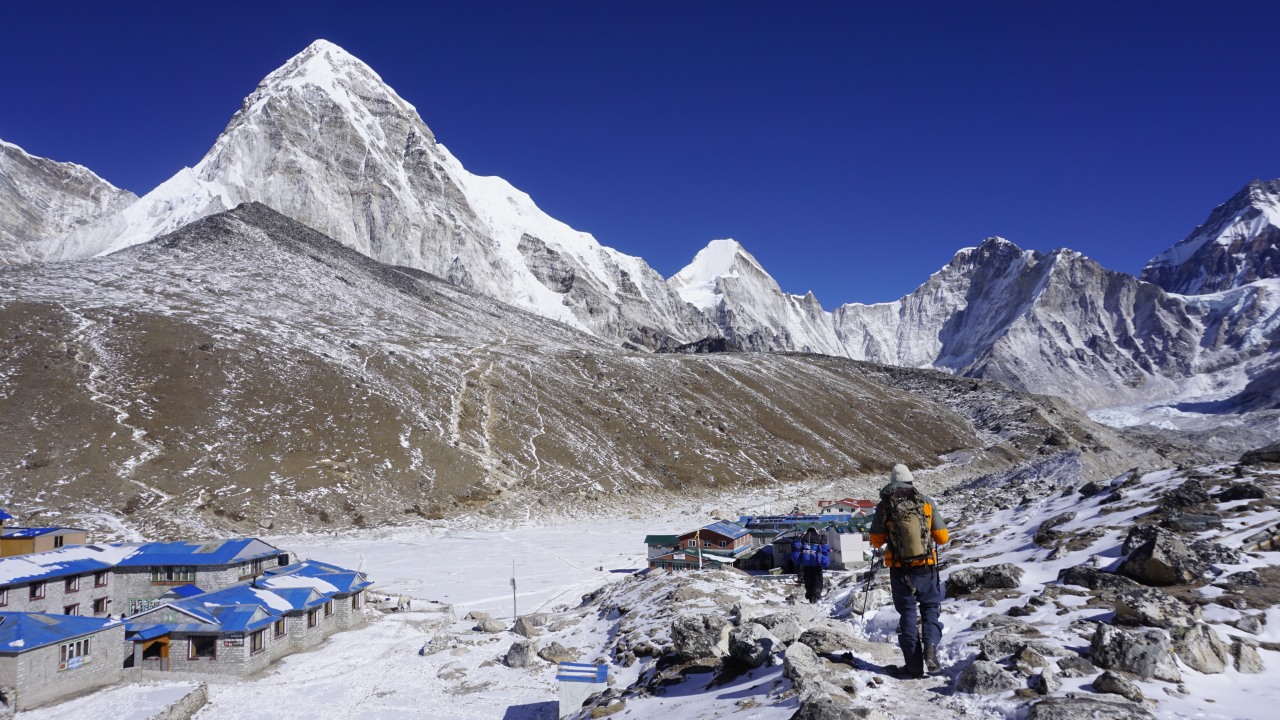
  • We trek along the rough path beside the Khumbu Glacier to the tea shacks at Gorak Shep.
  • You leave behind some grazing land and a few tea houses as you proceed towards Everest Base Camp from Gorak Shep.
  • The more you head towards Base Camp, the more barren the scenery becomes, and the trail grows more craggy and difficult to walk.
  • Stone landmarks erected along the trail have to be followed while passing glaciers or when the trail is covered by snow to avoid crevices, which can sometimes be fatal.
  • Though it is a two-hour walk from Gorak Shep, it is physically demanding.
  • The best suggestion would be to walk slowly and carefully and take your guide's help or advice whenever you are doubtful about your physical ability.
10
Day 10

Hike to Kalapathar and Trek to Pheriche

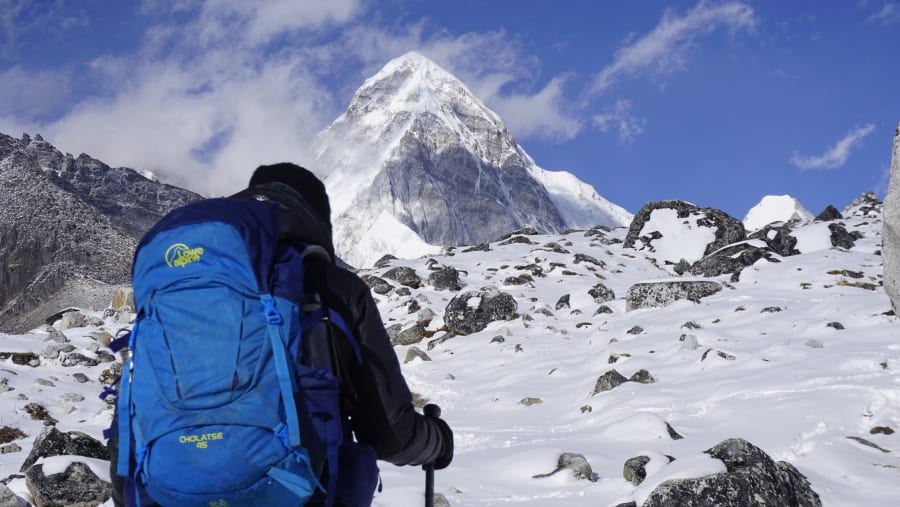
  • Behind rises the attractive 7000 m peak of Mount Pumori, which dwarfs our trek's summit of Kala Pattar. The route up is straightforward and takes most people between 90 minutes and 2 hours.
  • All the peaks - Everest, Lhotse, Lingtren, Nuptse, Changtse, Ama Dablam, and scores of other lesser peaks - can be seen from this wonderful vantage point.
  • We descend back down to Pheriche Valley following the same trail until we cross Dugla village, then head left down to our day trip destination.
11
Day 11

Trek to Phortse Sherpa Village

  • We gradually descend all morning down to Upper Pangboche. After lunch, we trek high on the west bank of the Imja River all the way to the popular Sherpa home village of Phortse.
  • This is a village of mountain climbers, where each household man has been to the summit for a living.
  • The village is atop the hill, across the valley from Tengboche and lower on the southern flank of Tawoche.
12
Day 12

Trek to Monjo

  • On the lap of Khumbi-Yulha, we wake up to see the beautiful green valley with Thamserku, Khangtega, Kongde, and Ama Dablam in front of our sight.
  • We leave for our camp ahead by a gradual uphill and mostly downhill trail via Namche towards Monjo.
  • This is the starting point of Sagarmatha National Park. Relax with the peaceful nature of Monjo.
13
Day 13

Trek to Lukla

  • Today will be the last day of the trek.
  • We leave behind all the beauties of the Himalayas and take only the memories and pictures as we finally climb to Lukla.
  • Our camp is located in a good place for proper rest and leisure.
  • Tonight, we may have to bid farewell to our support team. This will be the end of their services.
14
Day 14

Flight to Kathmandu and Hotel Check-in

  • Another chance to experience the domestic flight from Lukla.
  • Please note that the weather in Lukla and Kathmandu can cause delays due to fog or wind. Be reassured that our staff in Lukla and Kathmandu will do everything possible to minimize the inconvenience if this happens.
  • Your understanding and patience during such a situation will be greatly appreciated.
15
Day 15

Departure from Kathmandu

  • Our guide will drive you to Tribhuvan International Airport (TIA). Airport check-in and flight to your onward destination. We end our services here.
  • Note: This itinerary is only a guideline and is occasionally subject to change to suit local conditions, particularly on this trek where a lot of time is spent above 3000 meters.
Kala Patthar, Everest Base Camp-South, Namche Bazaar, Tengboche Monastery

Where this trip takes you

Kala Patthar, Everest Base Camp-South, Namche Bazaar, Tengboche Monastery

The route

Where you'll travel

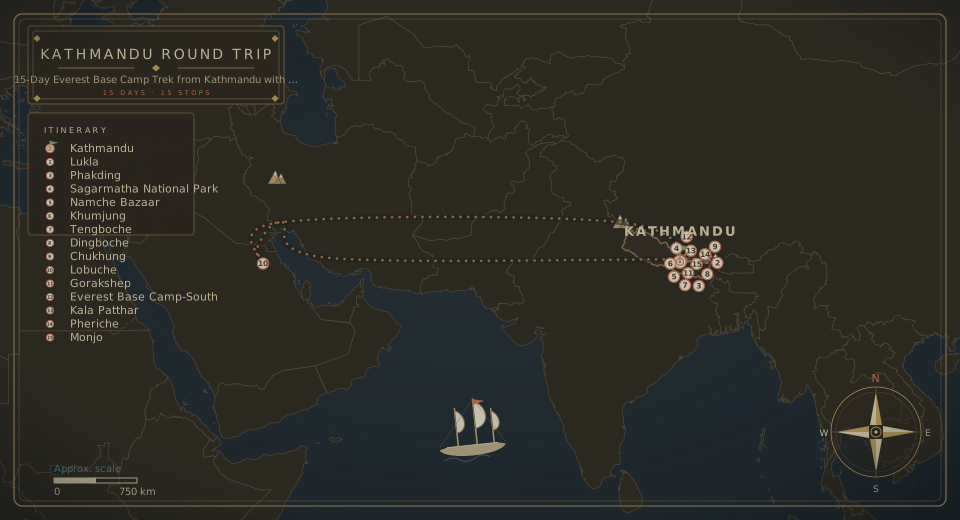
Tour route map
Round trip from P7GR+PW8 15 cities · 15 Days

The fine print

Trip details

What's Included

  • Pickups and drop-offs from airport/hotel
  • Accommodation in a 3-star or equivalent hotel in Kathmandu
  • Accommodation at a teahouse/lodge during the trek
  • All three meals (BLD) per day during the trek/climb
  • Wages, lodging, accommodation, insurance, and meals for the guide and porter
  • Professional, well-trained, and multilingual guide
  • Strong, experienced, and capable porter
  • Domestic flight tickets as well as airport taxes
  • All taxes (government and local), necessary paperwork, and permits
  • First-aid kit
  • Complimentary trekking map
  • Trek permits, TIMS card, and required trek documents
  • Sightseeing in Kathmandu Valley
  • Trekking completion certificate as a memento for all our valued guests
  • Welcome and farewell Nepalese traditional dinner

What's Not Included

  • Visa fees
  • Travel and emergency helicopter evacuation insurance
  • Meals (lunch and dinner) and other expenses during Kathmandu (breakfast included at hotel)
  • Any type of bottled/boiled water, soft drinks, or alcoholic drinks during the trek
  • Personal expenses like hot showers, laundry, and unforeseen costs due to bad weather, flooding, landslides, urgent helicopter evacuation, etc.
  • Trekking gear and clothing
  • Tips for guide, driver, and porter (highly expected)
  • Climbing gear and personal equipment
  • Any other expenses not listed above

What to bring

Clothing

  • Jackets (fiber or down).
  • Woolen shirts and thick sweaters.
  • Waterproof jacket with hood or poncho.
  • Tracksuit.
  • Track shoes.
  • Trousers.
  • Thermal underwear and thermal coat.
  • 2 pairs of loose-fitting long shorts/skirts.
  • Pair of gloves.
  • Pair of sandals.
  • Thermal underwear.
  • Woolen hat.
  • Long-sleeved shirt.
  • Towel and hankies.
  • Lightweight walking boots.
  • 2 pairs of thin socks and 2 pairs of woolen socks.

Equipment and Accessories

  • Snow glasses and sunglasses.
  • Trekking sticks.
  • Duffle bag or kit bag to carry gear while trekking.
  • 2-4 plastic bags and 2-4 large plastic bags to separate clean clothes from dirty ones, plus 6-10 smaller plastic bags to dispose of garbage.
  • Daypack bag to carry your personal requirements.
  • Water bottle and water-purifying tablets.
  • Toilet articles and towels, toilet paper.
  • Umbrella (optional).
  • Headlamp, torch, candles.
  • Matches/lighters.
  • Binoculars, camera, trekking map and compass, pillow, knife, passport photograph, reading materials, pencil, rubber, pen and notebook, lip guard.
  • Toilet papers.

Details of Trekking Equipment

  • Camp shoes/sandals: A luxury for your feet at the end of the day. Sandals or running shoes are better and can be bought cheaply in Kathmandu. They are a necessity for showers during the Khumbu and Annapurna treks.
  • Thermal shirts/underwear: Good thermals, both tops and bottoms, are best for cold-weather trekking.
  • Nightwear thermals: Good for keeping warm at night in the sleeping bag. Silk-weight is the lightest and warm.
  • Fleece/sweatpants: Good for the cold evening and morning.
  • Day-wear T-shirts/shirts: At lower altitudes, trekking weather will be hot, so T-shirts and shirts are recommended.
  • Trekking pants: Recommended to have 2 pairs.
  • Wind pants: If your trekking pants are reasonably windproof, then special wind pants are not needed. If you do bring a pair, it is not necessary to have Gore-Tex. Similar non-waterproof options are quite OK.
  • Underwear: Regular everyday type.
  • Neck gaiter: For winter trekking, these are really the best for staying warm.
  • Trekking poles: Trekking poles are very useful, especially for downhill walking. On popular treks in Nepal, you can also buy wooden trekking poles sold by children, and trekking can be done without trekking poles as well.
  • Sunglasses: Good wraparound glasses suitable for snow are recommended. It is bright up there, but specialized glacier glasses with side pieces are not needed. Contact lens wearers report very few problems except cleaning them in the conditions.
  • Mittens/gloves: A good pair of windproof gloves is essential. You can buy them cheaply in Kathmandu if you do not have them.
  • Sun hat/woolen hat: Trekking in spring and summer at lower altitude is hotter and sunny all day, so you can bring a hat or small cap to protect from sunburn. On the upper part of the trek, it is colder and windier, so you can have a woolen hat to keep your head warmer.
  • First aid kit: All our trekking tour and trek leaders carry a first aid kit box, including medicine for altitude sickness, diarrhea, and other small problems. You should bring any personal medicines that you need, as sometimes your local medicine is more effective than what we provide.
  • Water purification: Some places on the teahouse trek sell mineral water, but it is discouraged from an environmental point of view because of the plastic bottles. Hot and boiled water can be obtained from the guesthouse. Iodine tablets and chlorine water-purification drops are recommended to take.
  • Water bottle: Two 1-liter water bottles are recommended. Bring good ones that can take boiling water and are leakproof. European aluminum bottles are best.
  • Torch/flashlight: A flashlight or headlamp is necessary.
  • Towel: During the trek, towels are not available at guesthouses, so you need one small and light towel for trekking.
  • Sunscreen and lip balm with sunscreen: The sun is strong at altitude, especially after snow. Bring at least sunscreen and lip balm with SPF 15, and better still SPF 30+. You can buy these in Kathmandu.
  • Moisturizer: The air is dry and windier, with dust on some parts of the trek, so moisturizer is good to carry for your skin.
  • Toiletries: Shampoo, soap, scissors, hair products, toothbrush and toothpaste, tissues, sun cream, chap stick, antiseptic hand wipes, face washer, etc.
  • Daypack: This should be comfortable, and a good waistband that transfers some of the weight to the hips is most important. It needs to be big enough to take a jacket, fleece, water, camera, and odds and ends. Kathmandu now offers a range of cheap fall-apart packs to top-of-the-range options.
  • Footwear: One pair of sturdy light- to middle-weight hiking boots. Typically, these are a combination of nylon and leather. We suggest boots with a Gore-Tex lining to be waterproof. These types of shoes have a lug sole for good traction and provide lateral support for the ankles, which is essential while hiking. Heavy-weight all-leather backpacking boots are not recommended. Be sure your footwear is broken in and fits well. Boots should fit comfortably over one thin liner sock and a mid-weight wool sock. This reduces chafing and blisters. Tennis shoes or sandals are also useful for camp use or bathing.
  • Socks: Four pairs of liner socks and four pairs of mid-weight wool socks. Socks and footwear should be coordinated for a proper fit.
  • Backpack: For travel in Nepal and for trekking, a backpack is more suitable than a suitcase. If you plan on trekking or hiking, a sturdy and comfortable backpack and daypack are essential. You should have your backpack expertly fitted to you before your departure. Your backpack should also have a waterproof cover. Normally, you need 2: one of 60 liters and another of 25 liters is more suitable.
  • Sleeping bag: Down-filled sleeping bags are better for Nepal tours and trekking. Beg, borrow, or steal a good one, ideally a 4-5 season bag, because high-altitude nights will be cool. Good down is fluffy, light, and thick. A muff, an extra section around the neck, makes a big difference to the overall warmth of a bag. Reasonable sleeping bags are cheaply available for rent or purchase in Kathmandu. We advise you to take one rated to -20.
  • Sleeping bag liner: Cotton, silk, or fleece. It saves washing your sleeping bag and adds warmth.
  • Down jacket/Gore-Tex: This jacket is needed for trekking up to 3200 m and is also useful in the cold evening and morning. If you do not have one and want to use it only for trekking in Nepal, you can rent one in Nepal.
  • Fleece jacket: Most trekkers consider this essential, but alternatives are a thick thermal top or a light down jacket. In Kathmandu, you can get almost any sort of copy fleece you need.
  • Rain jacket/wind shell: The jacket should be very water-repellent and roomy.
  • Layering: Keeping the proper temperature is best accomplished by adding or taking off layers of clothing. While hiking during the day, you may be in shorts or a skirt and a long-sleeved shirt. During the evening, as the temperature cools, you will add a sweater and perhaps a parka. Bringing the items outlined below will ensure that you are adequately prepared. Make sure that your clothing is sized to allow your layers and still move comfortably.

Know before you go

Before you come, it is important to know the cultural norms and values of local people. Most importantly, one should be fit enough to trek 5-6 hours a day in Himalayan terrain.

Everest Base Camp trek, known as EBC in its abbreviation, is one of the classic and famous treks that the Himalaya has to offer. The duration for this trek usually ranges from 12-17 days, providing an exhilarating experience of panoramic sights infused with rich cultural history and the warm hospitality of the indigenous Sherpa people.

This trek is designed for those who want to explore the cultural aspects of people living in the Everest region. As we all know, the warm hospitality of Sherpa people always makes someone feel at home away from home. This trek will give you more than you want and create a lifetime memory of a cultural trek in Everest, Nepal.

Logistics

Meeting & route

Meeting point
Kathmandu, Nepal
Tour start
P7GR+PW8, Ring Rd, Kathmandu 44601, Nepal
Tour ends at the same location as the start point.
End of the journey

Your 15 days finish where they began, in P7GR+PW8.

Watch the tourHQ film Watch the film

Create your own adventure

Can't find the perfect tour? Tailor your dream trip.

  • Tell us your destination, dates and group size.
  • Our travel experts and local guides design a tailored itinerary, just for you.
  • Enjoy your trip with peace of mind, knowing everything is taken care of.
Plan my holiday

Say goodbye to travel stress.

Starting from

USD 1,200 /person
Book This Tour

Estimated room rates

Single Room $1,200.00 — $1,400.00
Double Sharing $1,200.00 — $1,400.00

When

Travellers

Total