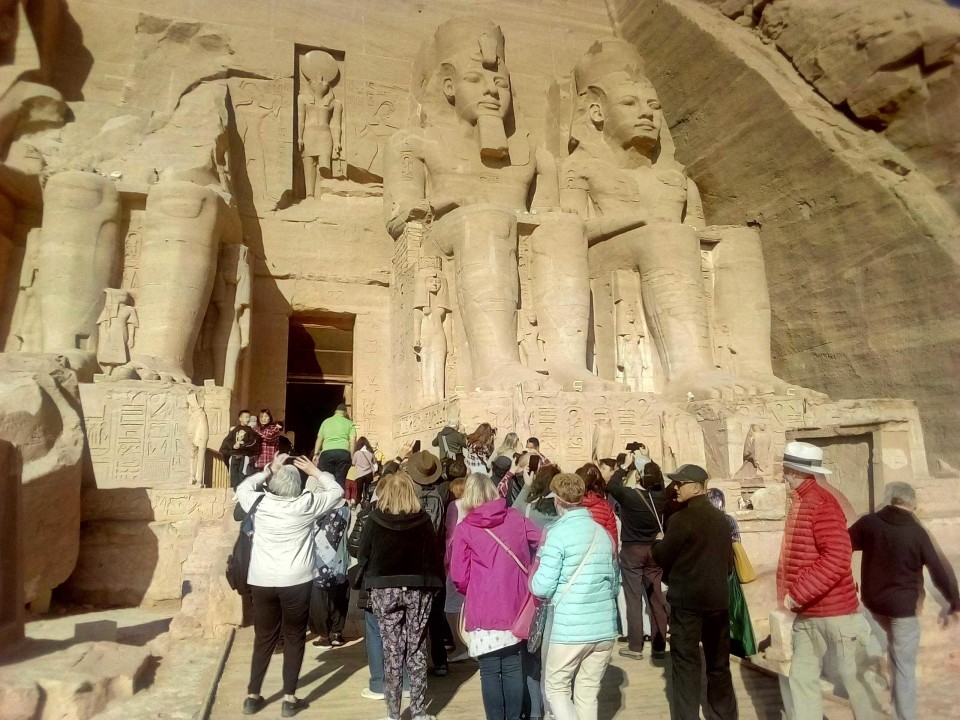
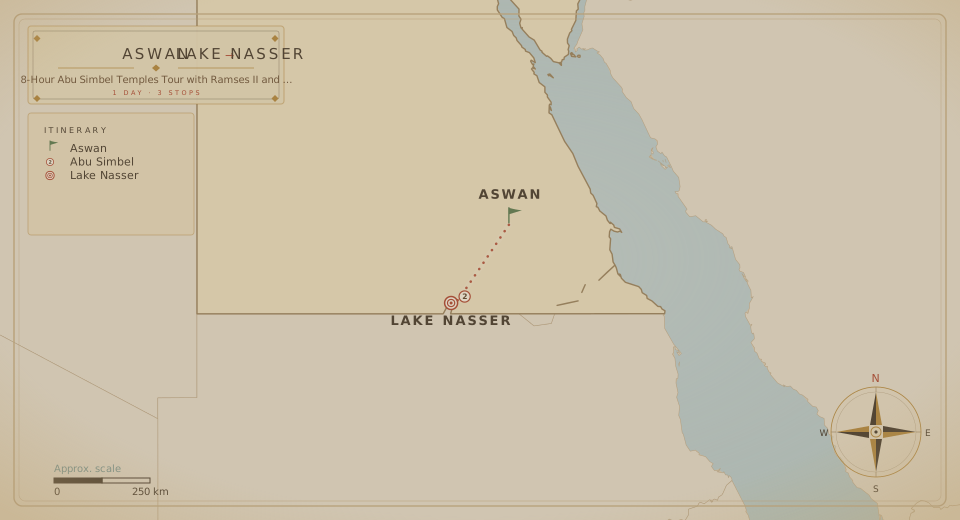
The guide will pick you up from your hotel in Aswan to fly to Abu Simbel, whose main attraction is the great sun temple of Ramses and the Temple of Queen Nefertari. Both temples were discovered in 1813 and were almost completely covered with sand. They were then moved in 1960 with the help of the Egyptian government and UNESCO to avoid the rising water of the Nile. Ramses II built the temple mostly to honour himself, as inside there is a mural depicting his famous victory at the Battle of Kadesh, where his army defeated his enemies. North of Ramses' temple, the Nefertari Temple was built by Ramses II for his favourite wife, Queen Nefertari, among 200 other wives and concubines. After the visit, you will fly back to Aswan and then be driven back to your hotel.
Both temples were discovered in 1813 and were almost completely covered with sand. They were then moved in 1960 with the help of the Egyptian government and UNESCO to avoid the rising water of the Nile.
The small temple of Queen Nefertari is located a hundred meters to the north of the large temple. This temple was carved into the rocks of the mountain that the ancient Egyptians called "The Pure Mountain" or "The Northern Mountain". Before the construction of the Nefertari temple, local people came to this mountain because they believed that the spirit of the goddess Hathor lived inside it. King Ramses took advantage of the people's belief in Abu Simbel and carved a temple dedicated to his wife, Queen Nefertari, and the goddess Hathor.
The small temple has a facade with six statues, followed by a pillared hall and a transverse hall. The temple ends with a small sanctuary and, on its sides, two adjacent rooms. Temple scenes focus on daily religious ceremonies, such as presenting flowers, carrying the clay tool, serving wine, and burning incense over offerings. It is noticeable in this temple that King Ramses II controlled much of the scenery. He alone owned seventeen views compared to twelve scenes of the temple owner, Nefertari, and carved four statues for himself on the facade and two for Nefertari.
The facade of the small temple is twelve metres high and twenty-eight metres wide. It is divided into two towers, each of which includes a group of three sculpted statues, each ten meters high. Two represent King Ramesses II and the third represents his wife Nefertari. The most beautiful statue of Queen Nefertari is in the group on the right, where she appears in a long transparent dress, holding the clay tool in her hands, and wearing the distinctive Hathori crown consisting of two feathers with the sun disk between them.
Enjoy your trip to Abu Simbel.