When is the best time of year to visit Kenya and Tanzania?
Kenya and Tanzania are great year-round destinations. The primary tourist season is in January and February, since the hot, dry weather at this time of year is generally considered the most pleasant. It's also when birdlife flocks to the Rift Valley lakes in the greatest numbers. June to September could be called the shoulder season, as the weather is still dry. The rains fall from March to May, and to a lesser extent from October to December. During these months, things are much quieter - places tend to have rooms available, and prices may decrease. The rains generally don't affect travellers' ability to get around.
Frequently asked questions travelling Kenya (FAQ), safaris Kenya, Masai Mara safaris: July, August, and December are the busiest times in Kenya and Tanzania, when parks and lodges get a bit crowded, and reservations often must be made at least 6 to 8 months in advance. Travel during the rest of the year primarily depends on the weather.
What is the weather like in Kenya and Tanzania?
Tanzania and Kenya enjoy a tropical climate. It is hot and humid on the coast, temperate inland, and very dry in the north and northeast parts of the country. The average annual temperature in Nairobi (altitude 4,980 feet) is 77°F maximum and 56°F minimum. The coastal town of Mombasa (altitude 50 feet) is 86°F maximum and 73°F minimum.
There is plenty of sunshine all year round, and summer clothes are worn throughout the year. However, it is usually cool at night and early in the morning. The long rains occur from April to June, and the short rains from October to December. Rainfall is sometimes heavy, and when it does come, it often falls in the afternoons and evenings. The hottest period is from February to March, and the coolest is from July to August.
When does the famous animal migration take place?
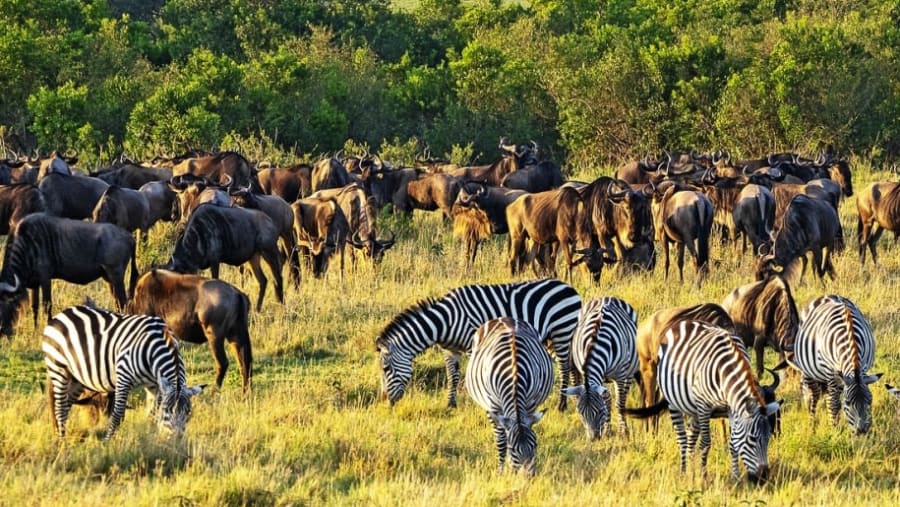
The annual migration of wildlife between Serengeti National Park in Tanzania and Maasai Mara National Park in Kenya occurs between June and September. The migration of almost two million wildebeest, zebras, and other species is nature's most wondrous spectacle on Earth. During the rest of the year, the herd can be seen in different parts of the massive Serengeti National Park.
Is a visa required for entry into Kenya and Tanzania?
Yes, depending on your country, you may require a visa to enter both Tanzania and Kenya. Please check with your embassies. A visa can be obtained upon arrival or in advance through the embassy offices close to you.
What is the mode of payment when I want to book a safari?
We require a 50-60% deposit to confirm a booking, sent by wire transfer to our bank account. The balance is payable at least 30 days before commencement of the safari, or it can be paid in cash in U.S. dollars or traveller's cheques on arrival.
Do I have to pay a departure tax at the airport?
Like most international destinations, Tanzania and Kenya charge an airport departure tax for all international flights. The tax may be included in the airline ticket price. Visitors must pay the tax in cash at the airport upon arrival if it is not included. Departure taxes can be paid in local currency or U.S. dollars.
Is tipping required in Tanzania and Kenya?
Most major hotels and restaurants include a service charge. Tipping is not obligatory and is entirely at your discretion. Porters at airports, hotels, or lodges may be tipped $1.00 per piece of baggage. A gratuity of 10% is customary at restaurants and bars where a service charge is not included.
Note that on safaris, tips are considered almost part of the pay. A tip for your guide of $2.00 to $5.00 per person daily is appropriate.
Will I be able to use my electrical equipment while on safari?
The local electricity supply is 220/240 volts A.C., 50HZ. The plugs are 3-point square. If you plan to bring a video camera charger or any other electrical device, please bring voltage and plug adaptors where appropriate. Major hotels usually provide hair dryers, irons, and other electrical amenities upon request.
How many packs do you take for a safari?
Most of our safaris operate on a private basis with a minimum two-person booking, and we recommend no more than seven persons for maximum comfort and guaranteed window seats.
What is safari accommodation like?
The accommodation type is basic camping, luxury tented camps, or lodges, depending on your budget.
What are the meals like?
The meals are primarily European-style buffets with African influences.
What kind of vehicle will we be travelling in during the safari?
Our classic safari vehicle is a purpose-built 7-seater minibus designed for easy photography. It comes complete with a pop-up roof for easy game viewing.
Do we require travel insurance?
We strongly recommend that you take out all necessary travel insurance before commencing your journey.