Tanzania · Trekking

5-Day Kilimanjaro Marangu Route Hike to Uhuru Peak at Sunrise

5 Days Round trip from Mandara Huts Moderate pace

The journey

Trip highlights
  • 01 Trek Kilimanjaro via the Marangu Route, known as the "Coca-Cola" route
  • 02 Enjoy great views of the Eastern Ice Fields at Gilman's Point
  • 03 See the sunrise behind Mawenzi Peak illuminating the plain
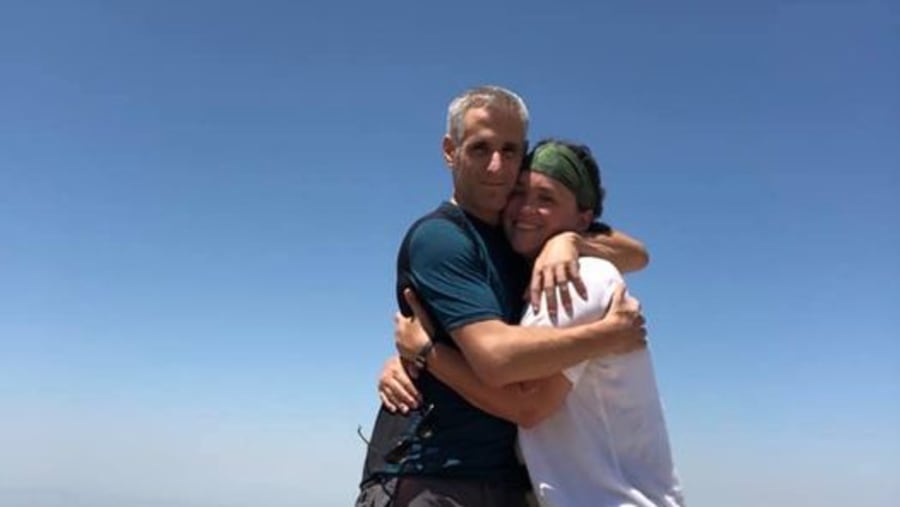
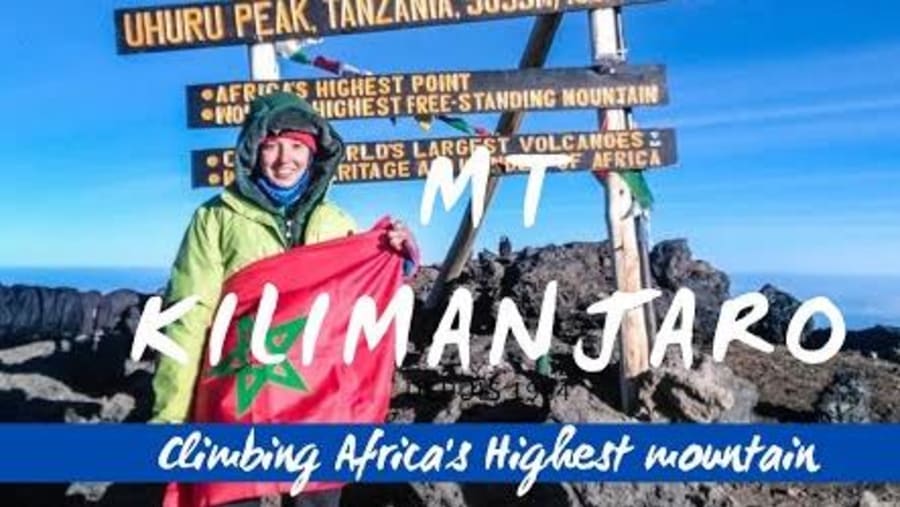
  • 04 Reach Uhuru Peak, the roof of Africa, at 5,895 m
  • 05 Marvel at the stunning views of the spectacular glaciers illuminated by sunrise

Embark on this journey to Kilimanjaro via the Marangu Route, also known as the "Coca-Cola" route. Enjoy an adventure on what is considered the easiest path on the mountain, thanks to its gradual slope. Hike through rainforest, heathland, moorland, and alpine desert as you make your way toward Uhuru Peak. Along the route, marvel at the scenic beauty of the landscape, sunrise views behind Mawenzi Peak, and the Eastern Ice Fields.

See the sunrise behind Mawenzi Peak illuminating the plain.

From the itinerary

At a glance

What this trip includes

Duration 5 Days
Tour type Shared
Activity level Moderate
Accommodation Included · Standard
Transport Included
Wheelchair access Not applicable
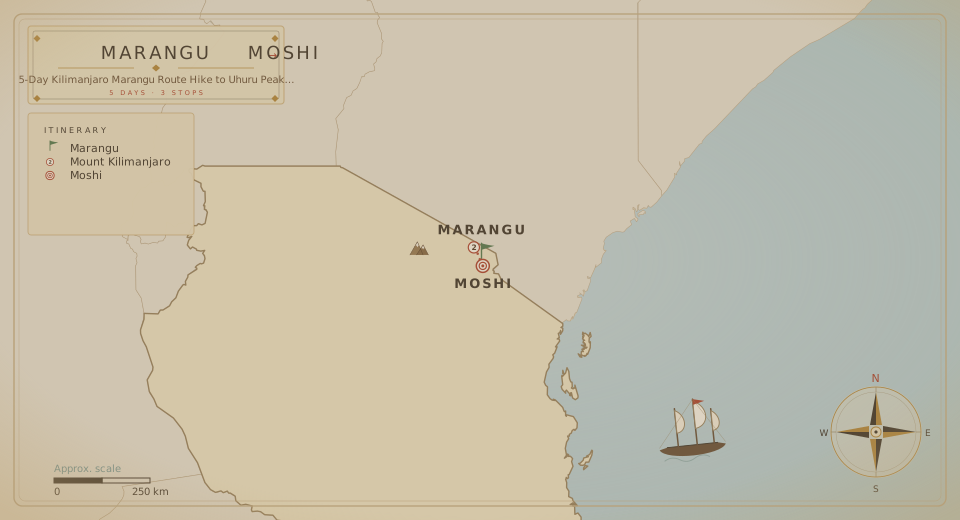
Cities Moshi, Mount Kilimanjaro, Marangu
Languages English

Day by day

The itinerary

1
Day 01

Marangu Gate Through Rainforest to Mandara Hut

You will be driven to Marangu Gate (1800 m) and begin walking through a thick rainforest. This trek takes 3-4 hours to reach Mandara Hut (2727 m). Mandara Hut lies on the forest belt border below the Maundi Crater, where you will have dinner and stay overnight.

Distance: 7 km

Hiking time: 4-5 hours

Habitat: Montane Forest

2
Day 02

Mandara Hut to Horombo Hut via Heath and Moorland

After breakfast, walk for 5-6 hours at a slow pace, following a path through the forest and then through the heather and moorland zone. Along the way, you can view Kilimanjaro's two peaks and Moshi town, with a lunch box provided en route. Arrive at Horombo Hut (3,720 m) for dinner and an overnight stay.

Distance: 11 km

Hiking time: 6-8 hours

Habitat: Heath Land

3
Day 03

Horombo Hut to Kibo Hut Across the Alpine Saddle

This is a hard day as you climb to Kibo Hut (4703 m), taking 5-6 hours across the barren sub-alpine terrain of the saddle between Mawenzi and Kibo peaks, with a picnic lunch box along the way. On arrival, you will relax and prepare for the next stage, which begins shortly after midnight.

With a very early start at around 12:00, follow the zigzag path up the scree slope, stopping frequently to catch your breath in the starlit air. This is the steepest and most demanding section of the climb, taking about five hours to reach Gilliman's Point (5685 m). Gillman's Point offers excellent views of the Eastern Ice Fields. See the sunrise behind Mawenzi Peak illuminating the plain.

Then walk a further 45 minutes around the crater and up to the highest point, Uhuru Peak (5,895 m), the roof of Africa, where you will be rewarded with stunning views of the spectacular glaciers illuminated by the sunrise. After that, descend for 3-4 hours to Kibo Hut (3720 m), with a rest at Kibo Hut en route. Dinner and overnight at Kibo Hut.

Distance: 10 km

Hiking Time: 6-8 hours

Habitat: Alpine Desert

4
Day 04

Uhuru Peak Descent to Horombo Hut

This is a more leisurely day, as you have the luxury of walking downhill on the way to Horombo Hut for dinner and an overnight stay.

Uhuru Peak (5,895 m/19,340 ft) to Horombo Hut (3,690 m/12,100 ft)

Distance: 4 km ascent, 14 km descent

Hiking Time: 10-15 hours

Habitat: Artic

5
Day 05

Horombo Hut to Marangu Gate

This is also a much easier day, as you walk downhill from Horombo Hut to the gate. At Marangu Gate, you will wait for a vehicle for your transfer to Moshi.

Distance: 18 km

Hiking time: 5-7 hours

Habitat: Rain Forest

Uhuru Peak, sunrise behind Mawenzi Peak, Eastern Ice Fields

Where this trip takes you

Uhuru Peak, sunrise behind Mawenzi Peak, Eastern Ice Fields

The route

Where you'll travel

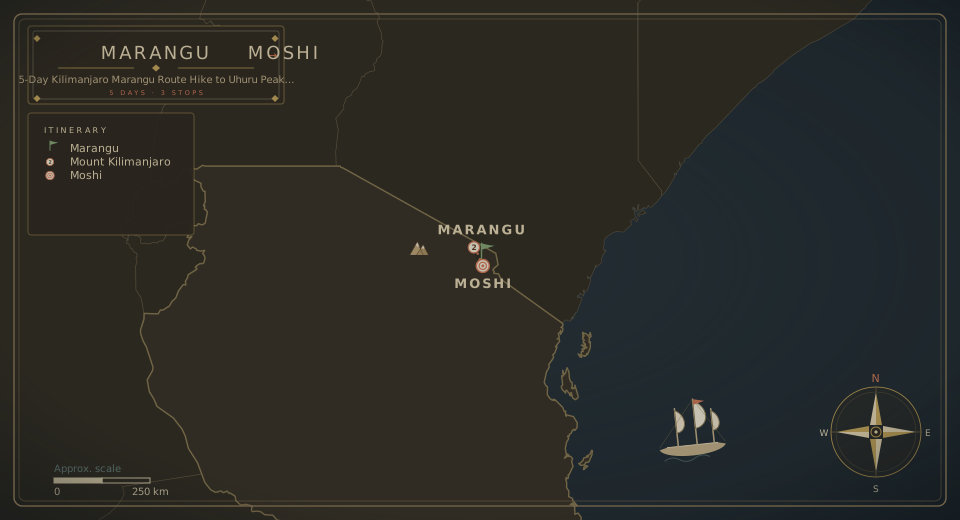
Tour route map
Round trip from Mandara Huts 3 cities · 5 Days

The fine print

Trip details

What's Included

  • Private transfer from/to Kilimanjaro International Airport
  • Hut or camping fees
  • All park fees
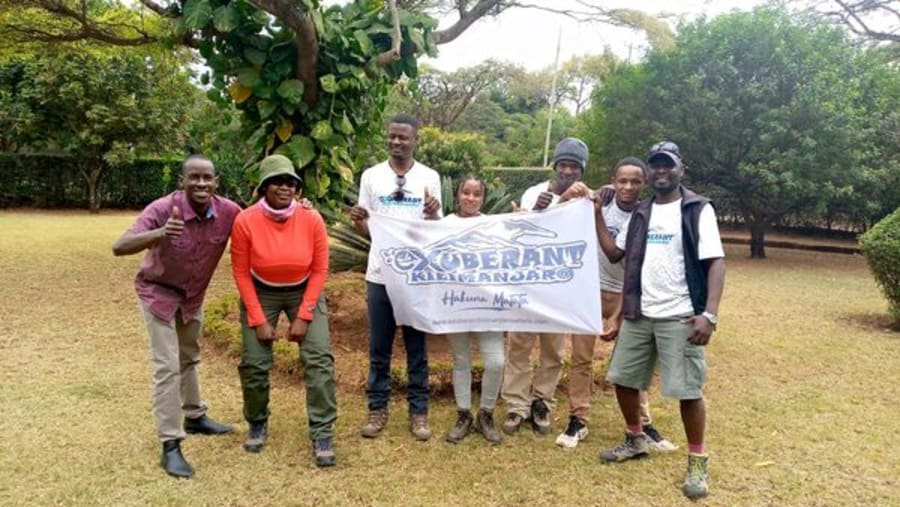
  • Salary for the crew (guide, porter, and cook)
  • Rescue fee
  • Three daily meals (breakfast, lunch, dinner, and mineral water), including an appetizer, main dish, and dessert. We also provide vegetarian meals.
  • Tent, foam sleeping pads, cooking equipment, and eating utensils. (Mountain Hardware tents) Climbers will sleep in state-of-the-art, four-season mountain tents during the trek.
  • Oxygen cylinder and ox-meter
  • All government tax (VAT)
  • Two nights' accommodation (one night before the climb and one night after the climb) B/B

What's Not Included

  • Tipping for the crew (guide, porters, and cook) is $500-$600 and is obligatory, depending on group size.
  • Some equipment is available for rent.
  • Lunch and dinner at the hotel
  • Extra personal needs (cigarettes and alcoholic drinks)
  • Private toilet
  • Two nights' accommodation (one night before the climb and one night after the climb) B/B
  • Extra nights' accommodation
  • Local flights

What to bring

  • Swimsuit
  • Towel
  • Sunscreen
  • Dry clothes
  • Camera
  • 1 duffel bag or backpack to keep climbing items in (to be carried by your porter)
  • 1 day pack to keep items you will need on a day-to-day basis
  • 1 sleeping bag for extreme cold weather (-7 to -10 Celsius)
  • 1 sleeping bag liner
  • 1 over bag to keep the bag dry
  • 1 pair of walking/trekking poles
  • 1 toothbrush, toothpaste, razor, soap, and other personal items
  • 1 lip balm
  • 1 roll of toilet paper
  • 1 camp towel
  • 1 small mirror
  • 1 sewing kit
  • Personal snacks
  • Biscuits, chocolate, sweets, nuts, and dried fruits. Glucose powder and other energy-rich packs. Multi-vitamins (B, C, E, Iron, and Zinc)
  • 3 pairs of socks
  • 3 liner socks
  • 3 short-sleeve shirts or T-shirts (made from wicking material to keep you dry)
  • 1 gaiters
  • 1 light wool/warm hat
  • 1 fleece jacket
  • 1 Gore-Tex shell jacket/windproof jacket
  • 1 fleece or leather gloves
  • 1 Gore-Tex mitten shell/gloves
  • 1 heavy trekking pants
  • 1 balaclava
  • 1 scarf
  • 1 sun hat with a wide brim for sun protection
  • 1 tennis shoes/trainers to wear in camp
  • 1 mountaineering boots - please break your shoes in well before you come to Kilimanjaro
  • 1 waterproof jacket (with hood or rain hat) and trousers
  • 2 quick-dry pants (preferably with zipper legs)
  • 2 long-sleeved quick-dry shirts
  • Portable toilet: There is not much to say about our toilets. They are essential because the public long-drop toilets on Kilimanjaro are horrendous and overcrowded. Our porters empty the holding tanks at the nearest public toilets at every camp. Please note - at Crater Camp, there are no public toilets, so we use the Clean-Waste toilet kits to bag the waste and carry it down.
  • Portable shower: There is plenty of misunderstanding about our showers on Kilimanjaro. First of all, it is an optional service we provide, so you are not forced to shower. We generally set up our showers at the halfway camp on the way to the summit and at Mweka Camp after you have reached the summit.
  • All outfitters provide bowls of warm water to their clients so they can wash after a long day of trekking. The same amount of water can be put in a sun shower instead of a bowl. This allows you to rinse your whole body with minimum water, but the short splash makes a huge difference. You will feel refreshed and ready for your next challenge. A short shower is a really good solution to help prevent painful chafe caused by perspiration between the legs and buttocks areas.
  • Gamow bags: Available when sleeping in the Crater. If you overnight in the Crater on Kilimanjaro, simple evacuations are not always possible because you have to ascend higher in order to scale the rim before descending to a lower elevation. If you are suffering from serious altitude-related symptoms, it may be safer to stabilize you by placing you in our pressured altitude chamber for an hour or so. This will fool your body into thinking you are 2000 ft or so lower in elevation, and the improvement in your condition will buy precious time as we evacuate you over Stella Point and down to safety. A Gamow bag is not needed for treks that do not overnight in the Crater, as immediate and fast descending is always possible and preferred.
  • Automated External Defibrillator (AED): AEDs are offered as an upgrade option. You must know that these devices are unproven at high altitudes in cold/wet weather. They may malfunction, and medical studies have shown AEDs to be very ineffective in most heart-related emergencies when used in hospital emergency rooms. Immediate CPR remains the most important life-saving technique, and our guides will do CPR first, as it is very important to keep oxygen flowing into the brain while the lungs and heart are pumped. An AED shock will be a last-ditch attempt if CPR fails to revive the patient. Using an AED instead of CPR will waste precious early minutes that may result in serious brain damage.

Logistics

Meeting & route

Meeting point
Kilimanjaro International Airport - KIA (JRO), Kilimanjaro Airport Road, Tanzania
Tour start
Mandara Huts, Tanzania
Tour ends at the same location as the start point.
End of the journey

Your 5 days finish where they began, in Mandara Huts.

Watch the tourHQ film Watch the film

Create your own adventure

Can't find the perfect tour? Tailor your dream trip.

  • Tell us your destination, dates and group size.
  • Our travel experts and local guides design a tailored itinerary, just for you.
  • Enjoy your trip with peace of mind, knowing everything is taken care of.
Plan my holiday

Say goodbye to travel stress.

Starting from

USD 2,272.40 /person
Book This Tour

When

Travellers

Total