Tanzania · Safari

5-Day Tarangire Serengeti and Ngorongoro Safari with Big Five Views

5 Days Round trip from XXVH+PGJ Easy pace

The journey

Trip highlights
  • 01 Marvel at giraffes, zebras, elephants, tree-climbing lions, and leopards in Tarangire
  • 02 Explore Serengeti National Park, famous for over a million migrating wildebeest
  • 03 Enjoy beautiful landscapes and scenic views at Ngorongoro Crater
  • 04 Spot the Big Five from the Ngorongoro Crater floor
  • 05 See giant baobab trees and large numbers of African giant elephants in Tarangire

Embark on a 5-day safari through Tarangire, Serengeti, and Ngorongoro Crater from Moshi. Explore Tarangire, famous for its giant baobab trees and large herds of African giant elephants, continue to the vast Serengeti, renowned for over a million migrating wildebeest, and discover the beautiful landscapes of Ngorongoro Crater. From the crater floor, it is easy to spot the Big Five while enjoying spectacular scenic views and rewarding game drives across Tanzania's most celebrated wildlife areas.

From the crater floor, it is easy to spot the Big Five while enjoying spectacular scenic views and rewarding game drives across Tanzania's most celebrated wildlife areas.

From the itinerary

At a glance

What this trip includes

Duration 5 Days
Tour type Private
Activity level Easy
Accommodation Included · Standard
Transport Included
Wheelchair access No
Cities Arusha, Moshi, Serengeti National Park, Ngorongoro Conservation Area, Tarangire National Park
Languages English

Day by day

The itinerary

1
Day 01

Game Drive in Tarangire National Park

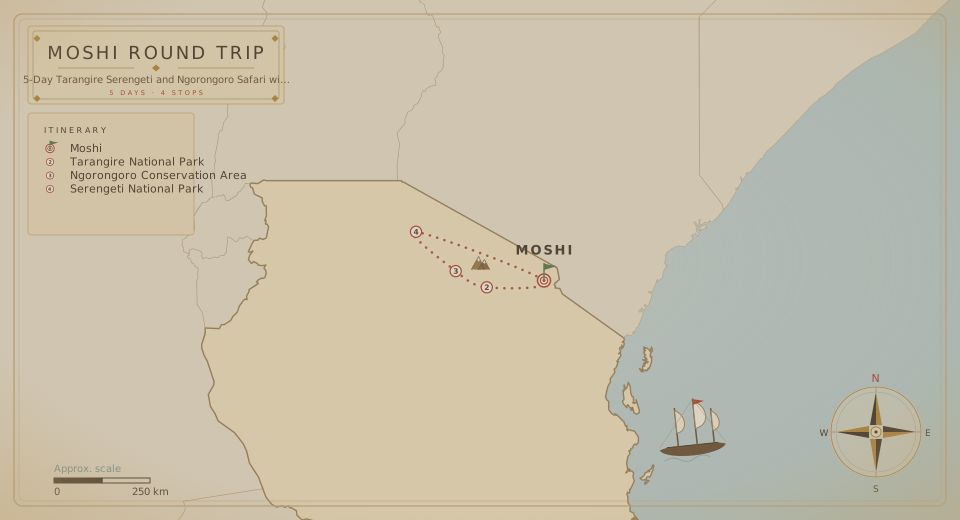
  • After breakfast in the morning, leave Moshi town and drive to Tarangire National Park (196 km, 3-4 hours). Enjoy afternoon game drives, then continue to a lodge/campsite later in the evening for dinner and an overnight stay.
  • Common animals you are likely to see include giraffes, zebras, elephants, tree-climbing lions, leopards, warthogs, hyenas, buffaloes, baboons, blue and vervet monkeys, and several species of birds, including lesser and greater flamingos, pelicans, and storks on the lake.
2
Day 02

Drive to Serengeti via Ngorongoro Conservation Area

  • Leave the lodge/campsite in the morning after breakfast with your picnic lunch and drive to Serengeti National Park via the Ngorongoro Conservation Area (190 km, 4-6 hours, as the road is sometimes very rough).
  • The game drive will be en route to a lodge/campsite in the Seronera Area, at the heart of the park, for dinner and an overnight stay. Common animals likely to be seen are wildebeests, giraffes, zebras, elephants, lions, hippos, leopards, cheetahs, eland, warthogs, hyenas, buffaloes, blue monkeys, vervet monkeys, baboons, and several species of birds.
3
Day 03

Full-Day Game Drive in Serengeti National Park

  • This will be a full day inside this mighty park, with game drives in different locations.
  • Later in the evening, drive back to the lodge/campsite for dinner and an overnight stay.
4
Day 04

Early Game Drive and Transfer to Ngorongoro Crater Rim

  • Enjoy early morning game drives before breakfast. You are likely to see the sunrise if the day is clear, as it is one of the attractions over the endless plains, and you may also spot nocturnal animals as they return to their dens.
  • After breakfast, go on the final game drive on the way out of the park to the rim of Ngorongoro Crater, then continue to a lodge/campsite (175 km, 4-5 hours) overlooking the crater for dinner and an overnight stay.
5
Day 05

Ngorongoro Crater Game Drive and Return

  • After breakfast in the morning, descend the 600 m-high crater walls to the crater floor with your picnic lunch. Explore this fantastic area until later in the afternoon, then ascend the crater and drive back to Moshi/Arusha or the airport in 3-4 hours - end of the safari.
  • Common animals likely to be seen in the crater are rhinos, wildebeests, zebras, elephants, lions, cheetahs, warthogs, hippos, hyenas, buffaloes, blue monkeys, vervet monkeys, baboons, and several species of birds, including the heaviest flying bird (kori bustard) and the smallest flying one (larks).

End of tour.

Tarangire National Park baobabs, Serengeti National Park plains, Ngorongoro Crater floor

Where this trip takes you

Tarangire National Park baobabs, Serengeti National Park plains, Ngorongoro Crater floor

The route

Where you'll travel

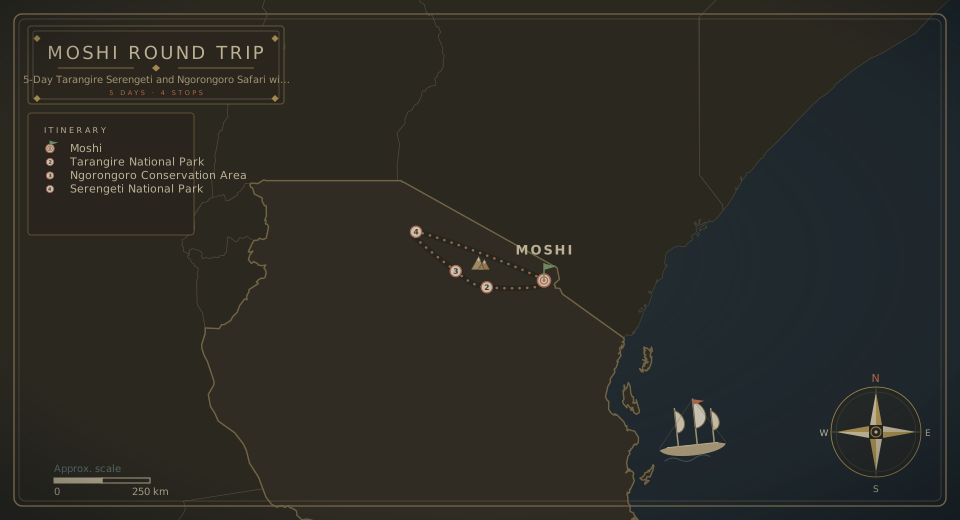
Tour route map
Round trip from XXVH+PGJ 5 cities · 5 Days

The fine print

Trip details

What's Included

  • Full-board accommodation whilst on safari in the above-mentioned suite-tented camps and lodges
  • Private safari guide
  • Private 4 x 4 safari jeep with pop-up roof for game viewing
  • Transfers in both directions between the International Airport
  • Park fees
  • Crater fees
  • Airport arrival/departure meet and greets at the airport
  • On safari - vehicles equipped with an ice chest with mineral water, a wildlife guidebook, and a Karibuni welcome packet with helpful information for all guests
  • Government taxes, VAT, and service charges relating to accommodation and included meals

What's Not Included

  • Tanzania visa: $50 per person on arrival (USA and Canada passport holders USD 100)
  • Personal expenses (e.g. laundry, telephone, beverages, etc.)
  • Meals not listed above
  • Optional tours (balloon rides USD 500 per person, etc.)
  • Tips and any items of a personal nature

What to bring

  • A backpack - While there is plenty of room in our safari vehicles for your larger suitcase, it is always handy to have a more manageable bag that you can keep with you in the vehicle.
  • A warm sweater or light fleece - Nights and mornings in East Africa can be cold, so it is always good to have something a little warmer to throw on until the sun warms the plains.
  • A windbreaker or waterproof jacket - You never know when there will be a sudden squall or downpour, so packing a lightweight rain jacket is a good idea. While you will be safe and dry inside your safari vehicle, a rain jacket is a good option for when you are moving around camp.
  • Walking shoes or boots - Much of your safari takes place within your safari vehicle. Still, you will need a comfortable pair of shoes or hiking boots for walking to your lodges, taking photos from the picnic spot, or if you have added any walking safaris to your itinerary. Even in the car, you will want a pair of comfortable shoes that cover your skin to help prevent sunburn and insect bites.
  • A long-sleeve dress shirt and trousers - Perfect for sun protection and to ward off hungry mosquitoes, a long-sleeve shirt and trousers are also a good option for a cold morning or evening. If you are staying in more excellent lodges, you will also want these handy for dinner and drinks at the end of a long day.
  • Sunglasses - The sun in East Africa can be pretty intense, so sunglasses are a good protective measure and also help reduce glare while you are game-viewing.
  • Sun hat - Sun protection should be a priority while you are on safari. While your vehicle provides shade, having the top up for game-viewing means you will be exposed to the elements. A good hat is a great way to avoid nasty burns or heatstroke.
  • Sunscreen and lip balm - Another valuable precaution against the often harsh equatorial sun, sunscreen and lip balm will protect you where your clothes do not.
  • Insect repellent - Mosquitoes and tsetse flies can carry diseases, and their bites can be quite irritating or painful. Tsetse flies can deliver a particularly nasty sting. A good insect repellent is an excellent way to ward off these blood-thirsty little guys.
  • Camera - It goes without saying that you will want a camera for your safari adventure. While, in some cases, your smartphone will be enough to snap a shot, a camera with a good zoom lens is the perfect companion.
  • Binoculars - Shadows of Africa vehicles come standard with a single pair of binoculars that you can share with your driver, but having your own pair is an excellent way to ensure you do not miss a second of the action. You do not need an expensive pair. Even a travel-sized pair of binoculars is sufficient for game-viewing.
  • Charger for your camera - You do not want to be midway through a day on safari and suddenly run out of battery for your camera. Overland Safaris vehicles come standard with in-car charging stations, but travelling with an additional battery is always a good idea. Additional SD cards are also a good idea to ensure you do not need to stop to delete photos.
  • A flashlight or headlamp - The wilderness can be pretty dark, so a headlamp or flashlight can be essential when moving around camp after dark. Many lodges provide these, but it is a good idea to bring your own headlamp.
  • Guidebooks - You do not need a hefty Lonely Planet for your safari, but having a wilderness guidebook is an excellent way to build a

Know before you go

  • Recommended immunisations - As a sensible precaution, we recommend that you consider getting at least some of the following recommended immunisations:
    • Hepatitis A - You can get Hepatitis A through contaminated food or water in Tanzania, regardless of where you are eating or staying.
    • Typhoid - You can get Typhoid through contaminated food or water in Tanzania, especially if you are visiting smaller cities or rural areas. Please check with your local travel clinic for the latest recommendations.
  • Immigration & customs
  • An onward ticket and sufficient funds are required when entering Tanzania. Tanzanian people are friendly and will always offer a helping hand.
    • Insurance - It is strongly advised to take out travel insurance that should cover baggage as well as personal accident and medical insurance, and specifically cover your Kilimanjaro expedition.
    • Language - The official languages are Ki-Swahili and English. There are more than 120 tribal vernaculars.
      Religion - Mainly Muslim, Christian, and traditional beliefs. Please keep in mind that you are entering a different country with strong religious customs.
    • Security - As with any other town, walking alone at night is not advisable, and it is preferable to use taxis, which are available at most hotels. Do not leave cash or valuables in your hotel room, and use a safe deposit box. Make use of a safe deposit box to keep your belongings safe, and do not leave anything of value lying around in your hotel room.
    • Visa and entry requirements - Visas are required by most visitors to Tanzania. Visas are available at your local Tanzanian Embassy. Costs vary from country to country. Visas are valid for 3 months. It is possible, however, to obtain a tourist visa for a single entry at any one of the four main entries into Tanzania - subject to the fulfilment of all immigration and health requirements - for those who could not apply for a visa from a Tanzania mission abroad. These are:
      - Dar-es-Salaam International Airport
      - Zanzibar International Airport
      - Kilimanjaro International Airport
      - Namanga Entry Point (Tanzania-Kenya border point)
  • Payment at all these points is in US dollars or its equivalent in sterling. For all other entry points in Tanzania, visitors must hold valid visas prior to approaching those entry points in Tanzania. However, in order to avoid unnecessary delays, those who proceed to Tanzania from a country where there is a Tanzania Diplomatic Mission or Consular Office are strongly advised to obtain their entry visa prior to departure to Tanzania.

Logistics

Meeting & route

Meeting point
XXVH+PGJ, Tanzania
Tour start
XXVH+PGJ, Tanzania
Tour ends at the same location as the start point.
End of the journey

Your 5 days finish where they began, in XXVH+PGJ.

Watch the tourHQ film Watch the film

Create your own adventure

Can't find the perfect tour? Tailor your dream trip.

  • Tell us your destination, dates and group size.
  • Our travel experts and local guides design a tailored itinerary, just for you.
  • Enjoy your trip with peace of mind, knowing everything is taken care of.
Plan my holiday

Say goodbye to travel stress.

Starting from

USD 2,400 /person
Book This Tour

When

Travellers

Total