Day 01
Explore Islamic Cairo's Historic Streets and Monuments
- Meet your tour guide and begin your tour with a visit to the Mosque of Al-Hakim. Then continue north and walk through one of the northern gates of the citadel, Bab al-Futuh. When you reach the other side, turn right and follow the city wall for a few minutes until you reach the second gate, Bab El Nasr. Walk through it to re-enter Islamic Cairo.
- Spend the next 30 minutes or so walking south down El-Gamaleya Street and Khan Gaafar Street, and witness a more genuine side of Islamic Cairo with fewer tourists around. Trays of freshly baked bread carried on heads, donkeys pulling carts, and authentic street food stalls can all be seen here.
- See the Mausoleum of Sidi Zouk. It is a mausoleum dating back to the Mamluk era and was famous for an Egyptian saying: "Taste is the only way out of Egypt." Stories about the shrine's owner are limited to three versions: that he was a merchant connected to a guarded fatwa, a blessed person, or a man of Moroccan origin.
- Walk through Muizz Street, one of Cairo's oldest streets. At approximately one kilometre long, this beautiful street features all kinds of colourful shops selling African spices, old antiques, clothing, and perfumes, to name a few. Feel free to wander into one or two of the side streets to find more interesting shops.
- Reach the northernmost point of El Moez Street and see the impressive Mosque of Al-Hakim on the right. The mosque, which was started in 990 and completed in 1013, is the second largest Fatimid mosque in Cairo. Like all mosques in Cairo, it is free to enter, but if you want to go up one of the tall minarets, you will need one of the key keepers to take you up for a small tip. This is worth doing, as the views from above are quite impressive.
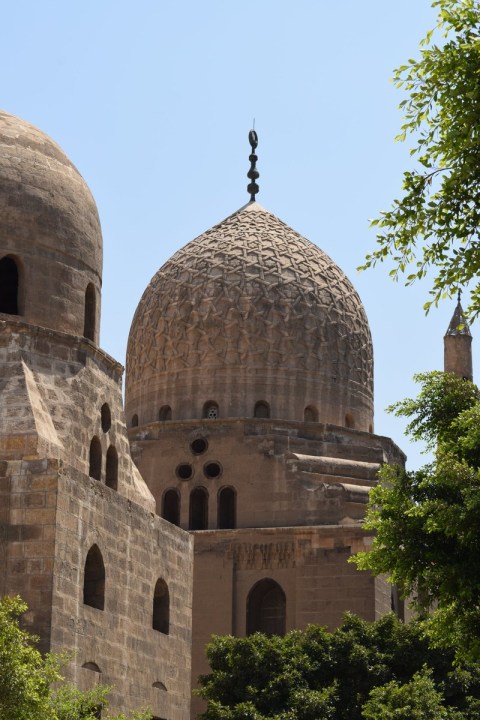
- Head to see the Qorkamas Dome. It is an ancient tall mausoleum dome of unknown origin, once located next to the main door of the Al-Hakim Mosque in a position that blocked the mosque's entrance. People were long confused about its origin. Some said it belonged to Prince Muhammad Qurqamas, others believed it belonged to a sheikh who wished to be buried beside his own soil, while others thought it was the tomb of the emir of the armies, Badr al-Jamali, because of the splendour of its construction and height. Another view held that it was a cemetery built by the ruler for himself, though he was never buried there, and it later became known as the "cemetery of the courier." The Egyptian Antiquities Authority registered it under the name of the Qerqamas Dome. However, Karkamas is buried in his tomb in the cemetery east of Cairo, next to the Khanqah of Sultan Faraj bin Barquq. Since this dome was alien to the construction of the Al-Hakim Mosque and distorted its entrance, it was dismantled in October 1980 as part of the Al-Hakim Mosque renovation project and transferred to the Al-Ghafir cemetery, where it was rebuilt between the Sultan Al-Ashraf Barsbay Mosque and the tomb of Jani Bey Al-Ashraf. The mosque's main facade is on its western side and contains the entrance to the mosque and its annexes, reached by several stairs. It is rectangular and divided into two squares. The outer western square includes a courtyard surrounded on all four sides by porticos covered with small domes resting on marble columns. The courtyard is covered in the middle by a wooden roof with a ventilating opening. The eastern square is the qibla iwan, covered by a wooden ceiling with simple decorations. In the middle of this iwan is a hollow mihrab carved entirely from marble, and next to it is a wooden pulpit. The imam's bench occupies the entire western wall facing the qibla wall and is made of wood. The minaret is located on the main facade next to the mosque door. It is cylindrical in the Ottoman style and consists of two floors. The facade of the sabil is round, covered with gilded marble, and has four copper windows.
- See the House of Mustafa Jaafar Al-Silahdar. It was established by Prince Mustafa Jaafar al-Silhdar, the chief dignitary of the coffee merchants in the Dhi al-Fiqar Katkhuda Agency. The house was built on the site of a coffee house called "Al-Mawardi Coffee," which was part of the endowments of Al-Khawaja Shehab Atta. Haji Mustafa Jaafar bought it and the surrounding area to build his house. The house is currently used as an administrative headquarters for the North Cairo area for Islamic and Coptic antiquities.
- Visit the Aqmar Mosque. The building was not originally a جامع mosque, and the Friday sermon was not delivered from its pulpit except in Ramadan in the year 799 AH / 1396 AD, after it was repaired and renovated by Prince Yalbugha al-Salmi in 1396 AD by order of Sultan Barquq. It became dilapidated at the end of the 19th century. The Committee for the Preservation of Arab Antiquities restored and renovated the mosque and preserved its decorations in 1928. The Supreme Council of Antiquities also renovated it and removed the buildings in front of its facade so that the facade's decorations could be seen completely. Al-Aqmar is one of the suspended mosques. When it was built, there were shops underneath it, and it is located in the Al-Nahhasin area on Al-Moez Street.
- Continue north on El Moez Street until the road forks. In the middle of the fork stands the Sabil-Kuttab of Katkhuda, an interesting building containing a public fountain, an elementary Quran school, and an adjoining residential wing. Built in 1744 by a forward-thinking Egyptian architect, the Sabil-Kuttab of Katkhuda is an excellent example of Ottoman and Mamluk architectural styles. Some architects have described the narrow structure as "The treasure of Ottoman architecture." Its exterior is more impressive than the inside, so you can save time by not going in.
- Proceed west along Sidi Al Dardirai Street and Al Kahkeen Street until you reach Al Motaz Ldin Allah Street, which runs north to south. Follow it south and simply enjoy a more local and authentic side of Islamic Cairo. It is here that more genuine welcoming smiles and hellos will greet you. The area is a real feast for the senses and a photographer's playground.
- Go ahead to see the Hamam of Inal. The bathhouse was built in the Islamic public bath style of the Middle Ages. It consists of a simple entrance leading to a bent corridor and then to the cold room, where visitors would undress and prepare for bathing. There are seating areas and lockers for keeping personal belongings, and that room leads to another corridor that opens into the warm room. The heated room was used with both cold and hot rooms and has shallow domes to maintain hot air circulation. An octagonal area with a basin characterizes the heated room in the middle, and perpendicular to it are four iwans for sitting, along with four corner entrances leading to khans, each with basins and terraces.
- Take the left fork in the road, passing the Sabil-Kuttab of Katkhuda on your right, and continue walking north on El Moez Street. Look out for Al Dabeeba Street on the right, where you will notice an interesting cafe called Cafe al-Lord. A well-known cafe in Islamic Cairo, Cafe al-Lord is frequented mainly by tourists, so it is not the most authentic Egyptian experience in the area. However, if pictures of Egyptian movie stars and life-size statues of famous figures appeal to you, feel free to rest your feet and enjoy tea or Turkish coffee at this popular, though overpriced, cafe.
- Continue walking north on El Moez Street until you reach the Qalawun Complex on the left. The huge complex of Sultan Qalawun was built in 1284 by Sultan El Mansur Qalawun. It contains a mosque-madrassa, a mausoleum, and a mauristan, though in the 1920s this was replaced by a new hospital. The Qalawun Complex is the earliest example of a new Syrian style of architecture and interior design from that period. It is a stunning building with amazing attention to detail and is reminiscent of the Gothic style. This is a highlight of the Islamic Cairo walking route.
- Move forward to see the only museum of its kind in the Middle East. This interesting museum features textiles from ancient Egypt and the Roman, Coptic, and Islamic eras. The collection begins at the very start, with Pharaonic diapers, and continues through beautifully embroidered Coptic tunics and finely embroidered Kiswat, such as the panels that adorn the Kaaba in Mecca. It is a small museum, but well worth a visit for anyone with an affinity for weaving and fabric.
- At the end of Khan Gaafar Street, the road bends left until it joins Al Mashhad Al Husseini Street. Continue south along Al Mashhad Al Husseini Street, and you will soon reach the central souk area of Khan el-Khalili. This market may be the most touristy attraction on the Islamic Cairo walking route, but it is still a great place to buy Egyptian souvenirs. Market traders work hard to grab your attention and lure you into their shops, but some good deals can be found with a bit of haggling. In addition to shops, several coffee houses, eateries, and street food vendors are scattered throughout the market.
- Sit down at a pleasant spot at the end of Mashhad Al Husseini Street for a relaxing drink. The line of inexpensive coffee shops on the west side of the open square is ideal for people-watching and for viewing the impressive Al-Hussein Mosque. Unfortunately, tourists are not allowed to enter this mosque, but it is still very photogenic from the outside. There are around eight coffee shops, one after another, but they are all similar and offer the same menu of juices, soft drinks, teas, and coffees.
- Walk around the back of Al-Azhar Mosque and head east along the charming bookshop-lined street of Mohammed Abdou. You will soon reach a cosy courtyard featuring Wasila Historical House in the south-eastern corner. Beit El Sit El Wasila is another example of early Egyptian architecture and is one of the oldest houses in the city. The highlight here is the ground-floor hall and rooms, which have been historically preserved and include elegant wall paintings of travels and pilgrimages. The hall hosts several cultural events throughout the year, with poetry being the most popular.
- Cross Nafak Al Azhar Street. The only challenge on this Islamic Cairo walking route is crossing the busy Nafak Al Azhar Street. There is a tall safety fence in the middle of the road, but locals often ignore it and squeeze through gaps to cross. Follow their lead to reach Al-Azhar Mosque on the other side. This is the last of the mosques on the route. Commissioned in 970, it was the first mosque erected in Cairo, a city that has since gained the nickname "the City of a Thousand Minarets." It is free to wander and explore inside, and the stairs to the minarets will be open to the public during our visit. The Mosque of Al-Sultan Al-Moayad Sheikh, also known as Al-Moayad Mosque, is one of Cairo's famous archaeological mosques and is described as the pride of the mosques of the Circassian Mamluk era.
- See the Sultan Al-Ghuri Complex. Also known as al-Ghuriya, this monumental Islamic religious and funerary complex was built by Sultan Qansuh al-Ghuri between 1503 and 1505 CE. The complex consists of two significant buildings facing each other on al-Mu'izz li-Din Allah Street in the Fahhamin Quarter.
- Finish your Islamic Cairo walking tour at the southern gate of Bab Zuwayla. Considered a major landmark, Bab Zuweila is one of the three remaining gates in the Old City's walls and the last remaining southern gate. Its name comes from Bab, meaning "door," and Zuwayla, the name of a clan of Berber soldiers from the western desert who were entrusted with guarding the gate.
- Return to the hotel. We recommend arriving at sunset to watch the sun drop over the city from one of the two towering minarets. The views from up there are among the best in Cairo.