21-Day Limi Valley Trek from Kathmandu with Chagzur Hot Springs

21 Days Round trip from Kathmandu 44600 Moderate pace

The journey

Trip highlights
  • 01 Trek through the spectacular and varied Limi Valley
  • 02 Follow the Karnali River as it cuts through spectacular rock formations
  • 03 Bathe in the healing Chagzur hot springs
  • 04 Cross breathtaking 16,000 ft (4,900 m) passes
  • 05 Wander through ancient Buddhist monasteries
  • 06 Explore the nomadic and authentic culture of rural communities

Embark on this exciting expedition through the Limi Valley in Humla, the highest, northernmost, and most remote district of Nepal. Witness the cultural diversity of the region as you pass through the southern valleys and riverbeds of the Khasas (Hindus), trek through incredible remote villages, and explore ancient monasteries along the way. This adventurous journey also takes you across high mountain passes, along the Karnali River, and into the authentic rural life of western Nepal.

At a glance

What this trip includes

Duration 21 Days
Tour type Shared
Activity level Moderate
Accommodation Not included
Transport Included
Wheelchair access No
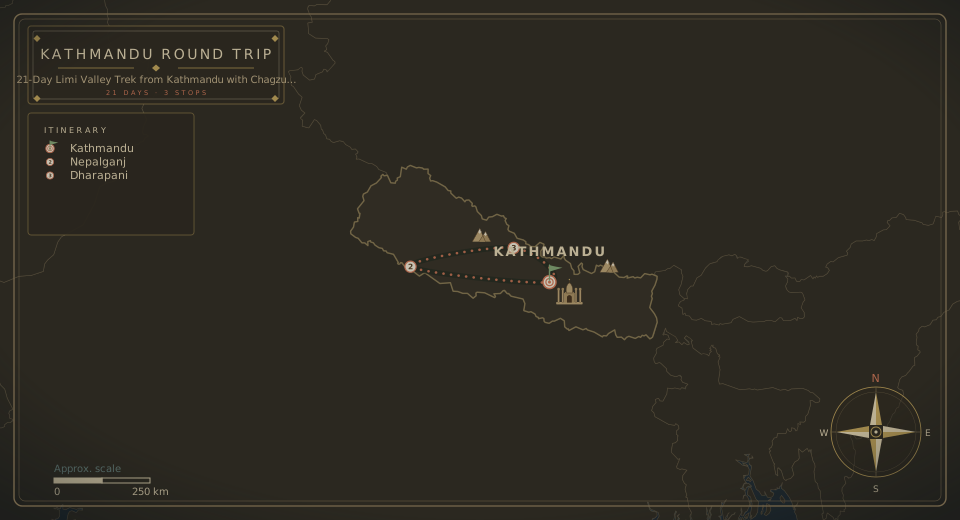
Cities Nepalganj, Kathmandu, Dharapani
Languages English

Day by day

The itinerary

1
Day 01

Arrival in Kathmandu, Nepal

  • The flight into Kathmandu Valley is breathtaking, with a panoramic view of the Himalayan ranges and the valley below. A representative will meet you at Tribhuvan International Airport and drive you to your accommodation.
2
Day 02

Kathmandu Heritage Sightseeing and Trek Preparation

  • Tour the World Heritage Sites of Durbar Square, Pashupatinath Temple, Swayambhunath Stupa, and Bouddhanath Stupa. Durbar Square provides insight into the perceptions of ancient royals. For all Hindus, Pashupatinath Temple is one of the most important pilgrimage sites. The Monkey Temple is also known as Swayambhunath, and Bouddhanath Stupa is one of the world's biggest stupas.
  • Later in the evening, meet up with your trekking guide and prepare for your trek.
3
Day 03

Flight from Kathmandu to Nepalgunj

  • Today, you'll leave Kathmandu and fly to Nepalgunj. Once you land at Mahendra Airport in Nepalgunj, you will experience a noticeable temperature difference. Nepalgunj is the financial hub in the Terai flatlands, bordering India.
  • On the route, you'll pass through several historic settlements.
  • In the evening, you may walk through the streets and enjoy some local cuisine.
4
Day 04

Flight from Nepalgunj to Simikot in Humla

  • After breakfast, you will travel to the domestic airport early in the morning to catch a flight to Simikot, the administrative center of the Humla region in the north. Humla is rural and isolated from the rest of Nepal, so the landscape changes drastically. Due to the airport, Simikot is one of Humla's larger and most dynamic settlements. Beyond the settlement, you can see the Karnali River, which is also the starting point for an expedition to Mt. Kailash and Western Tibet.
  • The hamlet is inhabited by Tibetan Buddhists, Thakuri, and Khas communities, who are all extraordinarily kind and hospitable. You may go around the hamlet in the afternoon and visit local sacred places. The most notable attraction is the Bon Shaman Monastery, which was rebuilt after being destroyed.
5
Day 05

Trek from Simikot to Dharapori

  • The first day of your trek starts with a moderate ascent of approximately an hour from Simikot to Dharmapuri. You'll then descend alongside the Karnali River after crossing 3,000m/9,842ft, travelling through pine forests and settlements. Dharmapuri will be reached after a steep climb. You'll see residents hauling timber logs and everyday necessities up the steep trail along the route. Dharmapuri is a tiny rural community populated primarily by Hindus and Buddhists.
  • On this day, you will be camping along the Karnali riverbed.
6
Day 06

Trek from Dharapori to Kermi

  • After breakfast, you will ascend the route that follows the Karnali River along some steep slopes, then make a rapid descent to the barley, buckwheat, rice, and potato patches. You will eventually arrive at Kermi, and you may explore the village since you have the entire day to yourself. Kermi is the first settlement entirely inhabited by Buddhists.
  • In the afternoon, you may visit the ancient Kermi Laikyo Gompa and Lhundrup Choeling Gompa, which are 45 and 30 minutes away from the campground.
7
Day 07

Trek from Kermi to Yalbang

  • Today's trail is relatively flat, with a slight uphill portion. The trail will continue for another two hours until it reaches a small pass with barley and buckwheat farmlands.
  • From here, descend for around 20 minutes before crossing a large iron suspension bridge over the Sali River. On the path above the gushing Karnali, walk through spectacular pine forests. You'll come across villagers from Simkot and Nyinba regions travelling with their mule caravans along the trail. They trade in Taklakot, which is located on the Tibetan side of the border.
  • After a few more hours on the trail, you'll arrive in Yalbang, a charming and secluded settlement. You may explore the Namkha Khyung Dzong Monastery, the largest in the region, after setting up everything for the night. Since it accommodates 130 monks, it is always busy. A school and a clinic are also located on the monastery premises. You can even attend their afternoon prayers.
8
Day 08

Trek from Yalbang to Tumkot Khola

  • Above the Karnali River, the trail from Yalbang to Tumkot starts and passes Yangar village thereafter, crossing terrain that is mostly level with only a few uphill and downhill twists. Huge carved rocks can be seen along the way. The enormous pine trees that give way to tiny bushes further ahead will astound you. A wooden suspension bridge spanning the Karnali River leads to an incredible high-altitude trek on the upper side of the Karnali Valley.
  • The ancient salt trade from Humla to Tibet is still going strong, as seen by herds of sheep and their owners moving back and forth along the road. Then, you'll arrive at Muchu village, which is not far from Tumkot, and you can take a break and visit Muchu village. As you approach Tumkot village, continue on the route to locate some modest teahouses. Our day's camp is along the Tumkot River, approximately 20 minutes from the settlement. Tibetan Buddhists and ethnic Shakyas inhabit the village. After setting up camp, you may visit the Dhungkar Choezom Monastery, Humla's only Shakya Monastery. It is historically and culturally significant to the residents of the area.
9
Day 09

Trek from Tumkot to Yari or Thado Dhunga

  • On your route to Thado Dhunga, you'll be trekking in wild, rugged, and rocky terrain today. The trek begins with a gradual climb up a steep trail, which becomes more challenging as you leave Tumkot. There are no signs of habitation between these places and only a few sparse juniper trees.
  • Pass through Pani Palwang, a little settlement with a few teahouses where you may pause for a break. After the break, continue for an additional 1 to 2 hours of walking. You may either stay in Yari or keep walking to Thado Dhunga. It is advisable to reach Thado Dhunga so that you can acclimatize ahead of tomorrow's schedule.
10
Day 10

Trek from Yari to Hilsa via Nara La Pass

  • Today, you'll go to Hilsa on the Tibetan border. As the environment gets barren, trees gradually fade away, and you may see caravans of yaks travelling in the distance, making for an incredible photography sight, along with various tent motels that provide food and drinks. The trek will be challenging because you will be traversing a high pass above 4,000 meters. Start as early as possible to avoid the high winds at the pass, and cross more rugged and desolate terrain before beginning the difficult ascent to the 4,620m Nara La Pass.
  • The ascent becomes much more challenging if there is snow, and Tibetan prayer flags flutter in the wind as you walk through the pass. The view is worth the effort of hiking to the top, and the trail becomes relatively gentle after reaching the pass. The landscape is as barren as a desert, with just a little vegetation visible in the distance. The rocky mountains are ash-coloured, copper-coloured, brown-coloured, and dark yellow in hue.
  • Furthermore, you will be at Hilsa in a few hours. Hilsa is a bustling, lively town in the Humla region. Tibetan Buddhists primarily populate it. Other travellers, especially from the Bon, Buddhist, Hindu, and Jain communities, will be encountered along the journey on their way to Lake Mansarovar and Mount Kailash for pilgrimage.
11
Day 11

Trek from Hilsa to Manipeme

  • Following the Karnali River, cross the suspension bridge, then continue north towards Limi Valley after breakfast. Snow leopards, Himalayan blue sheep, and bharals may be seen along the journey if you're lucky.
  • You'll arrive at Manipeme in around 5 to 6 hours, where you'll set up camp for the day. The name Manipeme originates from the carvings of the Mani Mantra on enormous rocks.
12
Day 12

Trek from Manipeme to Til Village

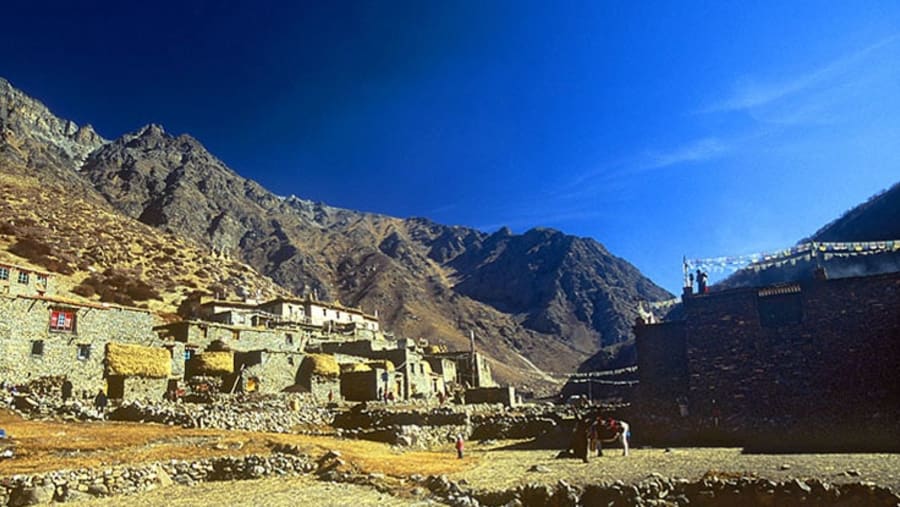
  • You'll be trekking deeper into the Limi Valley today, so it will be a longer walk than usual. Pack up and cross the Chenglungma caravan camp after breakfast. From there, you'll travel to Cha-Sa Nam-Ka Dzong, a historically significant cave. It is a stunning tourist destination since it is situated on a rocky cliff on a hillside. From here onward, the landscape is arid, steep, and rocky. To add to the difficulty, you will have to share the steep trail with animals such as sheep and yaks carrying heavy loads. Limi Valley, also referred to as Limi village, comprises three villages: Til, Halji, and Jang. The journey will explore the three settlements over the next few days. At an elevation of 4,300 meters, you will first cross Lamka-La, a high pass. Til is the first settlement you'll come upon. Despite the arid terrain, it is an agricultural community, and its inhabitants cultivate barley in their fields on the western end. Willow and birch trees can also be found. It's also the smallest and most accessible settlement on the Tibetan border.
  • When you get to Til, you can rest for a while before exploring the settlement. In addition, the Kunzum Do Nag Monastery, which is said to be 300 years old, can be visited in what is regarded as the second dispersion of Buddhism in Tibet.
  • You can observe a massive cultural interchange. Interact with the inhabitants who reside in stone cottages and are warm and welcoming. Til village is where you will spend the night.
13
Day 13

Trek from Til Village to Chagzur Hot Springs via Halji

  • On your way to Chagzur Hot Springs, you'll travel through Limi's second settlement, Halji.
  • Start walking down the route for roughly an hour until you reach Tiljung. Then, following the Tagtsi Khola, the primary tributary of the Karnali, proceed below from Jang to Til.
  • You'll eventually come to a narrow valley to the east, cross another bridge, and turn left from there. Finally, you will arrive in the northeastern settlement of Halji in about an hour.
  • The largest village in Limi Valley is Halji, and a massive gate will welcome you into the settlement. A chorten and a huge Mani wall with stone carvings of holy mantras and drawings of Buddhist deities can be found on the side. This village is yours to explore at your leisure. More significantly, you must visit the magnificent Rinchhen Ling Gompa Monastery, which is over 800 years old. It is the religious hub of the region and belongs to the Kagyu Pa lineage.
  • You can continue walking towards Jang village after exploring the region. Another significant monastery, estimated to be 250 years old, may be found there. Take a short stroll from there to the Chagzur Hot Spring, where you'll spend the night.
14
Day 14

Rest Day at Chagzur Hot Spring

  • After a rigorous trek, you'll have your first rest day at Chagzur Hot Spring. It's also known as Tashi Tang, which is more well known in the area. You may sleep in today, wash your clothes if needed, and have breakfast at your own pace, as you have the entire day free to take a relaxing dip in Chagzur's natural hot springs. The hot spring is renowned for naturally healing any condition. Alternatively, you may hike up to Lapcha Syar, which is 4,900m/16,000ft above sea level.
15
Day 15

Trek to Jade or Nyalu Base Camp in Talung Valley

  • You'll leave early this morning for the Jade or Nyalu Base Camps. On the way, you'll make a quick stop at Tulgling. Tulgling is a small settlement that has only recently been established.
  • Then you have two options for getting to Nyalu Base Camp. You may either take a faster path across a river to the new road or take the longer, more scenic route via Tagtsi. Tagtsi is an old caravan route that connects the Humla Mansarovar and Humla Limi Valley routes. The ruins of the historic Limi settlement of Tshamdo/Zambuk/Lama Palya will be seen. Next, cross the Nyingchhu River and arrive at Tshogo Lake. Beyond that are the Talung meadows, where yaks and livestock from the Limi Valley graze undisturbed. The day's hard adventure comes to a close here at Nyalu Base Camp.
16
Day 16

Trek from Nyalu Base Camp to Sheng Jungma

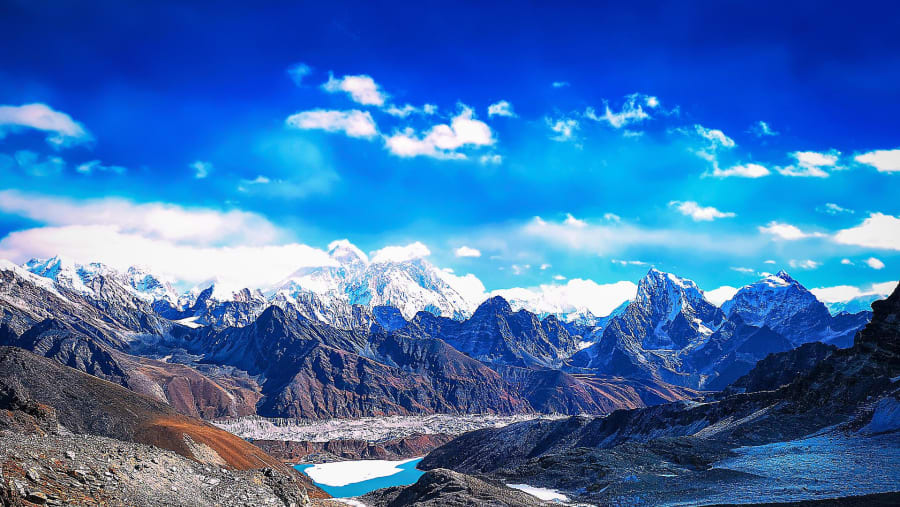
  • The trek to Sheng Jungma today is lengthy and might take up to 8 hours. The first few hours of the hike will be spent ascending steeply to the summit of Nyalu Pass, which sits at an elevation of 4,990m/14,000ft. It's a difficult climb, but the panoramas make it all worthwhile once you get there. High-standing Nepalese and Tibetan mountains such as Mt. Kailash, Kanjiroba, Mt. Api, and Mt. Saipal can be seen here.
  • After soaking in the breathtaking views, descend from the pass to see another magnificent sight: Sheliman Lake, a tiny lake at an elevation of 2,570m/15,000ft. From there, you'll continue down to Tshongsa's meadows and river.
  • The sights of the rhododendron woodland will greet you in the spring. Another noteworthy sight along the walk is the Tshogsi Tsan waterfall, also known locally as the wild monster of Tshongsa, which cascades between cliffs. An hour away, the pasturelands of Sheng Jungma may be seen far beyond.
17
Day 17

Trek from Sheng Jungma to Langdogd Base or Dinga Village Herd Site

  • Starting from the Tshongsa River, make your way to the left bank of the Zhestse River, which runs east-west.
  • You'll start climbing higher until you reach the right bank of the Zhetse. You may stop by the herders' summer camp in Chyadok hamlet just before crossing a bridge. The valley of Zhetse may be seen in its entirety from here.
  • You may stay at the Dinga village herders' encampment for the night. You'll have a few hours remaining in the day, so go for a walk around the neighbourhood and take some unforgettable photos.
18
Day 18

Trek from Langdogd Base to Lekh Dinga via Langdogd Pass

  • Today's hike starts with a gradual ascent to Langdogd Pass, which peaks at 4,550m/14,900ft and gives gorgeous views of the valley's high cliffs and mountains.
  • After taking in the vistas, descend steeply through a juniper and birch woodland. Takhar Khola is reached by following the path.
  • After approximately 1.5 hours, you'll cross a creek and arrive at Lekh Dinga, a Laga Dinga campsite. The Limi people come here in the autumn for trading, and the Laga Dinga people come here for settlement in the summer.
19
Day 19

Trek from Lekh Dinga to Simikot

  • On this day, you will depart Limi Valley and the neighbouring districts and go to Simikot, the capital of Humla. Begin your hike early in the morning after breakfast. The settlements of Yapka and Tangin will be on your left throughout the first part of the trip, while Aul Dinga will be on your right, falling steeply towards the Yapka Khola after passing them. As you get closer, cross the wooden bridge and rise to Okhreni, a Thakuri village.
  • After taking a break, you'll continue to Simikot on the freshly built road. The Nyinba Valley will become more visible as you continue walking. You can rest when you get to Simikot.
  • Later in the evening, you and your team can have a local drink with the locals. On this day, your incredible trip to Humla comes to an end.
20
Day 20

Flight from Simikot to Nepalgunj and Kathmandu

  • Finally, your trip to Limi Valley ends after the long trekking days. You'll go to Simikot's domestic airport and then fly back to Nepalgunj, before taking a flight from Nepalgunj to Kathmandu city.
  • Depending on your flight itinerary, you may be able to do some last-minute souvenir shopping and eat lunch once you get to the city.
21
Day 21

Departure from Kathmandu

  • Our representative will drop you off at the airport three hours before your flight's departure. Please let us know if you want to experience more of Nepal. Choose from one of our pre-planned itineraries or let us create a journey just for you.

The route

Where you'll travel

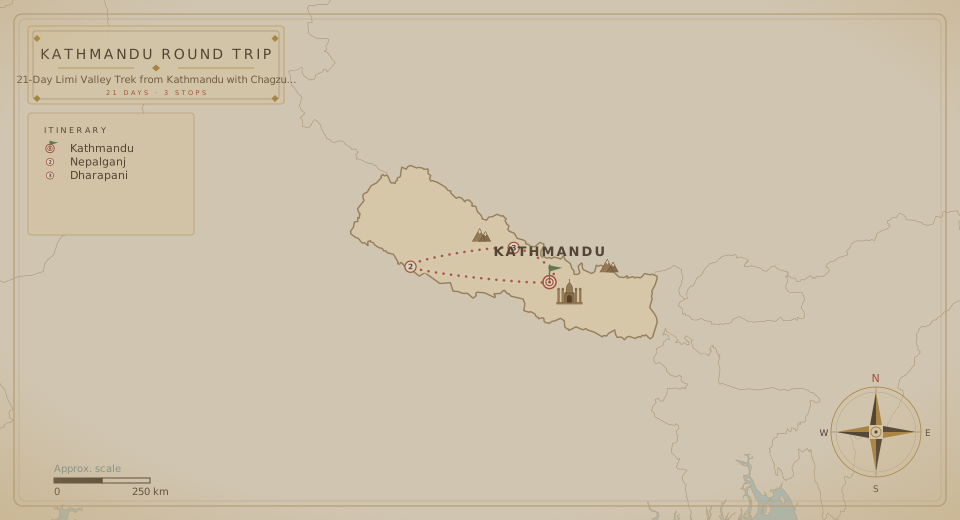
Tour route map
Round trip from Kathmandu 44600 3 cities · 21 Days

The fine print

Trip details

What's Included

  • All private transportation, including airport transfers
  • Meals (breakfast, dinner, and supper) during the trek
  • Insurance for the guide
  • All necessary permits, papers, and TIMS card
  • A basic first aid box
  • Emergency rescue operation (only if you have travel insurance)
  • All government, local taxes, and official expenses
  • Farewell dinner at a typical Nepalese restaurant with cultural shows

What's Not Included

  • Nepal entry visa fees. You can easily obtain a visa on arrival at Tribhuvan International Airport, Kathmandu.
  • Food and hotels before and after the trek
  • All kinds of beverages, including tea, water, wine, etc.
  • Additional costs beyond management control due to natural calamities, weather conditions, etc.
  • Personal expenses, including snacks, laundry, telephone, Wi-Fi, and hot showers at tea houses during the trek
  • Personal trekking equipment for this trek
  • Tipping for the guide and staff (recommended)
  • Any other expenses not mentioned in the Price Include section of this trek

What to bring

  • Daypack above 40 litres (must be waterproof)
  • Down jacket (rental available)
  • Warm sleeping bag (rental available)
  • Sun hat, wool cap, sunglasses, headlamp, and torchlight
  • Ear muffs, sun lotion, or sun cream
  • One pair of liner gloves in thin wool or synthetic material
  • Cotton T-shirts and synthetic T-shirts
  • Two long-sleeve polyester or synthetic lightweight tops for sunny days
  • One soft-shell jacket with water and wind resistance
  • One swimming dress
  • Inner clothes as required
  • Liner socks and woollen socks
  • Proper trekking shoes
  • Imodium or Pepto-Bismol capsules for an upset stomach or diarrhea
  • Diamox for altitude sickness. The guide will help you take it.
  • One small personal-sized first-aid kit with blister treatments such as moleskin, bandages, anti-infection ointments, and muscle relief ointments

Know before you go

  • Meals and drinking water: Popular trekking areas like Annapurna, Everest, Langtang, and Manaslu have a menu system with different ethnic cuisine as well as Western meals, but some places provide typical Nepali meals, which are different from international meals. Local suppliers prepare these meals, and every tourist lodge and tea house usually has a well-trained cook with attention to clean, hygienic, fresh, and delicious food. Every lodge has safe drinking water or mineral water. If you buy water purification tablets in Kathmandu, you can take water from the tap and purify it yourself. This will be cheaper and help control plastic pollution as well.
  • Travel insurance: All clients participating in any activity must have travel insurance. Personal injury, death, hospital expenditures, repatriation fees, helicopter rescue, and any other illness covered by the insurance plan should be included. We highly advise you to acquire a comprehensive insurance plan from a trustworthy insurance company.
  • Passport and visa: Every client must have a valid passport with at least 6 months' validity from the return date. A Nepal visa can be obtained through the Nepalese consulate in your country or from the immigration office at Tribhuvan International Airport in Kathmandu.

Logistics

Meeting & route

Meeting point
Tribhuvan International Airport (KTM), International Terminal, Kathmandu, Nepal
Tour start
Kathmandu 44600, Nepal
Tour ends at the same location as the start point.
End of the journey

Your 21 days finish where they began, in Kathmandu 44600.

Watch the tourHQ film Watch the film

Create your own adventure

Can't find the perfect tour? Tailor your dream trip.

  • Tell us your destination, dates and group size.
  • Our travel experts and local guides design a tailored itinerary, just for you.
  • Enjoy your trip with peace of mind, knowing everything is taken care of.
Plan my holiday

Say goodbye to travel stress.

Starting from

USD 1,099 /person
Book This Tour

When

Travellers

Total