Nepal · Trekking

14-Day Everest Base Camp Trek from Kathmandu with Kala Patthar

14 Days Round trip from Ring Rd Hard pace

The journey

Trip highlights
  • 01 Trek to Everest Base Camp through the Khumbu region
  • 02 Wander Namche Bazaar and interact with local people
  • 03 Enjoy mesmerizing views of Everest, Nuptse, Lhotse, Ama Dablam, and Thamserku
  • 04 Spend acclimatization days in Namche Bazaar and Dingboche
  • 05 Hike to Kala Patthar for one of the trek's most iconic Everest viewpoints

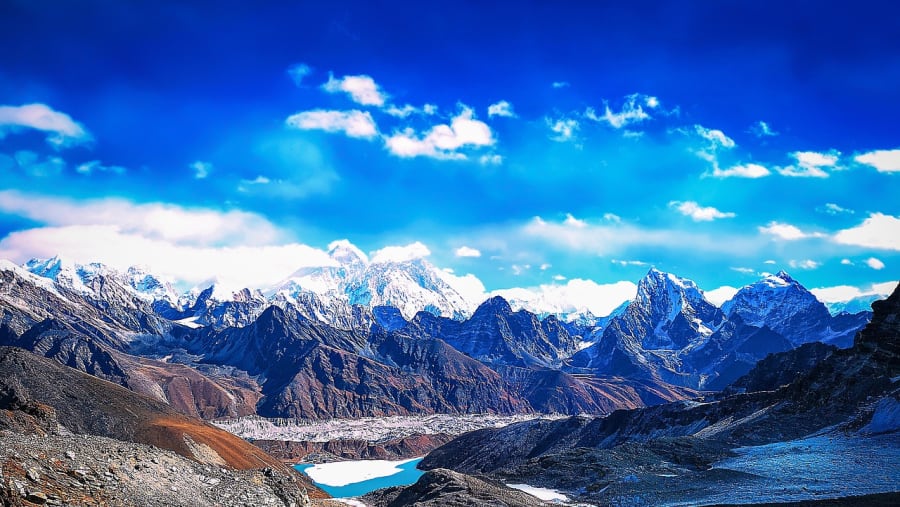
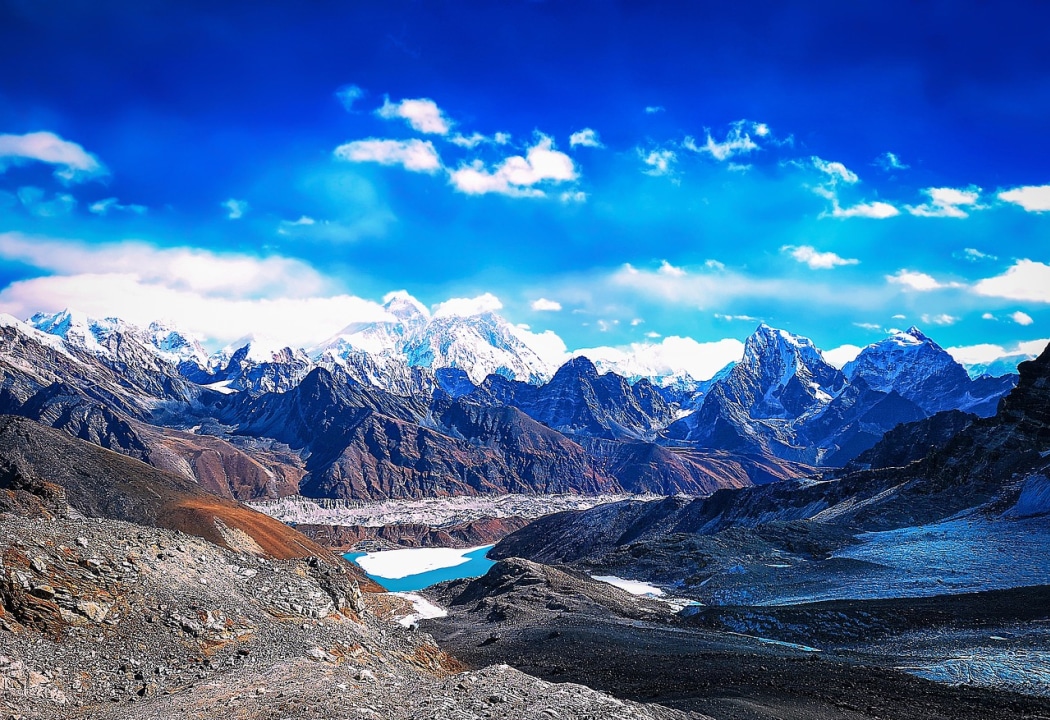
Discover heart-melting mountain views and magnificent landscapes on this 14-day Everest Base Camp trek from Kathmandu. Follow trails through unbelievable forests of rhododendrons, blue pines, firs, and junipers as you pass Phakding, Namche Bazaar, Tengboche, Dingboche, Pangboche, and Lobuche on the way to Everest Base Camp. Along the journey, experience Sherpa villages, mountain teahouses, and inspiring Himalayan scenery before admiring the mighty Mount Everest from its most iconic viewpoints.

On this particular day of trekking, we will reach Kalapatthar, a place where every traveller dreams of being.

From the itinerary

At a glance

What this trip includes

Duration 14 Days
Tour type Shared
Activity level Hard
Accommodation Included · Standard
Transport Included
Wheelchair access Yes
Cities Kathmandu, Mount Everest, Everest Base Camp-South, Lukla, Dingboche, Namche Bazaar, Tengboche, Phakding, Lobuche, Kala Patthar, Pangboche, Gorakshep
Languages English, Hindi

Day by day

The itinerary

1
Day 01

Arrival in Kathmandu

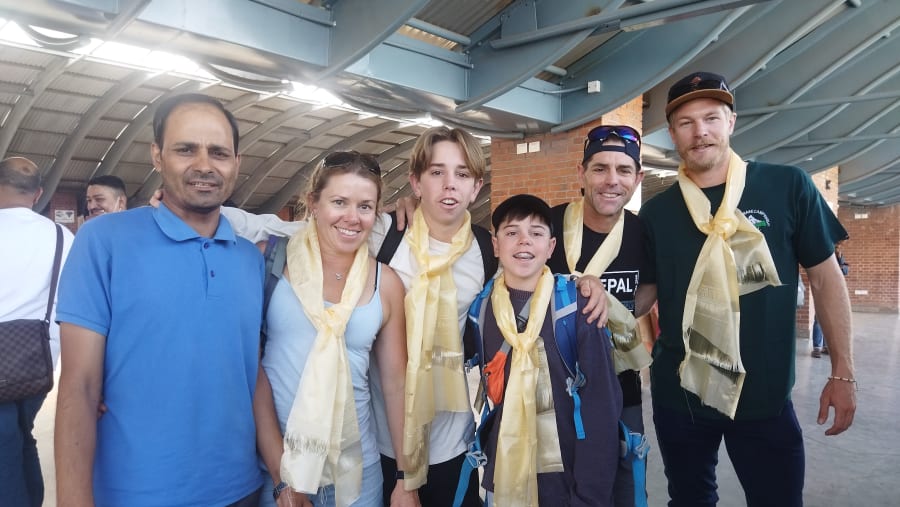
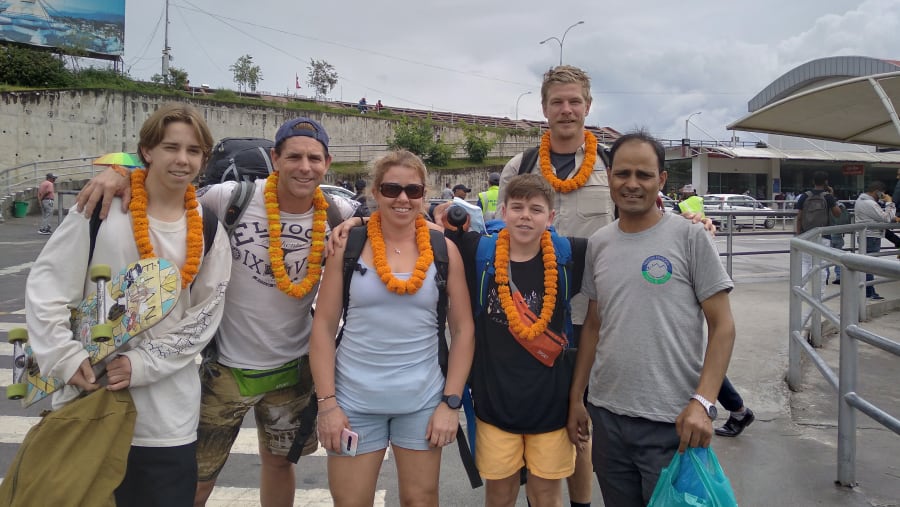
Our office representative will be waiting for you at Tribhuvan International Airport to warmly welcome you with a garland of flowers and your name on a placard. You will then be transferred for recreation and an overnight stay at your hotel in Kathmandu.

2
Day 02

Fly to Lukla and Trek to Phakding

We will fly from Kathmandu to Lukla, approximately 40 minutes away. From Lukla, at 2865 meters in the Khumbu region, we will begin our trek to Phakding at 2650 meters, walking for about 3 to 4 hours. Along the way, we will observe the lifestyle of the local people, as well as the terraced landscapes and the valley. Our overnight stay will be at a teahouse in Phakding.

3
Day 03

Trek through Forests to Namche Bazaar

We will lead our way through unbelievable forests of rhododendrons, blue pines, firs, and junipers. After about 7 hours of walking, we will reach Namche Bazaar. We will stay overnight in Namche Bazaar.

4
Day 04

Acclimatization Day in Namche Bazaar

We will spend the whole day acclimatizing in Namche Bazaar, wandering through the village and spending time close to its natives. We will also visit the local museum to become more familiar with the place. Overnight stay will be in Namche Bazaar.

5
Day 05

Trek to Tengboche with Himalayan Views

We will trek to Tengboche through Phunki, walking for about 3 hours. Mesmerizing views of Mt Everest, Nuptse, Lhotse, Cholatse, Kantaiga, Ama Dablam, and Thamserku will inspire you all along the way. We will stay overnight in Tengboche.

6
Day 06

Trek through Rhododendron Forest to Dingboche

We will begin our journey through the rhododendron forest as we make our way to Dingboche. After passing along the trail to Dingboche, we will stay overnight at a guest house.

7
Day 07

Acclimatization in Dingboche

On the seventh day of our adventurous trek, we will stay one more day in Dingboche to acclimatize ourselves and be ready to move further.

8
Day 08

Climb to Lobuche via Khumbu Glacier

Continuing our journey, we will climb to the terminal rubble of the Khumbu Glacier, where we can see six monuments to Sherpas who passed away in the Lobuche inundation. We will stay overnight at an altitude of 4940 meters in Lobuche at a guest house.

9
Day 09

Trek to Gorakshep and Everest Base Camp

Early in the morning, we will start trekking to Gorakshep. Within a few hours of walking, we will reach the closest and most beautiful view of Mount Everest from top to bottom in a single sight. Afterward, we will return to Gorak Shep for an overnight stay.

10
Day 10

Hike to Kala Patthar and Continue to Pangboche

On this particular day of trekking, we will reach Kalapatthar, a place where every traveller dreams of being. After that, we will continue to Pangboche for our overnight stay.

11
Day 11

Descend from Pangboche to Namche

We will gradually descend from Pangboche to Namche, enjoying the most striking natural scenery along the way. Overnight stay will be at Namche Bazaar.

12
Day 12

Trek Back to Lukla

We will descend again to Lukla, enjoying the splendid and incomparable scenery on the way from Namche Bazaar. The pine, oak, and rhododendron trees bid farewell to you as you reach Lukla for your overnight stay.

13
Day 13

Fly Back to Kathmandu

We will take you back to Kathmandu and let you refresh during the day. After the long trek, you can rest as soon as possible after reaching the hotel in Kathmandu. We will stay overnight at a guesthouse in Kathmandu.

14
Day 14

Departure from Kathmandu

We will accompany you to the airport for your departure to your homeland.

Mount Everest, Everest Base Camp-South, Kala Patthar, Namche Bazaar

Where this trip takes you

Mount Everest, Everest Base Camp-South, Kala Patthar, Namche Bazaar

The route

Where you'll travel

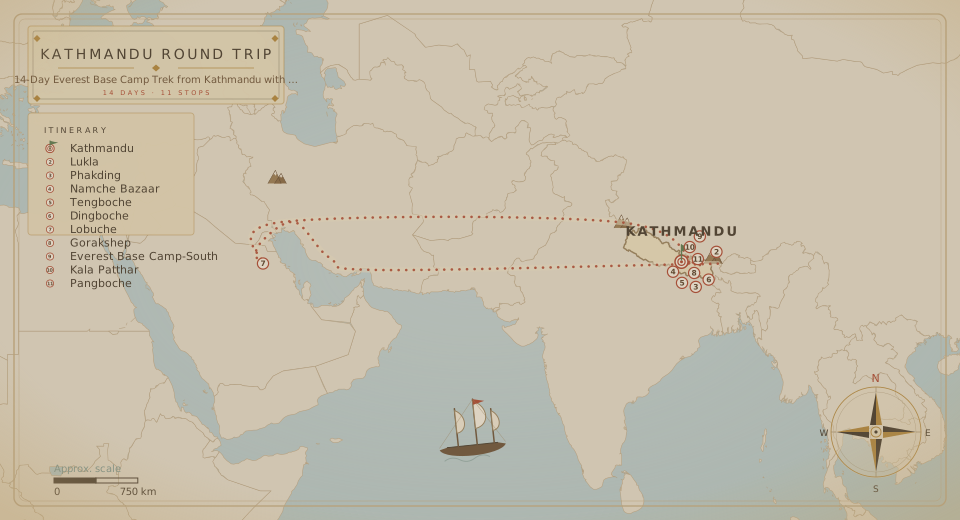
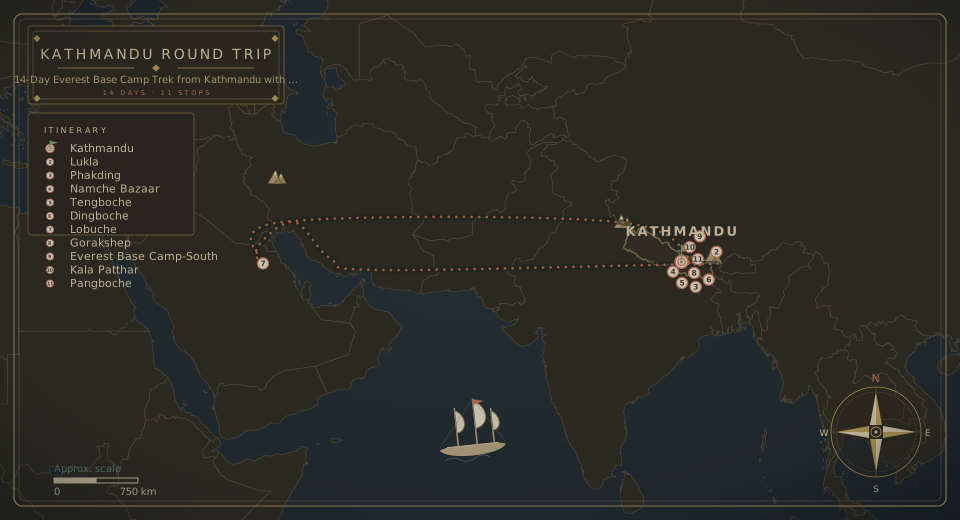
Tour route map
Round trip from Ring Rd 12 cities · 14 Days

The fine print

Trip details

What's Included

  • Pick-up and drop-off from the international airport to the hotel
  • 2-night hotel stay in Kathmandu on a B/B plan
  • Domestic flight ticket from Kathmandu to Lukla and back to Kathmandu
  • Pick-up and drop-off from the domestic airport to the hotel and vice versa
  • Trekking permits and TIMS card
  • Experienced English-speaking, government-licensed trekking guide
  • Accommodation in a teahouse during the trek
  • Three meals a day - breakfast, lunch, and dinner - with 3 cups of tea or coffee during the trek
  • Insurance, daily wages, equipment, meals, and accommodation
  • Guides and porters
  • All taxes and company service charges
  • Medical support kit box

What's Not Included

  • Nepal visa fees
  • Travel and evacuation insurance
  • International airfare to enter and leave Nepal
  • Lunch and dinner in Kathmandu
  • Expenses for beverages, drinking water, desserts, extra porters, showers, laundry, or any other services not mentioned by the company
  • One porter for two guests
  • The cost of spending extra nights in a destination by your own choice
  • Tips for the guide, porter, or local people during your trip
  • Equipment such as a sleeping bag, down jacket, and trekking pole

What to bring

  • Passport
  • Copies of documents
  • Down jacket
  • Waterproof jacket
  • Trekking shoes
  • Hiking pants
  • Hiking shirts
  • Full-sleeve shirt
  • T-shirts
  • Sun hat
  • Camelback water bottle
  • Flashlights, batteries, and bulbs
  • Maps and travel guide
  • Personal towel
  • Rucksack
  • Sunscreen lotion
  • Medical and first-aid kit
  • Sewing kit
  • Polypropylene/wool socks
  • Sleeping bag
  • Thermal insulation
  • Chocolate bar
  • Raincoat (personal and backpack)
  • Walking stick
  • Other required equipment

Know before you go

Before You Book:

Trekking or simply visiting Nepal can be a very life-changing experience. Still, you should learn as much as possible about Nepal and other aspects of your travel before flying there. Discuss and get extra information about the routes you plan to travel, and ensure that your physical health condition is good enough to support you until the end of your travel period. Likewise, learn about the permits and documentation you may require while travelling in Nepal.

About Mount Everest:

Mount Everest is the world's highest mountain in the Solukhumbu district of Nepal, at 8848 meters (29029 feet) above sea level. It is located between Nepal and Tibet, an autonomous region of China. There are two main climbing routes, one approaching the summit from the southeast in Nepal, known as the "standard route," and the other from the north in Tibet. In the nineteenth century, the mountain was named after George Everest, a former Surveyor General of India. The Tibetan name is Chomolungma, which means "Mother Goddess of the World." The Nepali Sanskrit name is Sagarmatha, which means literally "Peak of Heaven".

Mount Everest attracts many climbers, including highly experienced mountaineers. It requires a great deal of mountaineering experience, certification of good health, equipment, and a trained Nepalese guide. Most climbers are not accustomed to the high altitude and low oxygen levels and rely on bottled oxygen they bring along. This is why Everest's area above 8000 meters (2600 ft) elevation is called the "death zone." Climbers who spend long periods in this region can develop altitude sickness and even brain swelling.

Earth scientists estimate that Everest is 50 to 60 million years old, a youngster by geological standards. The first recorded people to climb Everest were Sir Edmund Hillary, a mountaineer from New Zealand, and his Tibetan guide, Tenzing Norgay. They climbed the mountain in 1953 and held the record together. The weather conditions on Mount Everest are extreme and have always been hard to predict. The temperature never rises above freezing, so there is very little native flora and fauna on Everest. The animal species found there are very rare and limited, such as the snow leopard, Himalayan bear, Himalayan goral, red panda, and Himalayan tahr. Similarly, significant plants include birch, juniper, blue pines, firs, bamboo, wild rose, rhododendron, and hemlock.

The Himalayan mountains have long been home to indigenous groups living in the valleys. Most of these are the Sherpa people. Traditionally, their lifestyle has consisted of farming, herding, and trade. Overall, Everest trekking is more than climbing and trekking; it is a life-changing experience, and many see it as a journey close to achieving Nirvana.

  • Climate and weather

The climate of the mountains is ever-changing and unpredictable. The average temperature is 17°C, considered the coldest during the year. Every season is suitable for Everest Base Camp, but different seasons enhance your trekking experience differently. Spring and autumn are mainly considered the best seasons for Everest, while monsoon and winter are also good for trekking.

  • Spring and Autumn

Spring (March, April, May) at EBC is one of the best times of the year to visit. The temperature warms rapidly, but the nights remain cold and chilly, dropping below freezing. The weather is generally bright with clear skies, days are longer with enough sunlight hours and few clouds, and the view of the summit is incredible. Autumn (September, October, and November) is another good season for Everest, with clearer skies after the monsoon rains and the landscape still as verdant as ever. Bright sunshine is warming, with highs of up to 17°C, though the winds can still be strong and cold, making it feel cooler. The heavier clouds are gone, and the mountain's summit is once more visible from the base camp.

  • Monsoon and winter

Monsoon (June, July, and August) sees much higher rainfall at EBC than throughout the rest of the year. Temperatures are higher, reaching around 22°C, but the rainfall can make the area muddy and hard to traverse. Trekking during this season is for adventure seekers and nature lovers. Winter (December, January, and February) is the season for snowfall, the ice-cold time of the year, but the trek is still entirely enjoyable at this time.

  • Local culture and religion

Sherpa is the native community of Everest and other higher Himalayan regions. These days, ethnic groups like Tamang, Rai, and Sherpa live in the Everest region. The language is distinct and is primarily spoken, though it is occasionally written in Tibetan or Devanagari script. Most Sherpas live in Nepal and speak Nepali along with their native language. They can also communicate in one or more languages used by climbers and tourists.

They construct Gompas to practice their religion. Tengboche was the first celibate monastery in the region. Walking from one village to another, you will encounter many prayer walls and religious monuments of stupas with rows of spinning prayer wheels. The majority of people are Buddhists. They mostly celebrate Lhosar as well as a festival called Mani Rimdu, which is celebrated on a large scale in Tengboche Monastery.

  • Foods

Trekking all day at altitude makes you hungry. Luckily, you can order various hot-cooked dishes at your teahouses, with a choice of Nepali and Western meals at every meal. The meals include energy-giving and liquid foods like rice, cereals, lentil soup, noodle soup, hot tea, potatoes, and more.

  • Accommodation

In the Everest region, most accommodations are managed by Sherpas. The Sherpa community populates Namche village, and you receive great hospitality from them when you visit. You can find friendly teahouses and luxurious hotels. Tented camps are still possible, but they are not so popular since teahouses and hotels are easy to find. Rooms are available on a twin-sharing basis. Each room comes with two beds and does not have an attached bathroom. There are more luxurious options during the trek in some lodges with better room facilities. The beds have mattresses, pillows, bed sheets, and some blankets. Almost all places have hot showers available, mostly gas-heated. They also offer buckets filled with hot water for bathing. Wi-Fi is available throughout the Khumbu (Everest) region, though good and reliable speed is not guaranteed.

  • Travel Insurance

We strongly recommend that you get travel insurance before going on a trek. Make sure your insurance covers accidents abroad and high-altitude trekking in the mountains. We do our best to take care of you, but sometimes unavoidable accidents happen that are out of our control. It is best to have insurance in case of a medical emergency leading to a helicopter evacuation.

  • Guide and Porters

According to the Nepal Tourism Board, all trekking activities should be conducted with a government-licensed guide and porter. Your safety is our priority, so our guide and porter are dedicated to making your trekking experience in Nepal memorable without compromising your safety. Along with your safety, we also focus on the safety of our guide and porter. Notably, our guide and porter are provided with insurance facilities.

  • Altitude Sickness

Typically, altitude sickness occurs when you travel to a high altitude too quickly. Headache, nausea, tiredness, and similar symptoms occur when your body tries to adjust to the lower air pressure and lower oxygen levels at high altitudes. Here are some things you can do to prevent altitude sickness.

  • Stop and rest where you are.
  • Do not go any higher for at least 24 to 48 hours.
  • Make sure you are drinking enough water.
  • Do not smoke, drink alcohol, or exercise.

Eat foods and drink fluids containing carbohydrates such as bread, pasta, fruits, milk, rice, and more.

Logistics

Meeting & route

Meeting point
Tribhuvan International Airport
Tour start
Ring Rd, काठमाडौँ 44600, Nepal
Tour ends at the same location as the start point.
End of the journey

Your 14 days finish where they began, in Ring Rd.

Watch the tourHQ film Watch the film

Create your own adventure

Can't find the perfect tour? Tailor your dream trip.

  • Tell us your destination, dates and group size.
  • Our travel experts and local guides design a tailored itinerary, just for you.
  • Enjoy your trip with peace of mind, knowing everything is taken care of.
Plan my holiday

Say goodbye to travel stress.

Starting from

USD 1,399 /person
Book This Tour

When

Travellers

Total