Tanzania · Trekking

8-Day Kilimanjaro Rongai Route Trek to Uhuru Peak via Marangu

8 Days Round trip from Mt Kilimanjaro Hard pace

The journey

Trip highlights
  • 01 Climb Mount Kilimanjaro via the Rongai Route to Uhuru Peak
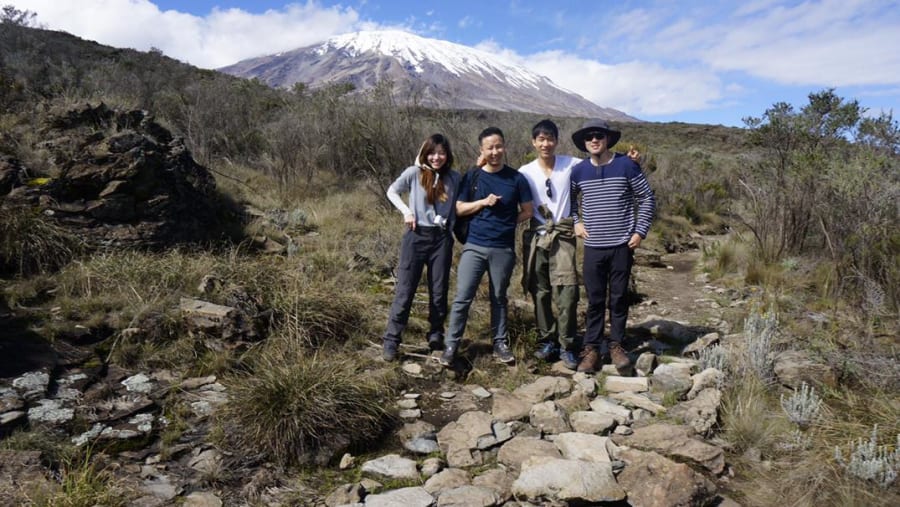
  • 02 Enjoy scenic views of Kibo and Mawenzi along the ascent
  • 03 Acclimatize beneath Mawenzi's towering spires at Mawenzi Tarn Camp
  • 04 Make a midnight summit push to Africa's highest point
  • 05 Descend on the Marangu Route and receive your summit certificate

Embark on an adventurous voyage to summit Uhuru Peak via the Rongai Route, one of the most accessible ways to climb mighty Mount Kilimanjaro. Trek through farmland, pine forest, moorland, and alpine wilderness, with scenic views of Kibo and Mawenzi along the way. Acclimatize at Mawenzi Tarn, make your midnight push to Africa's highest point, and descend via the Marangu Route on the mountain's south side. With airport transfers, Moshi accommodation, camping support, meals on the mountain, and a professional crew included, this trek offers a well-supported Kilimanjaro experience.

You'll wake up at about 23:20, have some tea and cookies, and then trudge off into the darkness, where the going becomes very difficult.

From the itinerary

At a glance

What this trip includes

Duration 8 Days
Tour type Shared
Activity level Hard
Accommodation Included · Budget
Transport Included
Wheelchair access Not applicable
Cities Moshi, Zanzibar, Mount Kilimanjaro, Marangu
Languages English, Swahili

Day by day

The itinerary

1
Day 01

Arrival in Tanzania and Trek Briefing

You will be picked up from Kilimanjaro International Airport and transferred to your accommodation in Moshi town. There, you will meet your guide, who will brief you on your forthcoming trip and carry out an equipment check to ensure that you have all the required mountain gear. On this day, you may also hire any missing equipment.

Meals: Breakfast, Lunch & Dinner are all included.

2
Day 02

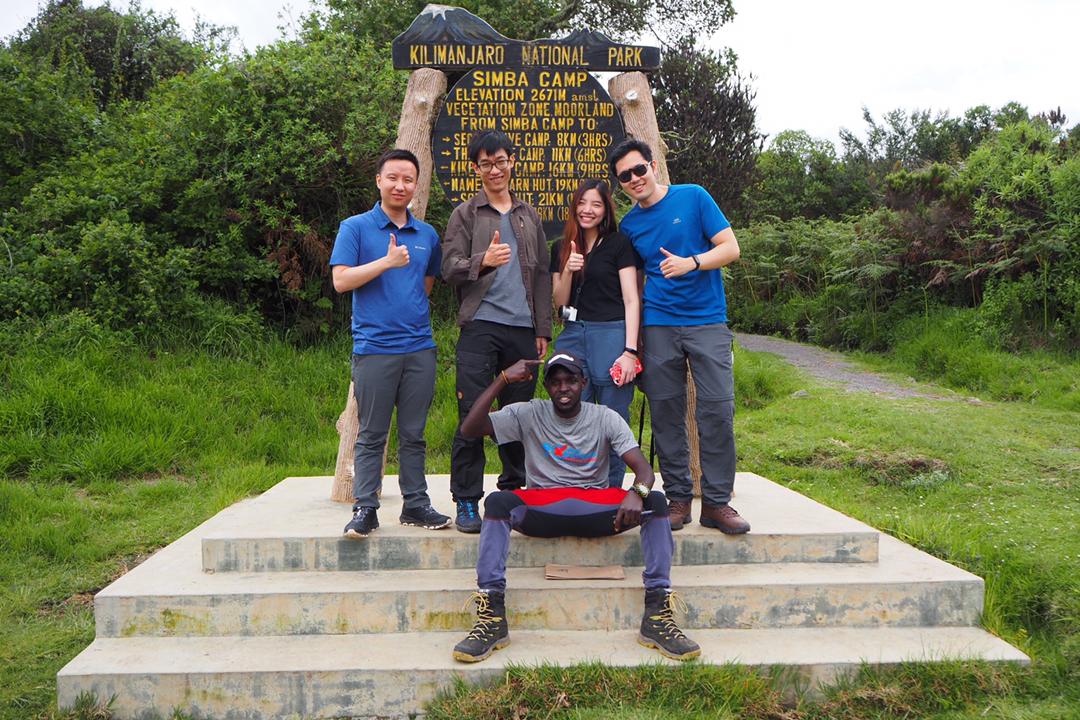
Nalemoru Gate to Simba Camp

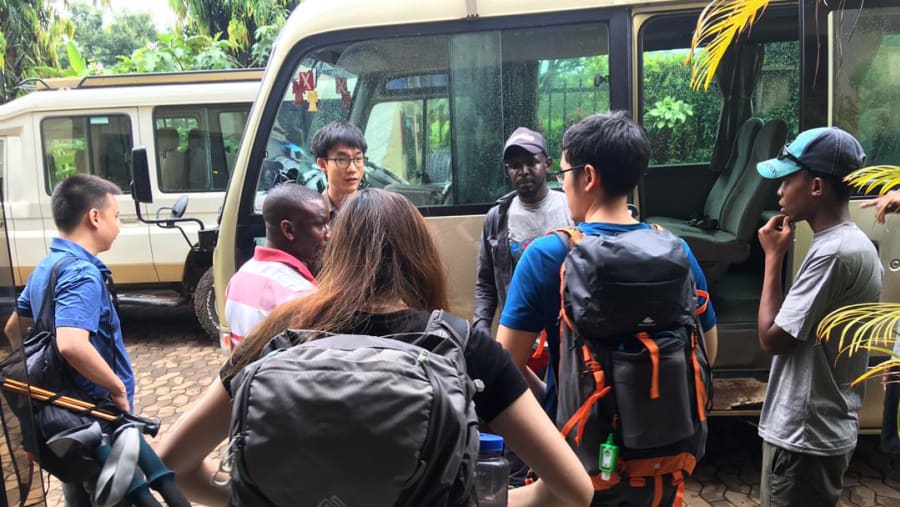
This morning, we'll travel to Nale Moru, the starting point for the Rongai Trail. The trek begins with a section through farmland and pine woods, where you may spot lovely Colobus monkeys or, if you're fortunate, elephants or buffalos along the way. Our first overnight stop is Simba Camp, situated at 2625 m on the edge of the moorland zone.

Distance traveled: 8 km

Time spent: 5 hrs

Meals: Breakfast, Lunch & Dinner are all included.

3
Day 03

Simba Camp to Kikelewa Camp via First Caves

We walk 5.8 kilometers from Simba Camp up toward Kibo, reaching 3,482 meters for lunch at First Caves. After lunch, we continue hiking until we arrive at Kikelewa Camp, located at an elevation of 3679 meters.

The vistas begin to open up, and you really start to feel that you are on a very large mountain. Water may be obtained from a clear stream below the cave, though you may need to go a little farther downhill to locate a pool or two. At Kikelewa Camp, you will have supper and stay the night.

Time spent: 7 hrs

Distance traveled: 11.8 km

Meals: Breakfast, Lunch & Dinner are all included.

4
Day 04

Kikelewa Cave to Mawenzi Tarn Camp

This wilderness region is best appreciated on a short but steep hike up grassy hills. The vegetation zone ends just before you arrive at Mawenzi Tarn, which is beautifully set beneath Mawenzi's towering spires. Spend the rest of the day getting to know the area and acclimatizing.

Distance traveled: 8 km

Time spent: 4-5 hrs

Meals: Breakfast, Lunch & Dinner are all included.

5
Day 05

Mawenzi Tarn Camp to Kibo Hut

After breakfast, we head west and continue climbing on the eastern side of Kibo, crossing the Mawenzi-Kibo Saddle and arriving at Kibo Hut in 4 to 5 hours. The remainder of the day is spent resting and recuperating before the final ascent, which begins shortly after midnight. You will spend the night at Kibo Hut.

Distance traveled: 8 km

Time spent: 6 hrs

Meals: Breakfast, Lunch & Dinner are all included.

6
Day 06

Kibo Hut to Uhuru Peak and Down to Horombo Hut

You'll wake up at about 23:20, have some tea and cookies, and then trudge off into the darkness, where the going becomes very difficult. The route begins with a rough track leading to Hans Meyer Cave (5150 m), which also serves as a good resting point.

The trail then climbs in a zigzag pattern to Gillman's Point (5681 m), located on the crater rim. This section is very steep, with plenty of loose stone scree, and it demands considerable physical and mental effort.

This is the most difficult part of the entire trail. Move slowly and follow the Kili shuffle. Snow is usually encountered from Gillman's Point all the way up to Uhuru Peak (5895 m), Africa's highest point.

Exhilaration and fulfillment abound - you've accomplished your goal.

The weather at the summit will determine how much time you have for photos before the three-hour descent back to Kibo Hut. After a brief break at Kibo Hut, you will collect the belongings you left behind for the climb and continue descending to Horombo Hut for the night.

Compared with the ascent, the descent to Horombo Hut will feel quite fast. This day will take about 14 hours to complete, so be prepared for a long one.

Later that evening, you will enjoy your last supper on the mountain, with soft drinks and beer available for purchase at the camp office, followed by a well-deserved sleep filled with memories and stirring emotions.

Time spent: 8 hrs to reach Uhuru Peak, 8 hrs to descend to Horombo

Distance traveled: 15 hrs

Meals: Breakfast, Lunch & Dinner are all included.

7
Day 07

Horombo Hut to Marangu Gate

After breakfast, continue your descent for about 6 hours to Marangu Gate, passing Mandara Hut along the way. It is highly advised that you do not tip the porters until you and all of your belongings have safely arrived at the gate.

At Marangu Gate, you must sign a register with your name and contact information. Successful climbers will also receive their summit certificates here. Green certificates are given to climbers who reach Gillman's Point (5685 m), while gold certificates are awarded to climbers who reach Uhuru Peak (5895 m).

You are then driven back to Moshi for a long-awaited hot shower, supper, a comfortable bed, and celebrations.

Time spent: 6 hrs

Distance traveled: 29 km

Meals: Breakfast, Lunch & Dinner are all included.

8
Day 08

Departure from Tanzania

After the hike, you'll have the rest of the day free to relax before your journey home. Depending on your departure schedule, you may also tour Moshi town and pick up some souvenirs before heading to the airport.

If you want to continue exploring Tanzania, add-ons such as safaris, Zanzibar, and other excursions are available.

Meals: Breakfast is included in the price.

Rongai Route, Mawenzi Tarn Camp, Uhuru Peak

Where this trip takes you

Rongai Route, Mawenzi Tarn Camp, Uhuru Peak

The route

Where you'll travel

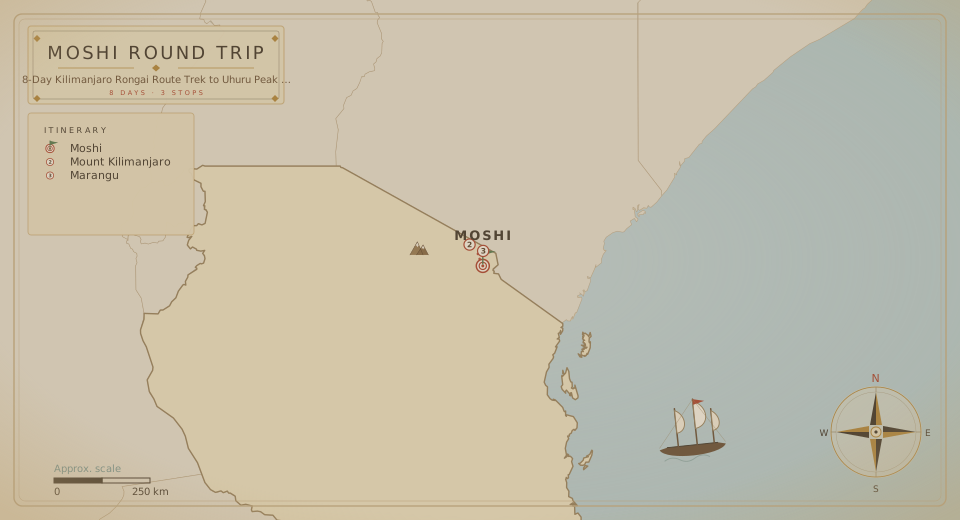
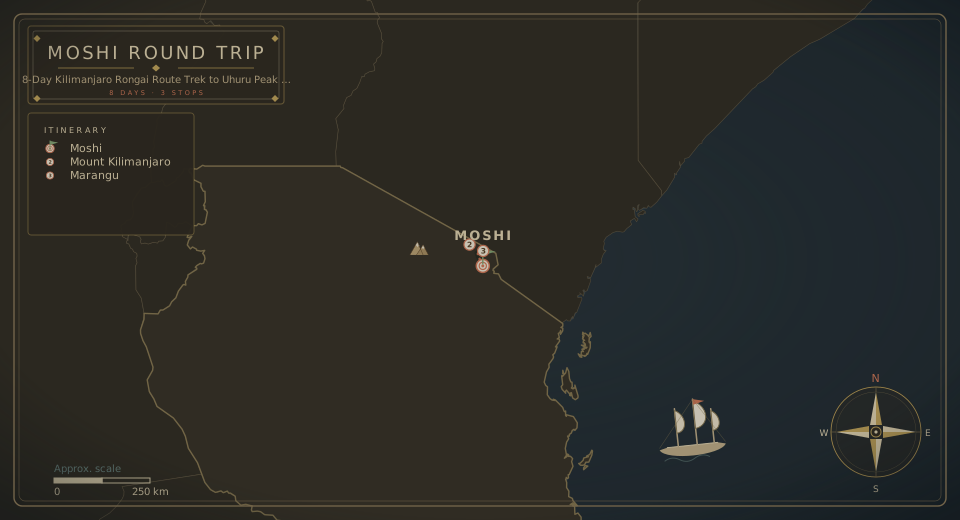
Tour route map
Round trip from Mt Kilimanjaro 4 cities · 8 Days

The fine print

Trip details

What's Included

  • Private transport to and from Kilimanjaro International Airport and your accommodation in Moshi
  • 2 nights of accommodation in Moshi at Weruweru River Lodge or Park View Hotel
  • Transportation to and from the Kilimanjaro gate
  • Park entry fees
  • Camping fees
  • Crater fee (if any)
  • Team Kilimanjaro Rescue fees
  • 18% VAT on tour fees and services
  • 4-season mountain tents
  • Double-layered sleeping mats, 4 inches (10 cm) thick
  • Friendly and professional mountain guides, cook, and porters
  • 3 meals daily while on the mountain
  • Enough treated and filtered drinking water throughout the trek
  • Hot water for washing
  • Fair wages for the mountain crew as approved by the Kilimanjaro National Park Authority (KINAPA) and Kilimanjaro Association of Tour Operators (KIATO)
  • Government taxes
  • Portable oxygen tanks
  • Ox meter
  • Emergency first-aid kit
  • Stethoscope
  • Mountain climbing certificates

What's Not Included

  • Drinks at your hotel before and after the climb
  • Travel insurance
  • Portable flush toilet with a toilet tent
  • Flights
  • Laundry (available at the hotel)
  • Personal items and toiletries
  • Tips for guides, porters, and cook

What to bring

Technical Clothing

  • 1 - Waterproof jacket, breathable, with hood
  • 1 - Insulated jacket, synthetic or down
  • 1 - Soft jacket, fleece or soft-shell
  • 2 - Long-sleeve shirts, lightweight, moisture-wicking fabric
  • 1 - Short-sleeve shirt, lightweight, moisture-wicking fabric
  • 1 - Waterproof pants, breathable (side zipper recommended)
  • 2 - Hiking pants (convertible to shorts recommended)
  • 1 - Fleece pants
  • 1 - Shorts (optional)
  • 1 - Long underwear (moisture-wicking fabric recommended)
  • 3 - Underwear, briefs (moisture-wicking fabric recommended)

Headwear

  • 1 - Brimmed hat, for sun protection
  • 1 - Knit hat, for warmth
  • 1 - Balaclava, for face coverage (optional)
  • 1 - Bandana (optional)

Handwear

  • 1 - Gloves, warm (waterproof recommended)
  • 1 - Glove liners, thin, synthetic, worn under gloves for added warmth (optional)

Footwear

  • 1 - Hiking boots, warm, waterproof, broken-in, with spare laces
  • 1 - Gym shoes, to wear at camp (optional)
  • 3 - Socks, thick, wool or synthetic
  • 3 - Sock liners, tight, thin, synthetic, worn under socks to prevent blisters (optional)
  • 1 - Gaiters, waterproof (optional)

Accessories

  • 1 - Sunglasses or goggles
  • 1 - Backpack cover, waterproof (optional)
  • 1 - Poncho, during rainy season (optional)
  • 1 - Water bottle (Nalgene, 32 oz. recommended)
  • 1 - Water bladder, Camelbak type (recommended)
  • 1 - Towel, lightweight, quick-dry (optional)
  • 1 - Pee bottle, to avoid leaving the tent at night (recommended)
  • Stuff sacks or plastic bags, various sizes, to keep gear dry and separate

Equipment

  • 1 - Sleeping bag, warm, four seasons
  • 1 - Sleeping bag liner, for added warmth (optional)
  • 1 - Trekking poles (recommended)
  • 1 - Headlamp, with extra batteries
  • 1 - Duffel bag (waterproof recommended) for porters to carry your equipment
  • 1 - Daypack, for you to carry your personal gear

Paperwork

  • Trip receipt
  • Passport
  • Visa (available at JRO)
  • Immunization papers
  • Insurance documents

Know before you go

Altitude Sickness

The science behind altitude sickness is fairly simple to understand. Throughout the troposphere (that is, from sea level to an altitude of approximately 10 km), the air composition remains the same: about 20% oxygen and nearly 80% nitrogen.

So when you read that there is a lack of oxygen at the summit, that is not strictly true - oxygen still makes up 20% of the air. The real issue is not a lack of oxygen, but lower air pressure.

To put it more precisely, atmospheric pressure drops by about one-tenth for every 1000 m of altitude. Thus, the air pressure at the top of Kilimanjaro is approximately 40% of that found at sea level.

In layman's terms, although each breath at the summit is still 20% oxygen, just as it is at sea level, it becomes much harder to fill your lungs because the atmosphere is not pushing as much air into them.

Acute Mountain Sickness (AMS)

Acute Mountain Sickness (AMS) - also known as altitude sickness or altitude illness - is a pathological effect on humans caused by ascending to high altitudes too quickly, where lower oxygen availability inhibits normal physiological processes.

People typically begin experiencing Acute Mountain Sickness symptoms at about 10,000 feet (3,000 m).

Some people can experience symptoms as low as 8,000 feet (just over 2,400 m).

Due to Kilimanjaro's rather rapid ascent profile, altitude sickness among trekkers is unfortunately quite common.

The following are symptoms of Acute Mountain Sickness:

  • Fatigue
  • Headaches
  • Nausea and dizziness
  • Shortness of breath
  • Disturbed sleep
  • Loss of appetite
  • Very bad headaches that are not relieved with medication

Shortness of Breath

If you suffer any of the symptoms above, it is important to communicate to your climbing partners and guide how you are feeling.

These symptoms generally disappear if you rest for a day at the altitude where they first began. This is why an acclimatization day, where you climb high and sleep low, is so important.

Golden Rules

Trekking Kilimanjaro need not be a very risky or dangerous adventure as long as you follow some basic rules.

If you have a chance to pre-acclimatize before trekking Mount Kilimanjaro, do so. A good option in Tanzania is to trek the neighboring Mount Meru (4,565 m) before attempting Kilimanjaro.

  1. If you are a novice high-altitude trekker, then choose a route itinerary that is at least seven days long (6 up, 1 down). In our opinion, the seven-day Machame or 7/8-day Lemosho are the most suitable routes for the average trekker.
  2. Ensure the route allows for a good climb-high, sleep-low opportunity (both the Machame and Lemosho do).
  3. When on the mountain, make a point of going as slowly as possible. Do not overexert yourself, even on the lower reaches.
  4. Drink plenty of fluids (2.5-4 liters a day).
  5. Do not drink alcohol, take stimulants, smoke, or consume caffeine on the mountain.
  6. We recommend taking acetazolamide (Diamox).

Finally, as recommended by the charity Altitude.org, always remember these 3 golden rules when at altitude:

  • If you feel unwell, you have altitude sickness until proven otherwise.
  • Do not ascend further if you have symptoms of altitude sickness.
  • If you are getting worse, then descend immediately.

Preventative Medications - Diamox

Acetazolamide, or Diamox, is a drug that has been proven effective in mitigating altitude sickness.

The drug helps increase the acidity of the blood by acting as a diuretic and promoting urination.

Increased acidity in the blood is interpreted by our bodies as increased CO2, and so you begin breathing deeper and faster to get rid of the CO2. Deeper, faster breathing increases the amount of oxygen received by the blood and helps prevent the onset of AMS symptoms.

It is important to note that Diamox is a prophylactic (preventative medicine) and does not cure the symptoms of AMS.

Once altitude sickness symptoms have started, the only way to stop them is descent. Under no circumstances should Diamox be used to continue an ascent with AMS.

Diamox is also a prescription drug, so it is important that you first consult your doctor to check whether it is suitable given your particular medical history.

It is not suitable for pregnant women or anyone with kidney or liver disease issues.

We recommend taking Diamox for 2-3 days, 2 weeks before departure, to test whether you experience any side effects.

Typical Side Effects Associated with Diamox

  • Frequent urination

- Everyone experiences this when taking Diamox. It can result in the development of kidney stones, so it is important that you drink plenty of fluids while taking the medication.

  • Numbness and tingling in the fingers, toes, and face

- Many people experience this side effect when taking Diamox. The sensation is a little discomforting but not dangerous.

  • Taste alterations (some foods might taste strange)
  • Nausea, vomiting, and diarrhea

- This is rare. These side effects should be identified during your test before departing for Kilimanjaro. Unfortunately, these side effects are common with AMS and therefore can easily be misdiagnosed as AMS.

  • Drowsiness and confusion are also possible - again, these side effects can be confused with AMS.

Diamox comes in 250 mg tablets. Most people take half a tablet in the morning and half in the evening.

You should start taking the tablets one day before arriving in Kilimanjaro and continue with the same dosage for all ascent days. You can stop taking Diamox on descent.

Logistics

Meeting & route

Meeting point
Moshi, Kilimanjaro, Tanzania
Tour start
Mt Kilimanjaro, Tanzania
Tour ends at the same location as the start point.
End of the journey

Your 8 days finish where they began, in Mt Kilimanjaro.

Watch the tourHQ film Watch the film

Create your own adventure

Can't find the perfect tour? Tailor your dream trip.

  • Tell us your destination, dates and group size.
  • Our travel experts and local guides design a tailored itinerary, just for you.
  • Enjoy your trip with peace of mind, knowing everything is taken care of.
Plan my holiday

Say goodbye to travel stress.

Starting from

USD 204 /person
Book This Tour

Estimated room rates

Single Room $204.00 — $1,080.00
Double Sharing $204.00 — $1,080.00

When

Travellers

Total