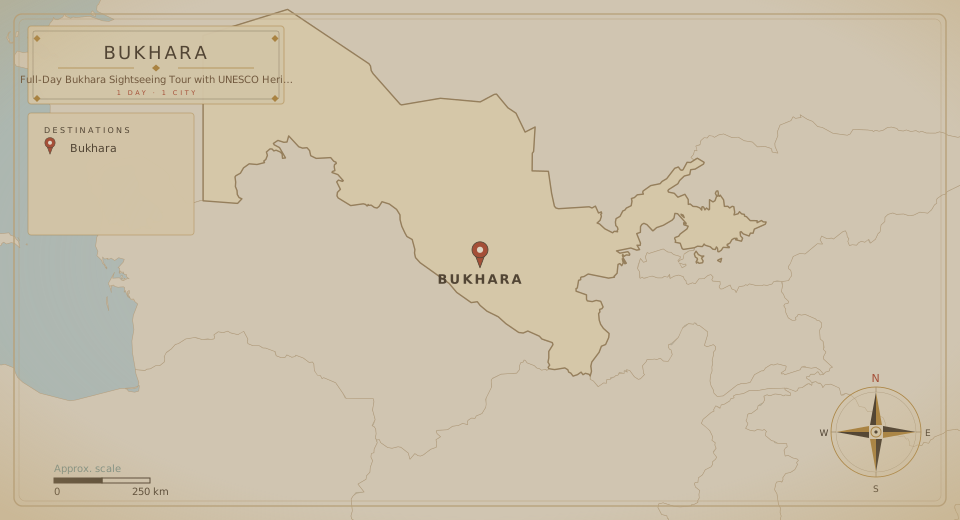




Bukhara Heritage and Architectural Highlights
Connect with the guide at your hotel or designated meeting place to start the excursion in Bukhara.
Explore the following tourist attractions:
- The Samanid Mausoleum: Built in the 10th century, the Samanid Mausoleum is located in the northwestern part of Bukhara, Uzbekistan, just outside its historic center. It was built as the resting place of the powerful and influential Islamic Samanid dynasty that ruled the Samanid Empire from approximately 900 to 1000. It contained three burials, one of whom is known to have been Nasr II.
- Chashma-Ayub Mausoleum: Chashma-Ayub Mausoleum is located near the Samanid Mausoleum in Bukhara, Uzbekistan. Its name means Job's Well, due to the legend in which Job (Ayub) visited this place and created a well by striking the ground with his staff. The water of this well is still pure and is considered healing. The current building was constructed during the reign of Timur and features a Khwarazm-style conical dome uncommon in Bukhara.
- The Bolo Haouz Mosque: Bolo Haouz Mosque is a historical mosque in Bukhara, Uzbekistan. Built in 1712 on the opposite side of the Ark citadel in the Registan district, it is inscribed on the UNESCO World Heritage Site list along with other parts of the historic city. It served as a Friday mosque during the time when the emir of Bukhara was being subjugated under Bolshevik Russian rule in the 1920s. Thin columns made of painted wood were added to the front part of the iwan (entrance) in 1917, additionally supporting the bulged roof of the summer prayer room. The columns are decorated with colored muqarnas.
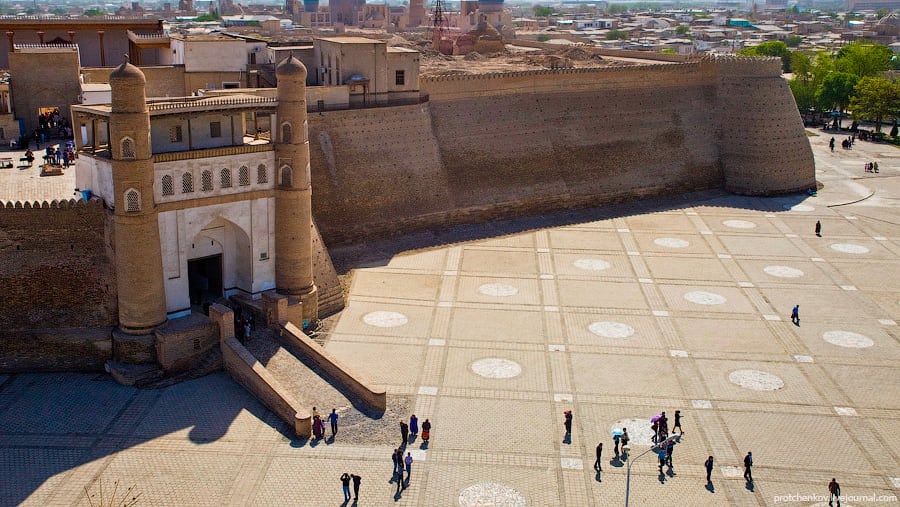
- The Ark of Bukhara: The Ark of Bukhara is a massive fortress located in the city of Bukhara, Uzbekistan, which was initially built and occupied around the 5th century AD. In addition to being a military structure, the Ark encompassed what was essentially a town that, during much of the fortress's history, was inhabited by the various royal courts that held sway over the region surrounding Bukhara. The Ark was used as a fortress until it fell to Russia in 1920. Currently, the Ark is a tourist attraction and houses museums covering its history.
- The Kalyan Minaret: The Kalyan Minaret (Persian/Tajik: Minâra-i Kalân, Kalon Minor, Kalon Minaret) is a minaret of the Po-i-Kalyan mosque complex in Bukhara, Uzbekistan, and one of the most prominent landmarks in the city. The minaret, designed by Bako, was built by the Qarakhanid ruler Mohammad Arslan Khan in 1127 to summon Muslims to prayer five times a day. An earlier tower collapsed before completion. It is made in the form of a circular-pillar baked brick tower, narrowing upwards. It is 45.6 meters (149.61 ft) high, or 48 meters including the point, with a diameter of 9 meters (29.53 ft) at the bottom and 6 meters (19.69 ft) overhead. There is a brick spiral staircase that twists up inside around the pillar to the rotunda. The tower base has narrow ornamental strings belted across it, made of bricks placed in both straight and diagonal fashion. The frieze is covered with a blue glaze with inscriptions.
- The Kalyan Mosque and the Mir-i-Arab Madrasah: Po-i-Kalan or Poi Kalan (Uzbek: Poi Kalon, Persian: پای کلان Pā-i Kalān, which means "At the Foot of the Great One") is an Islamic religious complex located in Bukhara, Uzbekistan. The complex consists of three parts: the Kalan Mosque (Masjid-i Kalan), the Kalan Minaret (Minâra-i Kalân), to which the name refers, and the Mir-i-Arab Madrasah. The positioning of the three structures creates a square courtyard in its center, with the Mir-i-Arab and the Kalan Mosque standing on opposite ends. In addition, the square is enclosed by a bazaar and a set of baths connected to the minaret on the northern and southern ends respectively. The congregational mosque in the complex is one of the largest mosques in Central Asia, behind the Bibi Khanum Mosque in Samarkand, Uzbekistan, and the Great Mosque of Herat in Afghanistan.
- Trade domes: Toki-Sarrofon Trading Dome stands beside the Lyabi-Khauz, with a crossroads running under it. Small shops are scattered around it. Once, one of the largest currency exchanges in Central Asia was located here, where merchants from India, China, and other countries changed their money with money-changers known as sarrafs. The name of the trading dome originated from them. Several centuries later, one can only buy carpets, kerchiefs, and other souvenirs here.
- Telpak Furushon Trading Dome: A little to the north of Toki-Sarrofon stands the large Telpak Furushon Trading Dome. This is a massive complex with a hexagonal orientation. Under its spherical dome are shops selling knives, pieces of jewelry, musical instruments, and various souvenirs. Next to it is a medieval blacksmith shop, where one can watch the process of manufacturing knives and other tools. Once, the shops sold books, which is why the trading dome was called Kitab-Furushon ("kitab" is translated from Uzbek as "book"). Step by step, the place of book selling was occupied by shops trading headwear, and later the selling of caps in turn gave way to souvenir products made by local craftsmen.
- Tim Abdullakhan Trading Dome: This trade dome differs considerably from its fellows. It is located not at a crossroads but along a street; it is an indoor premise where it is always cool. Light in the Tim Abdullakhan penetrates through small windows and apertures in the domes. Over the centuries, carpets and fabrics were sold here, and even today one can buy a variegated carpet, a beautifully wrought kerchief, or a square of Bukhara cloth.
- Toki-Zargaron Trading Dome: This is the largest trading dome in Bukhara. It is the northernmost dome and is located beside the Po-i-Kalyan. The Toki-Zargaron dome is stretched upwards and strengthened with ribs, which makes it different from the others. The name Zargaron is connected with the word "zargar," which can be translated as "goldsmith." Once, 36 jewelers' workshop-shops selling various jewelry were located here. In addition, Toki-Zargaron was the first among the trading domes of Bukhara. Today, one can purchase jewelry, kerchiefs, and various household accessories such as Bukhara door handles, bells, and a horseshoe for luck.
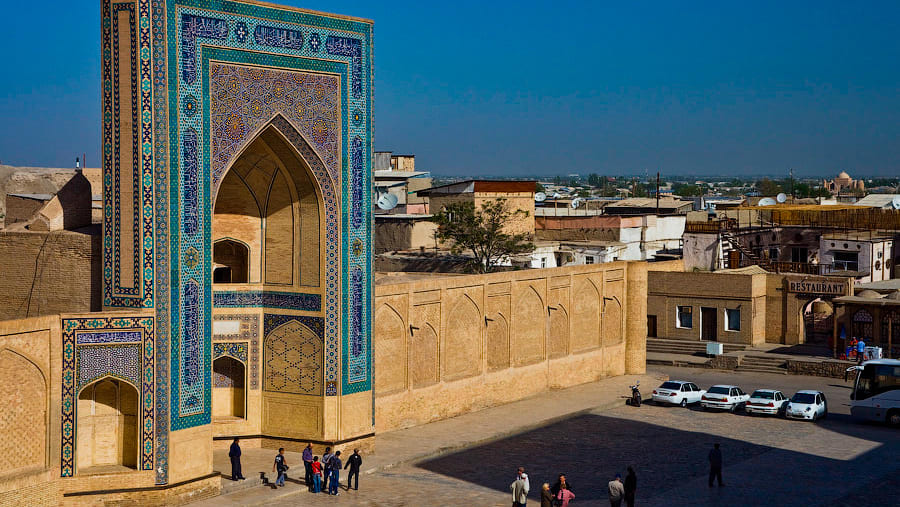
- Ulugbek Madrasah: Ulugbek (also spelled Ulugh Beg, Ulughbeg, Ulugh-Beg), Tamerlane's grandson, was an enlightened and intellectual ruler. He was very much concerned with the development of science in his large kingdom. Besides the well-known madrasah in Registan Square in Samarkand and the madrasah in Gijduvan (Uzbek: G'ijduvon; also spelled Gizhduvan), he ordered that one be built in conservative and strict Bukhara, the Islamic capital of Central Asia, in the hope that the city would become a center of science and education as well. Ulugbek Madrasah in Bukhara was for a long time followed as an example by builders of Islamic schools in other Central Asian cities.
- Abdulaziz Khan Madrasah: Opposite Ulugbek Madrasah stands Abdullazizkhan Madrasah. Abdullazizkhan built it in 1651-1652, and it is the last large madrasah in Bukhara. The building is typical in composition, with a four-ayvan courtyard, but with an extraordinarily divergent arrangement of hujra groups after the side ayvans and cupola buildings on the central axis.
- Magok-i-Attari Mosque: Maghoki Attori Mosque (Uzbek: Magʻoki Attori masjidi, Tajik: Масҷиди Мағокии Атторӣ, romanized: Masjidi Maghokii Attori, Persian: مسجد مغاکی عطاری, romanized: Masjed-e Maghākī-ye Attārī) is a historical mosque in Bukhara, Uzbekistan. It forms part of the historical religious complex of Lyab-i Hauz. The mosque is located in the historical center of Bukhara, about 300 meters southwest of Po-i-Kalyan, 100 meters southwest of the Toqi Telpak Furushon trading dome, and 100 meters east of Lab-i Hauz. It is part of the UNESCO World Heritage Site Historic Center of Bukhara. Today, the mosque is used as a carpet museum.
- Lyabi House Complex: Lab-i Hauz (Uzbek: Labihovuz, Tajik: Лаби Ҳавз, romanized: Labi Havz, Persian: لب حوض, romanized: Lab-e Howz, meaning "by the pool" in Persian), sometimes also known as Lyab-i Khauz, is the name of the area surrounding one of the few remaining hauz pools that have survived in the city of Bukhara. Until the Soviet period, there were many such pools, which were the city's principal source of water, but they were notorious for spreading disease and were mostly filled in during the 1920s and 1930s.
The Lab-i Hauz survived because it is the centerpiece of a magnificent architectural ensemble, created during the 16th and 17th centuries, which has not been significantly changed since. The Lab-i Hauz ensemble, surrounding the pool on three sides, consists of the Kukeldash Madrasah (1568-1569), the largest in the city, on the north side of the pool, and two religious edifices built by Nadir Divan-Beghi: a khanqah (1620), or lodging house for itinerant Sufis, and a madrasa (1622), which stand on the west and east sides of the pool respectively. The small Qāzī-e Kalān Nasreddīn madrasa, now demolished, was formerly located beside the Kukeldash Madrasah.
Tour ends.