

Day 01
Samarkand's Architectural and Sacred Landmarks
- Connect with your tour guide at your hotel or designated meeting place to begin your excursion in Samarkand.
- Explore the following tourist attractions:
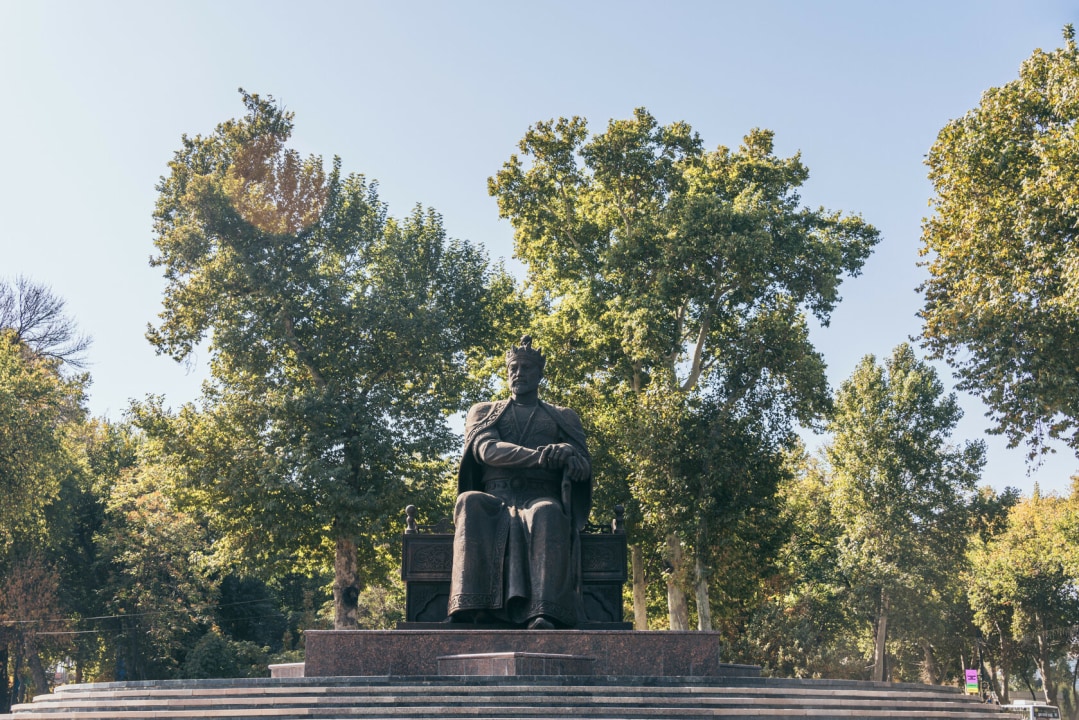
- Mausoleum Gur Emir: The Gur-i Amir or Guri Amir (Uzbek: Amir Temur maqbarasi, Go'ri Amir, Persian: گورِ امیر) is a mausoleum of the Turco-Mongol conqueror Timur, also known as Tamerlane, in Samarkand, Uzbekistan. It occupies an important place in the history of Central Asian architecture as the precursor and model for later Mughal tombs, including the Gardens of Babur in Kabul, Humayun's Tomb in Delhi, and the Taj Mahal in Agra, built by Timur's descendants. The mausoleum has been heavily restored. (30 minutes)
- The Rukhabad Mausoleum: The Rukhabad Mausoleum was built on the order of Tamerlane in the 12th century. This mausoleum was constructed over the tomb of the famous scientist Sagaradzhi. The grandiose building occupied a rectangular courtyard surrounded by bewitching landscapes. Its exterior decoration consists of spherical domes that form a cube at the base of the building. (20 minutes)
- Registan Square: Registan was the heart of the ancient city of Samarkand of the Timurid Empire, now in Uzbekistan. The name Registan (ریگستان) means "sandy place" or "desert" in Persian. It is a complex of three monuments: Ulugbek Madrasah (15th century), Sher-Dor Madrasah (17th century), and Tillya Kori Madrasah (17th century). The Registan was a public square where people gathered to hear royal proclamations, heralded by blasts on enormous copper pipes called azhdarchids, and it was also a place of public executions. It is framed by three madrasahs (Islamic schools) of distinctive Islamic architecture. The square was regarded as the hub of the Timurid Renaissance. (60 minutes)
- The Bibi-Khanym Mosque: The Bibi-Khanym Mosque (Uzbek: Bibi-Xonim masjid; Persian: مسجد بی بی خانم; also variously spelt as Khanum, Khanom, Hanum, Hanim) is one of the most important monuments of Samarkand. In the 15th century, it was one of the largest and most magnificent mosques in the Islamic world. By the mid-20th century, only a splendid ruin still survived, but significant parts of the mosque were restored during the Soviet period. (30 minutes)
- Siyob Bazaar: Siyob Bazaar (Uzbek: Сиёб бозор), also called Siab Bazaar, is the largest bazaar in Samarkand, Uzbekistan. All daily necessities, such as "Samarkand naan," are sold here. Siyob Bazaar is located adjacent to the Bibi-Khanym Mosque and is visited by local people as well as domestic and foreign tourists. (60 minutes)
- The Shah-i-Zinda Ensemble: The Shah-i-Zinda Ensemble includes mausoleums and other ritual buildings from the 11th-15th and 19th centuries. The name Shah-i-Zinda, meaning "The living king," is connected with the legend that Qutham ibn Abbas, a cousin of the Prophet Muhammad, is buried here. He came to Samarkand with the Arab invasion in the 7th century to preach Islam. Popular legends say that he was beheaded for his faith, but did not die; instead, he took his head and went into the deep well, the Garden of Paradise, where he is believed to still be living. (40 minutes)
- Ulugh Beg Observatory: The Ulugh Beg Observatory is an observatory in Samarkand, Uzbekistan. It was built in the 1420s by the Timurid astronomer Ulugh Beg. Islamic astronomers who worked at the observatory include Al-Kashi, Ali Qushji, and Ulugh Beg himself. The observatory was destroyed in 1449 and rediscovered in 1908. (30 minutes)
- Afrasiab Museum of Samarkand: Afrasiab Museum of Samarkand (Uzbek: Afrosiyob-Samarqand Shahar tarixi muzeyi) is a museum located at the historical site of Afrasiyab, one of the largest archaeological sites in the world and the ancient city that was destroyed by the Mongols in the early 13th century. (40 minutes)
- Mausoleum of St. Daniel in Samarkand: On the shore of Siab, a small tributary of the Zerafshan River, there is a sacred place that keeps the relics of Daniel, the Old Testament Biblical Prophet. Another version says that these are the relics of Daniyol, or Danier, an associate of the Arab preacher Kusama ibn Abbas. (40 minutes)
Tour ends.