Uganda · Safari

5-Day Uganda Safari to Murchison Falls with Chimps and Rhinos

5 Days Round trip from Kampala Easy pace

The journey

Trip highlights
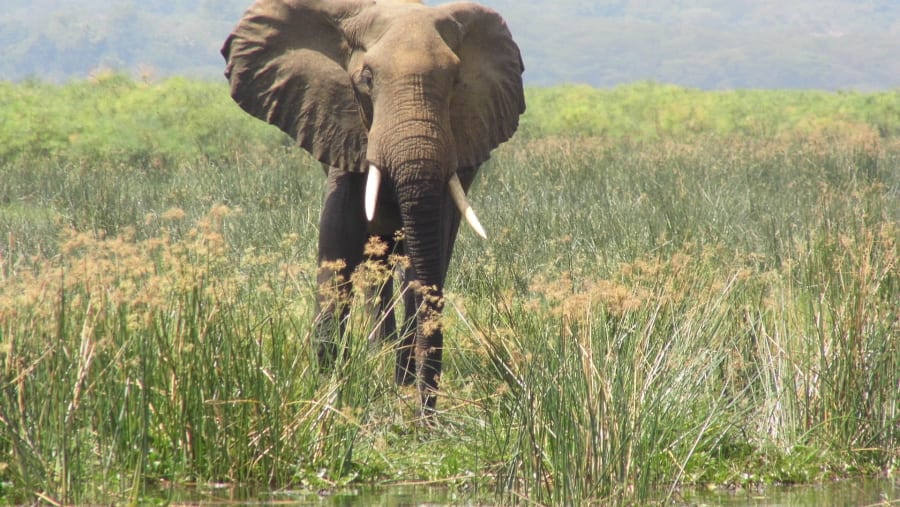
  • 01 Enjoy game drives in Murchison Falls National Park to spot elephants, lions, buffaloes, giraffes, and more
  • 02 Cruise on the Victoria Nile to the base of Murchison Falls and the Nile Delta
  • 03 Marvel at the Nile squeezing through a 6-meter canyon at the top of Murchison Falls
  • 04 Track chimpanzees in Budongo Forest with an experienced ranger guide
  • 05 Encounter Uganda's remaining rhino population on foot at Ziwa Rhino Sanctuary

Discover Uganda's remarkable wildlife on a 5-day safari through Murchison Falls National Park, Budongo Forest, and Ziwa Rhino Sanctuary. Enjoy game drives across the park's plains, cruise on the Victoria Nile to the base of the falls and the delta area, and marvel at the Nile squeezing through a narrow gorge at the top of Murchison Falls. Track chimpanzees in Budongo Forest with an experienced ranger guide and encounter Uganda's remaining rhino population on foot at Ziwa Rhino Sanctuary.

Marvel at the Nile compressing from 50 meters to squeeze through a 6-meter canyon and dropping 40 meters with a thunderous roar.

From the itinerary

At a glance

What this trip includes

Duration 5 Days
Tour type Shared
Activity level Easy
Accommodation Included · Standard
Transport Included
Wheelchair access No
Cities Kampala, Entebbe, Murchison Falls National Park, Ziwa Rhino Sanctuary
Languages English

Day by day

The itinerary

1
Day 01

Kampala to Murchison Falls National Park and Top of the Falls

  • After an early morning breakfast, our guide will pick you up from your hotel in Kampala by 7:30 am and transfer you northwest through the famous Luwero Triangle and Masindi Town to Murchison Falls National Park.
  • Enjoy an en-route lunch at Kabalega Dinners.
  • Proceed into the park with a visit to the top of the falls, where you can see the Nile's beauty perfectly. Marvel at the Nile compressing from 50 meters to squeeze through a 6-meter canyon and dropping 40 meters with a thunderous roar.
  • Later, enjoy an evening game drive as you proceed to your lodge.

Meal plan: Half-Board

Dinner and overnight at Safari Lodge. (Mid-Range)
2
Day 02

Morning Game Drive and Victoria Nile Boat Ride

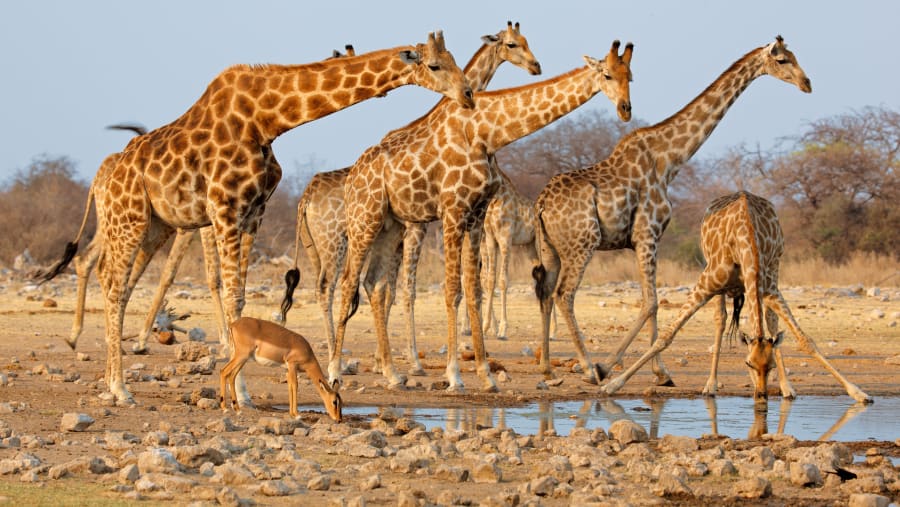
  • Set out for a morning game drive via the Nyamsika Plateau, where you can enjoy the views and may see some of the Big Five, including elephants, lions, buffaloes, and giraffes, as well as warthogs, bushbucks, waterbucks, hartebeests, and many more.
  • Return to the lodge for refreshments, breakfast, and lunch, then prepare for a boat trip on the placid Victoria Nile upstream to the base of the falls.
  • En route, look out for hippos, crocodiles, waterbucks, and a wide variety of birds such as pelicans, bee-eaters, egrets, kingfishers, eagles, weaver birds, and herons.
  • The boat stops just tens of meters from the "Devil's Cauldron".
  • Take pictures of the photogenic and majestic Murchison Falls, then return to the lodge for dinner and overnight.

Meal plan: Full-Board.

3
Day 03

Nile Delta Boat Cruise and Paraa Game Drive

  • After breakfast, you will be picked up by boat and taken to the delta area of Murchison Falls National Park. The Nile Delta boat cruise offers a chance to see many wildlife species, including buffaloes, elephants, crocodiles, hippos, and the rare shoebill stork.
  • You will also observe the Nile reducing speed as it deposits waste before entering Lake Albert.
  • Return to the lodge for lunch, then prepare for your evening game drive in the Paraa area to look for animals you may have missed on the first game drive.
  • After the game drive, transfer to Safari Lodge for dinner and an overnight stay.
4
Day 04

Budongo Chimp Tracking and Transfer to Ziwa Rhino Sanctuary

  • After an early morning breakfast, transfer to the ferry crossing point, where you will cross on the 7:00 am ferry and proceed to the Budongo head office for a briefing on how the tracking is done. You will then be led by an experienced ranger guide who will take you through the monitoring.
  • You are advised to carry bottled water and snacks in case the tracking takes longer. Once the chimpanzees have been spotted, you will be given a maximum of 1 hour with them to enjoy this thrilling experience.
  • This chimp trekking experience also allows birdwatchers to sight different bird species in the forest, especially in Budongo Forest. Afterwards, you will return to your lodge, where lunch will be served, and you can relax a little after your excellent chimpanzee trekking.
  • After lunch, transfer from Budongo to Ziwa, home of the rhinos in Uganda.

Dinner and overnight stay at the lodge.

5
Day 05

Ziwa Rhino Trekking and Return to Kampala

  • After an early morning breakfast, go for your rhino trekking walk in Ziwa Rhino Sanctuary, home to Uganda's remaining rhino population. Ziwa Rhino Sanctuary was created to conserve the rhinos and reintroduce them to other parks in Uganda where they once lived before they were all poached.
  • After your rhino trekking experience, return to your lodge, relax, have lunch, and then proceed to Kampala.
Murchison Falls, Victoria Nile delta, Budongo Forest trails, Ziwa Rhino Sanctuary

Where this trip takes you

Murchison Falls, Victoria Nile delta, Budongo Forest trails, Ziwa Rhino Sanctuary

The route

Where you'll travel

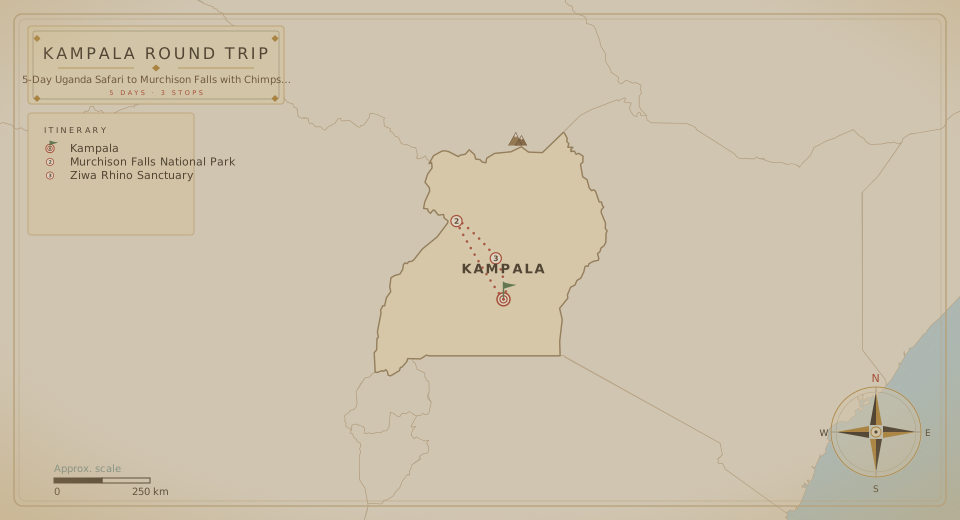
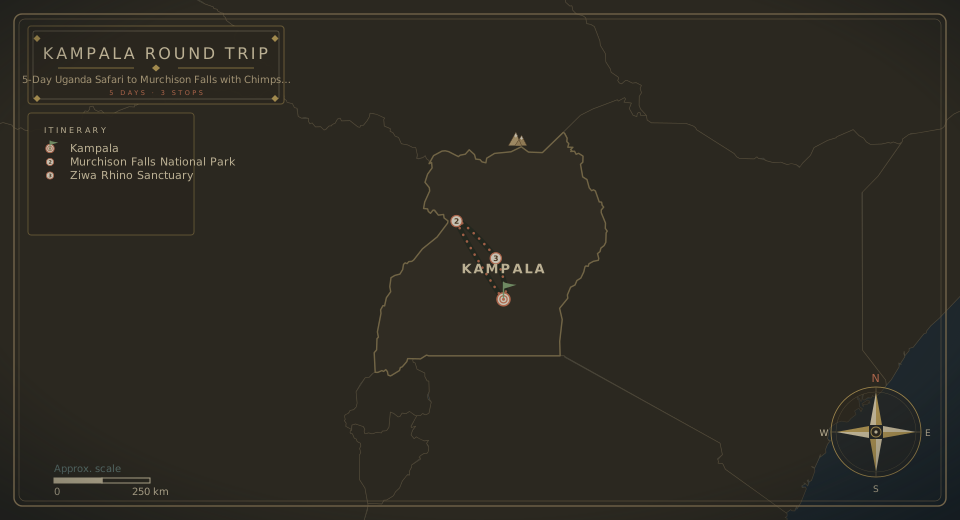
Tour route map
Round trip from Kampala 4 cities · 5 Days

The fine print

Trip details

What's Included

  • Park entrance fees
  • Chimpanzee trekking fees
  • Rhino trekking fees
  • Delta boat cruise
  • Visit to the top of the falls
  • Ferry crossing
  • Game drives
  • Boat ride to the bottom of the falls
  • Transportation by 4x4 safari vehicle (Private)
  • Accommodation and meals as per itinerary
  • Driver allowances
  • En-route lunches

What's Not Included

  • Visa
  • Air ticket

What to bring

  • Bottled water
  • Snacks

Know before you go

  • Uganda's largest protected area, the 3,840 km2 Murchison Falls National Park, lies at the core of the greater Murchison Falls Conservation Area, which also embraces the Bugungu and Karuma Wildlife Reserves and Budongo Forest. Gazetted in its modern form in 1952, the national park previously formed part of the Bunyoro Game Reserves, proclaimed in 1910 following the evacuation of the local human population during a sleeping-sickness epidemic. During the Amin era, Murchison Falls was officially re-christened Kabarega Falls, after the former king of Bunyoro. This name still appears on some maps of Uganda, even though it fell into official and vernacular disuse soon after Amin departed the country. But whatever one elects to call it, Murchison Falls - the vast, languid Nile being transformed into an explosive froth of thunderous white water as it funnels through a narrow cleft in the Rift Valley Escarpment - is easily the most impressive sight of its type in East Africa.
  • Spanning altitudes of 619 m to 1,292 m, Murchison Falls National Park is low-lying by Ugandan standards. Of those parts of the country that tourists regularly visit, it is the only one that periodically becomes stiflingly hot. The average annual rainfall of 1,085 mm, though significantly lower than in the forests of the southwest, compares favourably to most other East African savanna ecosystems. The Victoria Nile, flowing in a westerly direction between Lake Kyoga and Lake Albert, divides the park into two roughly equal parts. North of the river, the vegetation broadly consists of tall, green grassland interspersed with isolated stands of Borassus palms, acacia trees, and riverine woodland. South of the river, the park is characterized by denser woodland, giving way in the southeast to the closed-canopy forest around Rabongo Hill, the highest peak in the park.
  • In the 1960s, Murchison Falls - with its spectacular waterfall, prolific game, and a clutch of outstanding lodges - was universally regarded as one of East Africa's most compelling national parks. It was particularly renowned for its prolific elephant population: herds of 500 or greater were a common sight, and the total count of 14,500 was probably the densest on the continent. According to the 1969 census, the park also supported around 26,500 buffalo, 14,000 hippos, 16,000 Jackson's hartebeest, 30,000 Uganda kob, and 11,000 warthogs, as well as substantial populations of Rothschild's giraffe and both black and white rhinoceros, the latter introduced from the West Nile in the early 1960s. Ironically, in hindsight, the primary conservation issue associated with Murchison Falls in the 1960s was overpopulation, particularly of elephants, and associated environmental destruction - indeed, the authorities opted to cull some 3,500 elephants and 4,000 hippos during the last years of the decade.
  • Murchison Falls remained a popular tourist draw in the early days of the Amin regime, but the gates closed in September 1972, when foreign visitors were banned from Uganda. Within a couple of years, conservation activities within the national park had practically ceased, making its wildlife easy prey for commercial and subsistence poachers. In 1980, a year after Amin was ousted, aerial surveys indicated that the number of elephants and hippos had been reduced to around 1,400 and 1,200, respectively, while buffalo and other large-mammal populations continued to be slaughtered unabated as a succession of military factions occupied the park and treated it as a moving larder. By 1990, fewer than 250 elephants and 1,000 buffalo survived, the hartebeest and kob herds had plummeted to around 3,000 and 6,000 respectively, rhinos and African hunting dogs had been hunted to local extinction, and the dwindling populations, declining tourist arrivals, and ongoing guerrilla activity had rendered all three of the park's lodges inoperative.
  • This downward trend was reversed in the early 1990s. Although wildlife populations have yet to re-approach their pre-Amin highs, nobody who has visited the park regularly over the past decade will be in doubt as to the steady and significant growth in animal numbers. A recent aerial census indicated that the elephant population has risen to roughly 1,100, with herds of several hundred occasionally observed north of the Nile. In 2002, based on partial counts, the buffalo population was estimated at 8,200, an increase of 50% from 1999. The numbers of kob, hartebeest, and giraffe have doubled or perhaps even trebled in recent years. Particularly pleasing has been an explosion in the lion population: scarce and skittish into the late 1990s, lions are now readily located on the plains north of the Nile, and it has been credibly estimated that the park supports a healthy population of 150-200 lions across some 15-20 prides. Previously unrecorded in Murchison Falls, a solitary cheetah was observed by rangers in the northern sector on several occasions.
  • In total, 76 mammal species have been recorded in Murchison Falls. Aside from those species already mentioned, bushbuck, Defassa waterbuck, Bohor reedbuck, oribi, warthog, and side-striped jackal are frequently observed on game drives, along with vervet monkey and olive baboon. Also present on the plain, but less frequently observed, are leopard, spotted hyena, and the localized patas monkey. The Rabongo Forest harbours black-and-white colobus, chimpanzees, and other forest primates. The bird checklist of 460 confirmed and 19 unconfirmed species is headed in desirability by the shoebill, most common along the stretch of river between Nile Safari Camp and the estuary into Lake Albert. Many other water-associated birds are prolific along the river, while raptors make a strong showing on the checklist, with 53 species recorded.
  • Paraa, situated alongside the Nile a few kilometres downriver of Murchison Falls, is the focal point of tourist activities in the national park. All access roads leading into the garden converge at Paraa, where a regular motor ferry provides the only means of crossing between the northern and southern banks of the Nile within the park. The famous launch trip to the base of the falls departs from Paraa, as does the central game-viewing circuit north of the river.

Logistics

Meeting & route

Meeting point
Entebbe International Airport, Kitaasa Rd, Entebbe, Uganda
Tour start
Kampala, Uganda
Tour ends at the same location as the start point.
End of the journey

Your 5 days finish where they began, in Kampala.

Watch the tourHQ film Watch the film

Create your own adventure

Can't find the perfect tour? Tailor your dream trip.

  • Tell us your destination, dates and group size.
  • Our travel experts and local guides design a tailored itinerary, just for you.
  • Enjoy your trip with peace of mind, knowing everything is taken care of.
Plan my holiday

Say goodbye to travel stress.

Price on Request

Book This Tour
Price On Request

When

Travellers