Tanzania · Trekking

5-Day Mount Kilimanjaro Marangu Route Trek to Uhuru Peak

5 Days Round trip from Marangu Easy pace

The journey

Trip highlights
  • 01 Traverse the accessible Marangu Route to climb the iconic Mount Kilimanjaro
  • 02 Witness spectacular vistas of the peaks of Kibo and Mawenzi as you rise
  • 03 Sleep in mountain huts along the route, including Mandara, Horombo, and Kibo
  • 04 Reach Gilman's Point in time for a spectacular sunrise behind Mawenzi
  • 05 Celebrate your summit achievement at Uhuru Peak, 5896 metres above sea level

Trek Mount Kilimanjaro via the Marangu Route on a 5-day climb through rainforest, alpine moorland, and high-altitude desert to Uhuru Peak. Along the way, pass Mandara, Horombo, and Kibo huts, with chances to visit Maundi Crater and enjoy breathtaking views of Kibo and Mawenzi. Summit night begins at midnight, leading to Gilman's Point and a spectacular sunrise from behind Mawenzi before the final push to the top. This route is known for its hut accommodation and is one of the shortest and most accessible ways to reach the summit.

Summit night begins at midnight, leading to Gilman's Point and a spectacular sunrise from behind Mawenzi before the final push to the top.

From the itinerary

At a glance

What this trip includes

Duration 5 Days
Tour type Shared
Activity level Easy
Accommodation Included · Standard
Transport Included
Wheelchair access Yes
Cities Mount Kilimanjaro, Marangu
Languages English

Day by day

The itinerary

1
Day 01

Marangu Gate Through Rainforest to Mandara Hut

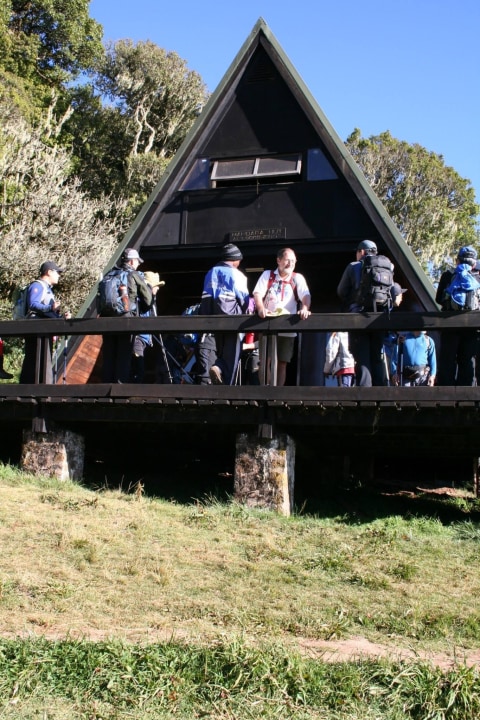
  • Climbers are taken from their hotel to Marangu Gate, which sits at an altitude of about 1,600 metres at the entrance to the rainforest.
  • The trail climbs through the lush forest to Mandara Hut at 2,700 metres. This walk takes around 4 hours at a gentle pace. Mandara Hut is close to the edge of the forest and within a short walk of Maundi Crater, a tiny parasitic volcanic cone just above the forest.
  • Climbers often visit Maundi in the afternoon after arriving at Mandara. In clear weather, the views of Mawenzi, the lower of Kilimanjaro's two prominent peaks, are breathtaking.
2
Day 02

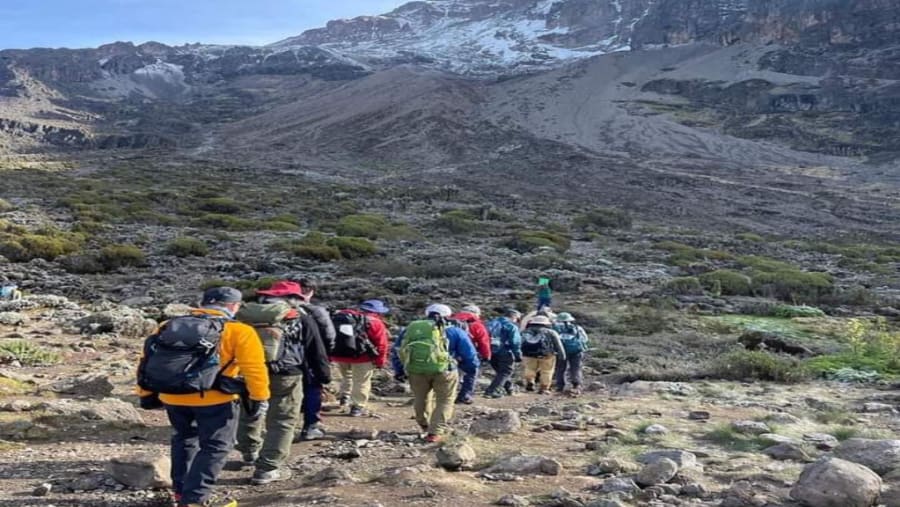
From Mandara Hut to Horombo Across Alpine Moorland

  • Climbers leave Mandara at about 9 o'clock. The first half-hour or so continues through the rainforest, after which the trail emerges into alpine moorland for an approximate 7-hour walk to Horombo, which is at 3,700 metres.
  • If the day is clear, there are splendid views of both Kibo and Mawenzi, as well as the plains stretching away below the mountain. The vegetation is also spectacular, with different types of heather, everlasting flowers, red hot pokers, protea, lobelia, and giant groundsel.
3
Day 03

Horombo Hut to Kibo Hut via the Saddle

  • There are two paths from Horombo Hut to Kibo Hut. The "upper route" is the older path, heading quite steeply uphill from Horombo to the foot of Mawenzi, a climb of about 600 metres. This path then descends to the "saddle," the high-altitude desert between Kibo and Mawenzi, and crosses the saddle to Kibo Hut. The saddle slopes gently uphill until about an hour before Kibo Hut, where it starts to climb quite steeply to the hut, which is at an altitude of around 4,700 metres.
  • The "lower" route heads more directly towards Kibo Hut from Horombo. It is shorter than the upper route, but it is not as physically attractive as the upper route.
  • Climbers often choose the upper route for the ascent and the lower path for the descent. This day's trek can take from 6 to 8 hours.
4
Day 04

Midnight Summit Push to Uhuru Peak and Descent to Horombo

  • Climbers are awoken at about 11 pm.
  • After dressing in warm clothing, they have a hot drink and then set off at midnight.
  • The first part of the ascent to the Hans Meyer Cave is quite indirect, going around large rock outcrops, and it is not as steep as the latter part. The surface is loose and can be hard going.
  • After the cave, the scree slope becomes extremely steep, and you have to climb in a zig-zag fashion.
  • It takes an average of 6 hours to reach Gilman's Point on the crater rim.
  • On a fine morning, the views of the sun rising from behind Mawenzi are spectacular. Gilman's Point is at 5,700 metres. From here, the path goes around the crater rim for a further one and a half to two hours to the summit at Uhuru Peak, 5896 metres.
  • The descent back to Kibo Hut can take a further 3 or 4 hours.
  • After a rest and a meal, the descent continues to Horombo Hut via the lower route, a further trek of around 3 hours.
5
Day 05

Descend from Horombo Hut to Marangu Gate

  • The descent from Horombo to Mandara Hut takes around 3 hours, and the final part of the descent through the forest to Marangu Gate takes another 2 hours.
  • At the gate, vehicles will be waiting to take you back to the hotel.
Mandara Hut and Maundi Crater, alpine moorland above Horombo Hut, Gilman's Point and Uhuru Peak

Where this trip takes you

Mandara Hut and Maundi Crater, alpine moorland above Horombo Hut, Gilman's Point and Uhuru Peak

The route

Where you'll travel

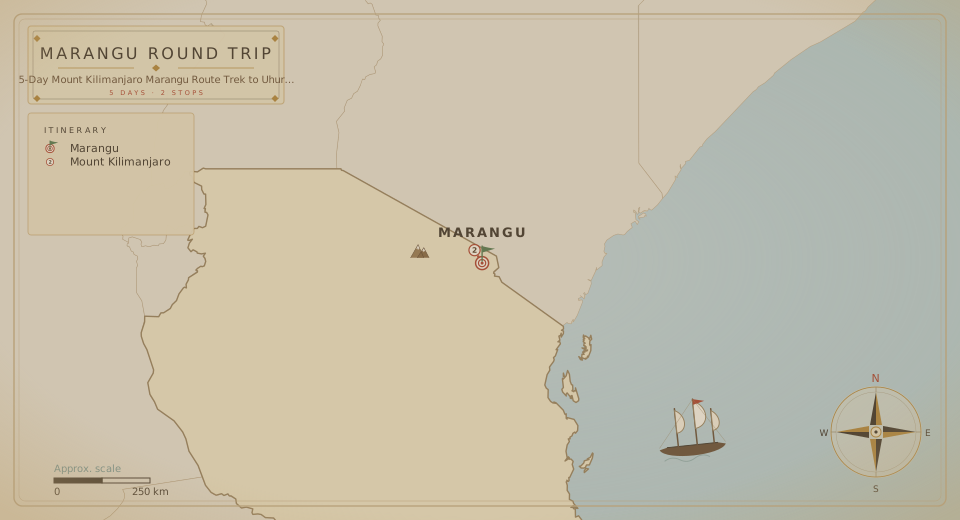
Tour route map
Round trip from Marangu 2 cities · 5 Days

The fine print

Trip details

What's Included

  • Arrival and departure transfers from/to JRO
  • Accommodation on the mountain and 2 nights at the hotel, with meals
  • All park fees, mountain rescue fees, and government taxes
  • Services and salaries for the crew team
  • Highest-quality tent
  • Transport to and from the mountain
  • Emergency oxygen cylinder
  • Mattress

What's Not Included

  • Items of a personal nature, such as passport, visa, and travellers cheques
  • Tips for the crew
  • Medical equipment such as a hyperbaric chamber
  • Portable toilets, available for rent at USD 110 per trip
  • Overweight or extra luggage will require an extra porter at a rate of USD 11 per bag per day
  • Massage can be arranged for USD 40 per person

What to bring

  • Climbing Kilimanjaro without the proper gear could spell disaster. It's the difference between enjoying your trek and hating it.
  • Don't make the mistake of skimping on buying high-quality trekking gear. It's worth the money and will stand you in good stead on a freezing mountain with strong, glacial winds.
  • Some of the essential climbing gear to invest in is a high-quality, weatherproof jacket that is fully lined.
  • Down jackets are expensive but worth every penny and are highly recommended for a Kilimanjaro trek. Invest in good-quality hiking boots with proper grip and ankle support.
  • Don't forget to purchase several thermal layers made from fleece materials, not cotton, a four-season sleeping bag, thermal gloves, thermal socks, and head protection.
  • Other essential gear includes a headlamp with enough replaceable batteries, collapsible trekking poles, a 30-litre daypack, and a 3-litre water bladder or camel pack.

Know before you go

Train for your trek:

  • Climbing Kilimanjaro is no walk in the park. It is challenging, and acclimatisation can set you back no matter how fit you are.
  • This is one of the main reasons many people fail to make it to the summit. Being aerobically fit for your trek is essential, but so is having strong, conditioned legs that can withstand uphill and downhill strain for extended periods.
  • A fit and strong body will ultimately help you function better with less oxygen as you ascend the mountain. At the same time, this will also help you withstand the stress of consecutive days of strenuous exercise.
  • That being said, overly brutal training regimes are unnecessary to prepare for your hike. All you need to do is hike as much and as often as possible.
  • Day hiking, which involves uphill and downhill training, is ideal, but you can hit the gym and train there if you don't have access to hiking trails. The stair master machine is another perfect form of training.
  • Ideally, you should begin training for your Kilimanjaro trek at least two months before your hike. If you are entirely new to hiking, remember to start with shorter walks at a slower pace.
  • As your fitness increases, increase your hike length and pace to build up your endurance. Try to train approximately three times a week for an hour at a time.
  • If you can incorporate day hikes into your training, aim for walks that are 4-6 hours in length while carrying a 20 lb backpack.
  • Important tip: train in the hiking boots you intend to climb in to "break them in" and allow your feet to become accustomed to the shoes.
  • Marangu Route is also known as the "Coca Cola" or "tourist" route. It is the easiest and shortest route to the summit. This is also the only route with the comforts of sleeping huts at every campsite, with solar lights and comfortable beds. The huts are communal, and they have a sponge mattress, pillow, and solar power.
  • There are 60 beds at both Mandara and Kibo Huts and 120 beds at Horombo Hut. Bathrooms and running water are available at the two lower huts, but at Kibo Hut, running water is not available because it is a dry camp.
  • All climbing groups, often from several countries around the world, share meals in dining huts, providing a jovial and energetic atmosphere.
  • This route is usually done in 5 days but can be done in 6 days for better acclimatization. The extra day can be spent resting at Horombo or conducting a nature walk to Zebra Rock.

Logistics

Meeting & route

Meeting point
Your hotel
Tour start
Marangu, Tanzania
Tour ends at the same location as the start point.
End of the journey

Your 5 days finish where they began, in Marangu.

Watch the tourHQ film Watch the film

Create your own adventure

Can't find the perfect tour? Tailor your dream trip.

  • Tell us your destination, dates and group size.
  • Our travel experts and local guides design a tailored itinerary, just for you.
  • Enjoy your trip with peace of mind, knowing everything is taken care of.
Plan my holiday

Say goodbye to travel stress.

Starting from

USD 2,328 /person
Book This Tour

When

Travellers

Total