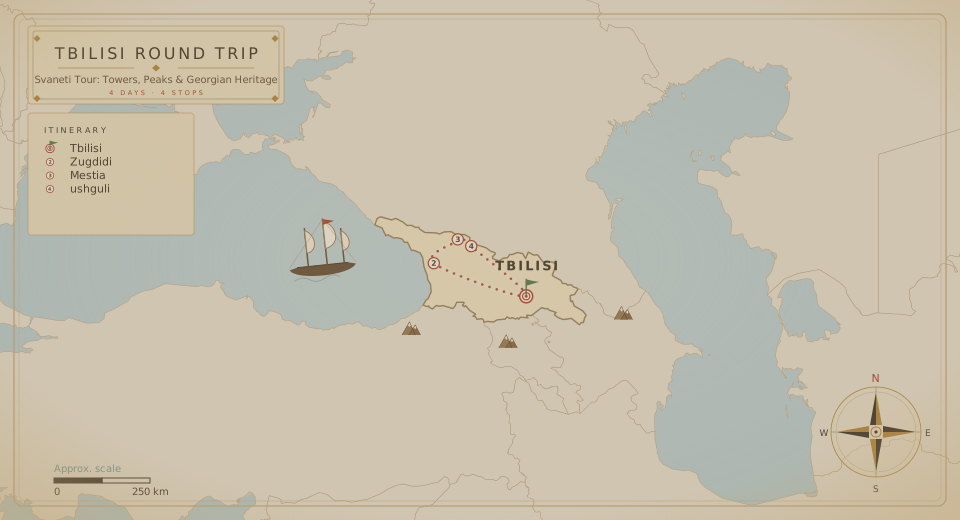
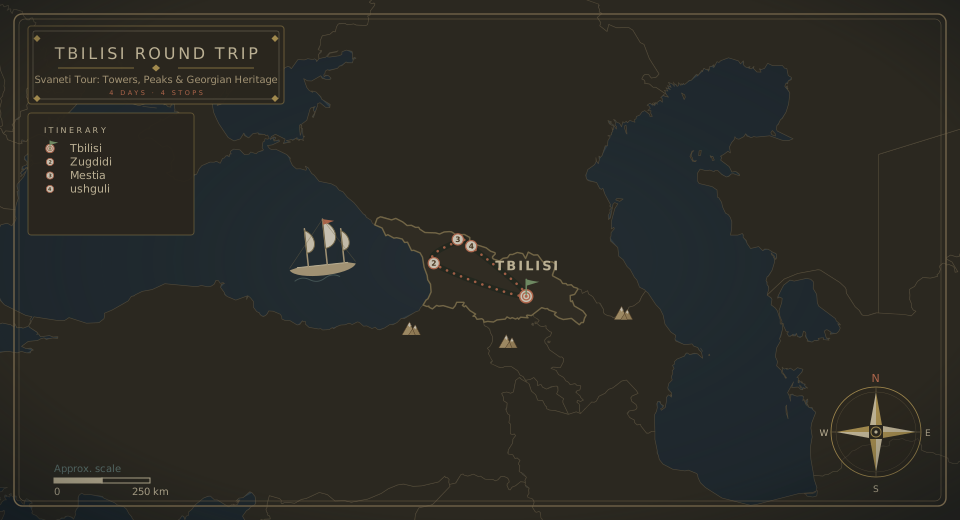
Svaneti Tour
The Svaneti Tour is your chance to explore some of the most iconic places located in Georgia. For example, you will visit Dadiani Palace and Enguri Dam as part of the tour.
Dadiani Palaces
The Dadiani Palaces History and Architecture Museum is considered to be one of the most eminent palaces in Caucasus. Three palaces form the modern museum complex, parts of which are also Blachernae Virgin Church and Zugdidi Botanical Garden.
The Dadiani Palaces display important cultural heritage items from Georgia. The Tagiloni treasure, the Mother of God holy vesture, and the icon of Queen Bordokhan are included. Queen Bordokhan was the mother of Queen Tamar. The collection also features manuscripts from the 13th and 14th centuries, miniatures, and memorial relics of the Dadiani dynasty.
Additionally, there are objects related to Napoleon Bonaparte. These items were brought to the palace by Achille Murat, the husband of David Dadiani's daughter. Achille Murat was the grandson of Napoleon's sister, Caroline Bonaparte.
Enguri Dam
The Enguri Dam is a hydroelectric dam on the Enguri River in Georgia. Currently it is the world's second highest concrete arch dam with a height of 271.5 metres (891 ft). It is located north of the town Jvari.
Mestia
Mestia is a small town in northwest Georgia. It sits at an elevation of 1,500 meters, or 4,921 feet, in the Caucasus Mountains. Mestia is located in the Svaneti region.
Historically and ethnographically, Mestia has always been regarded as a chief community of Zemo, or Upper Svaneti province.
The population is mostly Svans, a cultural and linguistic subgroup of the Georgians. Even though it was small, the town was an important center of Georgian culture for centuries. It has many medieval monuments, like churches and forts, that are on the UNESCO World Heritage Sites list.
Svan towers are famous defensive buildings in the Svaneti region of Georgia. They were built between the 9th and 12th centuries.
They were used for homes and defense. They helped protect against invaders and avalanches.
Typically attached to family homes, each tower has multiple floors connected by narrow ladders and trapdoors. The thick walls and narrow windows made them resilient fortresses.
These towers are a testament to the region's feudal past, where families and clans relied on them for security. Their unique design and cultural significance have made them UNESCO World Heritage sites.
The towers represent the strength, resilience, and independence of the Svan people. They have kept their language, traditions, and architecture alive for centuries. Visitors to Svaneti are drawn to the stunning mountain views and the medieval buildings. These structures stand as quiet guardians of history.