
Georgia · Archaeology

Explore Dmanisi & Bolnisi: Private Trip with Museums

10 Hours Round trip from Pickup service provided in Tbilisi. Easy pace

The journey

Trip highlights
  • 01 Visit the Dmanisi Archaeological Site, home to 1.8 million-year-old hominin remains
  • 02 Explore Dmanisi Sioni, a distinctive 6th-century three-church basilica
  • 03 See Bolnisi Sioni Cathedral, the oldest extant church building in Georgia
  • 04 Discover exhibits on early humans, metallurgy, and medieval history at Bolnisi Museum
  • 05 Visit Tsughrughasheni Church, a richly ornamented 13th-century monument
  • 06 Enjoy a private full-day trip from Tbilisi with guide, transport, lunch, and wine tasting

Discover two of Georgia’s most historically rich regions on this private full-day journey from Tbilisi to Dmanisi and Bolnisi. Explore the remarkable Dmanisi Archaeological Site, where 1.8 million-year-old hominin remains were discovered, and visit important religious landmarks including Dmanisi Sioni, Bolnisi Sioni Cathedral, and Tsughrughasheni Church.

Along the way, gain deeper insight into early human history, medieval architecture, and the legacy of German settlement in the region with a visit to Bolnisi Museum. The experience also includes lunch featuring traditional local cuisine and a wine tasting of endemic regional wines, making this a rewarding day for travellers interested in archaeology, culture, and heritage.

1.8 million years old hominin remains discovered in 1991 by David Lordkipanidze are the oldest found outside Africa and the oldest human skeletons ever discovered in Europe.

From the itinerary

At a glance

What this trip includes

Duration 10 Hours
Tour type Private
Activity level Easy
Accommodation Not included
Transport Included
Wheelchair access No
Cities Tbilisi, Dmanisi, Bolnisi
Languages English

Day by day

The itinerary

1
Day 01

Dmanisi Sioni (6th century)

Dmanisi Sioni built in the 6th century is described as a "three-church" basilica that is an unusual design in which the nave is completely separated from the aisles and create almost three independent churches. Only the middle nave retains its original form. Damaged 13th-14th century icon of Christ, saints and inscriptions survive in the altar apse. Richly adorned gate with inscriptions of King George IV and his son David VII, was added in the 13th century. To the north stands a bell-tower and single-nave church of Saint Marina. The church served as a burial ground to King Vakhtang III, Baratashvili and Orbeliani families. 

Dmanisi Archeological Site

Dmanisi is first mentioned in the 9th century as a possession of the Arab emirate of Tbilisi, though the area had been settled since the Early Bronze Age. Located on the confluence of trading routes and cultural influences, Dmanisi was a major commercial center. Archeological studies began in the area in 1936. Beyond a rich collection of artifacts, remains of prehistoric animals and humans were found. The discovery of primitive stone tools in 1984 led to increasing interest to the site. In 1991, a team of Georgian scholars was joined by the German and later the U.S., French and Spanish researchers. 1.8 million years old hominin remains discovered in 1991 by David Lordkipanidze are the oldest found outside Africa and the oldest human skeletons ever discovered in Europe.

Bolnisi Museum

Bolnisi Museum exhibition shows the history of the first hominins, emergence of agriculture, ancient metallurgy and Bronze Age cultures, early-Christian architecture, examples of the old Georgian inscriptions and stone, clay objects of medieval era. The last hall is dedicated to the history of the German population who immigrated to Georgia 200 years ago.

Bolnisi Sioni Cathedral (478–493)

Bolnisi Sioni Cathedral built in 478–493 is the oldest extant church building in Georgia. The cathedral is known for its inscriptions that are one of the oldest historical documents of the Georgian alphabet. This church is the first Georgian building to have a completion date on the exterior. Bolnisi Sioni’s decorative scheme was a Sasanian style. The southern and central parts of the church are adorned with curling vine scrolls, arabesques, and foliate motifs. The decoration of the building has Persian influence. The hunting depictions and sculpture are similar to Iranian 4th and 5th century art and architecture.

Tsughrughasheni Church (13th Century)

Tsughrughasheni Church was built in 1212–1222 by King Lasha-Giorgi. It resembles the other churches from the period but it is smaller with higher cupola. It is rich with ornaments.
The route

Where you'll travel

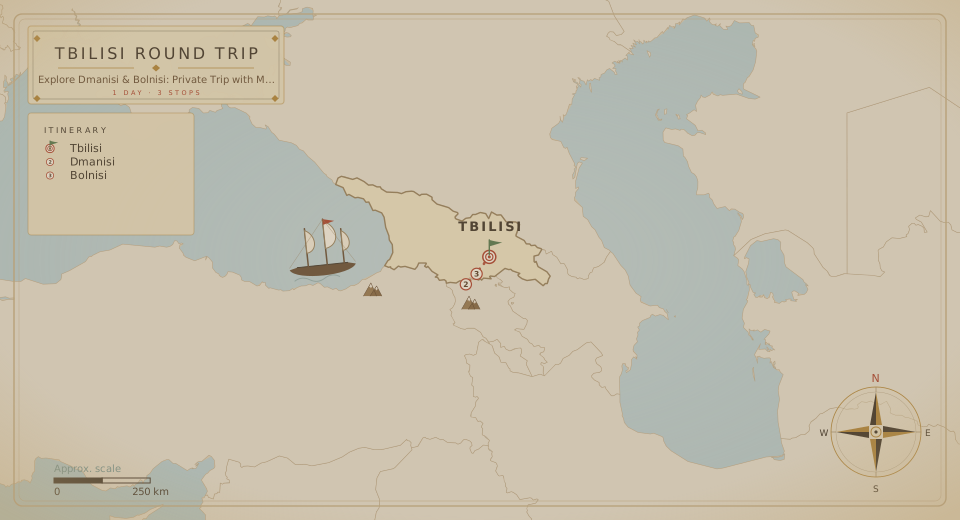
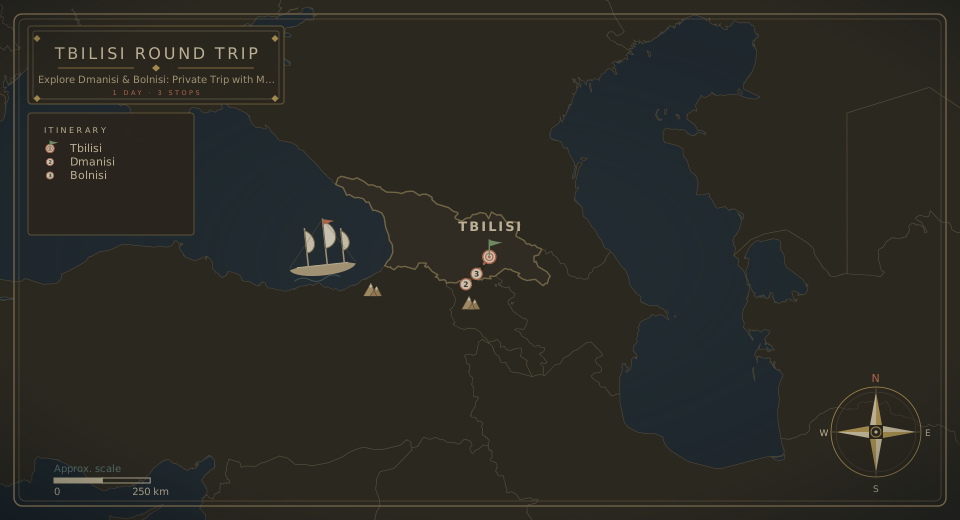
Tour route map
Round trip from Pickup service provided in Tbilisi. 3 cities · 10 Hours

The fine print

Trip details

What's Included

  • ✔Private transportation with A/C
  • ✔Private English speaking guide
  • ✔Lunch & Wine tasting
  • ✔All entrance tickets
  • ✔WiFi on board
  • ✔Bottled water

Know before you go

  • Not wheelchair accessible
  • Not stroller accessible
  • Not suitable for pets
  • No public transportation nearby
  • Infants must not sit on laps
  • Infant seats unavailable

Logistics

Meeting & route

Meeting point
Pickup service provided in Tbilisi.
Tour start
Pickup service provided in Tbilisi.
Tour ends at the same location as the start point.
End of the journey

Your 10 hours finish where they began, in Pickup service provided in Tbilisi..

Watch the tourHQ film Watch the film

Create your own adventure

Can't find the perfect tour? Tailor your dream trip.

  • Tell us your destination, dates and group size.
  • Our travel experts and local guides design a tailored itinerary, just for you.
  • Enjoy your trip with peace of mind, knowing everything is taken care of.
Plan my holiday

Say goodbye to travel stress.
