India · Monuments

22-Day Rajasthan and North India Tour with desert camp and Varanasi

22 Days Round trip from Delhi Easy pace

The journey

Trip highlights
  • 01 Explore Jama Masjid's grandeur in Delhi
  • 02 Marvel at the Taj Mahal's timeless beauty in Agra
  • 03 Experience a camel ride and desert overnight in Jaisalmer
  • 04 Witness the captivating Khajuraho Group of Monuments
  • 05 Attend the mesmerizing Aarti ceremony on the Ganges in Varanasi

Enjoy a comprehensive 22-day journey through Delhi, Rajasthan, Agra, Gwalior, Orchha, Khajuraho, and Varanasi, covering some of North India's most significant destinations. Explore landmarks such as Jama Masjid in Delhi, the Taj Mahal in Agra, and the Khajuraho Group of Monuments, while also experiencing a camel ride and overnight stay in the Jaisalmer desert. The tour also includes heritage forts, palaces, temples, markets, and the captivating Aarti ceremony on the Ganges River in Varanasi.

Indulge in stargazing as a million stars shine brightly through the cold, clear skies above the dunes.

From the itinerary

At a glance

What this trip includes

Duration 22 Days
Tour type Private
Activity level Easy
Accommodation Included · Standard
Transport Included
Wheelchair access No
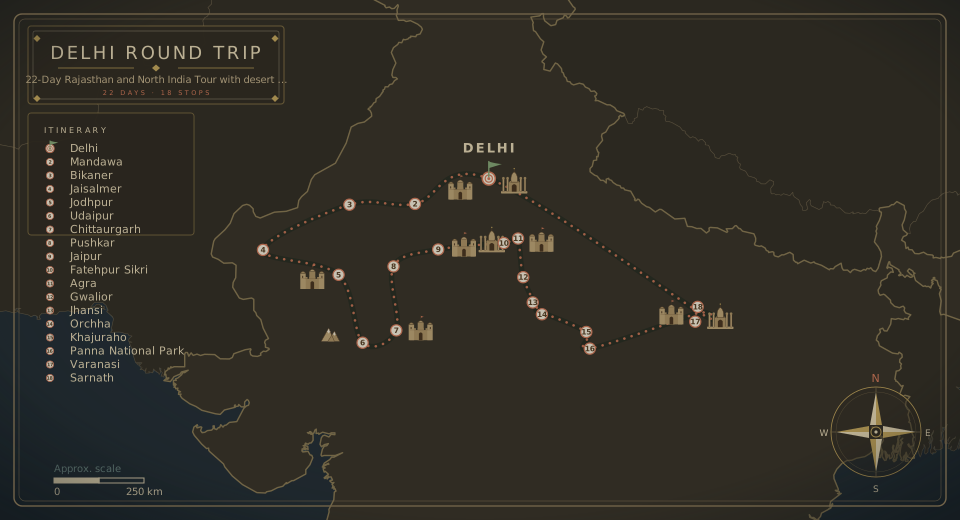
Cities Delhi, Gwalior, Jaipur, Jodhpur, Bikaner, Udaipur, Chittaurgarh, Agra, Varanasi, Jhansi, Khajuraho, Jaisalmer, Pushkar, Orchha, Fatehpur Sikri, Sarnath, Mandawa, Panna National Park
Languages English

Day by day

The itinerary

1
Day 01

Arrival in Delhi and Hotel Transfer

  • Meet the guide in Delhi and transfer to the hotel.
  • Enjoy the rest of the time at leisure.

Overnight stay in a Delhi hotel.

2
Day 02

Delhi to Mandawa and Heritage Haveli Visit

  • Visit Harlalka Well. The history of Harlalka Well is generally not known by many even today. This destination is just a few steps away from the haveli of Murmuria and is a very rustic and beautiful place. Go up with a camel ramp towards the well. Please note that you have to be very careful, as there are no guard railings to prevent a fall. The well is very deep and is still filled with enough water. This is one of the places where you can relax and enjoy some peace.
  • Go to Gulab Rai Ladia Haveli, which is considered the most palatial mansion of Mandawa. It is an exceptional piece of art and architecture for all its exotic imagery. Even today, the haveli is known for holding its charm and vintage appeal.
  • Later, visit the Mandawa market.

Overnight stay in an old haveli.

3
Day 03

Mandawa to Bikaner and Junagarh Fort

  • Visit Junagarh Fort, which was built by a Mughal army general, Raja Rai Singh, in 1593. The courtyard of the fort, along with the balcony, kiosks, and windows, are perfect examples of the artisanship of that time. The beautiful cutwork and dots on the red stones and the marbles are fascinating. The various parts of the palace - the Dewan-i-Khas, the Phool Mahal, Hawa Mahal, Badal Mahal, and Anup Mahal - reflect the glorious architecture of Bikaner.
  • Go to the Rat Temple (Karni Mata Temple), a famous 600-year-old temple situated 30 km from Bikaner in Deshnok. It is dedicated to Karni Mata, an incarnation of Goddess Durga. The temple has huge intricately carved silver gates that were donated by Maharaja Ganga Singh.
  • In the evening, visit the market.

Overnight stay at a Bikaner hotel.

4
Day 04

Bikaner to Sam Desert via Kuldhara Village

  • Visit Kuldhara Village, an abandoned village in Jaisalmer established around the 13th century. Over the years, Kuldhara acquired a reputation as a haunted site, and the Government of Rajasthan decided to develop it as a tourist spot in 2010.
  • Head to Sam Sand Dunes for an evening jeep safari and a camel safari in the desert. Witness the unparalleled views of the sunset over the tall sand dunes located at a distance of 40 km from the Golden City of Jaisalmer.
  • Enjoy music and dance performances by local artists that reflect the rich culture of Rajasthan. Satisfy your taste buds with delicious, authentic local cuisine served at the Sam Dunes. Indulge in stargazing as a million stars shine brightly through the cold, clear skies above the dunes.

Overnight stay in a desert camp.

5
Day 05

Jaisalmer Forts, Havelis and Bada Bagh

  • Visit Jaisalmer Fort, situated in the city of Jaisalmer. It is believed to be one of the very few "living forts" in the world, as nearly one-fourth of the old city's population still resides within the fort. For the better part of its 800-year history, the fort was the city of Jaisalmer.
  • Head to Patwa Havelis, a cluster of five havelis aligned in a narrow lane in the heart of the city. Of the five havelis, the first haveli in the lane, also known as Kothari's Patwa Haveli, is not only extraordinarily preserved and restored but is also open to visitors to experience the lifestyle of the erstwhile Patwas.
  • Then go to Nathmalji ki Haveli, which was constructed by Maharawal Berisal in 1885 CE to serve as the residence of Diwan Mohata Nathmal, the then Prime Minister of Jaisalmer. The chief architects of this haveli were two brothers named Hathi and Lulu. There is a very interesting story regarding its construction. It is believed that both brothers started building the facets of the haveli simultaneously. The two sides are similar, but not identical.
  • Move to Salim Singh ki Haveli, an architecturally notable residence built in 1815 with a peacock-shaped roof and numerous balconies.
  • Stop by Bada Bagh, also called Barabagh, a garden complex located about six kilometers north of Jaisalmer. Overlooking a mango grove sits a set of royal chhatri cenotaphs constructed by the Maharajas of the Jaisalmer State in the 18th, 19th, and early 20th centuries.

Overnight stay in a Jaisalmer city hotel.

6
Day 06

Jaisalmer to Jodhpur and Clock Tower Market

  • Visit the Clock Tower, a popular landmark in the old city. The vibrant Sardar Market is close to the tower, and narrow alleys lead from here to a bazaar selling vegetables, spices, Indian sweets, textiles, silver, and handicrafts.

Overnight stay at Jee Ri Haveli hotel in Jodhpur.

7
Day 07

Jodhpur Forts, Memorials and Palace

  • Visit Mehrangarh Fort. The 5-km-long majestic fort on a 125 m high hill is one of the most impressive and formidable structures. Although invincible from the outside, the fort has four gates approached by winding roads. Within the fort are some magnificent palaces with marvellously carved panels, latticed windows, and evocative names.
  • Go to Jaswant Thada. The imposing white marble memorial marks the site of the royal crematorium. It houses portraits of successive rulers. The four cenotaphs around it commemorate notable acts of bravery and generosity of the four successive rulers.
  • See Umaid Bhawan Palace, a fabulous building that is split between the museum and a 5-star hotel. The museum is interesting, and attached is a small collection of vintage cars that you can see.

Overnight stay in Jodhpur at Jee Ri Haveli hotel.

8
Day 08

Drive to Udaipur via Ranakpur and Kumbhalgarh

  • In the morning, drive to Ranakpur Jain Temple. The Ranakpur Temple complex comprises 1,444 intricately carved pillars, 24 pillared halls accompanied by 80 domes borne by 400 columns. The apogee of this entire temple architecture is the fact that no two pillars here are the same. The temple structure has five spires, each of which houses a shrine underneath, and it is under the largest spire in the axis of the main entrance, the Chaumukha Shrine, that one can locate the 6-foot-tall statue of Lord Adinath. Another exquisite aspect that has also earned the temple its name is the carving of the four-headed image of Adinath, sheltered by a 108-headed snake with numerous tails. The four heads face four directions, suggesting the pursuit of the Tirthankaras.
  • Then go to Kumbhalgarh Fort. It has the second-largest wall after the Great Wall of China - it is none but Kumbhalgarh Fort in Rajasthan. The mighty fort is 3,600 ft tall and 38 km long and surrounds the area of Udaipur. It is considered to have been built by Rana Kumbha in the 15th century. The fort is further declared a UNESCO World Heritage Site under the group Hill Forts of Rajasthan. It is located strategically on the western Aravalli hills.

Overnight stay at a Udaipur hotel.

9
Day 09

Udaipur Palaces, Gardens and Folk Dance

  • Visit the City Palace, a palace complex situated in the city of Udaipur. It was built over a period of nearly 400 years, with contributions from several rulers of the Mewar dynasty.
  • Then go to Saheliyon Ki Bari, laid out for a group of forty-eight maidens. This garden is located on the banks of Fateh Sagar Lake, presenting a green retreat in the drylands of Rajasthan. It was built from 1710 to 1734 by Maharana Sangram Singh for the royal ladies.
  • Move to Jagdish Temple, a world-renowned temple of Lord Vishnu. This three-storey and 79-foot-high temple was built by Maharana Jagat Singhji in 1651 and cost 1.5 million rupees. It is owned and managed by the royal family of Udaipur.
  • See the Lake Palace and Dudh Talai located on the banks of Lake Pichola near the City Palace. Enjoy the beautiful view of Lake Pichola, Jagmandir Island Palace, Lake Palace, Udaivilas, The Leela Palace, the gorgeous Aravalli ranges, and Udaipur old city.
  • Head to Bagore ki Haveli and, in the evening, watch the "Dharohar" folk dance show at Bagore-ki-Haveli. This gorgeous 18th-century haveli has been converted into a museum showcasing Mewar art and architecture. The haveli puts on one of the best Rajasthani folk dance shows in Rajasthan. For an hour, performers dance to Rajasthani folk music wearing bright-coloured ethnic dresses. The dances are varied and demonstrate the tradition and culture of Rajasthani folklore.

Overnight stay at a Udaipur hotel.

10
Day 10

Udaipur to Pushkar via Chittorgarh Fort

  • Visit Chittorgarh Fort, the largest fort in India. It is a UNESCO World Heritage Site. The fort was the capital of Mewar and is located in the present-day town of Chittor. It sprawls over a hill 180 meters in height over an area of 280 ha (691.9 acres) above the plains of the valley drained by the Berach River. The fort has several historical palaces, gates, a temple, and two prominent commemorative towers.
  • Then head to Pushkar. The creation of Pushkar Lake as an artificial lake is also credited to the 12th century, when a dam was built across the headwaters of the Luni River. The 10th Sikh guru, Guru Govind Singh (1666-1708), is said to have recited the Sikh sacred text Guru Granth Sahib on the banks of the lake.

Overnight stay in a Pushkar hotel.

11
Day 11

Pushkar Temple Visit and Drive to Jaipur

  • Go to Pushkar, best known for its Brahma Temple.
  • After that, head to Jaipur.
  • Visit Chokhi Dhani.

Overnight stay at a Jaipur hotel.

12
Day 12

Jaipur Forts, Palace and Observatory

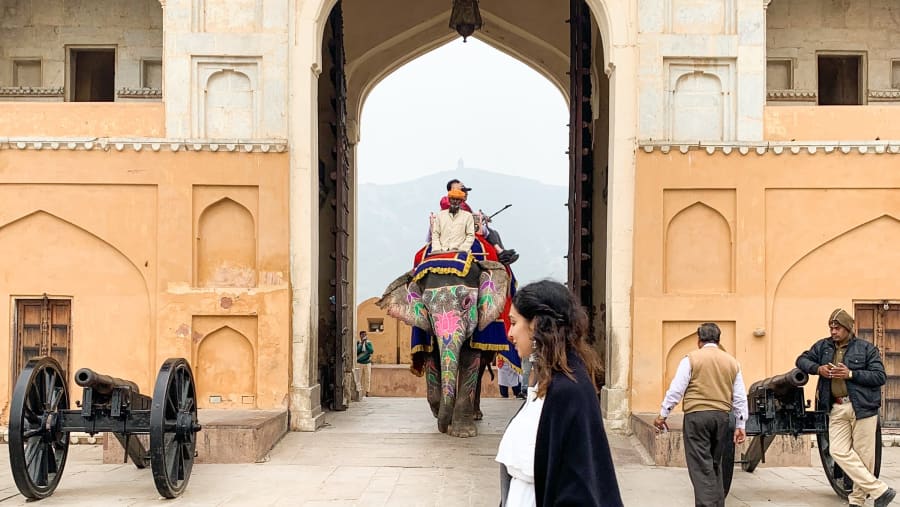
  • In the morning, visit Amber Fort, situated on the top of the hill. Amer Fort is located in Amer. It was built by Raja Man Singh I and is known for its artistic elements. The Maota Lake located in front of the monument acts as a source of water for the fort.
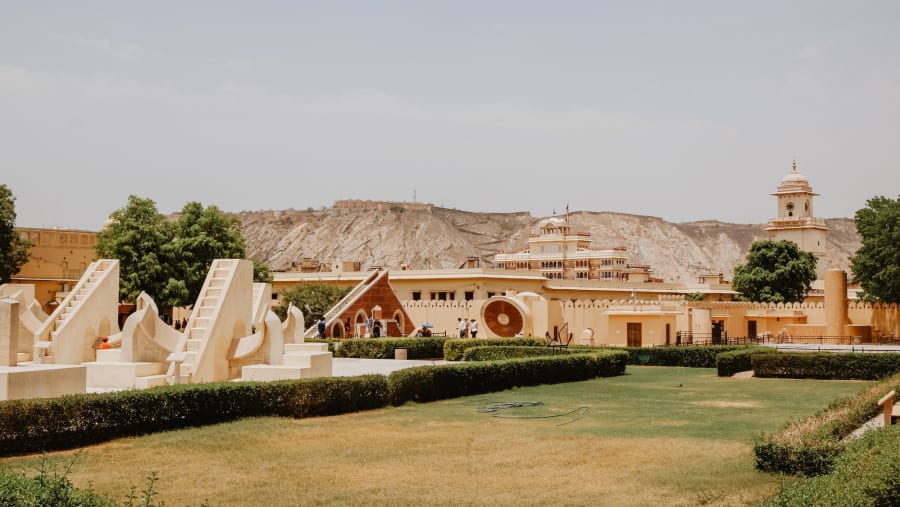
  • Head to Jantar Mantar, a UNESCO World Heritage Site built in 1734. It is a collection of nineteen architectural astronomical instruments built by the Rajput king Sawai Jai Singh II, the founder of Jaipur. The instruments allow the observation of astronomical positions with the naked eye.
  • Move to City Palace and spend one hour exploring Maharaja's City Palace. The City Palace of Jaipur was originally the administrative and ceremonial seat of the Maharaja of Jaipur, constructed in 1721. It was also the location of religious and cultural events that took place at that time. It now houses the Maharaja Sawai Man Singh II Museum and continues to be the home of the Jaipur royal family.
  • See Jal Mahal, 6 km on the way to Amer. This small palace is set in the middle of Man Sagar Lake. Renovation around the lake is in progress.
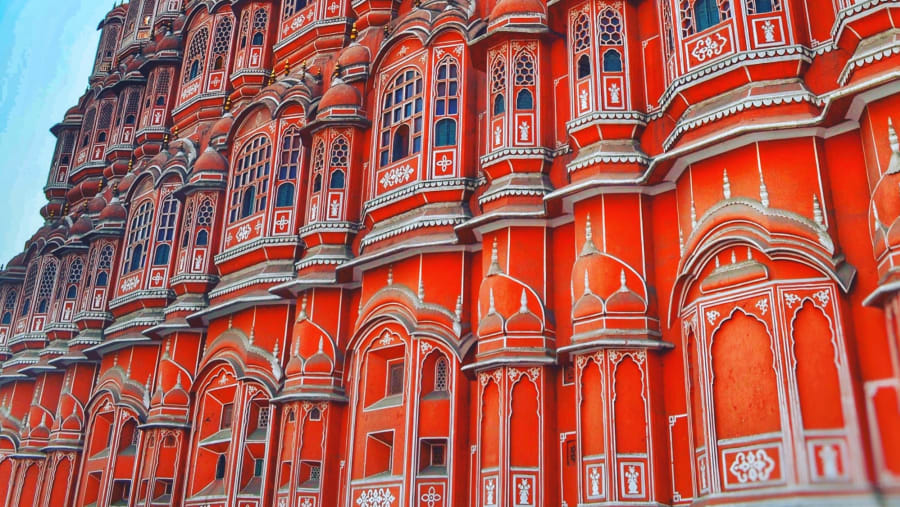
  • Stop by Hawa Mahal, also famous by the name "The Palace of Winds" or "The Palace of Breeze." Built from red and pink sandstone, the palace sits on the edge of the City Palace, Jaipur, and extends to the Zenana, or women's chambers.
  • In the evening, free for leisure and marketing.

Overnight stay in a Jaipur hotel.

13
Day 13

Jaipur to Agra via Chand Baori and Fatehpur Sikri

  • Visit Chand Baori, built during the 8th and 9th centuries, with 3,500 narrow steps arranged in perfect symmetry that descend 20 m to the bottom of the well.
  • Head to Fatehpur Sikri, a small city in northern India just west of Agra, founded by a 16th-century Mughal emperor. Red sandstone buildings cluster at its center. Buland Darwaza gate is the entrance to Jama Masjid mosque. Nearby is the marble Tomb of Salim Chishti. Diwan-E-Khas hall has a carved central pillar. Jodha Bai's Palace is a mix of Hindu and Mughal styles.
  • In the evening, visit the old Agra market.

Overnight stay in an Agra hotel.

14
Day 14

Agra Fort and Taj Mahal Exploration

  • Visit the Taj Mahal, an ivory-white marble mausoleum on the southern bank of the river Yamuna in the Indian city of Agra. It was commissioned in 1632 by the Mughal emperor Shah Jahan to house the tomb of his favourite wife, Mumtaz Mahal. It also houses the tomb of Shah Jahan himself.
  • Then head to Agra Fort, a historical fort in the city of Agra in India. It was the main residence of the emperors of the Mughal Dynasty until 1638, when the capital was shifted from Agra to Delhi. Before capture by the British, the last Indian rulers to have occupied it were the Marathas.
  • The rest of the time is free for leisure.

Overnight stay at an Agra hotel.

15
Day 15

Agra to Gwalior and Palace Museum Visit

  • Go to Gwalior Fort, known as "The pearl among fortresses in India." The impenetrable Gwalior Fort has witnessed many wars and events. Standing tall atop a rocky mountain, this architectural marvel spreads over an area of 3 sq. km and is visible from all corners of the city. There are several attractions inside the fort, including palaces, temples, and water tanks, and it might take almost a day to explore the place.
  • Then visit the Jai Vilas Palace Museum, which is only 650 meters from Moti Mahal. Jai Vilas Palace is a grand structure built by Jayaji Rao Scindia in 1874. The building has European-style architecture and is quite famous for its Durbar Hall, which is adorned with some of the grandest chandeliers in the world and a huge carpet that took nearly 12 years to weave. The rooms in the palace have been converted into a museum and exhibit furniture, paintings, sculptures, decorative art, textiles, and more collected by the royal family.
  • Visit Sarafa Bazar. From jewellery to handicrafts and textiles, Sarafa Bazar is a must-visit place for shopaholics. It is one of the oldest and most famous markets in Gwalior. You can buy lacquer work, chanderi silk, home decor, handmade carpets, and vases with intricate designs here at unbelievable prices. Don't forget to try pani puri and other lip-smacking street food at the market.

Overnight stay at a Gwalior hotel.

16
Day 16

Gwalior to Orchha via Jhansi Fort

  • Visit Jhansi Fort, built by Raja Bir Singh Deo of Orchha in 1613 CE and serving as a stronghold of the Chandela Kings from the 11th to 17th century AD. In the 18th century, Jhansi served as the capital of the Maratha province and later the Princely State of Jhansi from 1804 to 1853 CE. The fort was the residence of the great Rani Lakshmi Bai of Jhansi, who fought the British East India Company during the 1857 War of Independence. This fort has been a witness to the fiery battle led by Rani Lakshmi Bai. During the mutiny, the queen and her army fought fiercely for two weeks.
  • Orchha: The historic town of Orchha, nestled on the banks of the river Betwa, was founded in the 16th century by the Bundela Rajput Chief, Rudra Pratap. Here, the river Betwa splits into seven channels, also called the Satdhara. Legend goes that this is in honour of the seven erstwhile Chiefs of Orchha. The ancient town seems frozen in time, with its many monuments continuing to retain their original grandeur even to this day. Here you will find some of the most fascinating temples and palaces that will help you realise a childhood fantasy - travelling back in time. You can see Raja Mahal, Rai Praveen Mahal, Ram Raja Temple, Chaturbhuj Temple, Orchha Fort, and more.
  • Overnight stay in an Orchha hotel.
17
Day 17

Orchha to Khajuraho and Temple Show

  • Visit Khajuraho Temple, best known for its rich historical charm. Khajuraho showcases some of the best and most ancient temples in the world. Essentially a group of Hindu, Jain, and Buddhist temples, the Khajuraho Group of Monuments enjoys fame for stunning nagara-style architecture and erotic sculptures that grace the temples.
  • Attend the Sound and Light Show near the Western Group of Temples.

Overnight stay at a Khajuraho hotel.

18
Day 18

Panna National Park Excursion from Khajuraho

  • Visit Panna National Park, located in the Chhatarpur district of Madhya Pradesh. Panna National Park is the state's 5th tiger reserve and the country's 22nd. Several wildlife species call this national park their home, including cheetah, langur, jackal, chinkara, and wild boar. Birds like the honey buzzard, king vulture, Indian vulture, hawk-eagle, and many more are sheltered in its lush green drapes.

The rest of the day is free for leisure.

Overnight stay at a Khajuraho hotel.

19
Day 19

Flight to Varanasi and Sacred Ghats Tour

  • After breakfast, enjoy some time at leisure. Later, get transferred to the airport for the flight to Varanasi.
  • Upon arrival in Varanasi, transfer to the hotel for check-in.
  • Drive 14 kilometers from the city center to Ramnagar Fort. The 18th-century sandstone fort and palace is no longer used as a defensive structure but instead houses a quirky museum brimming with vintage automobiles, elaborate hookahs, antique weapons, sedan chairs decked out in jewels, and a one-of-a-kind astronomical clock that is more than 150 years old.
  • See Dhamek Stupa, situated 12 kilometers away in the village of Sarnath. Here, find the Dhamek Stupa, a massive stone and brick structure that is 43.6 meters tall and 28 meters in diameter. The stupa was built more than 1,500 years ago as a replacement for a structure that dated back to 249 BCE.
  • Go to Dasaswamedh Ghat and experience the lively atmosphere of the ghat.
  • Head to Manikarnika Ghat and see the perpetual cremations that happen on this ghat. Hindus believe that Manikarnika Ghat is one of the most auspicious places for the departed to reach moksha, or emancipation from the cycle of spiritual rebirth. The funeral pyre at this ghat burns 24/7, and around 100 cremations take place every day.
  • See Assi Ghat, the city's southernmost main ghat. Assi Ghat's star attraction is a Shiva lingam beneath a sacred fig tree. It draws hundreds of pilgrims every day who come to worship Lord Shiva after rinsing in the Ganges River.

Overnight stay in a Varanasi hotel.

20
Day 20

Varanasi Temple Visit and Flight to Delhi

  • Visit Shri Kashi Vishwanath Temple. The impressive structure, dedicated to the Hindu deity Shiva, has earned the nickname "The Golden Temple" for its striking spire - plated in some 800 kilograms of pure gold. The distinctive design of this temple has gone on to inspire the architecture of hundreds of other temples across India.
  • Pickup from Delhi Airport and transfer to the hotel. In the evening, visit Connaught Place.
  • Visit Connaught Place, a frenetic business and financial hub centred on a ring of colonnaded Georgian-style buildings with global chain stores, vintage cinemas, bars, and Indian restaurants. Stalls at Janpath Market sell saris, embroidered bags, and trinkets. The peaceful Sikh temple Gurdwara Bangla Sahib is known for its reflecting pool, and Jantar Mantar is a 1700s observatory with huge astronomical instruments.

Overnight stay at a Delhi hotel.

21
Day 21

Delhi Monuments and Mughal Heritage

  • Visit the Red Fort. Shah Jahan constructed the Red Fort in 1639. It was the main residence of the Mughal Dynasty and is located in the city center. It is made from red sandstone, and that is where it gets its name. It became a UNESCO World Heritage Site in 2007.
  • Head to Qutub Minar, a five-storey tapering tower with a height of 73 meters. The spiral staircase in this minaret has 379 staircases. It is a UNESCO World Heritage Site and is visited by many every day.
  • See Jama Masjid, one of the largest mosques in the country. Jama Masjid is made of red sandstone and marble. It was constructed by Shah Jahan and is visited by hundreds of people every day. The mosque's courtyard can accommodate about 25,000 people and was built for about one million Indian rupees.
  • Visit Humayun's Tomb, the tomb of the Mughal Emperor Humayun in Delhi, India. The tomb was commissioned by Humayun's first wife and chief consort, Empress Bega Begum, in 1558 and designed by Mirak Mirza Ghiyas and his son, Sayyid Muhammad. Persian architects were chosen by her.
  • Head to Raj Ghat, a memorial dedicated to Mahatma Gandhi. Raj Ghat is situated in Delhi. It is a black marble platform open to the sky, and an eternal flame burns at one end. It is a great place to learn more about the history of the country.

Overnight stay at a Delhi hotel.

22
Day 22

Lotus Temple, Chandni Chowk and Departure

  • After breakfast, visit the Lotus Temple. Famous for its flower-like shape, the Lotus Temple is a house of worship and open to all. Having won numerous awards, this place is a prominent attraction for all.
  • Head to Chandni Chowk and enjoy a cycle rickshaw ride through Chandni Chowk and Khari Baoli Spice Market, a busy shopping area with markets full of spices, dried fruit, silver jewellery, and vivid saris. At the same time, the narrow side streets are crowded with tiny shops selling essential oils, stationery, and traditional Indian sweets.
  • In the evening, drop off at Delhi Airport or any desired location.
Taj Mahal, Sam Sand Dunes, Mehrangarh Fort, Dasaswamedh Ghat

Where this trip takes you

Taj Mahal, Sam Sand Dunes, Mehrangarh Fort, Dasaswamedh Ghat

The route
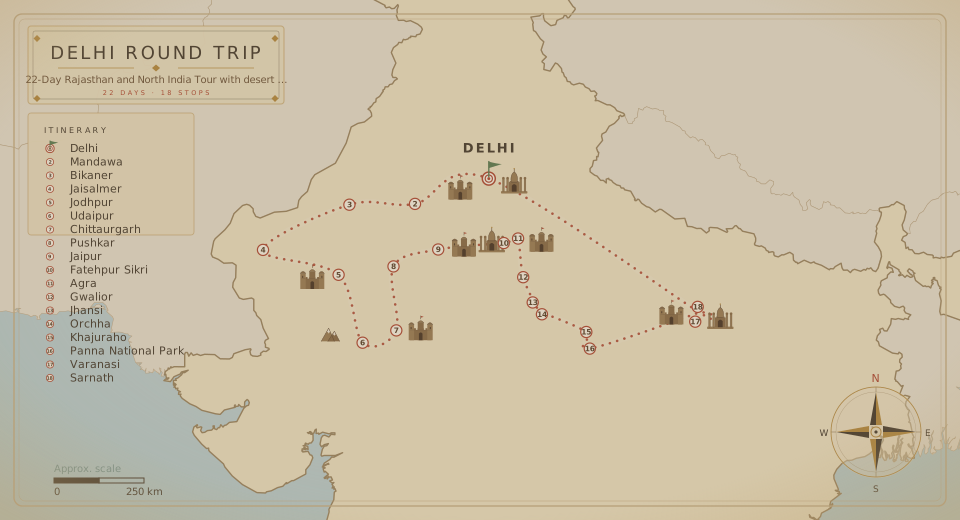
Where you'll travel

Tour route map
Round trip from Delhi 18 cities · 22 Days

The fine print

Trip details

What's Included

  • Breakfast
  • Private air-conditioned transport
  • Camel safari
  • Jeep safari
  • 1 night in desert accommodation with a gala dinner
  • Sightseeing
  • Hotel accommodation
  • Toll tax, parking, and fuel
  • Pick-up and drop-off

What's Not Included

  • Lunch and dinner
  • Any type of monument charges
  • Any type of drinks
  • Any type of personal expenses
  • Flight ticket from Khajuraho to Varanasi
  • Flight ticket from Varanasi to Delhi

What to bring

  • Camera

Logistics

Meeting & route

Meeting point
Delhi, India
Tour start
Delhi, India
Tour ends at the same location as the start point.
End of the journey

Your 22 days finish where they began, in Delhi.

Watch the tourHQ film Watch the film

Create your own adventure

Can't find the perfect tour? Tailor your dream trip.

  • Tell us your destination, dates and group size.
  • Our travel experts and local guides design a tailored itinerary, just for you.
  • Enjoy your trip with peace of mind, knowing everything is taken care of.
Plan my holiday

Say goodbye to travel stress.

Starting from

INR 150,000 /person
Book This Tour

Estimated room rates

Single Room ₹150,000.00 — ₹180,000.00
Double Sharing ₹150,000.00 — ₹180,000.00

When

Travellers

Total