

Day 01
Arrival in Ashgabat
Arrive at Ashgabat International Airport, where you will be met by our representatives and transferred to the hotel.
Enjoy some free time.


Explore the world with tourHQ
Iran, Turkmenistan · UNESCO Heritage Sites
The journey
Embark on a journey through Turkmenistan, a land of ancient traditions, rich history, and stunning landscapes. Visit the extravagant Turkmenbashy Ruhy Mosque, one of the largest mosques in Central Asia, explore Ashgabat's striking landmarks, and gain insights into the historical significance of this Silk Road hub. Discover UNESCO-listed sites such as Nissa, Merv, and Kunya Urgench, and witness the spectacular sight of the burning Darwaza gas crater in the Karakum Desert.
Embark on a journey through Turkmenistan, a land of ancient traditions, rich history, and stunning landscapes.
From the itinerary
At a glance
Day by day
Arrive at Ashgabat International Airport, where you will be met by our representatives and transferred to the hotel.
Enjoy some free time.
Eat breakfast at the hotel.
Go on a morning drive to visit Nissa Fortress - the Sanctuary of Parthian Kings. UNESCO declared the fortress a World Heritage Site in 2007. Nissa is described as one of the first capitals of the Parthians. It was founded by Arsaces I (reigned c. 250 BC - 211 BC) and is the royal necropolis of the Parthian Kings. However, it has neither been established that the fortress at Nissa was a royal residence nor a mausoleum. The ruins of the ancient settlement of Nissa are located 18 km from Ashgabat in Bagyr village.
Drive to visit Turkmenbashy Ruhy Mosque in Kipchak, the largest mosque in Central Asia.
Have an Ashgabat city tour, where you will see the Presidential Palace, Ruhyyet Palace, Wedding Palace, the modern "Yildyz" Hotel, Ferris Wheel, Constitution Monument, Arch of Neutrality, Monument and Park of Independence, Ertogrul Gazy Mosque, and the Ashgabat 2017 sports and housing facilities.
Overnight at a hotel.
Eat breakfast at the hotel.
Go on a morning drive to Mary. You will also see the ruins of Seyitjemalledin Mosque in Anau. The mosque was built in 1456 when Abu-ibn-Kasim Baber Bahadurkhan ruled Khorasan (1446 - 1457). Construction of the mosque was financed by Bahadurkhan's vizier, Muhammed Hudaidot, who also selected the construction site - near the grave of his father, Sheikh Jemaleddin, a native of Anau. The square central hall, with sides of 10.5 meters, was crowned with a dome. During later periods, the Seyit-Jemaleddin Mosque was partially reconstructed. By the nineteenth century, land subsidence had already heavily damaged the building, and during the 1948 Ashgabat earthquake, it was destroyed completely. Now, only the lower parts of the portal and some fragments of the walls remain.
On the way, visit Abiwerd, once an important trading town of North Khorasan. It was a critical link on the Great Silk Road between Nisa and Merv and also enjoyed ties with Nishapur, across the Kopetdag Mountains to the south.
Drive to Merv to explore ancient Merv - the "Queen of the world" - which was one of the most important capitals of Islam, along with Baghdad, Cairo, and Damascus. Sightseeing in ancient Merv includes Greater Kyz Gala and Lesser Kyz Gala (VI-VII), the Complex of Askhabs (VIII-XIV), Erk Gala (VI BC), Gyaur Gala (IV BC), Hoja Yusup Hamadani Complex, Sultan Sanjar Mausoleum, and Muhamed Ibn Zeid Mausoleum.
Transfer to Mary Airport after sightseeing for the flight back to Ashgabat.
Arrive in Ashgabat.
Accommodation and overnight at a hotel.
Savour breakfast at the hotel and enjoy your free time.
Go for an afternoon drive to the Darwaza burning Gas Crater (268 km), dubbed by locals as "The Door to Hell". The Darwaza area is rich in natural gas. While drilling in 1971, Soviet geologists tapped into a cavern filled with natural gas. The ground beneath the drilling rig collapsed, leaving a large hole with a diameter of 70 meters. To avoid poisonous gas discharge, it was decided that the best solution was to burn it off. Geologists had hoped the fire would use all the fuel in a few days, but the gas still burns today.
Cross the Karakum Desert en route, and stop in the small desert village of Erbent.
Watch the spectacular and fascinating view of the gas crater in the evening.
Eat a BBQ dinner at the Gas Crater.
Overnight in camp.
Eat a picnic-style breakfast at the Gas Crater.
Leave for a morning drive to Kunya Urgench.
Enjoy a sightseeing tour in Kunya Urgench: visit the Portal of Caravansaray, Mamun Minaret, II Arslan Mausoleum, Sultan Tekesh Mausoleum, Academy of Horezm, Kutlug Timur Minaret, and Turabek Hanum Mausoleum.
Drive to Dashoguz city.
Accommodation and overnight at a hotel.
Eat breakfast at the hotel.
Transfer to Dashoguz Airport for the morning flight to Ashgabat.
Arrive in Ashgabat and drive to Nokhur mountain village. The village itself fills a small depression valley in the mountains of the Kopet Dag Range, and the houses are built with local boulders cemented with mud. Apart from the main street through the middle of the town, the streets are so narrow that they only fit a car between the high stone retaining walls on each side. The Nokhuri people who populate this remote mountain village differ from other Turkmen tribes. They live in a handful of villages in the mountainous border area spanning Turkmenistan and Iran; Nokhur is the largest village, with just a thousand or maybe two thousand people.
Drive to Kowata Underground Lake, which is located 107 km from Ashgabat. The Turkmen name Kow-Ata means "father of caves". This underground area seems like a magnificent auditorium: the overall length of the cave is 230 m, its height reaches 20 m, and its width is at some points 57 m. The bottom of the cave is covered with lumps of dissolved limestone (stalagmites), and its warm and gushing water is clear and emerald-coloured. The water has a constant temperature of 33-37°C. You should swim in the lake.
Drive to Gokdepe Fortress, which was attacked in December 1880 by the Russian Empire Army. The siege of Gokdepe lasted 23 days, after which the city was taken by storm.
Visit Geokdepe Mosque (Saparmyrat Hajj), built in 1995 to commemorate the defeat and noted for its mint-turquoise blue-coloured roof and white marble structure.
Drive to a horse farm to see the national pride of the Turkmen people - Akhalteke horses, considered the most excellent horses in the world. Five thousand years ago, Turkmens began to breed Akhalteke horses. This unique breed was never mixed with other breeds. Such illustrious emperors as Alexander the Great and Darius I desired to own Akhalteke horses. There are over 35 beautiful horses on the farm. According to superstition, every sick person who touches an Akhalteke horse will get well soon.
Overnight at a hotel.
Eat breakfast at the hotel.
Transfer to Ashgabat International Airport.

Where this trip takes you
Darwaza gas crater, Karakum Desert, ancient Merv, Kunya Urgench
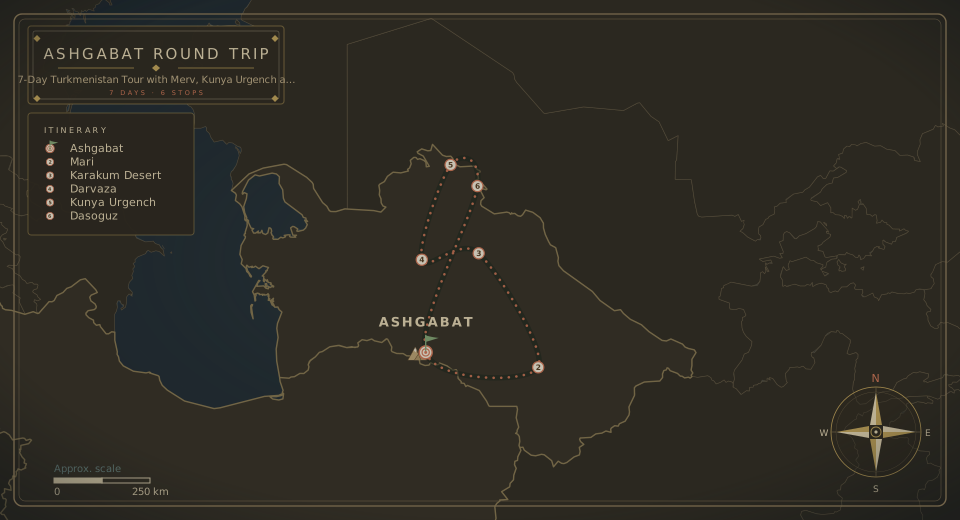
The route
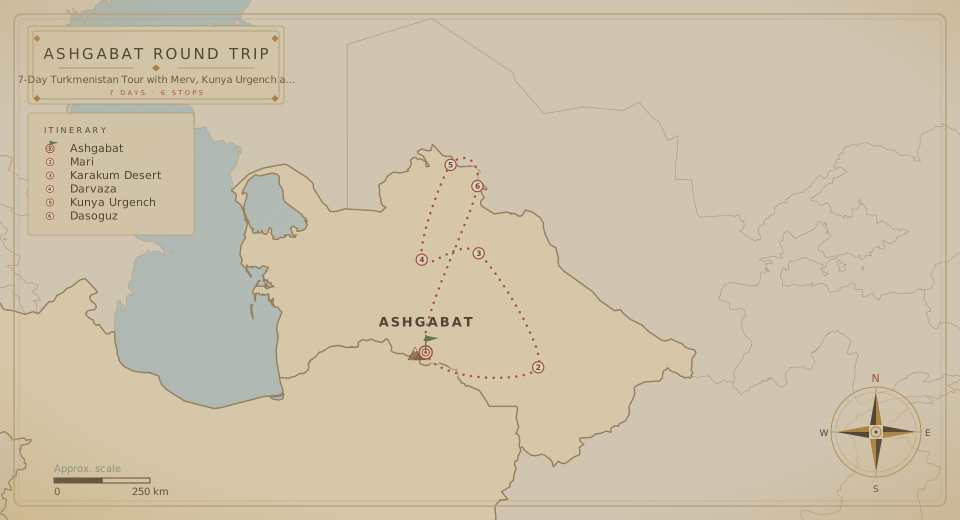
The fine print
Letter of invitation
Registration in Ashgabat city
Accommodation in rooms:
Sport Hotel 4* - 4 nights
Dashoguz Hotel 4* - 1 night
Tent stay in Darwaza - 1 night
Transportation throughout the tour
Flight tickets: Mary - Ashgabat, Dashoguz - Ashgabat
Escort: English-speaking guide service
Entrance tickets to Nissa Fortress, Kunya Urgench and Merv sites, Kowata Underground Lake, and the horse farm
Meals: BBQ dinner and breakfast at the Gas Crater
1.5 L of water per person per day
Travel tax: 2 USD per person per night
International flights
Cost of Turkmen visa and border fees
Early check-in at hotels
Payment for photo and video
Tips for the guide and driver
Medical insurance
Meals: lunch and dinner
Services not shown in the program
Logistics
Your 7 days finish where they began, in Ashgabat.
 Watch the film
Create your own adventure
Say goodbye to travel stress.
Starting from
Estimated room rates
When
Travellers
Total
—