
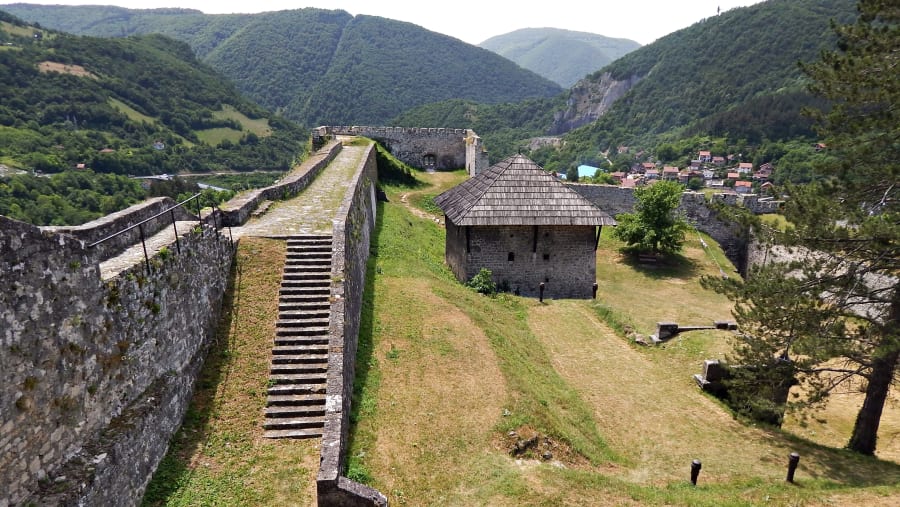
9-Day Bosnia Heritage Tour from Tuzla with UNESCO Sites and Hidden Gems

9 Days Round trip from Tuzla Easy pace

The journey

Trip highlights
  • 01 Explore medieval fortresses including Srebrenik, Doboj, Tešanj, Jajce, Bobovac, and Vranduk
  • 02 Discover UNESCO-listed and UNESCO Tentative List heritage sites across Bosnia and Herzegovina
  • 03 Visit the famous Stari Most in Mostar and wander its Ottoman Old Bazaar
  • 04 Admire scenic natural landmarks such as Ramsko Lake and Kravica Waterfalls
  • 05 Experience spiritual and monastic heritage in Medjugorje, Blagaj, Rama-Šćit, Tvrdoš, Zavala, and Dobrićevo
  • 06 Enjoy time in charming historic towns including Jajce, Počitelj, Stolac, Trebinje, Sarajevo, and Zenica

Sign up for this enchanting 9-day tour in Bosnia and Herzegovina to discover UNESCO sites and other top destinations beyond the usual tourist trail. This journey through this medieval land takes you to old towns, fortresses, monasteries, and other remarkable heritage sites, while showcasing the country's off-the-beaten-path character. Experience the Balkans safely and responsibly as you explore Bosnia's hidden gems from Tuzla.

At a glance

What this trip includes

Duration 9 Days
Tour type Private
Activity level Easy
Accommodation Included · Standard
Transport Included
Wheelchair access No
Cities Sarajevo, Tuzla, Zenica, Mostar, Doboj, Trebinje, Medjugorje, Blagaj, Jajce
Languages English, Russian, Spanish

Day by day

The itinerary

1
Day 01

Srebrenik Castle and Doboj Fortress

  • Visit the imposing Srebrenik, located on the northeastern slopes of Majevica Mountain in the village of Gornji Srebrenik. It is not only one of the most beautiful royal castles in Bosnia and Herzegovina, but also one of Bosnia's oldest and best-preserved castles. Srebrenik stood on what were once important military roads, which made it an important strategic stronghold. Dating back to 1333 and located in the far north of the country, Srebrenik was the birthplace of Bosnia's first king. The main outer walls and towers of the castle are still in excellent condition, and it still looms over the surrounding area from its prominent position on a high rock. The rock is isolated from the surrounding hills, which in the past made the castle well fortified.

  • Drive next to Doboj, a city located in Republika Srpska, an entity of Bosnia and Herzegovina. It is situated on the banks of the Bosna River, in the northern region of Republika Srpska. It is one of the oldest cities in the country and the most important urban center in northern Republika Srpska.

  • See the most visited area of the city, the freshly renovated medieval city castle, Doboj Fortress. It was built in the early 13th century on the site of an earlier clay-and-wood structure from the 10th or 11th century. Doboj Fortress now houses restaurants, shops, and medieval exhibitions of preserved weaponry and more. In the first period of its existence, from the early 13th to about the early 15th century (1415), the fortress was built in the Romanesque architectural style. While still retaining some of its original Romanesque elements, the fortress now displays a Gothic structure. Throughout its turbulent history, this magnificent stone fortress has been burned and ransacked at least 18 times, according to official records. Doboj Fortress is one of the most important cultural-historical National Monuments of Bosnia and Herzegovina.

Have one night's accommodation, so check in.

Explore this colourful city by yourself. There are plenty of restaurants, taverns, bars, and shops.

2
Day 02

Tešanj Fortress and Charming Jajce

  • Eat breakfast.

  • Go to Tešanj, a town located in the northern part of Bosnia and Herzegovina, developed around the river Tešanjka. The town dates back to 1461. The history of Tešanj was somewhat chaotic, generally speaking. Between 1463 and 1476, Tešanj was the center of the Bosnian Kingdom and the residence of Duke Radivoj Kotromanić.

  • See how the Old Town is dominated by the well-preserved fortress called Gradina, which overlooks the entire city. Very early on, this fortress became a center of the economic and cultural life of Tešanj. This developed along with retail and trade in Tešanj. The foundation of this fortification started even before the Romans conquered the region, although the exact dates are unknown. It was later enhanced by the Romans, Slavs, and Ottoman forces. It has been primarily a defensive fortification. Tešanj Castle is one of the most significant and biggest castles in Bosnia. The hour tower was built in the 17th century. Out of a total of 21 hour towers that were constructed throughout Bosnia and Herzegovina, this tower is one of four that are still working correctly.

  • Drive later to the charming Jajce, currently a candidate for being named a UNESCO World Heritage Site. Jajce is a small city located in Republika Srpska, Central Bosnia, at the confluence of the rivers Pliva and Vrbas. It is central not only geographically but also culturally. Throughout Bosnia's long history, Jajce has been the home of medieval kings, Ottoman governors, and a range of different ethnic groups, as well as being one of President Tito's earliest Communist strongholds. UNESCO has recently been investing in renovating the city's historical areas. The town is famous, among other sights, for its beautiful 22-metre (72 ft) high waterfall where the Pliva River meets the Vrbas River. The water is almost clear and a glittering bright turquoise colour. There are several excellent viewing points, the best one being the official viewing platform where visitors are close enough to feel the spray of the water.

  • Learn about Jajce Fortress, which was first built around the mid-14th century, although many alterations and additions have been made over the years. The central castle is located on top of a hill overlooking the city, and within the town there are various parts of the old fortified wall as well as gates. Also, from the castle, visitors can take in stunning views of the surrounding lush green mountains.

  • Explore the Old Town area, which is the most historic part of the city, with plenty of medieval buildings as well as some exemplary Ottoman architecture. The religious buildings to spot include St. Mary's Church, built in the 12th century and the location of the coronations of medieval kings, and the Mithraic Temple, an ancient construction dating from the 4th century that is now protected by UNESCO. Jajce itself is a small city, but its Old Town is wonderful. You will enjoy strolling around it.

  • Have one night's accommodation, and in the evening, you will have the chance to explore this gorgeous town by yourself.

3
Day 03

Ramsko Lake, Šćit Peninsula, and Mostar

  • Visit the monastery in Rama, built by the Franciscans in the 15th century and located in the middle of the scenic Ramsko Lake. It is one of thirteen monasteries referred to in 1514 in a census of the Bosnian Franciscan Province. The monastery and the church have been burned and restored several times. In the courtyard of the monastery, valuable art sculptures are installed. The beautiful Franciscan Monastery Rama-Šćit is a place full of history.

  • Admire Ramsko Lake, a hidden gem in the Herzegovina region, with a special charm in its unique shape combined with the stunning nature surrounding it. Located in a mountainous area, the lake curves around numerous hills and offers breathtaking views. The monastery and the Ethnographic Museum, located in the old monastery, are National Monuments. Visiting this monastery complex will definitely make your trip to Bosnia and Herzegovina memorable. Šćit is indeed an oasis of peace.

  • Drive to Mostar, one of the most frequented attractions in Bosnia, thanks to its outstanding natural beauty, architecture, and, of course, its famous UNESCO World Heritage Site, the Stari Most (Old Bridge). There, we'll have two nights' accommodation.

  • Explore in the evening, as usual, and walk through the cobblestone alleys of this vibrant city by yourself. Taverns and restaurants where you can sample the best of local cuisine, together with cafes, bars, and shops, line the streets.

4
Day 04

Međugorje, Kravica Waterfalls, and Počitelj

  • Visit Medjugorje, the Bosnian Lourdes, located in southwestern Bosnia and Herzegovina. The well-known Lourdes and Fatima have long held places in Roman Catholic devotion. A more recent addition to this pair of holy sites is Medjugorje. Since the Virgin Mary reputedly appeared to six local children, now adults, in 1981, the town has established itself as the premier pilgrimage destination in South-Eastern Europe. It is unsurprising, then, that Roman Catholics across the globe have become fascinated by this site, which has become a popular destination for pilgrims and is statistically considered to be the third most crucial mecca of its kind in Europe. Millions of Catholics from around the world make the pilgrimage to Medjugorje, where miracles are said to happen.

  • Go next to the beautiful Kravica Waterfalls. Although the water is crisp, the falls are suitable for swimming and fishing, with a descent of some 25 metres into a natural basin. In the meantime, the waterside restaurant offers an idyllic location for a cooling drink, delicious grilled food, and coffee.

  • Explore Počitelj, one of the most beautiful towns in Bosnia and Herzegovina. The medieval village, currently on the UNESCO Tentative List, was once of strategic importance before and during the Ottoman era, and it was protected by the Fort of Počitelj (Kula).

  • Walk along the maze of cobblestone streets through the old buildings, visit the fort that offers fantastic views over the town, and enjoy the 16th-century Hajji Alija's Mosque. Natural beauty surrounds the ancient town, making it a perfect place for a photo opportunity. Počitelj, still inhabited today, was built in the late 14th century but was expanded by the Ottomans and the Hungarians throughout its history. Certainly, Počitelj, on the banks of the Neretva River, makes a great place to visit.

  • Return finally to Mostar.

  • Have time for yourself and be able to enjoy the city's vibe to the fullest. Mostar is Bosnia's most visited city for the 16th-century Stari Most Bridge and Ottoman Old Bazaar. Mountains envelop the city, split by the clear waters of the Neretva River into the Ottoman side and a modern city center.

5
Day 05

Blagaj, Radimlja, Stolac, and Zavala

  • Go to Blagaj, currently on the UNESCO Tentative List, in the south-eastern region of the Mostar basin right after breakfast. It stands at the edge of Bišće plain. It is one of the most valuable mixed urban and rural structures in Bosnia and Herzegovina, distinguished from other similar structures by its urban layout.

  • See how within Blagaj is the famous tekija, or monastery, which was founded by Dervish monks in the 16th century. The monastery is beautifully nestled at the foot of a cliff face at the beautiful karstic spring of the Buna River. It exemplifies classic Ottoman architecture, with its wooden window frames and an overhanging roof. Now, the monastery houses a restaurant with tables looking out over the water, which makes for a picturesque and peaceful lunch setting.

  • Check out the Blagaj Fort, located a little way outside the town of Blagaj and once home to King Herceg-Stjepan. The castle is one of the largest in the region, with impressive sheer stone walls and typical medieval turrets. From the castle, visitors can look out onto beautiful views of the town and river in the valley below, which really gives a sense of the scale of the castle.

  • Next, we'll go to Radimlja, a monumental medieval tombstone (stećak) necropolis located near Stolac, Bosnia and Herzegovina. The Radimlja necropolis is one of the most valuable monuments of the mediaeval period in the country. The majority of its stećak tombstones date from the 1480s through the 16th century, as evidenced by the epitaph on one of the tombstones. The stećci lie scattered across Bosnia and Herzegovina. Appearing in the mid-12th century, with the first phase in the 13th century, the tombstones reached their peak in the 14th and 15th centuries before disappearing during the Ottoman conquest of Bosnia and Herzegovina in the very early 16th century. Stećci were inscribed as a UNESCO World Heritage Site in 2016. It includes a selection of 4,000 stećci at 28 necropolises, of which 22 are from Bosnia and Herzegovina, two from Croatia, three from Montenegro, and three from Serbia.

  • Finish sightseeing at one of the best-preserved collections of these tombstones, and we'll go to Stolac, currently on the UNESCO Tentative List and one of Herzegovina's oldest towns. It has an Ottoman center (Carsija), a Roman castle, and craggy mountains surrounding the historical town. The adorable Bregava River, a left tributary of the Neretva River, meanders through the town center with traditional buildings on its banks. Thanks to the town's favourable natural environment, geological composition, contours, climate, hydrography, and vegetation, Stolac and its area have been settled since ancient times. Its rich hunting grounds, along with other natural benefits, attracted prehistoric man and later the Illyrians, Romans, and Slavs, all of whom left a wealth of anthropological evidence.

  • Next, we'll go to Zavala Monastery, a historical Serbian Orthodox monastery located in the village of Zavala on the southwestern edge of Popovo Polje. The northern wall of the monastery's church is situated within a cave. This monastery is also known as the place where Saint Basil of Ostrog entered monasticism. Along with Žitomislić and Tvrdoš, Zavala is one of the most important monasteries in East Herzegovina. The first written record of the monastery dates back to the sixteenth century. Located in Popovo Polje in Ravno municipality, the village of Zavala, with its old architecture and stone masonry, together with Vjetrenica Cave, constitutes a natural and architectural ensemble that is already placed on the UNESCO Tentative List.

  • Go to Trebinje, the southernmost city in Bosnia and Herzegovina, situated on the banks of the Trebišnjica River in the region of East Herzegovina. It may be the best-kept secret of Bosnia and Herzegovina. For those who are looking for places off the beaten path, Trebinje is the perfect destination. Trebinje is only 28 km (17.3 miles) from Dubrovnik, Croatia. Here, we'll have two nights' accommodation.

  • Finish the check-in procedure, and you'll have time to rest or have a stroll independently to enjoy the buzzing atmosphere of the city.

6
Day 06

Tvrdoš Monastery and Trebinje

  • Savour breakfast.

  • Go to the quaint Tvrdoš, a monastery with a long tradition of winemaking. The 15th-century Serbian Orthodox Monastery is located in a scenic setting along the right bank of the Trebišnjica River, surrounded by bountiful vines and orchards. The monastery was already well known for its winemaking in the Middle Ages. The region's wine-growing tradition dates back to the first Hellenic colonies on the Adriatic Coast. The warm and dry conditions are particularly well suited to the native grape varieties Žilavka and Vranac, which thrive in the region. The 4th-century foundations of the first Roman Basilica, built by the Roman Emperor Constantine the Great and his mother, the Empress Saint Helena, are still visible on the site. The current monastery was established during the 15th century, with a cathedral constructed around 1508. The medieval monastery remained a seat of the Metropolitans of Herzegovina until the Venetian Empire destroyed it in 1694. The current monastery building was constructed in 1924. St. Basil of Ostrog, the founder of the famous Monastery of Ostrog in Montenegro, spent part of his life here. He came from Zavala Monastery, where he entered monasticism, for further spiritual and theological studies, since Tvrdoš Monastery has been one of the most important monasteries of the Serbian Orthodox Church for centuries. Today, the monastery is renowned for its award-winning wine production, a result of centuries-old winemaking tradition, and its wine cellars, one of which dates to the 15th century and is a popular tourist attraction. The old cellar is underneath the monastery, where the best Vranac wines age in big 100-year-old monastic oak barrels. During 2006 and 2012, new cellars were built with the latest winemaking technology, but they were perfectly integrated into the existing complex.

  • Return to Trebinje to continue our sightseeing, including the historic Ottoman Arslanagić Bridge (1574) and the Hercegovačka Gračanica Monastery on historic Crkvina Hill, offering beautiful panoramic views. Note that the city's Old Town dates to the 18th-century Ottoman period. The Old Town walls are well preserved. For a lot of good reasons, Trebinje is considered one of the most beautiful cities in Bosnia and Herzegovina.

  • Use the rest of the day to relax, go shopping, rent a bike, or explore the city independently. Taverns and restaurants where you can sample the best of local cuisine, together with cafes, bars, and shops, line the streets.

7
Day 07

Dobrićevo Monastery and Sarajevo

  • Visit Dobrićevo Monastery right after breakfast. It is a Serbian Orthodox monastery built in the 13th century in the Kingdom of Serbia, in modern-day Republic of Srpska, Bosnia and Herzegovina. The monastery was built on the foundations of an earlier Roman Basilica which was, according to local legend, built in the Byzantine style by the Roman Emperor Constantine the Great and his mother, the Empress Saint Helena, just like Tvrdoš Monastery. During its history, the monastery was destroyed or damaged many times. Near Dobrićevo Monastery was Kosijerevo Monastery, on the other side of the Trebišnjica River, which today belongs to Montenegro. Like Dobrićevo, Kosijerevo Monastery has also been moved to another location. Before the relocation, Dobrićevo Monastery stood on a hill on the right bank of the Trebišnjica River, at the Herzegovina-Montenegrin border. Since there was a danger that the monastery could be flooded, the BiH National Institute for Protection of Cultural Monuments considered that, in order to save the monastery, it should be relocated. Since the monastery, together with other buildings, was in danger of ending up under water, a preservation plan was developed. Eventually, through a delicate procedure, the whole complex was relocated. Now, this shrine is located almost on the shore of Bileća Lake, another extraordinary hidden gem of southern Bosnia and Herzegovina.

  • Leave for Sarajevo, the capital and largest city of Bosnia and Herzegovina, notably marked by its period under Ottoman rule. This buzzing city, currently on the UNESCO Tentative List, lies in a valley and is surrounded by the Dinaric Alps, situated along the Miljacka River in the heart of Southeastern Europe and the Balkans. It is the administrative, political, economic, social, cultural, educational, and sports center of Bosnia and Herzegovina, as well as a prominent center of culture in the Balkans. Sarajevo is among Europe's most colourful capitals. With its religious and cultural diversity, varied architecture, illustrious past, and rich culture, Sarajevo is certainly a beautiful destination and an exciting adventure across the Balkans. Sarajevo, dubbed the "Jerusalem of Europe", will leave you wanting more. Here, we're going to have one night's accommodation.

  • Have the chance to explore this lively city by yourself in the evening, as usual. You'll soak up the bustling atmosphere while strolling the pedestrian streets and enjoying the traditional cuisine.

8
Day 08

Kraljeva Sutjeska, Bobovac, and Zenica

  • Visit Kraljeva Sutjeska, a lovely village in Bosnia and Herzegovina that hosts several important historical sites. One of them is the beautiful 14th-century Catholic Franciscan monastery. Among other exciting things, it includes a museum that houses historical treasures and a library that keeps rare and valuable historical records. The historically significant dwelling of Bosnian kings, Bobovac, is also a short distance from the castle remains and the monastery, as well as other sights of Kraljevska Sutjeska.

  • Visit the fortified Bobovac, the residence of the Bosnian kings during medieval times and the site of the mausoleum of the royals and remnants of the Kotromanić dynasty castle. The fortress was first mentioned in documents dating back to 1349. It was once even home to the crown jewels of Bosnia, since it is one of the country's most well-protected fortresses. Bobovac was also the last seat of the Bosnian rulers before the Ottomans took over in the mid-1400s.

  • Go to Zenica, a city located in the valley of the Bosna River. The place was first mentioned under its present name on March 20, 1436, in a document filed at the Dubrovnik Republic Archives. Zenica is the administrative, political, economic, cultural, and sports seat of Zenica-Doboj Canton, composed of 12 municipalities. This canton is, by the size of its population, the third largest canton in the BiH Federation, after Sarajevo and Tuzla. Here, we'll have one night's accommodation.

  • Finish the check-in procedure, and you will have time to rest or have a stroll independently to enjoy the vibrant atmosphere of the city.

9
Day 09

Vranduk and Return to Tuzla

  • Wake up on the last day of our enchanting tour in Bosnia and Herzegovina.

  • Go to Vranduk, a historic village located in the Bosna River canyon. The village itself is one of the oldest and best-preserved settlements in Bosnia and Herzegovina, dating back to the 14th century and the times of the medieval bans and later kings of Bosnia. Vranduk village is established around the medieval citadel of the same name, and together they constitute a protected architectural ensemble and, as such, a national monument of Bosnia and Herzegovina, well preserved and maintained in good condition.

  • Leave for Tuzla, our final destination. Depending on your schedule and a previous request, we'll drop you off at your hotel.

The fine print

Trip details

What's Included

  • Transport with driver

  • Transport in an air-conditioned van

  • Tour director with you at all times

  • Transportation for your group only, with no foreigners

  • Accommodation in 3-star hotels or pensions

  • Accommodation in double rooms

  • Accommodation with breakfast only

  • English-speaking driver and tour director

What's Not Included

  • Lunch and dinner

  • Accommodation in single rooms

  • Hotel tourist tax

  • Professional tour guide

  • Entry fees and tickets

  • Flight tickets

  • Ferry tickets

  • Travel insurance

  • Country visas

Know before you go

    • All-season Bosnia discovery tour of non-touristy places from Tuzla

    • Explore Bosnia and Herzegovina’s outstanding natural beauty, from emerald-green rivers to dramatic mountain landscapes

    • Discover unspoiled destinations, including mountains, caves, waterfalls, and long, winding rivers with clear water

    • Experience the country’s rich heritage through Ottoman old towns with cobblestone alleys, centuries-old mosques, and elegant Austro-Hungarian facades alongside modern cityscapes

    • Visit UNESCO sites and other top destinations on a 9-day tour from Tuzla, including historic old towns, fortresses, monasteries, and more

    • Enjoy off-the-beaten-path travel with a focus on responsible exploration away from crowded tourist areas

    • Travel in a small group for a more personal experience in peaceful villages, scenic landscapes, and remarkable natural attractions

    • Follow a Slow Tourism approach, with a relaxed pace and ample time to appreciate history, culture, landscapes, and local traditions

    • Minimum 2 participants; maximum 5 participants (group discounts may be available where applicable)

    • Itinerary can be customised to suit different travel plans, personal interests, and schedules

    • Available in English and Spanish (Disponible en español)

Logistics

Meeting & route

Meeting point
Pickup is available from any hotel or location in Tuzla or the surrounding area.
Tour start
Tuzla
Tour ends at the same location as the start point.
End of the journey

Your 9 days finish where they began, in Tuzla.

Watch the tourHQ film Watch the film

Create your own adventure

Can't find the perfect tour? Tailor your dream trip.

  • Tell us your destination, dates and group size.
  • Our travel experts and local guides design a tailored itinerary, just for you.
  • Enjoy your trip with peace of mind, knowing everything is taken care of.
Plan my holiday

Say goodbye to travel stress.

Starting from

EUR 2,027 /person
Book This Tour

When

Travellers

Total