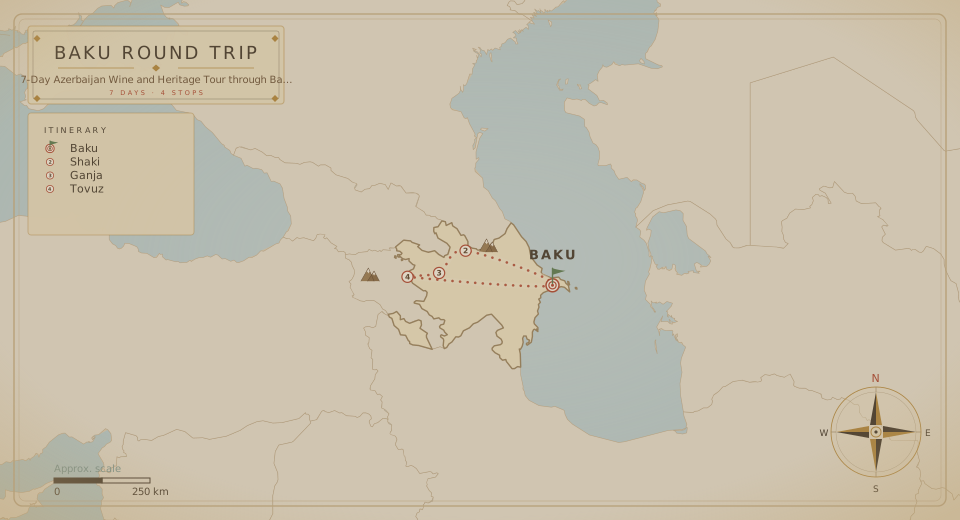
Azerbaijan is a country that preserves the ancient traditions of viticulture and winemaking. In the Tovuz region, located in the west of Azerbaijan, winemaking was developed in the 7th century. During the USSR, Azerbaijan was one of the largest wine-producing republics. On the territory of this country, more than three hundred thousand hectares of vineyards were cultivated. One of the main wineries in Azerbaijan today is the Tovuz cognac and wine factory. The company has reserves of high-quality cognac spirit aged in oak barrels of 100-year-old oak, in an amount of at least 10 thousand decalitres. There are cognac spirits whose age varies from 5 to 50 years. Stocks are constantly replenished by harvesting from their own vineyards, which cover 25 thousand hectares. Cognac, pomegranate, and quince wines produced here are successfully sold in 75 countries of the world. Visitors will have the opportunity to taste products before purchasing them. The Tovuz Baltia company presents the best names of cognacs from the Tovuz region of Azerbaijan, as well as pomegranate wines and quince wines. Cognacs are made by traditional technology from selected cognac spirits. Cognac spirits are aged in a new barrel, after which this oak packaging is no longer used. The company buys bottles for wine and cognac in the Czech Republic and France. The assortment of the company consists of cognac "Tovuz" V.S., aged at least 5 years, cognac "Tovuz" V.S.O.P. aged not less than 10 years, and cognac "Tovuz" H.O. aged from 3 to 30 years. The real pearl of the product range of the enterprise is a unique pomegranate wine, quince wine, and quince and pomegranate champagne. It is bottled under the name "Tovuz" in semi-dry and semi-sweet variants. This wine has a healing effect: it improves appetite, lowers blood pressure, increases haemoglobin level, and reduces the harmful effects of radiation. The Tovuz Baltia company considers the continuation and development of the traditional technologies of viticulture and winemaking in Azerbaijan, existing for more than ten centuries, as the main goal of its activity. The company "Tovuz Wine" has repeatedly been awarded honorary diplomas for the quality of its products.
The LLC Vinagro company was legally registered in May 2006, and one of its divisions was OJSC Gökögel Winery, a wine-making industrial enterprise combining primary and secondary branches of production. Under the Soviet economic management system, the Khanlar Agro-Industrial Complex, as it was known at that time, was focused on the production of wine and brandy products and their sales throughout the Union. The volume share of brandy produced by this enterprise amounted to about 7% of the all-Union total. After the devastation of this area during the "anti-alcohol period", the current Goygol Winery rose from the ruins. At present, it is a modern industrial enterprise combining the latest equipment and classic technology.
The road south from Xanlar winds up through the woodland picnic spots of Hacikand and onto a ridge with magnificent views of the dramatic Lesser Caucasus range, crowned by the distinctive cleft peak of Mt Kapaz. For now, the valley beyond is out of bounds. However, it contains one of Azerbaijan's most celebrated beauty spots, the gorgeous, forest-ringed Goy Gol (Blue Lake), which is slated to reopen to tourism as a new national park within the next few years. The distinctive rocky beak of Mt Kyapaz opened in the 1139 earthquake and disgorged such a mass of rock that it dammed the mountain streams in several places. The result was a string of seven idyllic mountain lakes known as the "tears of Kyapaz". The most famous are Goy Gol (Blue Lake), formerly a popular sanatorium and camping retreat, and the more secluded Maral Gol (Deer Lake). Lesser-known Zali Gol (Leech Lake) and Sara Gol (Yellow Lake) never sounded as appealing. The area is especially magnificent in autumn, when green forests are burnished yellow, auburn, and red like a pointillist painting rising from Goy Gol's still blue waters to Kyapaz's dramatic crown. The best views are part way to Maral Gol.
Mausoleum of Nizami Ganjavi: Nizami Ganjavi, born in 1141, was one of the most educated people of his time. World-renowned, he is recognized as the author of "Hamsa" (Pyateritsy), in which five poems were combined, reflecting not only the high skill of the poet's pen but also his ethical and philosophical views. Most of Nizami's lyrics are devoted to love. Other world-famous works by Nizami are the poems "Khosrov and Shirin", "Leyli and Majnun", and "Iskender-nime". To this day, the mausoleum remains a place of pilgrimage and the worship of poets. It is located at the entrance to the city from the south-west side. The tomb is a modern monumental cylindrical structure made of red granite, carved in the manner of semicircular facets. Just below is the entrance, which seems tiny against the grandeur of the whole building. The name Nizami is carved in gold right above the entrance.
Dzhavadhan Mausoleum: Not long ago, on the territory of the historical ensemble, in the courtyard of the mosque, a tomb was built on the site of the grave of the fearless ruler of Ganja, Javadkhan, who died on January 3, 1804, while protecting Ganja from foreign invaders. In the 1990s, the remains of Javadkhan were moved here from the ancient city cemetery. Construction started in 2004 and lasted several months. When it was erected, the builders adhered to the requirements of the medieval architecture school. The monument was opened in 2005 and occupied a worthy place among other monuments of the 17th century.
The remains of the once high fortress can be seen at Khansky Garden in Ganja. From its former greatness, only formless brick blocks remain. The fortress wall stretched along the entire bank of the Ganjachay River. But over time, the water, which had served as the faithful guard of the fortress, crept closer and undermined the already dilapidated walls. Once there were two powerful towers at a distance of about 600 meters from each other. The famous gates of ancient Ganja served as the gates of the fortress.
Caravan-Sarai is the third building in the ensemble of Sheikh Bahauddin. Today, the medieval caravanserai building plays the role of the Temple of Knowledge. At the end of the 20th century, the Ganja Humanitarian College was conveniently located here. The caravanserai is a two-storey building comprising 15 sections and 54 rooms. The building also houses the museum of the poetess Meskheti Ganjavi.
Chokyak-Hamam is a bathhouse consisting of two communicating rooms. In the center of the large hall are a swimming pool and a fountain intended for relaxation, while the smaller room is designed for bathing. Built from red brick, the bath has two large and five small domes. At the top of the large domes, there are half-domes that played the role of ventilation, with pipes dispersed through the space inside the walls. In winter it was hot there, and in summer it was cool. The sauna was heated with firewood. In the basement, there were two steam boilers. Steam was fed into the halls along ceramic pipes, which also passed through the walls and the floor of the bath. Steam circulated evenly and heated the entire room. This unique system of the 400-year-old bathhouse worked perfectly until 1963, and throughout those centuries the bath was very popular among the townspeople.
"Ganja is a city of Khans and Poets." Ganja, as a fabulously beautiful city, could not have appeared just like that. According to legend, it was founded on the place where the traveler Maazid found a huge treasure - pots filled with precious stones and gold. The city was named after this incredible find and several centuries later became the second most important city in Azerbaijan. By the way, the famous Great Silk Road passed through Ganja. Today, the city is participating in a project to restore this ancient trade route. Many sights of Ganja are included in the UNESCO World Heritage List.
Azerbaijani wine producer "ASK Şəki Şərab" will present its brands "Bouquet Sheki" and "Askona". Under these brands, wines are made from grapes harvested in Azerbaijan, such as Rkatsiteli, Saperavi, Madras, Muscat, Chardonnay, and Merlot. These very high-quality wines are completely Azerbaijani products made according to European technologies.
Albanian Church: According to legend, this church is the first Christian church built not only in the territory of Caucasian Albania but in the whole of Transcaucasia. This place is also remarkable because burial places of people were found on the territory of the temple, and their structure is very different from that of the current inhabitants of this region. In 2003, the church was restored with funds from the Norwegian government thanks to the personal efforts of Tour Heyerdahl. Here, next to the church territory, you can find a memorial bust in honour of the famous researcher, set up as a token of gratitude from local residents and the state.
Sheki is one of the most famous and ancient settlements of Azerbaijan. It is located 700 m above sea level and, like an amphitheatre, is surrounded by mountains. This ancient city has long been known as the center of silk and an important transit point on the Great Silk Road.
Very often Icheri Sheher is called a fortress, as it is surrounded by a well-preserved fortress wall. People lived in the territory of Icheri Sheher in the Bronze Age, and by the 8th-11th centuries it was completely populated. Behind the walls there are many unique monuments: the palace complex of the Shirvanshahs with a burial vault, a divan, and a mosque; Gyz Galasy (the Maiden's Tower); mosques and minarets; and the remains of caravanserais and baths. The buildings of the old fortress have a special character. Because of the lack of building space, structures were erected wall to wall here from ancient times. There are no gardens, and the yards are extremely small, separated by threads of narrow streets, lanes, and dead ends. When the Shirvanshahs moved their capital from Shemakha to Baku in the 15th century, massive construction began in Icheri Sheher. During this period, the pearl of the fortress, the Palace of the Shirvanshahs, was built. It should be noted that Baku in the 17th-19th centuries did not go beyond the boundaries of Icheri Sheher. Here were located the palaces of the rulers and residential quarters. From 1747 to 1806, it was the capital of the Baku Khanate. Only after the beginning of the oil boom did the city begin to expand beyond the boundaries of Icheri Sheher. The fortress wall itself is also of interest. Once Baku had two walls separated by moats, but at the beginning of the 19th century the city grew so fast that it became necessary to demolish the outer wall. Only the inner wall remained. It has 25 towers and 5 gates. They say that back in the 1930s there were more than 900 buildings in the fortress, and by the beginning of the 21st century only half remained.
Bibi-Heybat Mosque (Azerbaijan's Bibiheybət məscidi) is a mosque located on the shore of Baku Bay in Azerbaijan. The existing structure, built in the 1990s, is a reconstruction of the mosque of the same name, originally built in the 13th century by Shirvanshah Abu-l-Fath Farrukhzad and destroyed by the Bolsheviks in 1936 during the fierce struggle with religion throughout the USSR. The Bibi-Eybat complex, in addition to the mosque, includes tombs of revered people, including the grave of Ukeima Khanum, a descendant of the Prophet Muhammad. Before its destruction, and again today, it has been a spiritual center for Muslims of the East and one of the significant monuments of Islamic architecture in Azerbaijan. The mosque was once visited by Abaskuli-aga Bakikhanov, Alexander Dumas, and Khurshudbanu Natavan. The local population in the past called it "the mosque of Fatima". Using the same name, Alexander Dumas described the mosque after visiting it in the 1840s.
Holy Wives of the Myrrhbearers: During the Soviet period, the temple was one of the first to be closed in 1920. First, it served as a warehouse and then as a gym. During the January events of 1990, two shells hit the bell tower of the temple, partially destroying it: the floor sagged, the walls cracked, and the roof collapsed. In 1991, the dilapidated church building was transferred to the Russian Orthodox Church. On May 27, 2001, His Holiness Patriarch Alexy II of Moscow and All Russia performed the great consecration of the Holy Mother of God Church and conferred on it the status of a cathedral of the diocese.
Baku Boulevard, the national park sometimes called the "diamond necklace of Baku", stretches along Baku Bay for 16 km. At every time of day, the boulevard has its charm: in the morning, you can walk in silence, feel unity with nature, and do sports; during the day, especially on weekends, the boulevard comes alive thanks to the small inhabitants of the capital riding attractions, rollerblades, and bicycles; in the evening, it turns into a magical world of dreams for lovers. The original illumination of the park, fountains, and other features give the boulevard a special charm.
Wine Tour in Azerbaijan - Walking and Wine - Dervish Way.
Wine tours to Azerbaijan may at first glance look a little unusual, considering that when you hear the word wine, you more often think of France, Italy, Spain, or Georgia. However, this stereotype about Tovuz will disappear rapidly when you learn the tradition and culture of wine, and not only wine, in Azerbaijan. The fact is that Azerbaijan has very ancient wine traditions dating back to the early medieval state of Caucasian Albania, which were forgotten with the Arab conquests.
Visa upon arrival at international airports of Azerbaijan can be obtained only by citizens of Turkey, Israel, Qatar, Oman, Saudi Arabia, Bahrain, Kuwait, Japan, China, South Korea, Malaysia, and Singapore. For citizens of Russia and the CIS, except for Turkmenistan, a visa is not required for Azerbaijan. Citizens of other countries must obtain a visa prior to arrival through the consulates of Azerbaijan in their country or issue an electronic visa through travel agencies. To apply for a visa, contact the managers at least 4 weeks before arriving in Azerbaijan.
Local currency: Manat.
The recommended currencies for exchange are USD or Euro.
Where to exchange currency: Upon arrival at the airport, the guide will provide accurate information on where and how to exchange cash for local currency.
Availability of ATMs: Only in large cities.
Credit cards are accepted only in large cities.