Silk Road - Ways of the Ancient Caravans
The Silk Road is one of the most famous trade routes in the East. From time immemorial, the trade route going from east to west and vice versa has attracted many caravans and civilizations. Depending on historical events such as wars, raids, and robberies, the Silk Road changed its route but ultimately reached its final destination.
Visa upon arrival at international airports of Azerbaijan can be obtained only by citizens of Turkey, Israel, Qatar, Oman, Saudi Arabia, Bahrain, Kuwait, Japan, China, South Korea, Malaysia, and Singapore. For citizens of Russia and the CIS (except for Turkmenistan), a visa is not required for Azerbaijan. Citizens of other countries must obtain a visa prior to arrival through the consulates of Azerbaijan in their country or issue an electronic visa through travel agencies. To apply for a visa, contact the managers at least 4 weeks before arriving in Azerbaijan.
Local currency: Manat.
The recommended currencies for exchange are USD or Euro.
Where to exchange currency: Upon arrival at the airport, the guide will provide accurate information on where and how to exchange cash for local currency.
Availability of ATMs: Only in large cities.
Credit cards are accepted only in large cities.
Baku Boulevard, sometimes called the "diamond necklace of Baku", stretches along Baku Bay for 16 km. At every time of day, the boulevard has its own charm - in the morning you can walk in silence, feel unity with nature, and do sports; during the day, especially on weekends, the boulevard comes alive thanks to the small inhabitants of the capital riding attractions, rollerblades, and bicycles; in the evening, it turns into a magical world of dreams for all lovers. The original illumination of the park, fountains, and other features gives the boulevard a special charm.
The Heydar Aliyev Center is a cultural complex that includes an auditorium (congress center), a museum, exhibition halls, and administrative offices. The famous architect Zaha Hadid designed the project of the centre. Baku is a city that combines modern and ancient, traditional and unusual.
Bibi-Heybat Mosque (Azerbaijan's Bibiheybət məscidi) is a mosque located on the shore of Baku Bay in Azerbaijan. The existing structure, built in the 1990s, is a reconstruction of the mosque of the same name, originally built in the 13th century by Shirvanshah Abu-l-Fath Farrukhzad and destroyed by the Bolsheviks in 1936 during the fierce struggle against religion throughout the USSR. In addition to the mosque, the Bibi-Heybat complex includes tombs of revered people, including the grave of Ukeima Khanum, a descendant of the Prophet Muhammad. Before its destruction and again today, it has been a spiritual center for Muslims of the East and one of the significant monuments of Islamic architecture in Azerbaijan. The mosque was once visited by Abaskuli-aga Bakikhanov, Alexander Dumas, and Khurshudbanu Natavan. The local population in the past called it "the mosque of Fatima", the same name used by Alexander Dumas when he described the mosque after visiting it in the 1840s.
Icheri Sheher is very often called a fortress, as it is surrounded by a well-preserved fortress wall. People lived in the territory of Icheri Sheher in the Bronze Age, and by the 8th-11th centuries it was fully populated. Behind the walls are many unique monuments: the palace complex of the Shirvanshahs with a burial vault, a sofa, and a mosque; Gyz Galasy (the Maiden's Tower); mosques and minarets; and the remains of caravanserais and baths. The buildings of the old fortress have a special character. Because of the lack of space, structures were built wall to wall from ancient times. There are no gardens, and the yards are extremely small, separated by narrow streets, lanes, and dead ends. When the Shirvanshahs moved their capital from Shemakha to Baku in the 15th century, major construction began in Icheri Sheher, including the pearl of the fortress, the Palace of the Shirvanshahs. It should be noted that Baku in the 17th-19th centuries did not extend beyond the boundaries of Icheri Sheher. Here were located the palaces of the rulers and residential quarters. From 1747 to 1806, it was the capital of the Baku Khanate. Only after the beginning of the oil boom did the city begin to expand beyond the boundaries of Icheri Sheher. The fortress wall itself is also of interest. Once Baku had two walls separated by moats, but at the beginning of the 19th century the city grew so quickly that the outer wall had to be demolished. Only the inner wall remained. It has 25 towers and 5 gates. It is said that in the 1930s there were more than 900 buildings in the fortress, and by the beginning of the 21st century only half remained.
The Temple of Eternal Fire - Ateshgyah - is an authentic Azerbaijani exotic and is well known practically all over the world. It is located 30 km from the center of Baku in the suburb of Surakhany. This territory is known for the unique natural phenomenon of burning natural gas outlets, where underground gas reaching the surface comes into contact with oxygen and ignites. The temple in its present state was constructed in the 17th-18th centuries by the Baku-based Hindu community related to Sikhs, although its history is much older. From ancient times, this was a holy place of Zoroastrians - fire worshippers - who attributed mystical significance to the inextinguishable fire and came here to worship the relic. After the introduction of Islam, the Zoroastrian temple was destroyed, and many Zoroastrians left for India, where they continued their worship. In the 15th-17th centuries, Hindu fire worshippers who came to Absheron with trading caravans began making pilgrimages to Surakhany, and Indian merchants started the erection of the temple. The earliest part of the temple dates to 1713, while the latest, the central temple-altar, was built with the support of merchant Kanchangar in 1810. During the 18th century, chapels, cells, and a caravanserai were added to the central part of the temple. Carved inscriptions in Indian lettering can be found there. In the early 19th century, the temple acquired its present-day appearance. Ateshgyah is a pentagonal structure with a castellation and entrance portal. In the center of the yard stands the altar-sanctuary, executed in the form of a stone bower, with several more towers located at its angles. In the center of the altar is a well from which "eternally" burning gas rises.
Burning Mountain Yanardagh is one of the most famous and popular tourist places of the "eternal flame" in Azerbaijan. In fact, it is more of a hill than a mountain, with natural gas burning on its slope since ancient times. Meter-long tongues of fire lick the stratified earth across approximately 10 m in width, searing those who approach too closely. People occupy the benches to watch the blazing hill in the evening, when the sight is most impressive. Yanar Dag is located 25 km north of Baku, in Mehemmedi village. Buses run there from the city, so it can be reached fairly cheaply and easily. Since 2007, Yanar Dag has been declared a state-protected conservation area.
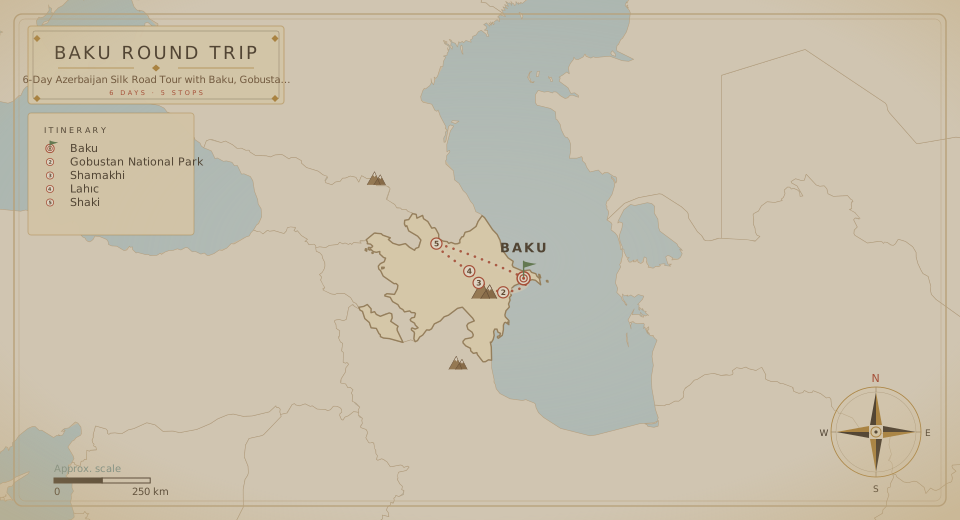
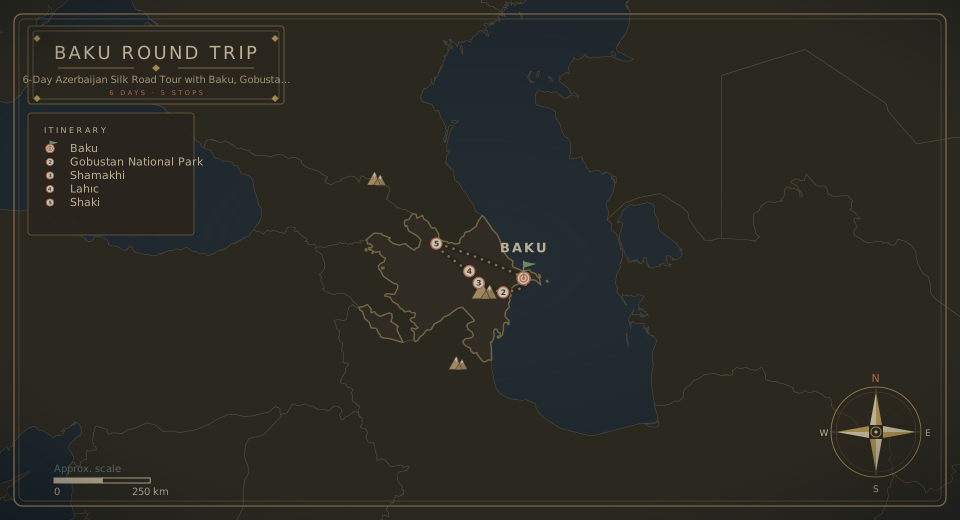
The Gobustan reserve of rock carvings is located 60 km from Baku, between the slope of the Great Caucasus Ridge and the Caspian Sea. Gobustan is an open-air reserve reflecting the life and everyday world of primitive people who lived here from the Mesolithic period until the Middle Ages. A special place is occupied by ancient rock carvings, pictograms, and petroglyphs. These ancient monuments of art reflect the worldview, economy, customs, and traditions of ancient Azerbaijanis. Gobustan is characterized by both male and female images. Men in the drawings are depicted as hunters with bows and arrows. They are tall, with slender bodies, belts, and pronounced muscles. In the reserve, you can also see animals that lived here during the last 10,000 years - gazelles, wild goats, deer, wild pigs, horses, lions, and more. The rocks also show birds, fish, snakes, lizards, and various insects. Ancient rock carvings, along with a variety of themes, abound in compositional scenes reflecting many spheres of human activity. These include the Azerbaijani dance of Yally, collective labour, hunting with various weapons, swimming on a Tigris-type boat, the reaping of animals, and attacks of predators on herbivores. Perhaps Yally was performed to the sound produced by the oldest musical instrument, Gavaldash, a stone with a deep resonating sound.
Excursion to the Mud Volcanoes: You will also have a chance to visit a truly unique site where 300 of the planet's estimated 700 mud volcanoes are located in Gobustan, Azerbaijan, and the Caspian Sea region. Many geologists, as well as local and international mud tourists, travel to places such as the Firuz Crater, Gobustan, and Salyan, and end up happily covered in mud that is thought to have medicinal qualities. In 2001, one mud volcano 15 kilometres from Baku made world headlines when it suddenly started spewing flames 15 meters high.
Shamakhi is an ancient Azerbaijani city that originated in the 5th century BCE. From the 9th to the 16th centuries, it was the capital of the Shirvan kingdom and the residence of the Shirvanshahs, making it one of the most beautiful cities of the East. From the middle of the 18th century, it became the center of the Shemakhan khanate. For a long time, Shemakha was one of the most important points along the Great Silk Road. This was due to the fact that the city was one of the centres of the Shirvan-Absheron architectural school and the school of decorative and applied art, including carpet making and miniatures. Located at the intersection of caravan routes, Shemakha was one of the major trade and craft centres in the Middle East and occupied an important place in the silk trade. As early as the 16th century, trade ties between Shemakha and Venetian merchants were recorded. Azerbaijani, Iranian, Arab, Central Asian, Russian, Indian, and West European merchants traded in Shemakha, where they owned factories and operated numerous silk-weaving, paper-spinning, and carpet workshops. The city became famous as the home of many prominent Azerbaijani philosophers, architects, scientists, and poets such as Khagani, Nasimi, and Sabir.
Diri Baba is a unique 15th-century two-story mosque-mausoleum located on the road from Baku to Shemakha in the village of Maraza, opposite the old cemetery. For a long time, local residents believed that an imperishable saint named Diri-Baba was buried here. The monument is associated with many legends and mystical details, and since the 17th century it has attracted many pilgrims and ordinary travellers. The peculiarity of the structure is that the architect seems to have "built" the tomb into the rock, making it appear as if it is suspended above the ground. The tomb impresses with the strictness of its architecture and the purity of its lines, while against the irregular dark rock, the light and smooth surface of its walls stands out solemnly.
Juma Mosque is the oldest and largest mosque in the Caucasus. According to legend, it was founded in the 8th century, when Shemakha was chosen as a residence by the Arab caliph. The exact date of construction is 744, established through research conducted by a geological commission from Tiflis headed by Prince Shakuli Kajar. This date was determined by the Arabic inscription on the facade of the mosque, which indicates the 126th year of the Muslim calendar as the date of foundation. It was at this time that the construction of new religious buildings began in the territory of modern Azerbaijan. The Juma Mosque in Shemakha is the earliest mosque in the Caucasus after the Derbent Cathedral Friday Mosque, built in 734.
Lahic is a village named after the Lagic tribe that came here in the 4th-5th centuries from the territory of Iran. This historical and architectural monument was established in the 5th century in the canyon of the Girdimanchai River. Old mosques and baths, as well as a medieval water supply and sewerage system, are preserved here. Although the village has been declared a historical and cultural reserve, the local population still lives here and is mainly engaged in handicrafts such as the manufacture of elegant household items made of copper, leatherwork, carpet weaving, and agriculture. From time immemorial, the Lahic tribe traded its products, which became known throughout the Middle East. Even today, in special workshops and souvenir shops, visiting tourists can buy a variety of handmade products such as carpets, dishes, daggers, and much more.
Sheki is one of the most famous and ancient settlements of Azerbaijan. It is located 700 m above sea level and, like an amphitheatre, is surrounded by mountains. This ancient city has long been known as a center of silk and an important transit point on the Great Silk Road.
According to legend, the Albanian Church is the first Christian church built not only in the territory of Caucasian Albania but in the whole of Transcaucasia. This place is also remarkable because burial places were found on the territory of the temple, and their structure is very different from that of the current inhabitants of the region. In 2003, the church was restored with funding from the Norwegian government thanks to the personal efforts of Tour Heyerdahl. Next to the church, you can find a memorial bust in honour of the famous researcher, set there as a token of gratitude from local residents and the state.
Excursion to Ilisu - Sultan's Garden with Water Aroma. This region of Azerbaijan is a treasure trove of historical and natural sights. It deserves books, epic poems, and encyclopedias, as one article cannot fully describe all that can and should be seen in the vicinity of Gakh. Therefore, the guide will not speak about the district as a whole, but about the village of Ilisu and its rich history, which is still told by the stones of its fortresses that have remained since the Middle Ages.